What Is a Pip in Forex? Value, Calculation and Examples
A pip (percentage in point) is the smallest standardized price movement in a forex pair, typically the fourth decimal place (0.0001) for most pairs or the second decimal place (0.01) for JPY pairs....
Reviewed using our forex & CFD broker review methodology
Checked on: 2026-08-17 | Broker terms, regulation, and pricing can change. Always verify at the official PU Prime site before opening an account.
Affiliate Disclosure: HNL Growth may earn a commission if you open an account through our links, at no additional cost to you. Risk Warning: CFDs and leveraged forex products are complex instruments and carry a high risk of losing money rapidly due to leverage. 62.2% of retail investor accounts lose money when trading CFDs with this provider. Trading forex and CFDs may not be suitable for all investors. Consider your objectives, experience, and risk appetite before trading, and ensure you understand the risks involved. Broker Disclosure: PU Prime is a live, regulated multi-entity broker (not a simulated prop-firm evaluation) — trades are executed with real capital in live market conditions, subject to normal market risk. Which PU Prime entity holds your account depends on your country of residence and determines your leverage cap and protections.
Last verified: August 2026 | Editorial Team
What Is a Pip in Forex? Value, Calculation and Examples
A pip (percentage in point) is the smallest standardized price movement in a forex pair, typically the fourth decimal place (0.0001) for most pairs or the second decimal place (0.01) for JPY pairs. When EUR/USD moves from 1.1050 to 1.1051, that one-unit change is one pip. Pips give every trader a universal language for measuring profit, loss, spread costs and risk—regardless of position size or account currency. Understanding pip values lets you translate abstract price movements into real money: a 20-pip loss on a 0.1 lot EUR/USD position costs roughly $20, while the same movement on a 1.0 lot costs $200. This guide explains how pips work, how to calculate their value across different currency pairs and lot sizes, and how to use them for risk control on both demo and live accounts.
Disclosure: This site may earn a commission if you open an account through links on this page, at no extra cost to you.
What a Pip Represents in Forex
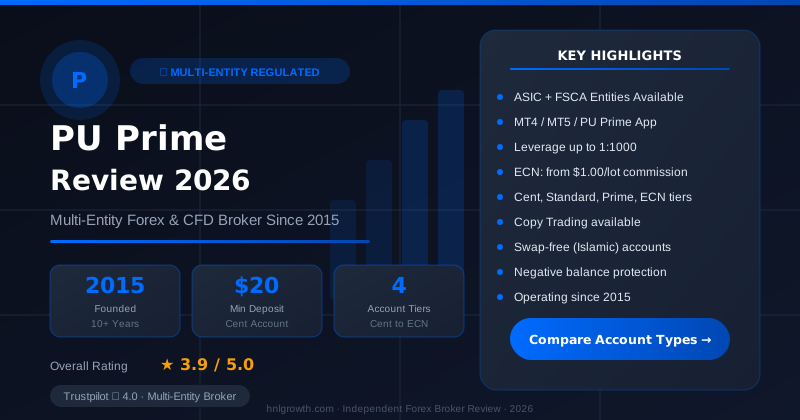
PU Prime — Multi-Entity Forex & CFD Broker
ASIC (AU) + FSCA (ZA) entities available · $20 min deposit (Cent) · MT4, MT5, PU Prime App · 4 account tiers
Most currency pairs quote to four decimal places. When GBP/USD trades at 1.2734, the "4" in the final position represents four pips above 1.2730. A move to 1.2735 is a one-pip increase; a drop to 1.2724 is a ten-pip decrease.
Japanese yen pairs follow a different convention because the yen's unit value is much lower. USD/JPY quotes to two decimal places—for example, 150.25. Here the pip is the second decimal place, so a move from 150.25 to 150.26 is one pip.
This standardization exists because forex pairs trade in vastly different numeric ranges. EUR/USD might sit around 1.10, while USD/JPY might be near 150.00. Without a universal smallest increment, comparing movement or calculating risk across pairs would require constant conversion. The pip solves that problem: one pip of movement in any pair represents a consistent fractional change in exchange rate, making profit-and-loss calculations portable across every currency market.
Brokers display live prices with the pip clearly visible. On a mobile trading screen showing EUR/USD at 1.1052, the two digits before any smaller superscript are the whole pips. The smaller superscript digit—if shown—is a fractional pip or pipette, equal to one-tenth of a pip. For beginner position sizing and risk management, you can safely focus on whole pips.
How Pip Values Translate to Real Money
The value of one pip depends on three factors: the currency pair you are trading, the size of your position (measured in lots), and your account currency. The formula is:
Pip value = (pip size ÷ exchange rate) × position size
For pairs where USD is the quote currency (the second currency in the pair, like EUR/USD or GBP/USD), one pip on a standard lot (100,000 units) equals $10. A mini lot (10,000 units or 0.1 lot) makes each pip worth $1. A micro lot (1,000 units or 0.01 lot) makes each pip worth $0.10. These figures hold at any rate because the pip is denominated in USD.
Worked Example: EUR/USD
You open a 0.1 lot position on EUR/USD at 1.1050. The pair moves 50 pips in your favor to 1.1100.
- Position size: 0.1 lot = 10,000 units
- Pip value per 0.1 lot on EUR/USD: $1 per pip
- Total movement: 50 pips
- Profit: 50 pips × $1 = $50
If the trade moves 50 pips against you, your loss is $50. The calculation is symmetrical.
Worked Example: GBP/USD
You open a 0.05 lot position on GBP/USD at 1.2700. The pair moves 30 pips against you to 1.2670.
- Position size: 0.05 lot = 5,000 units
- Pip value per 0.05 lot on GBP/USD: $0.50 per pip (half the 0.1 lot standard)
- Total movement: 30 pips
- Loss: 30 pips × $0.50 = $15
Worked Example: USD/JPY
JPY pairs require an extra step because USD is the base currency (the first in the pair). You open a 0.1 lot position on USD/JPY. For this illustration, assume an exchange rate of 150.00—this is used purely to demonstrate the arithmetic. The actual rate changes continuously; always use the current live rate when sizing a real position.
- Position size: 0.1 lot = 10,000 units of USD
- Pip size for JPY pairs: 0.01
- Step 1 — Pip value in JPY: 0.01 × 10,000 = 100 JPY per pip
- Step 2 — Convert to USD: 100 JPY ÷ 150.00 (the exchange rate) ≈ $0.667 per pip
- Total movement over 40 pips: 40 × $0.667 ≈ $26.68
Why does dividing by the exchange rate convert JPY into USD? Because the exchange rate tells you how many yen equal one dollar. Dividing JPY by that rate gives the dollar equivalent.
The USD/JPY pip value shifts as the exchange rate changes. At a hypothetical 145.00 the same formula gives approximately $0.69 per pip; at 155.00, approximately $0.65 per pip. These are illustrative estimates—always recalculate using the current live rate, or check the platform's displayed pip value, before sizing a new position. The variance is modest on single trades but compounds across larger positions or multiple trades.
The table below shows illustrative pip values for common pairs at typical lot sizes, assuming a USD-denominated account. All figures are mathematical approximations based on the rates shown; your trading platform calculates the live value automatically.
| Currency Pair | 0.01 Lot (Micro) | 0.1 Lot (Mini) | 1.0 Lot (Standard) | Rate Basis |
|---|---|---|---|---|
| EUR/USD | $0.10 | $1.00 | $10.00 | USD quote pair (rate-independent) |
| GBP/USD | $0.10 | $1.00 | $10.00 | USD quote pair (rate-independent) |
| USD/JPY | ~$0.07 | ~$0.67 | ~$6.70 | Illustrative rate of 150.00 |
| AUD/USD | $0.10 | $1.00 | $10.00 | USD quote pair (rate-independent) |
| EUR/GBP | ~$0.13 | ~$1.30 | ~$13.00 | Illustrative GBP/USD of 1.27 |
Cross-pair values such as EUR/GBP depend on a second exchange rate and shift as that rate moves. Treat all approximate values as starting estimates and verify against live platform data before placing a trade.
Finding Pips on Your Mobile Trading Screen
Modern trading apps display pips prominently, but knowing where to look prevents confusion when you open your first position.
On MetaTrader 4 and MetaTrader 5 mobile apps, open the Quotes tab. Each currency pair shows two prices: the Bid (the price at which you can sell) and the Ask (the price at which you can buy). The larger digits in the price are the whole pips; any smaller superscript digit is the fractional pip.
For example, EUR/USD might display:
- Bid: 1.10523
- Ask: 1.10551
The fourth decimal digits (52 and 55) are the whole pips. The fifth digit (3 and 1) is the fractional pip. The spread here is the difference between ask and bid: 1.10551 minus 1.10523 = 0.00028, or 2.8 pips.
When you tap a pair and select New Order, the order ticket shows the current price and lets you enter your position size in lots. After you open a trade, switch to the Trade tab to see your open positions. Each position displays:
- Current price (updating in real time)
- Profit/Loss in pips (how many pips the trade has moved)
- Profit/Loss in your account currency (the dollar, euro, or pound value of that pip movement)
If your trade shows "+23.5 pips" and "$23.50" profit, you are trading a 0.1 lot on a USD-quote pair. If it shows "+23.5 pips" and "$235.00" profit, you have a 1.0 lot position. The pip-to-money relationship is direct and transparent.
PU Prime's mobile app follows similar conventions to MetaTrader. Recognize that the larger digits in any price quote represent whole pips, and that your open positions tab converts pip movement into account currency automatically. The platform handles the arithmetic; your job is to decide your pip-based stop and target before you open the trade.
Note: Trading platform interfaces change between app versions. If the layout described above differs from what you see, consult the current in-app help or the broker's support documentation.
Why Pips Matter for Risk Control
Pips give you a concrete unit for defining risk before you open a trade. When you set a stop-loss order, you are instructing the platform to close your position automatically if the market moves a certain number of pips against you. This prevents emotional decision-making and caps your maximum planned loss on that trade.
A common risk-management guideline used in trading education is the 2% rule: risk no more than 2% of your account balance on a single trade. This is an educational framework, not a rule specific to any broker, and it does not guarantee that losses will be limited to that amount—stop-losses can be subject to slippage in fast markets. What the rule provides is a starting framework for translating pip risk into dollar risk.
Applying the 2% Guideline: Illustration
Your account balance is $1,000. Two percent is $20. You want to trade EUR/USD with a 0.1 lot position, where each pip is worth $1.
Maximum pip risk = $20 ÷ $1 per pip = 20 pips
If you set a 20-pip stop-loss, a trade that hits that stop closes with an approximate $20 loss. If you increase your position to 0.2 lots (where each pip is worth $2), maintaining the same $20 risk limit means reducing the stop-loss to 10 pips.
The table below illustrates how pip-based stop-loss distances change with account size, using a 2% risk guideline and a 0.1 lot EUR/USD position at $1 per pip. These are educational examples; confirm your broker's minimum lot sizes and available order types before trading.
| Account Balance | 2% Risk Limit | Pip Value (0.1 Lot EUR/USD) | Illustrative Stop-Loss Distance |
|---|---|---|---|
| $500 | $10 | $1 per pip | 10 pips |
| $1,000 | $20 | $1 per pip | 20 pips |
| $2,500 | $50 | $1 per pip | 50 pips |
| $5,000 | $100 | $1 per pip | 100 pips |
These figures apply to USD-quote pairs at the lot size shown. For JPY pairs or cross-currency pairs such as EUR/GBP, pip values differ, so your stop-loss placement must adjust to maintain the same dollar risk. The principle is: decide your dollar risk first, divide by pip value, and set your stop at that pip distance.
Pips also define your take-profit target. If you expect EUR/USD to rise 60 pips based on your analysis, you set a take-profit order 60 pips above your entry. When the market reaches that level, the platform closes the trade automatically—removing the temptation to hold too long and see the trade reverse.
Calculating Pip Value for Different Currency Pairs
Not all pips carry the same dollar value. The currencies involved in the pair determine how pip value translates into your account currency.
USD Quote Pairs (EUR/USD, GBP/USD, AUD/USD)
When USD is the second currency in the pair, pip value is straightforward. One pip on a standard lot is always $10, one pip on a 0.1 lot is $1, and one pip on a 0.01 lot is $0.10. These values do not fluctuate with the exchange rate.
USD Base Pairs (USD/JPY, USD/CHF, USD/CAD)
When USD is the first currency, the pip value in USD depends on the current exchange rate. Using the formula (pip size ÷ current rate) × lot size, a USD/JPY position at an illustrative 150.00 yields approximately $6.67 per pip on a standard lot. If the rate shifts to 145.00, the same calculation gives about $6.90 per pip; at 155.00, about $6.45 per pip. Recalculate when the rate has moved materially, or use the value your platform displays.
Cross Pairs (EUR/GBP, EUR/JPY, GBP/JPY)
Cross pairs do not include USD, so pip value must be converted through an intermediate rate. For EUR/GBP, the pip is denominated in GBP; multiply by the current GBP/USD rate to find the USD value. As that rate changes, so does your dollar-per-pip exposure.
Most traders do not calculate this manually mid-session. Trading platforms display pip value and profit/loss in your account currency automatically. The practical takeaway is that a 30-pip stop-loss represents different dollar risks depending on which pair you are trading and at what lot size—always verify the dollar risk, not just the pip distance.
Spread Costs and PU Prime Account Types
PU Prime operates three account types with different cost structures: Standard, Prime, and ECN. The information below is based on the official PU Prime spread and costs page, which explicitly states that all published spread values are for reference only and that traders should check the MT4/MT5 platform or the PU Prime mobile app for the most accurate live figures.
| Account Type | Cost structure | Commission |
|---|---|---|
| Standard | Spread-inclusive pricing | None charged separately |
| Prime | Tighter spreads than Standard | Charged per lot |
| ECN | Tightest spreads | Charged per lot |
Specific pip spread values for individual pairs are not reproduced here because the official page treats all published figures as indicative and subject to change. Verify current spreads directly on the platform before trading. What matters conceptually is that on a Standard account all costs are embedded in the spread: if the spread on a pair is 1.3 pips, a 0.1 lot trade opens $1.30 in the red on a USD-quote pair, and the market must first move 1.3 pips in your favor just to break even. On Prime and ECN accounts the spread is narrower, but the per-lot commission must be added to find your true entry cost.
According to the PU Prime account opening page, the Standard account requires a minimum deposit of $50 and the Cent account requires $20. These are the figures stated on that page at the time of writing; confirm current requirements directly with PU Prime before depositing, as minimums can change.
Practising Pip-Based Trades on a Demo Account
A demo account lets you trade currency pairs with virtual funds using the same pip mechanics as a live account. Pip value calculations, order types, and profit/loss displays work identically in mathematical terms. The PU Prime account opening page indicates that a demo account is available; confirm current access conditions and terms directly on PU Prime's website before relying on any specific arrangements.
Step-by-Step Demo Workflow
Select a currency pair. Start with EUR/USD or GBP/USD. These pairs have high liquidity and straightforward pip values ($1 per pip on a 0.1 lot in a USD account), making your calculations easy to verify.
Choose your position size. Begin with 0.01 or 0.05 lots. Small sizes let you experience pip movement and profit/loss calculations without large swings in your demo balance. Confirm the broker's minimum position size for your chosen account type before trading live.
Set a pip-based stop-loss before opening the trade. Decide your maximum acceptable loss in dollar terms first, then divide by the pip value to find your stop distance. On a 0.1 lot EUR/USD position at $1 per pip, a $10 risk limit means a 10-pip stop-loss.
Set a pip-based take-profit. Choose a target based on the pair's recent price range. A take-profit distance that equals or exceeds your stop-loss distance is a reasonable starting point for learning—not a prediction of what the market will do.
Open the trade and observe. Watch the Trade tab. Your open position shows live pip movement and the corresponding profit or loss in your account currency. Notice how each pip change translates directly into the dollar amount you calculated before entering.
Let the trade reach stop-loss or take-profit. Resist the urge to close manually unless you are deliberately testing manual exits. Letting your predefined levels execute builds discipline and shows that pip-based risk control can function automatically.
Review the closed trade. Check the trade history in the platform: entry price, exit price, total pip movement, and final profit or loss. Compare your planned pip risk to the actual outcome to verify that your sizing calculation was accurate.
Repeat this process across different pairs—USD/JPY, AUD/USD, EUR/GBP—to observe how pip values differ. A 20-pip stop on USD/JPY at an illustrative rate of 150.00 costs approximately $13 on a 0.1 lot; the same 20-pip stop on EUR/USD costs $20. This comparison makes clear why position size, not just pip distance, determines your actual dollar risk.
Demo environments may not perfectly replicate live spread widening during major news events, and psychological pressure differs when real capital is at stake. Treat demo practice as a way to understand pip mechanics, not as a predictor of live trading outcomes.
Open a PU Prime demo account to practice pip-based trading before committing real capital. Read the full risk warning below before proceeding.
Common Pip Mistakes Beginners Make
Ignoring Spread Costs
The spread—the difference between bid and ask price—is measured in pips and is an immediate entry cost. If the spread on a USD-quote pair is 1.3 pips, a 0.1 lot trade opens with a $1.30 deficit. A 10-pip take-profit target requires the market to move 11.3 pips in your favor (1.3 pips to recover the spread plus 10 pips of net profit). Beginners who set tight pip targets without accounting for spread often find trades close near break-even even when price moved in their direction. Check current spread values for your chosen pair and account type on the platform before calculating targets.
Using the Same Pip Stop Across All Pairs
A 20-pip stop-loss does not represent the same dollar risk on every pair. On EUR/USD with a 0.1 lot, 20 pips costs $20. On USD/JPY with a 0.1 lot at an illustrative 150.00, 20 pips costs roughly $13. On EUR/GBP with a 0.1 lot at an illustrative GBP/USD of 1.27, 20 pips costs approximately $26. Applying a fixed pip stop across pairs without adjusting position size creates inconsistent dollar risk. The correct approach is to decide your dollar risk first, then calculate the appropriate position size for each pair's current pip value.
Position Sizing Without Pip-to-Money Conversion
Opening a 1.0 lot position because it is a round number—without calculating pip value—is a common route to overleveraging. On EUR/USD, a 50-pip adverse move on 1.0 lot costs $500. If your account balance is $1,000, that single trade risked half your capital. Work out your position size before entering, using:
Position size = risk amount ÷ (pip value per lot × stop-loss in pips)
Assuming Demo and Live Pip Values Are Different
Pip values are mathematically identical on demo and live accounts for the same pair and lot size. What can differ is execution quality: live spreads may widen during major news releases in ways a demo environment does not fully replicate, and live orders can experience slippage in fast markets. The pip mechanics themselves are the same.
Measuring Success in Pips Without Context
Winning 100 pips sounds significant, but if you risked 80 pips to gain 100, your risk-reward ratio is 1.25:1—barely above break-even after spread costs and losing trades. A more useful measure is your average pip win relative to your average pip loss across many trades. If your average win is 40 pips and your average loss is 15 pips, you can sustain a sub-50% win rate and still come out ahead mathematically. Track pip statistics over a meaningful sample of trades, not individual outcomes.
When Pip-Based Trading May Not Suit You
Pip-based trading requires accepting that many individual trades will hit your stop-loss. If a strategy wins 50% of the time—a realistic expectation for many approaches—half your trades end in a planned pip loss. This is manageable when stop-losses are sized correctly, but it is psychologically demanding for traders who treat any loss as a failure.
If you cannot tolerate seeing your account balance decrease by planned amounts on losing trades—even when those losses fall within your risk parameters—active pip-based forex trading may cause more stress than benefit. Passive investment strategies involve losses too, but they typically unfold over months or years rather than minutes. The pip-by-pip visibility of forex losses can feel more immediate and disorienting.
Pip-based position sizing also assumes comfort with lot sizes, leverage, and margin requirements. If those concepts remain unclear after genuine study, it is worth asking whether the complexity serves your goals before committing real capital.
Some traders prefer copy trading as an alternative: allocating funds to experienced traders who handle position sizing and risk management on their behalf. Check the PU Prime website for whether a copy trading service is currently available, including any minimums, fees, and terms—no specific copy trading product details were available at the time of writing and the service may change.
Finally, pip-based trading is not appropriate if you cannot afford to lose the money you are trading with. Leverage amplifies both gains and losses. No position size, stop-loss level, or pip-based strategy eliminates the possibility of losing your entire capital. If that reality is incompatible with your financial situation, forex and CFD trading is not suitable for you regardless of how carefully pips are managed.
Frequently Asked Questions
What is a pipette, and do I need to worry about it?
A pipette is one-tenth of a pip, also called a fractional pip. Most brokers quote prices to five decimal places (EUR/USD: 1.10525) or three decimal places for JPY pairs (USD/JPY: 150.255). The extra digit is the pipette. For position sizing and stop-loss placement, you can safely round to whole pips. Pipettes matter primarily to high-frequency traders optimizing execution by fractions of a cent.
Do all brokers use the same pip values?
Pip values are determined by currency pair, lot size, and exchange rate—not by the broker. One pip on a 0.1 lot EUR/USD position is $1 at any regulated broker quoting standard lots. What differs between brokers is the spread (the pip cost to enter a trade) and execution quality. Pip value itself is a mathematical output of the pair and lot size.
How many pips should I risk per trade?
There is no universal answer. Your pip risk depends on your account size, the pair's typical volatility, and your strategy's time horizon. The practical approach is to set your dollar risk first (a commonly cited educational guideline is 1%–2% of account balance), then calculate the stop-loss distance that matches that dollar amount for your chosen pair and lot size.
Are pip values the same on demo and live accounts?
Yes, mathematically. The live execution environment may differ in spread width during volatile events and in slippage during fast markets, but pip value per unit of price movement is unchanged.
Can I trade without understanding pips?
You can place trades without consciously calculating pips, but you cannot manage risk effectively without understanding them. Pip values determine how much you win or lose per unit of price movement. Without that understanding, you cannot size positions correctly, set meaningful stop-losses, or evaluate whether a trade's potential reward justifies its risk. Overleveraging without understanding pip-to-money conversion is a common cause of rapid account losses for new traders.
Why does my EUR/USD trade show a loss immediately after I open it?
That is the spread cost. When you buy EUR/USD, you pay the ask price. The chart price (usually the bid) must rise to your entry level before you break even. If the spread is 1.3 pips, your trade opens 1.3 pips—or $1.30 on a 0.1 lot—in the red. This is the cost of entering the trade, similar in function to a commission. Tighter spreads reduce this initial cost, which is why account type and spread structure affect short-term trading profitability.
Risk Warning
Risk warning: CFDs and leveraged forex products are complex instruments and carry a high risk of losing money rapidly due to leverage. Consider whether you understand how these products work and whether you can afford to take the high risk of losing your capital. Check the entity, terms and protections that apply in your jurisdiction before trading.
Pip-based position sizing and stop-loss orders can help structure your approach to risk, but they do not eliminate the possibility of loss. Stop-losses can be subject to slippage in fast-moving markets, meaning execution may occur at a worse price than specified. Demo account performance is not indicative of live account outcomes.
PU Prime operates under multiple regulatory entities depending on your location. According to the PU Prime regulation page, the company states that it adheres to client fund protection, transparent operational standards, and audited compliance processes. The applicable entity, its regulator, and the investor protections it provides vary by jurisdiction. You are responsible for confirming which entity governs your account and what terms apply before depositing funds or placing trades.
Verification Checklist
No first-hand testing or live-account data was used in this article. Before making any trading decisions based on broker-specific details, verify the following directly:
- Current spreads: Check live spread values in the MT4/MT5 platform or PU Prime mobile app; the official spread page states all published figures are indicative only and subject to change.
- Account minimums and lot sizes: Confirm current minimum deposit requirements and minimum position sizes for each account type on the PU Prime account page.
- Demo account terms: Confirm current demo access conditions directly with PU Prime before relying on any specific terms.
- Copy trading availability: Check current service availability, minimum allocations, and terms on the PU Prime website.
- Regulatory entity: Confirm which PU Prime entity applies to your account and what investor protections are available in your jurisdiction via the PU Prime regulation page.
- Platform navigation: Trading app interfaces update regularly; verify current navigation steps against in-app help or broker support documentation.
Ready to Compare PU Prime Account Types?
PU Prime is a multi-entity broker — ASIC (Australia) and FSCA (South Africa) regulated entities offer stronger oversight, while most international clients are onboarded to the FSA Seychelles or FSC Mauritius entities. Four account tiers (Cent, Standard, Prime, ECN) range from a $20 minimum deposit to full ECN pricing.
Risk disclaimer: PU Prime is a live, regulated multi-entity broker — trading forex and CFDs is done with real capital under normal market risk (this is not a simulated prop-firm evaluation). PU Prime operates under multiple separate licenses (ASIC, FSCA, FSA Seychelles, FSC Mauritius); which entity holds your account depends on your country of residence and determines your leverage cap and protections — confirm this before funding. CFDs and leveraged forex products are complex instruments and carry a high risk of losing money rapidly due to leverage; 62.2% of retail investor accounts lose money when trading CFDs with this provider. Consider whether you understand how CFDs/forex work and whether you can afford the high risk of losing your money. Affiliate disclosure: HNL Growth earns a commission when you open a PU Prime account through links on this page.