What Is CFD Trading? How It Works, Costs and Risks
Affiliate disclosure: This article contains links to PU Prime. If you open an account through those links, we may receive a commission. This does not affect the information presented or our editorial...
Reviewed using our forex & CFD broker review methodology
Checked on: 2026-08-17 | Broker terms, regulation, and pricing can change. Always verify at the official PU Prime site before opening an account.
Affiliate Disclosure: HNL Growth may earn a commission if you open an account through our links, at no additional cost to you. Risk Warning: CFDs and leveraged forex products are complex instruments and carry a high risk of losing money rapidly due to leverage. 62.2% of retail investor accounts lose money when trading CFDs with this provider. Trading forex and CFDs may not be suitable for all investors. Consider your objectives, experience, and risk appetite before trading, and ensure you understand the risks involved. Broker Disclosure: PU Prime is a live, regulated multi-entity broker (not a simulated prop-firm evaluation) — trades are executed with real capital in live market conditions, subject to normal market risk. Which PU Prime entity holds your account depends on your country of residence and determines your leverage cap and protections.
Last verified: August 2026 | Editorial Team
What Is CFD Trading? How It Works, Costs and Risks
Affiliate disclosure: This article contains links to PU Prime. If you open an account through those links, we may receive a commission. This does not affect the information presented or our editorial independence.
A contract for difference (CFD) is a cash-settled agreement between you and a broker to exchange the difference in an asset's price from the moment you open a position to the moment you close it. You never own the underlying asset—no shares are transferred, no barrels of oil change hands. Your profit or loss equals the price movement multiplied by your position size. Because CFDs use leverage, a relatively small adverse price move can erase all of your margin deposit, and in some circumstances losses can exceed it. If that sounds like a lot to unpack, this guide walks through every layer—mechanics, costs, risks, regulation, and how to practise without risking real money first.
What a CFD Actually Is
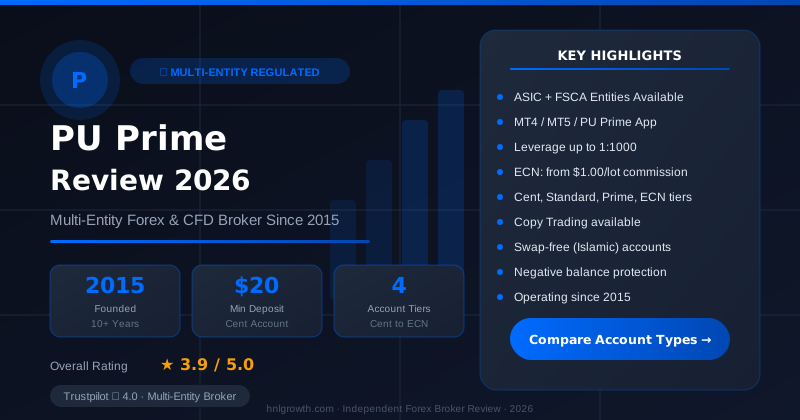
PU Prime — Multi-Entity Forex & CFD Broker
ASIC (AU) + FSCA (ZA) entities available · $20 min deposit (Cent) · MT4, MT5, PU Prime App · 4 account tiers
Think of a CFD as a price bet formalised as a contract. You and the broker agree on an entry price. When you close the position, whoever is on the right side of the price movement pays the other the difference. If you believed the price would rise (a long position) and it did, you collect the difference. If you were wrong, you pay it.
Three things set CFDs apart from buying an asset outright:
- No ownership. You hold a contract, not the asset. A CFD on Apple shares gives you no right to dividends, no voting rights, and no claim on Apple's assets.
- Cash settlement. Everything is settled in cash. There is no delivery, no custody, no broker holding securities on your behalf in the traditional sense.
- Bidirectional. You can go short (speculate on a price fall) just as easily as going long. Short-selling traditional shares involves borrowing stock and regulatory complexity; a short CFD is placed in the same way as a long one.
How the Mechanism Works, Step by Step
- Choose a direction. You decide whether you expect the price to rise (buy/long) or fall (sell/short).
- Open at the ask or bid price. The broker quotes two prices: the bid (what you sell at) and the ask (what you buy at). The gap between them is the spread—the first and immediate cost of every trade.
- The market moves. While your position is open, your unrealised profit or loss updates in real time as the price changes.
- Close the position. You close by placing the opposite trade. If you opened long, you close by selling. The broker calculates the difference between your entry price and exit price, multiplied by your position size, and credits or debits your account.
The broker acts as your counterparty or routes your order through liquidity providers, depending on their model. Either way, you are not interacting with another individual trader directly.
The Worked Example: Numbers, Not Theory
The figures below are illustrative only and do not represent any guaranteed, typical, or actual outcome. Actual spreads, financing rates, and leverage limits vary by instrument, account type, and the regulatory entity governing your account. Verify current figures at puprime.com/spread-and-costs before trading.
Scenario: You open a CFD on a stock index priced at 5,000 points. You trade 1 contract equivalent to 1 USD per point movement, using 1:10 leverage. Your margin requirement is 10% of the notional value, so you post 500 USD.
| Parameter | Loss scenario | Gain scenario |
|---|---|---|
| Asset | Stock index | Stock index |
| Entry price | 5,000 | 5,000 |
| Position size | 1 USD per point | 1 USD per point |
| Notional value | 5,000 USD | 5,000 USD |
| Leverage | 1:10 | 1:10 |
| Margin posted | 500 USD | 500 USD |
| Closing price | 4,900 | 5,100 |
| Price move | −100 points (−2%) | +100 points (+2%) |
| Gross P&L | −100 USD | +100 USD |
| Spread cost (illustrative) | −2 USD | −2 USD |
| Overnight fee (illustrative: 1 night) | −1.50 USD | −1.50 USD |
| Net P&L | −103.50 USD | +96.50 USD |
Two observations from this table that beginners routinely miss:
First, a 2% move against you wiped out roughly 20% of your 500 USD margin—because leverage magnified your exposure tenfold. Second, the gain scenario produced a net result below the gross gain once costs were included. A trade that moved in your favour still returned less than the raw price movement suggested. Both effects compound when positions are held for multiple days.
Spread and overnight financing figures in this table are for illustration only. The actual values that apply to your account type are published—and updated—at puprime.com/spread-and-costs. The platform (MT4, MT5, or the PU Prime app) displays the live figures that take precedence over all reference tables.
Leverage and Margin: The Amplifier That Works Both Ways
Leverage lets you control a larger position than your deposited capital would otherwise allow. At 1:10 leverage, 1,000 USD in margin controls a 10,000 USD position.
The arithmetic of loss is simple and worth reading carefully: if the position moves 10% against you, the 1,000 USD loss equals 100% of your margin. The position is gone. That is not a worst-case scenario—it is basic arithmetic applied to a 1:10 leverage ratio.
The margin call sequence:
- Your account equity falls toward the broker's margin call level (the exact threshold varies by broker, account type, and regulated entity—check your specific terms).
- The broker issues a margin call: a notification that you must deposit additional funds or close positions to restore your equity above the required level.
- If you do not act quickly enough, the broker initiates forced partial liquidation—closing your losing positions automatically to prevent your balance from going further into deficit.
- Under rapid or gapping market moves, forced liquidation may not prevent your balance from going negative.
Negative balance protection (NBP) is the regulatory safeguard that prevents your account from falling below zero. Where NBP is mandated for retail clients, your maximum loss is capped at your deposited funds. This protection is not universal—it applies only to the specific regulated entity your account is held under, and the conditions vary by regulator and jurisdiction. Verify whether NBP applies to your specific PU Prime entity at puprime.com/regulation before depositing.
Leverage limits also differ by regulated entity, instrument type, and whether you are classified as a retail or professional client. No single leverage cap applies across all PU Prime entities. The limits applicable to your account are stated in the account terms for your jurisdiction and on the regulation page. Do not assume that a leverage level you have seen advertised applies to your specific entity.
Important: Leverage limits and negative balance protection requirements differ by entity and jurisdiction. Read the terms that apply to your specific account at puprime.com/regulation before depositing.
Every Cost You Will Actually Pay
Three cost layers affect every CFD trade. Most beginner guides present these as separate footnotes. They are not—they are cumulative drag on any open position.
Layer 1: The bid-ask spread Every time you open a trade, you start in a small loss equal to the spread. On a Forex pair quoted at 1.3 pips, you need the market to move at least 1.3 pips in your favour before you break even. The spread is effectively paid on entry, since it is embedded in the opening price.
Layer 2: Commission (account-type dependent) PU Prime offers three main live account tiers—Standard, Prime, and ECN—with different cost structures. The Standard account uses a spread-only model with no separate commission charge. The Prime and ECN accounts apply a per-lot commission alongside tighter raw spreads. Which model is less expensive depends on your trading frequency and typical position size. Current spread and commission figures are published at puprime.com/spread-and-costs; all values there are stated as reference figures and the platform shows the most accurate live values.
Layer 3: Overnight financing (swap) If you hold a CFD position open past the daily rollover time (typically 17:00 New York), you pay or receive an overnight financing charge. The rate is based on the interbank rate for the relevant currency or instrument, adjusted by the broker's margin. For most retail traders holding long positions on most instruments, this is a cost rather than a credit.
The compounding effect of overnight fees is routinely underestimated. The table below illustrates how a financing charge accumulates over time using a hypothetical annualised rate—it is not sourced from PU Prime's current rate schedule and is provided only to show the mathematical structure. Actual instrument-specific rates must be verified at puprime.com/spread-and-costs before opening any overnight position:
| Cost type | How it arises | 1-day hold | 7-day hold | 30-day hold |
|---|---|---|---|---|
| Spread (illustrative) | Paid on entry | ~1.30 USD | ~1.30 USD | ~1.30 USD |
| Commission (Standard account) | None | 0 | 0 | 0 |
| Overnight financing (illustrative: ~5% p.a. on 10,000 USD notional) | Per night held past rollover | ~1.37 USD | ~9.59 USD | ~41.10 USD |
| Total illustrative drag | ~2.67 USD | ~10.89 USD | ~42.40 USD |
The illustrative structure shows that financing costs which appear trivial on a single night become significant over 30 nights. If a position is only a modest winner on price direction, accumulated financing can convert a gross gain into a net loss. This is not a theoretical edge case—it is the reason experienced traders either close positions before rollover or factor financing explicitly into their profit targets before entry.
All figures above are illustrative only. The annualised rate of 5% p.a. is a hypothetical placeholder. Source the actual rate for your instrument and account type from puprime.com/spread-and-costs before opening any position you plan to hold overnight.
What Assets You Can Trade
CFDs are available across multiple asset classes. The specific instruments available to you depend on the PU Prime entity your account is registered under and your jurisdiction.
- Forex pairs: Major, minor, and exotic currency pairs. The largest and most liquid market. Typical spreads are tightest here.
- Stock indices: Exposure to market benchmarks like the S&P 500 or Nikkei 225 as a single instrument, rather than buying each constituent share.
- Commodities: Hard commodities (crude oil, copper) and soft commodities (sugar). Prices are sensitive to geopolitical events and supply data.
- Metals: Gold and silver without taking physical delivery. PU Prime also lists 24/7 gold trading (XAUUSD247) as available beyond standard market hours, per puprime.com/spread-and-costs.
- Shares: CFDs on individual equities, including large-cap names, with leverage. You receive no shareholder rights.
- ETFs and bonds: Access to fund-structure and fixed-income exposure via CFD.
- Synthetic indices: Also listed among PU Prime's available instruments.
Asset availability and current instrument details are listed at puprime.com/spread-and-costs. Not all instruments are available in all jurisdictions, and availability may change.
CFDs Versus Buying Shares Outright
| Feature | CFD | Direct share purchase |
|---|---|---|
| Asset ownership | None—you hold a contract | You own the shares |
| Dividends | Cash adjustment credited/debited (no ownership rights) | Received as shareholder |
| Voting rights | None | Yes |
| Leverage available | Yes—amplifies gains and losses | Generally no (or limited margin borrowing) |
| Short-selling | Straightforward—open a sell position | Complex—requires borrowing shares |
| Typical cost structure | Spread, possible commission, overnight financing | Brokerage commission, custody fee |
| Market hours access | Often extended or near-24/5 | Exchange hours only |
| Tax treatment | Jurisdiction-specific—seek professional advice | Jurisdiction-specific—seek professional advice |
Neither instrument is inherently superior. CFDs suit traders who want leverage, short exposure, or extended hours access and can accept the associated costs and risks. Direct share purchase suits investors with a longer time horizon who want ownership rights and no overnight financing drag.
Tax treatment for CFD gains and losses varies significantly by jurisdiction. Some countries treat derivative gains as capital gains; others treat them as income; some apply specific rules for leveraged products. No general answer applies universally. Seek guidance from a qualified tax professional in your country before trading.
Who CFD Trading Is Not Suitable For
Before any account action, read this section honestly.
CFD trading is not suitable if any of the following apply:
- You have no emergency fund. Money used for CFD trading must be capital you can afford to lose entirely. If losing it would affect your rent, bills, or savings, do not trade with it.
- You are trading with borrowed money. Using a credit card advance, a loan, or borrowed funds to trade CFDs creates a compounding debt risk that most retail traders cannot manage.
- You cannot monitor open positions regularly. Leveraged positions can move against you quickly. If your schedule or internet access prevents monitoring, forced liquidation can occur before you can act.
- You have low structural tolerance for financial loss or volatility. If a significant drawdown on your demo account caused impulsive decisions, a live account will be harder, not easier.
- You are in a jurisdiction where CFDs are restricted or banned. CFDs are not available to retail traders in the United States under current CFTC and SEC rules. They are also restricted for retail clients in Belgium. Check your local regulatory status before proceeding.
- You are entirely new to financial markets with no educational foundation. CFDs are not where market education begins—they are where it is applied under financial pressure.
The proportion of retail CFD accounts that lose money is material and is consistently disclosed by regulated brokers. The specific figure applicable to PU Prime's regulated entities is available in their official risk documentation. Review the current figure at puprime.com/regulation before opening any account. Treat this statistic as direct calibration for the difficulty level you are entering.
Regulation: What It Means for Your Money
Regulation is not a marketing badge—it is a set of specific obligations that affect what happens to your money and what recourse you have if something goes wrong.
PU Prime states that it is a regulated broker operating since 2015, with authorisation under multiple financial authorities. Its regulation page at puprime.com/regulation confirms general commitments to client fund protection, transparent operational standards, audited compliance processes, and segregated client accounts.
The page lists the specific regulated entities and licensing authorities. Because entity names, licence numbers, and jurisdictional coverage can change, and because the evidence available at the time of writing does not include each entity's full current licence data, this article does not reproduce the entity table. Verify directly instead:
How to verify independently: Go to puprime.com/regulation, note the exact entity name and licence number that applies to your jurisdiction, then search that licence number on the regulator's own public register. Each financial regulator—including the FSA (Seychelles), FSC (Mauritius), FSCA (South Africa), and CMA (Kenya)—maintains a searchable public register. A licence number visible on the broker's website confirms nothing until you have matched it against the regulator's own record.
What regulation means in practice:
- Segregated client funds: Your trading capital is held separately from the broker's operating funds. If the broker faces financial difficulties, client funds are not mixed with company assets. PU Prime confirms this arrangement on its regulation page.
- Negative balance protection: Where mandated for retail clients, your losses cannot exceed your deposit. Not all entities or jurisdictions require this—verify which applies to your specific account before depositing.
- Leverage limits: Regulated entities apply maximum leverage caps for retail clients. These limits differ by regulator and instrument type. The limits applicable to your account are stated in the account terms and on the regulation page—there is no single figure that applies across all PU Prime entities.
- Complaints process: Regulated brokers must maintain a formal complaints and dispute resolution process.
Entity matters. The protections available under one PU Prime regulated entity are not identical to those under another. Your account is governed by the entity assigned to your country of residence. Confirm which entity that is, and what protections it carries, before depositing any funds.
Start with a Demo Account: What to Practise and When to Stop
A demo account gives you access to the live platform, real market prices, and real order execution mechanics—without using real money. It is not optional for beginners; it is the only responsible starting point.
PU Prime describes the account registration process at puprime.com/how-to-open-a-trading-account, which also covers demo account access. The Cent account minimum deposit is USD 20 and the Standard account minimum is USD 50, according to that page—verify current minimums there before depositing, as these figures are subject to change.
What to practise in demo:
- Executing entry and exit orders correctly, including at-market and limit orders
- Setting a stop-loss and take-profit on every single trade before it is placed—not after
- Calculating position size relative to your account balance (keep risk per trade to approximately 1–2% of balance)
- Calculating the overnight financing cost before opening any position you plan to hold overnight
- Reviewing your completed trade log: did you follow your rules, or did you override them?
The honest limitation of demo trading: Demo removes the psychological pressure of real financial loss. You will likely trade more calmly, hold losers longer than you should, and take more risk than you would with real money. Demo is for building mechanical competence—correct order execution, position sizing, stop-loss discipline—not for replicating the emotional experience of live trading. Acknowledge this limitation before concluding that demo results are predictive of live performance.
Demo-to-live transition checklist:
- Minimum 30 consecutive days of demo trading completed
- Every demo trade had a stop-loss defined before entry (no exceptions)
- No single demo trade risked more than 2% of account balance
- Trade log reviewed—net demo P&L is positive over the full review period
- Overnight financing cost was calculated before every multi-day position opened
- You have rehearsed a margin call scenario: what would you do, and how quickly?
- The money you plan to use for live trading is genuinely disposable—losing it entirely would not change your life situation
- Tax implications have been researched or professional advice sought
- You have tested the platform on mobile and are comfortable with it under time pressure
- A significant demo drawdown occurred at some point—you assessed your emotional response honestly
If you cannot tick every item, continue in demo. The checklist is not a formality—it exists to stop you moving to live before you are ready.
Open a free PU Prime demo account to practise the concepts in this guide
How to Evaluate Any CFD Broker Before Opening an Account
Use this checklist against any broker, including PU Prime:
- Regulatory licence number is visible on the broker's website and verifiable on the regulator's own public register
- The specific regulated entity and its protections for your jurisdiction are clearly identified
- Spreads and overnight financing rates are published transparently on the website—not just available on request
- Demo account is accessible before you commit capital
- Negative balance protection is stated explicitly for your specific entity and jurisdiction
- Client funds are confirmed to be held in segregated accounts
- Leverage limits applicable to your entity and account type are clearly stated
- Mobile app is available and you have explored it before depositing
- Educational resources are appropriate for your experience level
- Withdrawal process is documented clearly with stated processing times
- Customer support has been tested before you fund—response time and quality matter more than a support page existing
Unregulated brokers represent a genuine risk. There is no complaints process, no segregation of funds requirement, and no regulatory authority to contact if funds are withheld. The presence of a licence number on a broker's own website means little without independent verification on the regulator's public register.
Beginner Mistakes That Cost Real Money
1. Over-leveraging on the first trade. Maximum available leverage is not a recommendation. Beginners who open at the maximum leverage cap frequently lose their entire margin on the first adverse move. Start at the lowest leverage ratio that still meets your strategy's requirements.
Corrective action: Set your leverage conservatively for your first live trades—well below the maximum permitted by your entity—regardless of what is technically available.
2. Placing a trade without a stop-loss. A stop-loss is the single most important mechanical rule in CFD trading. Without it, a position can run to zero or beyond, particularly where NBP does not apply to your account.
Corrective action: Define your stop-loss level before entering. If you cannot identify a logical stop level, do not enter the trade.
3. Opening an overnight position without calculating the financing cost. A trade that is slightly profitable at end of day can become unprofitable after several nights of financing. This is especially true for commodity and index CFDs.
Corrective action: Calculate the nightly financing cost on your intended position size before entry, using the rates at puprime.com/spread-and-costs. If the position needs to move a certain amount just to cover the overnight fee, adjust your plan accordingly.
4. Averaging down on a losing position. Adding to a losing position to reduce your average entry price is one of the most reliable ways to convert a small loss into a large one.
Corrective action: If the market has moved against your analysis, either your analysis was wrong or your timing was wrong. Neither is resolved by adding more exposure.
5. Moving to live trading before demo is genuinely profitable. A few lucky winning trades in demo do not constitute readiness. Thirty days of consistent, rule-following demo performance does.
Corrective action: Complete the full demo-to-live checklist above. If you are not profitable over 30 days of disciplined demo trading, the problem will be larger with real money at stake.
6. Ignoring the retail loss rate. The disclosure that a significant proportion of retail CFD accounts lose money is not a regulatory technicality—it is a statement about actual outcomes for most participants. Read the current figure disclosed by your specific broker and entity, contextualise it, and use it to set realistic expectations.
Corrective action: Before live trading, ask yourself what you will do differently from the majority of retail traders who lose money. If you cannot answer specifically, continue demo.
Frequently Asked Questions
What is the minimum deposit to open a PU Prime account? According to puprime.com/how-to-open-a-trading-account, the Cent account starts at USD 20 and the Standard account starts at USD 50. Minimums for other account types, and whether these figures remain current, should be verified directly on that page before depositing.
Can I lose more than I deposit? This depends on the entity your account is opened under. Where negative balance protection is in force for retail clients, your losses are capped at your deposited funds. Where it is not in force, losses can exceed your deposit during rapid or gapping market moves. Check your specific entity's terms at puprime.com/regulation.
Is CFD trading available in the United States? No. CFDs are not available to retail traders in the United States under current CFTC and SEC regulatory rules. If you are a US resident, trading CFDs through an offshore broker does not make this permissible.
Are CFD profits taxed? Tax treatment for CFD gains and losses varies significantly by jurisdiction and individual circumstances. Some jurisdictions treat them as capital gains; others as income; some apply specific rules for leveraged derivative products. This article cannot and does not provide tax advice. Seek guidance from a qualified tax professional in your jurisdiction before trading.
How do I close a CFD position? You close by placing the opposite trade to the one that opened the position. If you opened by buying (long), you close by selling the same instrument in the same size. The platform calculates your net profit or loss automatically. Both MetaTrader 4 and MetaTrader 5 allow you to manage and close positions from the open positions panel.
What happens if PU Prime became insolvent? Regulated brokers are required to hold client funds in segregated accounts—separate from the company's own operational funds. PU Prime confirms this arrangement at puprime.com/regulation. The extent of protection and any compensation scheme coverage depends on the regulated entity and jurisdiction. Verify the specific terms for the entity governing your account.
How do I get started? The recommended path for any beginner is: (1) understand the mechanics and costs described in this article; (2) open a demo account and complete at least 30 days of consistent practice; (3) complete the demo-to-live checklist above; (4) open a live account only when you have met every item on that checklist. You can begin step two without committing capital.
Open a free PU Prime demo account and start practising
Is CFD trading just gambling? CFDs share structural features with speculative instruments—directional positions, leverage, short time horizons. The distinction from gambling lies in the capacity to apply systematic analysis, defined position sizing, and risk management rules. However, for under-capitalised traders operating without rules or risk controls, the outcomes can be functionally similar to gambling. The product is high-risk; the suitability criteria in this article exist for a reason.
Risk Warning
Risk warning: CFDs and leveraged forex products are complex instruments and carry a high risk of losing money rapidly due to leverage. Consider whether you understand how these products work and whether you can afford to take the high risk of losing your capital. Check the entity, terms and protections that apply in your jurisdiction before trading.
Leverage means that losses can exceed your initial deposit unless negative balance protection applies to your specific account entity and jurisdiction. Negative balance protection is not universal—verify which protections apply to your account at puprime.com/regulation.
The proportion of retail investor accounts that lose money when trading CFDs is material. The current figure applicable to PU Prime's regulated entities is disclosed in their official risk documentation at puprime.com/regulation. Review this before opening an account.
Past performance of any market, instrument, or strategy is not indicative of future results. CFDs are not suitable for all investors.
CFDs are not available to retail traders in the United States. Availability and regulatory protections vary by jurisdiction.
Spread figures, account minimums, leverage limits, and regulatory details are subject to change. Verify all current figures directly at puprime.com/spread-and-costs, puprime.com/regulation, and puprime.com/how-to-open-a-trading-account before making any trading decisions.
Ready to Compare PU Prime Account Types?
PU Prime is a multi-entity broker — ASIC (Australia) and FSCA (South Africa) regulated entities offer stronger oversight, while most international clients are onboarded to the FSA Seychelles or FSC Mauritius entities. Four account tiers (Cent, Standard, Prime, ECN) range from a $20 minimum deposit to full ECN pricing.
Risk disclaimer: PU Prime is a live, regulated multi-entity broker — trading forex and CFDs is done with real capital under normal market risk (this is not a simulated prop-firm evaluation). PU Prime operates under multiple separate licenses (ASIC, FSCA, FSA Seychelles, FSC Mauritius); which entity holds your account depends on your country of residence and determines your leverage cap and protections — confirm this before funding. CFDs and leveraged forex products are complex instruments and carry a high risk of losing money rapidly due to leverage; 62.2% of retail investor accounts lose money when trading CFDs with this provider. Consider whether you understand how CFDs/forex work and whether you can afford the high risk of losing your money. Affiliate disclosure: HNL Growth earns a commission when you open a PU Prime account through links on this page.