What Is Copy Trading? How It Works, Costs and Risks
Copy trading is an automated investment method where your account replicates the trades of an experienced signal provider in real time, scaled proportionally to your allocated capital. When the...
Reviewed using our forex & CFD broker review methodology
Checked on: 2026-08-17 | Broker terms, regulation, and pricing can change. Always verify at the official PU Prime site before opening an account.
Affiliate Disclosure: HNL Growth may earn a commission if you open an account through our links, at no additional cost to you. Risk Warning: CFDs and leveraged forex products are complex instruments and carry a high risk of losing money rapidly due to leverage. 62.2% of retail investor accounts lose money when trading CFDs with this provider. Trading forex and CFDs may not be suitable for all investors. Consider your objectives, experience, and risk appetite before trading, and ensure you understand the risks involved. Broker Disclosure: PU Prime is a live, regulated multi-entity broker (not a simulated prop-firm evaluation) — trades are executed with real capital in live market conditions, subject to normal market risk. Which PU Prime entity holds your account depends on your country of residence and determines your leverage cap and protections.
Last verified: August 2026 | Editorial Team
What Is Copy Trading? How It Works, Costs and Risks
Copy trading is an automated investment method where your account replicates the trades of an experienced signal provider in real time, scaled proportionally to your allocated capital. When the provider opens, closes, or adjusts a position, your account mirrors those actions automatically—no manual execution required. It allows beginners or time-constrained traders to participate in markets without building independent strategies, but it does not eliminate risk. You can lose your entire allocation if the provider's positions move against you, and combined costs—spreads, commissions, and performance fees—can reduce gross returns substantially. Historical performance is backward-looking only and offers no guarantee of future results.
This guide explains the mechanics of proportional replication with worked examples, the full cost structure, how to evaluate providers beyond leaderboard rankings, the controls available to manage your exposure, and the risks that do not appear in past performance data.
What Copy Trading Automates—and What It Leaves to You
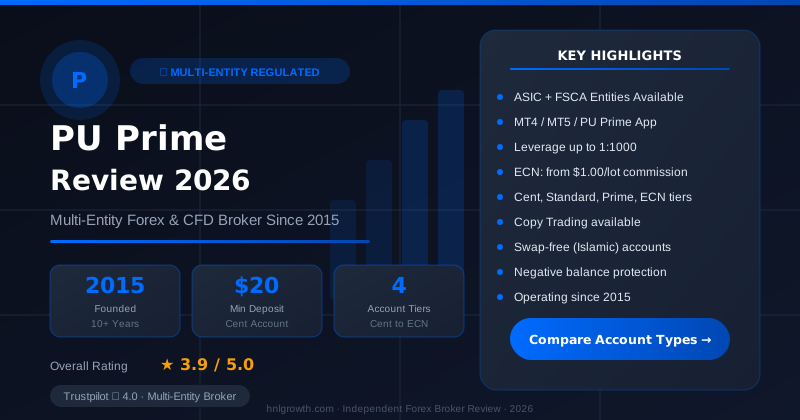
PU Prime — Multi-Entity Forex & CFD Broker
ASIC (AU) + FSCA (ZA) entities available · $20 min deposit (Cent) · MT4, MT5, PU Prime App · 4 account tiers
Copy trading automates trade execution. You allocate a portion of your capital to follow a signal provider—an experienced trader whose activity is publicly visible—and your account mirrors their trades proportionally. When they open a EUR/USD long position using 10% of their capital, your account opens the same position with 10% of your allocated funds. When they close, you close. When they adjust stop-loss levels, your position adjusts.
You do not choose entries, exits, position sizes, or instruments. The signal provider does. Your decisions are limited to:
- Which providers to copy
- How much capital to allocate to each
- What loss limits and position caps to set
- When to pause or stop copying
Copy trading does not automate risk management, provider evaluation, or portfolio monitoring. Those responsibilities remain yours. Delegating trade execution does not mean delegating oversight.
The method is legal and regulated in most jurisdictions when offered by licensed brokers. PU Prime is regulated by the Financial Services Authority of Seychelles (FSA), the Financial Services Commission of Mauritius (FSC), the Australian Securities and Investments Commission (ASIC), the Financial Sector Conduct Authority of South Africa (FSCA), and the Capital Market Authority of the UAE (CMA). Different entities may hold different licenses, and the protections available to you depend on which entity services your account and which jurisdiction you reside in. Regulation protects against broker fraud and requires segregated client funds; it does not protect against trading losses.
How Proportional Replication Works: A Step-by-Step Example
Proportional scaling means your position sizes mirror the provider's allocation percentages, not their absolute dollar amounts.
Example:
- Signal provider's account balance: $20,000
- Your allocated capital: $1,000
- Copy ratio: 1:1
The provider opens a position on GBP/USD using $2,000 of their capital (10% of their account). Your account automatically opens the same trade using $100 (10% of your $1,000 allocation).
If the trade gains 5%, the provider earns $100. You earn $5.
If the trade loses 15%, the provider loses $300. You lose $15.
The proportional relationship holds for every trade. If the provider splits $20,000 across five positions, your $1,000 splits across the same five positions in the same ratios.
Copy ratio adjustments:
Some platforms allow you to scale the provider's position sizes up or down. A 0.5x copy ratio opens positions at half the provider's percentage allocation. A 2x ratio doubles them. Scaling ratios above 1:1 amplify both gains and losses proportionally. Most beginners should start at 1:1 until they have observed how drawdowns play out in practice.
What happens when the provider adjusts a trade?
If the provider moves a stop-loss, your stop-loss updates automatically. If they partially close a position (taking 50% profit and leaving 50% running), your account does the same. You cannot override individual trades while copying is active. If you want control over specific positions, you must stop copying that provider first—which closes all open positions tied to them.
The Provider Side: Who Signal Providers Are and How They Earn
Signal providers are traders who share their activity publicly on a copy trading platform. They can be retail traders, professional fund managers, or algorithmic system operators. Platforms verify that an account is real and that performance data is accurate, but they do not independently assess provider skill, credentials, or long-term consistency.
Providers earn compensation through performance fees: a percentage of the net profit generated in your account, typically ranging from 20% to 50%. PU Prime calculates profit sharing using the High Water Mark method, which means providers earn fees only on genuine gains above the previous profit peak, not on recovering previous losses. Fees are settled weekly.
This fee structure creates a structural misalignment: providers earn a share of your profits but do not share your losses. A provider who gains 20% one period and then loses 20% the next still keeps the fee from the first period, while your account begins recovering from zero. Over time, this incentivises providers who produce occasional large gains even when those strategies also carry frequent large losses.
Before copying any provider, verify:
- Whether their account is a live trading account, not a demo
- How much of their own capital the provider has at risk (providers trading nominal amounts while earning fees on substantial copier capital have different incentives)
- Fee structure and settlement frequency
Providers can stop trading, change strategies, or close their profile at any time without notice. Most platforms do not require providers to disclose leverage changes, strategy shifts, or risk parameter adjustments to copiers.
Evaluating Providers: Metrics That Matter Beyond Win Rate
Leaderboards rank providers by total return, which rewards short-term volatility and survivorship. A provider showing 300% returns over three months may have taken concentrated risks that have not yet failed. A provider with 40% returns over 18 months, modest drawdowns, and consistent monthly distributions may represent a more durable signal.
Consistency:
Evaluate monthly return distribution. A provider with +8%, +6%, +11%, -3%, +7% over five months shows consistency. A provider with +40%, +60%, -25%, +80%, -30% shows a highly volatile equity curve. Volatility amplifies both gains and losses—the drawdown swings on a volatile provider can be severe enough to trigger equity stops before any recovery materialises.
Maximum drawdown:
Drawdown is the largest peak-to-trough decline in account balance. Check not just the maximum drawdown figure but also drawdown frequency. A provider who reaches 20% drawdowns every quarter carries different risk than one who had a single 25% drawdown across two years of trading.
Strategy type and instrument focus:
Scalpers open many trades, hold positions for minutes, and rely on tight spreads. Execution lag and slippage affect scalping strategies more than swing or position strategies. Swing traders hold positions for days or weeks and tolerate wider spreads. Copying several providers who all trade EUR/USD, GBP/USD, and USD/JPY does not produce meaningful diversification—you have multiplied your exposure to the same dollar and euro-area correlations rather than spread it.
Tenure and recent changes:
Providers with 12 months or more of live data offer more reliable signals than those with three months of history. But tenure alone is not sufficient. Watch for strategy drift: sudden increases in trade frequency, shifts from major to exotic pairs, or changes in average position size. A provider who spent 18 months swing trading and then pivoted to scalping in the past 30 days has effectively reset the informational value of their track record.
Fee impact on net return:
A provider showing 15% annual gross return with a 30% performance fee delivers 10.5% net return before spreads and commissions. A provider showing 12% gross with a 20% fee delivers 9.6% net. The second provider may be preferable once all costs are included. Always calculate net return, not gross.
Provider Evaluation Scorecard
| Criterion | Conservative | Moderate | Aggressive |
|---|---|---|---|
| Max Drawdown | <20% | 20–30% | >30% |
| Tenure | 18+ months | 12–18 months | <12 months |
| Win Rate | 55–65% | 50–55% | <50% or >70%* |
| Profit Factor | 1.5–2.0 | 1.3–1.5 | <1.3 or >2.5* |
| Trade Frequency | 10–30/month | 30–80/month | 80+/month |
| Strategy Type | Swing/position | Mixed | Scalping |
| Performance Fee | 20–30% | 30–40% | 40–50% |
| Instrument Focus | 5+ markets | 3–5 markets | 1–2 markets |
*Extremely high win rates or profit factors can signal survivorship bias, overfitted strategy parameters, or unsustainable risk concentration. They warrant closer scrutiny, not automatic approval.
These thresholds are indicative guidance for structuring your evaluation, not industry-standard benchmarks. Adjust them to match your own risk tolerance and time horizon.
For a deeper walkthrough of applying these criteria, see how to choose the best copy trading platform.
Setting Your Controls: Allocation, Stops, and Exit Rules
Your platform should provide risk controls at the account level, separate from and independent of the provider's decisions. These are your circuit breakers—configure them before you start copying, not after losses have accumulated.
Allocation cap:
PU Prime recommends never allocating more than 10–20% of your total trading capital to a single provider. If you have $5,000 and copy five providers, that means $500–$1,000 per provider. This limits single-provider failure to a manageable portion of your overall capital.
Equity stop-loss:
An equity stop-loss pauses copying automatically when your allocated balance drops below a threshold you set. For example, if you allocate $1,000 to a provider and set a 20% equity stop, copying halts if the balance on that allocation falls to $800. On PU Prime, you can configure this directly within your copy settings. Setting your stop level relative to the provider's historical maximum drawdown—adding a 5–10% buffer above their historical worst—gives the strategy room to recover while limiting your downside.
Position size limits:
Some platforms let you cap individual trade sizes independently of the provider's own sizing. If a provider opens a position using 15% of their capital but you have set a 10% cap, your account opens the trade at 10% instead. This reduces potential loss but also reduces potential gain and may distort the provider's intended risk-reward profile.
Pause and exit mechanisms:
Pausing copying stops new trades from opening but leaves existing open positions running. Stopping copying closes all open positions immediately at current market prices. Use pause when you want to observe without adding new exposure. Use stop when you need to exit entirely. Understand which action your platform performs before you need it under pressure.
Disclosure: This page may contain affiliate links. We may earn a commission if you open an account through our links, at no extra cost to you.
The Full Cost Picture: Spreads, Commissions, and Performance Fees
Copy trading costs operate across three layers: execution costs (spreads and commissions), performance fees to signal providers, and overnight financing charges (swap rates on leveraged positions held past the daily rollover). All three reduce your net return and should be calculated before you commit capital.
Spreads:
PU Prime's spread costs vary by account type and instrument. Standard accounts charge spreads with no per-trade commission. Prime and ECN accounts offer tighter spreads but add commissions per lot traded. All values on the spreads page are for reference; the most accurate current figures appear in the MT4/MT5 platform or the PU Prime mobile app.
Performance fees:
Signal providers earn 20–50% of your net profit, calculated using the High Water Mark method. This means fees are charged only on genuine gains above your previous profit peak, not on recovering losses. The mechanism is fair in principle but significant in impact: a 30% performance fee reduces a 15% gross return to 10.5% net, before spreads and swap charges.
Illustrative cost table:
The table below illustrates how costs interact at different capital levels, using hypothetical figures (15% gross return, 1.3-pip spread, 50 trades per month, 30% performance fee). These are illustrative only—your actual costs will depend on account type, instrument, trade frequency, and the provider's fee rate. Check current spreads in the platform before making calculations.
| Allocation | Gross Return | Illustrative Spread Cost | Performance Fee (30%) | Illustrative Net Return |
|---|---|---|---|---|
| $1,000 | 15% ($150) | ~$26 | ~$37 | ~8.7% |
| $5,000 | 15% ($750) | ~$130 | ~$186 | ~8.7% |
| $10,000 | 15% ($1,500) | ~$260 | ~$372 | ~8.7% |
Net return percentage remains consistent across capital levels in this illustration, but absolute fee amounts scale with allocation size. There are no subscription or management fees on PU Prime's copy trading offering.
For a detailed breakdown of how fees accumulate over time, see copy trading profitability explained.
Regulatory Safeguards: What Licensing Protects and What It Doesn't
Regulation protects you from broker fraud, misappropriation of funds, and operational misconduct. It does not protect you from trading losses, provider strategy changes, or market volatility.
What licensing by bodies such as ASIC, FSA, FSC, FSCA, and CMA requires:
- Client funds held in segregated accounts, separate from the broker's operating capital
- Minimum capital reserves maintained by the broker
- Regular audits and regulatory reporting
- Dispute resolution pathways
The specific protections you receive depend on which entity services your account, not simply the list of regulators a broker names across its group. Different licenses apply in different jurisdictions and may carry materially different levels of client protection.
Investor compensation schemes:
Some jurisdictions operate statutory compensation schemes for retail clients if a licensed broker becomes insolvent. The UK Financial Services Compensation Scheme (FSCS), for example, covers eligible clients of FCA-authorised firms up to £85,000. This protection applies only if you are dealing with an FCA-authorised entity—it does not extend to offshore-regulated entities regardless of the broker's group structure. PU Prime's current regulatory licenses (FSA, FSC, ASIC, FSCA, CMA) do not include FCA authorisation. UK-resident traders should verify which entity and protections apply to their account before depositing.
What regulation does not cover:
- Losses from copied trades
- Provider strategy changes or deteriorating performance
- Execution slippage
- Currency conversion costs or withdrawal delays within normal processing times
Verify PU Prime's regulatory status by cross-referencing license numbers directly on each regulator's official website. Relying solely on what any broker states on its own homepage is insufficient for due diligence.
Unlicensed brokers may offer copy trading, higher leverage, or lower fees, but you have limited legal recourse if funds are misappropriated.
Execution Mechanics: How Trades Are Copied and Where Lag Occurs
When a signal provider opens a trade, the platform sends a replication instruction to all active copiers' accounts. Your account receives the instruction, processes it, and submits an order to the broker's execution system. This sequence introduces a lag—typically milliseconds to a few seconds, depending on server load, connectivity, and market conditions.
Slippage:
The price at which the provider's trade executes may differ from the price at which your mirrored trade executes. In fast-moving markets—major economic data releases, central bank announcements, sudden liquidity gaps—slippage can be several pips. Over many trades, cumulative slippage reduces net returns.
As an illustration of the arithmetic: if a provider enters EUR/USD long at 1.1000 and your order executes at 1.1003 due to lag, and the provider exits at 1.1050 while your exit executes at 1.1047, you earn 44 pips rather than 50. The magnitude of slippage relative to the trade's target determines its impact—3 pips on a 10-pip target is a 30% reduction; 3 pips on a 100-pip target is 3%. Scalping strategies are disproportionately affected. These figures are illustrative; actual slippage depends on execution conditions at the time of the trade.
Execution quality factors:
- Broker liquidity providers: deeper liquidity generally reduces slippage on execution
- Server location: closer proximity to the broker's infrastructure reduces order latency
- Order routing: execution policies vary across brokers and account types
You cannot eliminate slippage, but you can reduce its impact by copying providers who trade liquid instruments (major forex pairs, widely traded indices) during active market sessions when spreads are narrowest.
Platform downtime:
If the copy trading platform or broker server goes offline while a provider has open positions, your positions remain open but stop mirroring new provider activity. When the platform reconnects, copying resumes, but trades opened or closed during the outage are not replicated. This creates tracking error—your portfolio diverges from the provider's record. Check a broker's published uptime record and server stability history before committing capital.
Risks That Don't Show Up in Past Performance
Historical returns and drawdown statistics are backward-looking. They describe what happened under specific past market conditions and say nothing definitive about future conditions or the provider's future behaviour.
Strategy drift:
A provider who spent 12 months trading conservatively may increase position sizes, shift to higher-leverage instruments, or begin trading around news events without disclosing the change. Past data does not signal this shift; only ongoing monitoring can detect it. Red flags include:
- Trade frequency doubling within 30 days
- Sudden shift from major pairs to exotic or less liquid instruments
- Average position size jumping significantly from the provider's historical norm
- New instruments appearing that were absent during the track-record period
Correlation risk:
Copying providers who all trade the same currency pairs or asset classes does not diversify your portfolio—it concentrates it. If all five providers trade dollar pairs, a shift in Federal Reserve policy or a dollar liquidity event will affect all five simultaneously. Meaningful diversification requires mixing asset classes (forex, commodities, equity indices), trading styles (scalping, swing, position), and market regimes (trend-following strategies alongside mean-reversion strategies).
Provider incentive misalignment:
A high performance fee with no loss-sharing means a provider who takes a large losing position bears none of the financial consequence. They earn fees on profits; losses fall entirely on the copier. This structural asymmetry can favour providers who survive through concentrated risk-taking rather than consistent skill. Lower performance fee rates tend to attract providers who rely on steady returns rather than occasional outsized gains.
Platform and broker risk:
If your broker becomes insolvent, copy trading stops and your funds enter insolvency proceedings. Regulated brokers must maintain segregated client funds, but the practical recovery process and timelines depend heavily on jurisdiction. Verify the regulatory entity that covers your account and the applicable compensation scheme, if any.
Behavioral traps:
- Delegation regret: Abandoning a provider during a drawdown that you would have tolerated in your own manual trading. This tends to lock in losses just before potential recovery.
- Recency bias: Switching to last month's top-ranked provider, who may be at the tail end of a lucky streak rather than the start of a consistent run.
- Overconfidence after early gains: Increasing allocation or adding leverage after a few profitable months, just before the first significant drawdown arrives.
These risks are cognitive rather than mechanical. No platform control eliminates them. Predefined rules for when you will pause, stop, or rebalance—set before you start, not in response to losses—reduce their impact.
Building a Copy Trading Approach: Allocation, Diversification, and Monitoring
A sustainable copy trading approach requires upfront planning and ongoing oversight—not a one-time setup.
Allocation framework:
Start with capital you could afford to lose entirely without affecting your financial obligations. Keep a 20–30% reserve outside your copied allocations to handle drawdowns without forced liquidation. Spread the remainder across 3–5 providers at no more than 10–20% of your total capital each.
Diversification checklist:
- Asset class: mix forex, indices, and commodities rather than copying five forex-only providers
- Strategy type: combine shorter-term strategies (higher trade frequency) with longer-term positions (lower frequency and wider price targets)
- Market regime: include providers whose strategies perform in trending markets and at least one whose approach suits ranging or mean-reverting conditions
- Session exposure: providers active across European, US, and Asian sessions reduce concentration in single-session news events
Monthly monitoring template:
| Provider | Allocation | Current Balance | Drawdown % | Fees Paid MTD | Trade Frequency | Strategy Consistency | Action |
|---|---|---|---|---|---|---|---|
| Provider A | $1,000 | $920 | -8% | $12 | 22 trades | Stable | Hold |
| Provider B | $1,000 | $850 | -15% | $18 | 65 trades | Frequency +40% | Review |
| Provider C | $1,000 | $1,080 | +8% | $24 | 18 trades | Stable | Hold |
Review weekly after profit-sharing settlement. Consider pausing or stopping a provider if:
- Drawdown exceeds their historical maximum by 10 percentage points or more
- Trade frequency doubles in a single month without explanation
- New instruments appear that were not present in the track-record period
- Fees paid in a month exceed 5% of your allocation to that provider
What to Consider Before Using a Demo Account
Most regulated copy trading platforms offer demo accounts that let you explore platform functionality—allocation tools, equity stop settings, provider statistics pages, and the interface for pausing or stopping—using virtual capital. This is useful for learning how controls are configured and understanding the platform's navigation before you commit live funds.
A demo environment cannot replicate the experience of watching real capital decline, and it does not test your response to drawdowns, the temptation to chase leaderboard rankings, or the discipline required to hold through a losing period. It also cannot verify execution quality, actual slippage, or real fill conditions.
Use a demo account to confirm that the platform's controls work as described and that you understand how to set stops and adjust allocations. Then consider starting with a small live allocation—within your stated loss tolerance—before scaling further.
Account opening at PU Prime requires a government-issued ID, proof of address, and a minimum deposit of $50 for a Standard account ($20 for a Cent account). The process takes approximately 10–15 minutes of active time, plus a compliance verification period.
Frequently Asked Questions
What is the minimum amount needed to start copy trading?
This depends on the broker and account type. PU Prime's account opening page shows a $50 minimum deposit for a Standard account and $20 for a Cent account. Check the copy trading section of the platform directly for any minimum per-provider allocation requirements.
Can I lose more than I invest?
It depends on whether your broker provides negative balance protection. If they do, losses are capped at your account balance. Without it, rapid market moves can trigger margin calls and losses exceeding your deposit. Verify whether the specific entity servicing your account offers negative balance protection before you trade.
Is copy trading legal?
Yes, when offered by a regulated broker in most jurisdictions. The legal and regulatory status of copy trading varies by country. Confirm that the broker you use is authorised in your jurisdiction and check which entity and protections apply to your account specifically.
How often should I review my copied providers?
Weekly is the minimum. Check drawdown levels, trade frequency, and fee accumulation after each profit-sharing settlement cycle. Monthly, compare current provider behaviour against their historical patterns to detect strategy drift.
What is the difference between copy trading and social trading?
Copy trading automates trade execution—your account mirrors a provider's trades without manual intervention. Social trading covers a broader set of community features: discussion forums, strategy sharing, and sentiment tools, which may or may not include automatic trade replication. Some platforms combine both.
Can I copy multiple providers simultaneously?
Yes. Copying 3–5 providers with different instruments and strategies reduces concentration in any single provider. Ensure your total allocation across providers stays within the capital you could afford to lose, and verify that the providers you choose are not all exposed to the same underlying market factors.
What happens if a provider I'm copying stops trading?
Copying pauses, and existing open positions remain open under your account. You must decide whether to close those positions manually or wait. Most platforms notify you when a provider becomes inactive. Have a plan for this scenario before it occurs.
Do copy trading profits get taxed?
Yes, in most jurisdictions, though the treatment varies significantly by country, the classification of the trader, how long positions are held, and other factors. Do not rely on generalised statements about tax treatment in any particular country—consult a qualified tax advisor for guidance that applies to your specific circumstances.
Risk Warning
Risk warning: CFDs and leveraged forex products are complex instruments and carry a high risk of losing money rapidly due to leverage. Consider whether you understand how these products work and whether you can afford to take the high risk of losing your capital. Check the entity, terms and protections that apply in your jurisdiction before trading.
Copy trading does not remove these risks. You can lose your entire allocated capital if the signal provider's positions move against you. Past performance of any signal provider is not a reliable indicator of future results, and no return or outcome can be guaranteed.
Ready to Compare PU Prime Account Types?
PU Prime is a multi-entity broker — ASIC (Australia) and FSCA (South Africa) regulated entities offer stronger oversight, while most international clients are onboarded to the FSA Seychelles or FSC Mauritius entities. Four account tiers (Cent, Standard, Prime, ECN) range from a $20 minimum deposit to full ECN pricing.
Risk disclaimer: PU Prime is a live, regulated multi-entity broker — trading forex and CFDs is done with real capital under normal market risk (this is not a simulated prop-firm evaluation). PU Prime operates under multiple separate licenses (ASIC, FSCA, FSA Seychelles, FSC Mauritius); which entity holds your account depends on your country of residence and determines your leverage cap and protections — confirm this before funding. CFDs and leveraged forex products are complex instruments and carry a high risk of losing money rapidly due to leverage; 62.2% of retail investor accounts lose money when trading CFDs with this provider. Consider whether you understand how CFDs/forex work and whether you can afford the high risk of losing your money. Affiliate disclosure: HNL Growth earns a commission when you open a PU Prime account through links on this page.