What Is Leverage in Forex? Margin, Risk and Real Examples
Leverage in forex lets you control a position much larger than your account balance by putting up only a fraction of its value as margin. A leverage ratio of 1:100 means $1,000 of margin can control...
Reviewed using our forex & CFD broker review methodology
Checked on: 2026-08-17 | Broker terms, regulation, and pricing can change. Always verify at the official PU Prime site before opening an account.
Affiliate Disclosure: HNL Growth may earn a commission if you open an account through our links, at no additional cost to you. Risk Warning: CFDs and leveraged forex products are complex instruments and carry a high risk of losing money rapidly due to leverage. 62.2% of retail investor accounts lose money when trading CFDs with this provider. Trading forex and CFDs may not be suitable for all investors. Consider your objectives, experience, and risk appetite before trading, and ensure you understand the risks involved. Broker Disclosure: PU Prime is a live, regulated multi-entity broker (not a simulated prop-firm evaluation) — trades are executed with real capital in live market conditions, subject to normal market risk. Which PU Prime entity holds your account depends on your country of residence and determines your leverage cap and protections.
Last verified: August 2026 | Editorial Team
What Is Leverage in Forex? Margin, Risk and Real Examples
Leverage in forex lets you control a position much larger than your account balance by putting up only a fraction of its value as margin. A leverage ratio of 1:100 means $1,000 of margin can control a $100,000 position. It doesn't create free money — it magnifies both profits and losses on the same capital, and it's the reason small price moves can produce outsized gains or margin calls. Understanding the mechanics before you trade live is the difference between using leverage as a tool and getting liquidated by it.
This guide breaks down the math, walks through worked examples at different leverage ratios, and covers the risks, mistakes, and practice steps that matter most for beginners.
What Leverage Actually Is, in Plain Terms
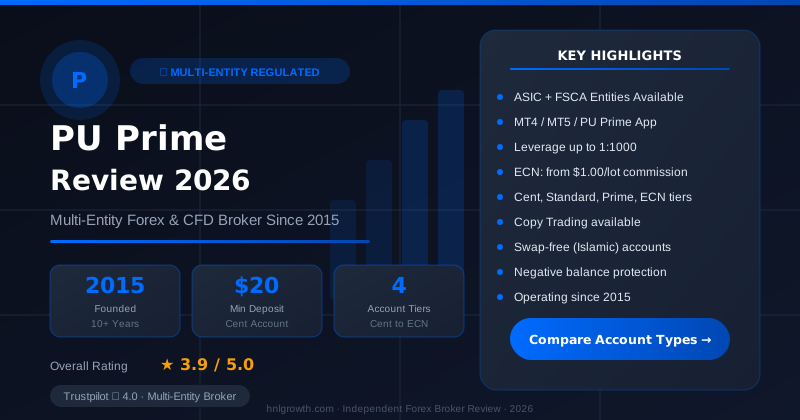
PU Prime — Multi-Entity Forex & CFD Broker
ASIC (AU) + FSCA (ZA) entities available · $20 min deposit (Cent) · MT4, MT5, PU Prime App · 4 account tiers
Leverage is borrowed exposure, not borrowed cash. When you open a leveraged forex position, your broker doesn't hand you money to spend. Instead, it lets you control a position size that's a multiple of the margin you set aside, and it holds that margin as collateral against potential losses.
The leverage ratio and the margin requirement are two sides of the same equation:
- Leverage ratio expresses how many times your margin the broker will let you control (e.g., 1:100, 1:200, 1:500).
- Margin requirement expresses the same relationship as a percentage of the position's notional value.
They're inversely related: divide 100 by the leverage ratio to get the margin percentage.
| Margin Requirement | Leverage Ratio |
|---|---|
| 5% | 1:20 |
| 3% | 1:33 |
| 2% | 1:50 |
| 1% | 1:100 |
| 0.5% | 1:200 |
| 0.2% | 1:500 |
A 1% margin requirement and 1:100 leverage describe the exact same exposure. Brokers usually quote one or the other depending on the platform, so it helps to be able to convert between them mentally.
Margin vs. Leverage: Why the Distinction Matters
Margin is the actual dollar amount locked up as collateral for a specific trade. Leverage is the ratio that determines how much margin that trade requires relative to its full value. You don't choose margin directly — you choose (or are assigned) a leverage ratio, and the margin requirement follows from it.
This distinction matters for two practical reasons. First, your used margin (locked against open positions) and your free margin (available for new trades or to absorb losses) are what determine whether you can open another position or survive a drawdown. Second, margin level, calculated as:
Margin Level (%) = (Equity ÷ Used Margin) × 100
is the number your platform monitors continuously. As losses eat into equity, margin level falls. Most brokers define a margin call threshold and a separate, lower stop-out level at which positions are automatically closed — the exact percentages vary by broker and account type, so check your account's specific terms and conditions on your platform before you rely on them in a live account.
How It Works: A Worked Example
Say a trader deposits $1,000 and opens a position on EUR/USD at 1.1000 using a mini lot (10,000 units), so the notional value of the trade is $11,000.
At 1:100 leverage (1% margin requirement):
| Item | Value |
|---|---|
| Position size | 10,000 units (0.1 lot) |
| Notional value | $11,000 |
| Margin required | $110 |
| Pip value (0.1 lot) | $1 per pip |
| Free margin remaining | $890 |
If the price moves 50 pips in the trader's favor, the position gains $50 — a 45% return on the $110 margin used, though only a 5% return on the full $1,000 account equity. If it moves 50 pips against them, the loss is the same $50, and margin level drops accordingly. The leverage itself didn't change the dollar risk on this specific trade; it changed how little capital had to be set aside to take it, which is why traders can end up holding several such positions at once and underestimating cumulative exposure.
Same trade at 1:500 leverage (0.2% margin requirement):
| Item | Value |
|---|---|
| Margin required | $22 |
| Free margin remaining | $978 |
The pip value and dollar profit/loss are identical — leverage doesn't change how much a pip is worth. What changes is how much margin is tied up, which frees capital to open more positions or larger ones. That's the real mechanism: leverage doesn't amplify a single trade's pip value, it amplifies how much total exposure your account can carry, and therefore how much can go wrong at once if multiple positions move against you.
Disclosure: This page may contain affiliate links. We may earn a commission if you open an account through our links, at no extra cost to you.
Running these numbers on paper is one thing; watching margin level move in real time is another. If you want to see how position size, margin, and pip movement interact before committing capital, you can open a demo account with PU Prime and test the calculations above on live pricing without risking money.
Leverage Ratios by Trader Profile
There's no universally "correct" leverage ratio — it depends on strategy, position-sizing discipline, and how much drawdown you can tolerate without being forced out of a trade prematurely. The table below maps common profiles to typical considerations, not prescriptions.
| Profile | Typical ratio range | Rationale |
|---|---|---|
| Conservative / swing trader | 1:20–1:50 | Wider stops relative to account size; fewer, larger margin buffers |
| Moderate / position trader | 1:50–1:100 | Balances capital efficiency with manageable drawdown per trade |
| Active day trader | 1:100–1:200 | Tighter stops, higher trade frequency, needs margin headroom for multiple concurrent positions |
| Aggressive / high-frequency | 1:200+ | Small per-trade margin use but compounding risk across volume; requires strict position sizing |
Higher leverage doesn't mean higher risk by itself — undersized stops and oversized position sizing relative to account equity are what actually cause blown accounts. A trader using 1:500 leverage but sizing positions conservatively can carry less real risk than a trader on 1:20 who overtrades their account.
Margin Calls and Liquidation, Explained Operationally
A margin call isn't a phone call — it's a status your platform flags when margin level falls to a broker-defined threshold, indicating your equity is getting close to the amount needed to keep positions open. If losses continue and margin level drops further, to a lower stop-out level, the platform will begin closing positions automatically, starting typically with the most unprofitable one, to bring margin level back above the threshold.
The practical implications for active traders:
- You can lose more than you expect if you're holding several correlated positions (e.g., multiple EUR crosses) that all move against you simultaneously, even if each one individually looks small.
- Gaps and fast markets can cause slippage on stop-outs, meaning the forced close may execute at a worse price than the stop-out level implied, particularly around news events or weekend opens.
- Margin call and stop-out percentages differ by broker and sometimes by account type, so the exact distance between "normal" and "forced liquidation" isn't a fixed number across the industry — always confirm the specific levels that apply to your account.
The Main Risks, and Who Leverage Trading Is Not For
Leverage magnifies outcomes in both directions, but the practical risk profile skews toward the downside for several reasons: losses compound faster than most beginners expect, emotional decision-making tends to worsen under margin pressure, and forced liquidations lock in losses at the worst possible moment.
Leverage trading is generally not suitable for:
- Traders without a stop-loss discipline. Leverage without exit planning turns a manageable drawdown into a forced liquidation.
- Anyone trading with money they can't afford to lose. CFDs and leveraged forex carry a real risk of losing your full deposited capital, and in some account structures, more than your deposit.
- Traders who size positions based on margin available rather than account equity. Just because you can open a large position with small margin doesn't mean the position is appropriately sized for your risk tolerance.
- Complete beginners trading live before understanding margin mechanics. Practicing the calculations on a demo first, as covered below, is a reasonable step before risking capital.
Common Mistakes
- Confusing available margin with acceptable risk. Free margin tells you what you can open, not what you should open.
- Ignoring correlation across open positions. Several EUR- or USD-based pairs moving together can multiply drawdown faster than a single-position risk calculation suggests.
- Setting stops based on a fixed pip count rather than account risk percentage. A 20-pip stop means something very different on a 0.1 lot than on a 1.0 lot.
- Increasing leverage after a loss to "win it back" faster. This compounds risk exactly when discipline matters most.
- Not accounting for spread and commission costs when sizing trades tightly. On leveraged positions, execution costs are a larger percentage of a thinner margin buffer than they appear against total notional value.
Execution Costs Under Leverage
Leverage changes position size, but it doesn't change how spreads, commissions, and swaps apply — and because leveraged positions are often larger relative to account equity, these costs matter more in percentage terms. PU Prime publishes live spreads, commissions, and swap rates by account type on its trading costs page, and account-type structures differ meaningfully:
| Account type | Spreads | Commission | Minimum deposit |
|---|---|---|---|
| Standard | From 1.3 pips on EUR/USD | None | $50 |
| Prime | From 0.0 pips (raw) | $3.50 per lot per side | $1,000 |
| ECN | From 0.0 pips (raw) | $1.50 per lot per side | $10,000 |
Source: PU Prime — How to Open a Trading Account. Exact spreads and commissions vary by symbol and market conditions — check MT4/MT5 or the PU Prime app for current values before trading.
For active or high-frequency strategies, the choice between a spread-only account and a raw-spread-plus-commission account changes the real cost of each round trip, which matters more the more leverage lets you trade. There's also a Cent account with a $20 minimum, aimed at testing strategies with reduced position sizes rather than lowering leverage risk itself.
How to Practise Leverage on a Demo Account
Before applying any of the leverage math above to a live account, it's worth confirming you can calculate margin, pip value, and margin level correctly under real-time price movement. A demo account uses live market pricing without risking capital, which makes it useful specifically for this purpose — not for confirming a strategy will be profitable live, since execution and psychology differ once real money is involved.
A reasonable sequence:
- Open a demo account and note the default leverage assigned to it.
- Calculate the margin required for a small position before opening it, then compare your number to what the platform shows.
- Open the position and track how margin level moves as price fluctuates, including during a losing stretch.
- Practice placing stop-losses sized to a percentage of account equity rather than a fixed pip count.
You can compare PU Prime account types to see which structure (Cent, Standard, Prime, or ECN) fits your intended position sizing and trading frequency once you're ready to move from demo to live.
Regulatory and Entity Context
Leverage limits are set by regulators and vary by jurisdiction, and sometimes by client classification (retail vs. professional) within the same jurisdiction. Some regulators cap retail leverage on major currency pairs at relatively conservative levels, while others permit higher ratios, particularly for professional or non-retail clients. Because these caps differ by regulator and can change, the leverage available to you depends on which regulated entity you're onboarded with, not on the brand generally.
PU Prime operates under multiple regulatory licenses, including the Financial Services Authority of Seychelles (FSA), the Financial Services Commission of Mauritius (FSC), the Financial Sector Conduct Authority of South Africa (FSCA), and the Capital Market Authority of the UAE (CMA), as listed on its regulation page. Terms, including maximum leverage, differ by entity and client jurisdiction, so confirm the specific terms that apply to your account before trading rather than assuming a single figure applies globally.
FAQ
What does 100:1 leverage actually mean? It means you can control a position worth 100 times your margin deposit. A $500 margin deposit at 1:100 leverage lets you control a $50,000 position. It does not mean you're risking 100 times your deposit on every trade — your actual risk depends on position size and stop-loss placement, not the leverage ratio alone.
Can I lose more than my initial deposit? This depends on the account type, jurisdiction, and whether negative balance protection applies to your specific entity and account. Confirm this in your account terms before trading, since it isn't a universal guarantee across all brokers or regions.
What leverage ratio do active traders typically use? There's no fixed standard — it depends on strategy and stop-loss discipline more than trading style alone. Day traders and scalpers often use higher ratios because their per-trade margin use is small relative to trade frequency, but this only reduces risk if position sizing and stops are managed relative to account equity, not margin availability.
How does leverage differ between forex and other assets like stocks? Forex leverage ratios are typically higher than those available for stock CFDs, reflecting differences in volatility and regulatory treatment between asset classes. Check the specific margin requirements for each instrument on your platform, since they vary by symbol.
What happens when my account hits a margin call? Margin level falls to a broker-defined threshold, signaling that equity is getting close to the level needed to sustain open positions. If losses continue to a lower stop-out level, positions begin closing automatically. The exact thresholds vary by broker and account type.
Is higher leverage automatically riskier? Not by itself. Leverage determines margin efficiency, not position size. Risk comes from how large a position you open and how far your stop-loss sits relative to your account equity, regardless of the leverage ratio used to open it.
Risk Warning
Risk warning: CFDs and leveraged forex products are complex instruments and carry a high risk of losing money rapidly due to leverage. Consider whether you understand how these products work and whether you can afford to take the high risk of losing your capital. Check the entity, terms and protections that apply in your jurisdiction before trading.
Ready to Compare PU Prime Account Types?
PU Prime is a multi-entity broker — ASIC (Australia) and FSCA (South Africa) regulated entities offer stronger oversight, while most international clients are onboarded to the FSA Seychelles or FSC Mauritius entities. Four account tiers (Cent, Standard, Prime, ECN) range from a $20 minimum deposit to full ECN pricing.
Risk disclaimer: PU Prime is a live, regulated multi-entity broker — trading forex and CFDs is done with real capital under normal market risk (this is not a simulated prop-firm evaluation). PU Prime operates under multiple separate licenses (ASIC, FSCA, FSA Seychelles, FSC Mauritius); which entity holds your account depends on your country of residence and determines your leverage cap and protections — confirm this before funding. CFDs and leveraged forex products are complex instruments and carry a high risk of losing money rapidly due to leverage; 62.2% of retail investor accounts lose money when trading CFDs with this provider. Consider whether you understand how CFDs/forex work and whether you can afford the high risk of losing your money. Affiliate disclosure: HNL Growth earns a commission when you open a PU Prime account through links on this page.