What Is Quantitative Easing? A Trader's Guide
Quantitative easing (QE) is a monetary policy tool where a central bank creates new digital reserves and uses them to buy government bonds and other securities from financial institutions. This...
Reviewed using our forex & CFD broker review methodology
Checked on: 2026-08-17 | Broker terms, regulation, and pricing can change. Always verify at the official PU Prime site before opening an account.
Affiliate Disclosure: HNL Growth may earn a commission if you open an account through our links, at no additional cost to you. Risk Warning: CFDs and leveraged forex products are complex instruments and carry a high risk of losing money rapidly due to leverage. 62.2% of retail investor accounts lose money when trading CFDs with this provider. Trading forex and CFDs may not be suitable for all investors. Consider your objectives, experience, and risk appetite before trading, and ensure you understand the risks involved. Broker Disclosure: PU Prime is a live, regulated multi-entity broker (not a simulated prop-firm evaluation) — trades are executed with real capital in live market conditions, subject to normal market risk. Which PU Prime entity holds your account depends on your country of residence and determines your leverage cap and protections.
Last verified: August 2026 | Editorial Team
What Is Quantitative Easing? A Trader's Guide
Disclosure: This page may contain affiliate links. We may earn a commission if you open an account through our links, at no extra cost to you.
Quantitative easing (QE) is a monetary policy tool where a central bank creates new digital reserves and uses them to buy government bonds and other securities from financial institutions. This process increases the money supply within the banking system, pushes down long-term interest rates, and aims to encourage lending and investment when traditional interest-rate cuts have reached their limit—typically near zero. For beginner traders, QE represents crucial macro context that affects asset prices, currency values, and market volatility, but it is not a direct trading signal or strategy you should act on immediately.
Understanding QE helps you make sense of why markets behave the way they do during economic crises, but it does not mean you should start live trading based on central bank announcements. This guide explains what QE is, how it works, and what it means for your trading education.
What Quantitative Easing Actually Is
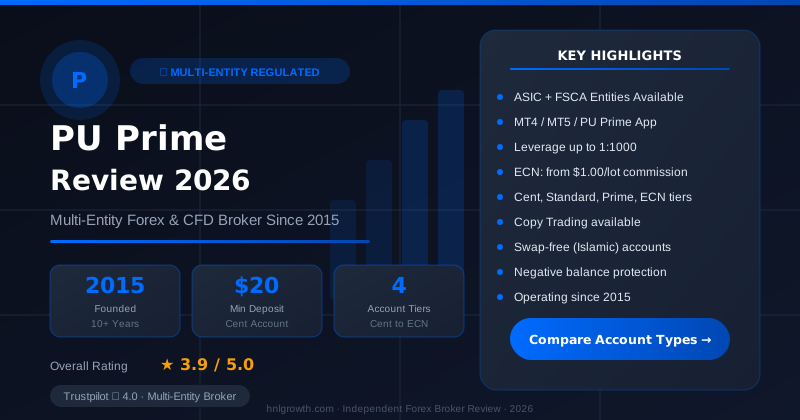
PU Prime — Multi-Entity Forex & CFD Broker
ASIC (AU) + FSCA (ZA) entities available · $20 min deposit (Cent) · MT4, MT5, PU Prime App · 4 account tiers
Quantitative easing is not "printing money" in the way most people imagine. The central bank does not produce physical currency or deposit cash into consumer bank accounts. Instead, it creates settlement balances—digital reserves that exist only in the accounts commercial banks hold at the central bank.
Here is the basic mechanism: the central bank adds a number to a commercial bank's reserve account, then uses that newly created balance to buy bonds from that bank. The bank now holds central bank reserves instead of bonds. Because reserves earn very low interest, banks have an incentive to lend those funds out or invest them elsewhere. That is the theory.
This process is fundamentally different from fiscal policy, where governments spend tax revenue or borrowed money directly into the economy. With QE, the central bank targets the banking system, hoping that lower borrowing costs and portfolio rebalancing will eventually reach businesses and consumers.
When Central Banks Deploy QE
Central banks turn to quantitative easing when conventional interest-rate cuts stop working. In normal economic slowdowns, a central bank lowers its policy rate—the rate at which commercial banks can borrow reserves overnight. Lower rates make borrowing cheaper, which encourages spending and investment.
But interest rates cannot go much below zero. Once the policy rate hits near-zero (or even slightly negative in some jurisdictions), the central bank has exhausted its main tool. If the economy is still struggling—high unemployment, stagnant growth, deflationary pressure—the central bank needs another option. That is when QE enters the picture.
The 2008 financial crisis forced major central banks into this corner. The Federal Reserve cut rates to near zero by December 2008, yet credit markets remained frozen and the economy continued to contract. QE became the next lever to pull.
Using a Demo Account to Observe QE Effects in Practice
Before exploring QE's mechanics further, it is worth addressing how you can use this knowledge as a beginner trader. A demo account lets you observe market behavior during periods of monetary policy shifts without risking real money. You can watch how currency pairs react to central bank statements, how volatility changes around QE announcements, and how your analysis performs in different macro environments.
Note that demo trading does not replicate the emotional pressure or financial consequence of risking real capital. It is, however, the right environment to learn how QE-related news moves markets and how your chosen instruments behave during policy shifts—before you consider committing real funds.
Open a free PU Prime demo account to practice understanding how central bank policy affects markets. The account opening process takes around 10 to 15 minutes, and you can begin with a demo while your documents are reviewed. Once you are ready to move to a live account, minimum deposits start from $20 depending on account type, and PU Prime operates under the oversight of several financial authorities.
How Quantitative Easing Works: The Process
Understanding the mechanics helps demystify QE and prevents common misconceptions.
Step 1: Creating Settlement Balances
The central bank decides on a target amount and a timeframe. It then credits commercial banks' reserve accounts with new balances. These are not physical notes or coins. They are digital entries that allow banks to settle transactions with each other and with the central bank.
Commercial banks are legally required to hold a certain level of reserves. Beyond that minimum, excess reserves earn very little interest. By flooding the system with reserves, the central bank makes holding those balances less attractive, nudging banks toward lending or buying other assets.
Step 2: Buying Bonds Through Reverse Auctions
The central bank announces which types of securities it will buy—usually government bonds, but sometimes corporate bonds or mortgage-backed securities. It conducts reverse auctions where banks offer to sell bonds at specific prices. The central bank accepts offers that meet its criteria, paying for the bonds with the newly created reserves.
This pushes up bond prices. Because bond prices and yields move inversely, higher prices mean lower yields. A government bond yielding 2.5% might drop to 1.8% after heavy central bank buying. Lower yields on government bonds ripple through the entire financial system.
Step 3: Portfolio Rebalancing and Lower Borrowing Costs
When banks sell bonds to the central bank, they receive reserves they did not particularly want. They look for better returns. Pension funds, insurance companies, and other institutional investors who also sold bonds to the central bank now have cash to redeploy. They buy corporate bonds, stocks, real estate, or lend to businesses.
This portfolio rebalancing is the main channel through which QE is supposed to work. Lower government bond yields push investors toward riskier assets, which raises their prices and lowers their yields too. Companies find it cheaper to borrow. Mortgage rates fall. Stock prices rise because future earnings are discounted at lower rates.
That is the theory. The reality is messier, which the limitations section covers.
Real-World QE Programs and Their Outcomes
QE is not a hypothetical concept. Major central banks have deployed it repeatedly over the past fifteen years, with varying results.
The 2008 Financial Crisis: The Federal Reserve's First Large-Scale QE
The Federal Reserve launched its first QE program in November 2008, shortly after Lehman Brothers collapsed. The Fed announced it would buy $600 billion in mortgage-backed securities and agency debt. By March 2009, it expanded the program to include long-term Treasury bonds.
The Fed's balance sheet grew substantially across three rounds of QE (commonly called QE1, QE2, and QE3) through 2014. These figures are drawn from Federal Reserve historical records; readers who require precise current balance sheet data should consult the Federal Reserve's published H.4.1 statistical releases directly.
The measurable outcomes: 10-year Treasury yields fell sharply from their mid-2007 levels to below 2% by 2012. Credit markets stabilized. Stock prices recovered—the S&P 500 bottomed in March 2009 and began a sustained recovery. Unemployment eventually fell from 10% in 2009 to under 4% by 2018, though how much of that recovery QE directly caused, versus fiscal stimulus and broader economic healing, remains a subject of debate among economists.
COVID-19 Emergency Response: Speed and Scale
When the COVID-19 pandemic shut down global economies in March 2020, the Federal Reserve acted faster and at greater scale than in 2008. Within weeks, it slashed rates to zero and announced open-ended asset purchases. The Fed's balance sheet expanded by more than $3 trillion in just a few months during early 2020—though readers who require precise figures and dates should verify against the Federal Reserve's published H.4.1 releases.
The European Central Bank, Bank of England, and Bank of Japan launched or expanded their own QE programs simultaneously. Markets stabilized relatively quickly. The S&P 500 recovered its pre-pandemic high by August 2020, even as unemployment remained elevated and lockdowns continued in many regions.
This episode also demonstrated one of QE's clearest limitations: when most major central banks conduct QE simultaneously, currency effects tend to be muted because no single currency is weakening in relative isolation. The policy divergence that creates sharp forex moves was largely absent during that period.
Japan's Decades-Long QE Experiment
The Bank of Japan began experimenting with QE in 2001, years before the global financial crisis. Japan faced persistent deflation, weak growth, and near-zero interest rates for over a decade. The BoJ bought government bonds and other assets in waves, eventually accumulating very substantial holdings of Japanese government bonds. Readers who need current BoJ balance sheet figures and reference dates should consult the Bank of Japan's published statistical data directly, as these figures change regularly.
The outcomes in Japan are widely characterised as mixed. Inflation remained stubbornly low despite years of QE. Economic growth stayed weak. The yen depreciated over time, which helped exporters but did not spark a broad recovery. Stock prices rose, but wage growth remained flat for most Japanese households for an extended period.
Japan's experience is a caution: QE can help stabilise financial markets and reduce deflationary pressure, but it does not automatically generate strong economic growth or broad prosperity, especially in economies facing structural challenges such as aging populations and high debt levels.
What QE Does to Financial Markets
For traders, the market effects of QE matter more than the policy mechanics.
Bond Yields and Borrowing Costs
QE's most direct effect is on bond yields. When a central bank buys large quantities of government bonds, it reduces the supply available to private investors. Basic supply and demand: less supply, higher prices, lower yields.
Lower government bond yields act as a benchmark. Corporate bonds, mortgage rates, and other forms of borrowing are priced relative to government yields. If the 10-year Treasury yield drops meaningfully, corporate bond yields tend to fall in parallel. Companies refinance debt at lower rates. New borrowing becomes cheaper.
For traders, this means the fixed-income market can experience significant volatility around QE announcements. Bond prices can spike, and yields can gap lower, within minutes of a central bank statement.
The Ripple Effect on Stocks and Other Assets
Lower bond yields make equities relatively more attractive. If a "safe" government bond pays a very low yield, investors may seek higher returns from riskier assets. Stocks, real estate, and commodities can all benefit from this shift.
During both the 2008–2014 and 2020–2021 QE periods, major stock indices saw substantial gains. The mechanism is partly portfolio rebalancing (investors moving from bonds to stocks) and partly the "wealth effect" (rising asset prices make households feel richer, which can encourage spending). It is worth noting that QE was not the only factor driving those gains—fiscal policy, earnings growth, and broader economic recovery all played roles.
Real estate prices also tend to rise during QE, especially in markets with supply constraints. Lower mortgage rates and cheaper credit can push property values higher.
Commodities, particularly gold, have historically rallied during some QE periods. Investors may view large-scale QE as dilutive to a currency and seek assets they perceive as inflation hedges. Gold prices rose substantially between 2008 and 2011 during the Fed's QE programs, though multiple factors beyond QE drove that move.
Currency Effects and Exchange Rates
QE increases the supply of a currency's reserves, which can weaken that currency relative to others. However, the effect is not automatic—it depends significantly on what other central banks are doing at the same time.
During 2020–2021, most major central banks launched QE simultaneously, and currency effects were largely muted as a result. During 2013–2014, when the Fed began tapering (reducing) QE while the ECB and BoJ continued or expanded theirs, the dollar strengthened against both the euro and the yen. The key driver is relative policy divergence, not QE in isolation.
For forex traders, QE announcements can trigger sharp currency moves when they signal a meaningful change in the policy gap between two central banks. Spread and cost conditions across currency pairs can also widen during high-volatility events like these announcements, which is another reason beginners should observe such events on a demo account before considering live trading.
The Risks and Limitations Every Trader Should Know
QE is not a free lunch. It carries risks and often fails to deliver the economic outcomes central banks hope for.
Inflation: The Delayed Risk
The most commonly cited risk is inflation. Creating trillions in new reserves sounds inflationary. In practice, the inflation response to QE is delayed and depends on whether banks actually lend those reserves and whether borrowers spend the money.
During the 2008–2014 QE programs, inflation remained low in the U.S. despite large-scale balance sheet expansion. Banks hoarded reserves rather than lending aggressively, and the economy had significant spare capacity. The 2020–2021 QE period produced a different outcome: inflation surged sharply in the U.S. and across Europe by 2022. The difference was that QE was accompanied by massive fiscal stimulus, supply chain disruptions, and a rapid economic reopening—a combination that proved far more inflationary than QE alone.
The inflation lag is real. It typically takes several months to well over a year for QE's effects to show up meaningfully in consumer prices, and the size and timing of that effect depend heavily on the economic context and accompanying policies. These are historically observed patterns, not guarantees about future policy cycles.
When Banks Don't Lend Despite Reserves
QE only works if banks use their new reserves to lend or invest. During financial crises, banks often do the opposite—they hoard cash, tighten lending standards, and wait for uncertainty to clear. In that environment, QE may stabilise financial markets but fail to stimulate lending or economic activity.
This was a persistent problem during Japan's QE programs and, to a lesser extent, during the early years of the Fed's QE in 2009–2010. Banks rebuilt capital buffers and reduced bad loan exposure rather than extending new credit.
For traders, this means QE's market effects (asset price support, lower volatility) can occur even when its real-economy effects (job creation, GDP growth) do not materialise. Understanding this disconnect is crucial.
Who Benefits and Who Doesn't
QE disproportionately benefits asset owners. If you own stocks, bonds, or real estate, QE tends to increase your wealth. If you do not own assets, QE offers little direct benefit and may contribute to higher living costs if inflation follows.
This distributional effect has become a significant criticism of QE. Central banks acknowledge it but generally argue their mandate is price stability and financial stability, not wealth distribution. For traders, the practical takeaway is that QE creates conditions favourable to asset markets, and understanding who benefits helps contextualise broader market trends.
Quantitative Tightening: QE in Reverse
Quantitative tightening (QT) is the process of unwinding QE. Instead of buying bonds, the central bank lets them mature without replacing them, or actively sells them. This reduces reserves in the banking system and pushes bond yields higher.
The Federal Reserve began QT in 2017–2019 after ending QE in 2014. Markets reacted poorly in late 2018—the S&P 500 fell sharply before the Fed paused QT. A similar pattern occurred in 2022–2023 when the Fed resumed QT alongside aggressive rate hikes. Bond yields rose significantly, and risk assets sold off.
QT tightens financial conditions by reversing the asset price support that QE provided. For traders, QT periods are typically associated with higher volatility and a shift toward more defensive positioning, though as with QE, the precise market impact depends on the pace and scale of the tightening and on what other central banks are doing simultaneously.
Does QE Actually Work? What the Research Says
The academic evidence on QE effectiveness is mixed. There is reasonable consensus on some points and ongoing debate on others.
Market stabilisation: There is broad agreement among researchers and policymakers that QE can calm financial panic and support asset prices during acute crises. The rapid market recoveries in 2009 and 2020 followed aggressive QE programs, and a body of academic work supports the view that the portfolio rebalancing channel functions as intended—bond buying lowers yields and nudges investors into riskier assets. The causal relationship between QE and market stabilisation is nonetheless difficult to isolate from other interventions deployed simultaneously, such as government guarantees and fiscal spending packages.
Economic growth stimulation: This is where the evidence becomes significantly more contested. Some studies find modest positive effects on GDP growth and employment. Others find little impact beyond what fiscal policy and time would have produced. Japan's multi-decade experience suggests QE alone cannot overcome deep structural economic problems. The honest characterisation is that academic consensus here is genuinely divided.
Inflation control: QE's impact on inflation is highly context-dependent, as discussed above. Central banks acknowledge they do not have precise control over inflation outcomes when deploying QE, particularly when fiscal policy is running simultaneously.
The honest summary: QE functions as a crisis-fighting tool that can stabilise markets and reduce the risk of deflationary spirals. Its ability to generate sustained, broad-based economic growth is less clear, and its side effects—inequality, potential asset bubbles, currency distortions—are real and acknowledged by policymakers.
QE Myths Beginners Should Ignore
Myth: QE is the same as printing cash you can spend. Reality: QE creates settlement balances held by commercial banks at the central bank. These are not physical notes or consumer deposits. You cannot spend QE reserves at a store.
Myth: QE guarantees stock market gains. Reality: QE tends to support asset prices, but it does not guarantee gains. Market direction also depends on earnings, valuations, investor sentiment, and other factors. QT periods show that removing QE support can lead to significant losses.
Myth: You should start live trading during QE announcements. Reality: QE announcements cause high volatility and can cause spreads to widen. This is a difficult environment for beginners. Understanding QE as context is valuable; trying to trade the announcements themselves requires experience and risk management skills most beginners have not yet developed.
Myth: QE always causes inflation immediately. Reality: Inflation responses to QE are delayed and depend on economic conditions, fiscal policy, and lending behaviour. The 2010s showed that QE can coexist with low inflation for an extended period.
Myth: Only professional investors benefit from QE. Reality: Anyone holding stocks, bonds, or real estate tends to benefit from the asset price increases QE can produce. However, the benefits are larger for wealthier households who hold more of those assets.
What This Means for Your Trading Journey
Quantitative easing is macro context, not a day-trading strategy. As a beginner, your job is to understand how QE shapes the environment you will trade in, not to predict central bank decisions or trade QE announcements.
Understanding Market Context vs. Trading QE Announcements
When a central bank is conducting QE, you can generally expect certain market conditions: lower volatility in government bonds, upward pressure on stocks and risk assets, potential currency weakness for the QE-conducting country, and lower borrowing costs across the economy. When a central bank shifts to QT, expect higher bond yields, pressure on risk assets, and tighter financial conditions.
This context helps you understand why markets are behaving a certain way. It does not tell you when to enter or exit a trade. For that, you need technical analysis, risk management, and experience reading price action—skills you build over time.
Comparing the Main Monetary Policy Tools
| Monetary Tool | When Used | How It Works | Typical Market Reaction | Beginner Takeaway |
|---|---|---|---|---|
| Traditional rate cuts | Moderate economic slowdown; rates above zero | Central bank lowers overnight lending rate | Lower borrowing costs; moderate support for stocks and bonds | Standard policy tool; more predictable in effect |
| Quantitative easing (QE) | Severe crisis; rates already near zero | Central bank creates reserves and buys bonds | Lower long-term yields; support for risk assets; potential currency weakness | Crisis tool; large market effects; observe on demo first |
| Quantitative tightening (QT) | Post-crisis normalisation; economy recovering | Central bank lets bonds mature or sells them | Higher yields; pressure on risk assets; potential currency strength | Reverses QE effects; typically associated with higher volatility |
Major QE Programs at a Glance
These figures are drawn from public central bank communications and are intended as approximate historical reference only. Readers who require precise current figures should consult the respective central bank's published statistical releases.
| Region / Central Bank | Start Date | Approximate Scale | Duration | Primary Observed Outcome |
|---|---|---|---|---|
| US Federal Reserve | Nov 2008 | Multiple trillion-dollar rounds across QE1–QE3 | 2008–2014 | Market stabilisation; equity recovery; inflation remained low through 2014 |
| US Federal Reserve | Mar 2020 | Over $3 trillion added in first months | 2020–2022 | Rapid market recovery; eventual inflation surge when combined with fiscal stimulus |
| Bank of Japan | Mar 2001 | Very large cumulative holdings; consult BoJ publications for current figures | 2001–present (intermittent) | Mixed; deflation reduced but growth weak; yen depreciation |
| European Central Bank | Mar 2015 | Approximately €2.6 trillion through initial programme | 2015–2022 (with pauses) | Deflation averted; uneven growth across Eurozone |
| Bank of England | Mar 2009 | Multiple programme expansions to £895 billion cumulative | 2009–2021 (multiple programmes) | Market support; variable inflation effects across periods |
QE Effects: What Traders Should Watch
| Effect | Historical Pattern | Speed | Trader Impact | What to Watch |
|---|---|---|---|---|
| Bond yield decline | Widely observed and well-documented | Immediate (hours to days) | High—affects fixed income and rate-sensitive sectors | Central bank announcements; auction results |
| Asset price support (stocks, real estate) | Observed in most QE periods; not guaranteed | Fast (days to weeks) | High—creates trends in equity indices | Index behaviour; sector rotation |
| Inflation increase | Delayed and context-dependent | Typically months to over a year | Medium—affects currency and commodity plays | CPI/PCE data; central bank forward guidance |
| Currency depreciation | Most pronounced when policy diverges between regions | Immediate to fast (hours to weeks) | High—major forex volatility possible | Relative QE policies across regions |
| Bank lending increase | Variable; often limited during crises | Slow (months to quarters) | Low—indirect effect via economic activity | Credit growth data; loan surveys |
Frequently Asked Questions
Is quantitative easing the same as printing money? No. QE creates digital settlement balances that exist only in accounts commercial banks hold at the central bank. These reserves are not physical currency or consumer deposits. Banks can use them to settle transactions or as a base for lending, but they are not cash consumers can withdraw or spend.
When do central banks use QE instead of lowering interest rates? Central banks turn to QE when interest rates are already near zero and further cuts are impractical. QE becomes the tool of choice during severe economic crises when conventional rate cuts have been exhausted but the economy still needs support.
Does QE actually work to boost the economy? The evidence is mixed. QE has shown a consistent ability to stabilise financial markets and support asset prices during crises. Its impact on real economic growth, employment, and consumer spending is less certain and appears to depend on whether banks lend the new reserves, whether fiscal policy is also supporting demand, and the structural conditions of the economy involved. Japan's experience is a notable example of QE's limitations when structural headwinds are severe.
What are the negative effects of quantitative easing? The main risks include delayed inflation (which can overshoot if combined with fiscal stimulus), currency devaluation, the potential for asset bubbles, and increased wealth inequality. QE benefits asset owners disproportionately. Banks may also hoard reserves rather than lending them, limiting QE's real-economy impact.
How does QE affect inflation? QE can contribute to inflation, but the effect is typically delayed and depends heavily on economic conditions. If the economy has significant spare capacity, QE may produce little inflation for an extended period. If the economy is near full capacity or supply is constrained, QE can contribute to meaningful inflation, especially when accompanied by fiscal stimulus. The 2010s and early 2020s offer contrasting historical examples of both outcomes.
Should I trade during QE announcements? Not as a beginner. QE announcements can create high volatility, rapid price moves, and spread widening—conditions that require experience and solid risk management to navigate. Understanding QE as macro context is valuable, but attempting to trade the announcements themselves is advanced and carries high risk.
What is quantitative tightening and how does it differ from QE? Quantitative tightening (QT) is the reversal of QE. Instead of buying bonds, the central bank lets them mature without replacement or actively sells them. This drains reserves from the banking system, pushes bond yields higher, and typically pressures risk assets. QT tightens financial conditions, while QE loosens them.
Risk warning: CFDs and leveraged forex products are complex instruments and carry a high risk of losing money rapidly due to leverage. Consider whether you understand how these products work and whether you can afford to take the high risk of losing your capital. Check the entity, terms and protections that apply in your jurisdiction before trading.
How to verify PU Prime's current regulatory status and trading conditions
No first-hand account testing was conducted for this article. Readers assessing PU Prime as a broker should complete their own due diligence using the following steps:
- Confirm the specific regulated entity that applies to your jurisdiction directly on PU Prime's regulation page, as entity and protections differ by region.
- Review live spread and cost information on PU Prime's spreads page, noting that all published values are indicative reference figures—actual spreads vary with market conditions.
- Check account type minimum deposits and opening requirements on PU Prime's account opening page.
- Cross-reference any regulatory licence numbers against the relevant authority's public register before opening a live account.
Ready to Compare PU Prime Account Types?
PU Prime is a multi-entity broker — ASIC (Australia) and FSCA (South Africa) regulated entities offer stronger oversight, while most international clients are onboarded to the FSA Seychelles or FSC Mauritius entities. Four account tiers (Cent, Standard, Prime, ECN) range from a $20 minimum deposit to full ECN pricing.
Risk disclaimer: PU Prime is a live, regulated multi-entity broker — trading forex and CFDs is done with real capital under normal market risk (this is not a simulated prop-firm evaluation). PU Prime operates under multiple separate licenses (ASIC, FSCA, FSA Seychelles, FSC Mauritius); which entity holds your account depends on your country of residence and determines your leverage cap and protections — confirm this before funding. CFDs and leveraged forex products are complex instruments and carry a high risk of losing money rapidly due to leverage; 62.2% of retail investor accounts lose money when trading CFDs with this provider. Consider whether you understand how CFDs/forex work and whether you can afford the high risk of losing your money. Affiliate disclosure: HNL Growth earns a commission when you open a PU Prime account through links on this page.