What Is the Spread in Forex? Types and True Cost
The spread is the difference between the bid price (what you can sell at) and the ask price (what you can buy at) that a broker quotes for a currency pair. It is measured in pips, built into the...
Reviewed using our forex & CFD broker review methodology
Checked on: 2026-08-17 | Broker terms, regulation, and pricing can change. Always verify at the official PU Prime site before opening an account.
Affiliate Disclosure: HNL Growth may earn a commission if you open an account through our links, at no additional cost to you. Risk Warning: CFDs and leveraged forex products are complex instruments and carry a high risk of losing money rapidly due to leverage. 62.2% of retail investor accounts lose money when trading CFDs with this provider. Trading forex and CFDs may not be suitable for all investors. Consider your objectives, experience, and risk appetite before trading, and ensure you understand the risks involved. Broker Disclosure: PU Prime is a live, regulated multi-entity broker (not a simulated prop-firm evaluation) — trades are executed with real capital in live market conditions, subject to normal market risk. Which PU Prime entity holds your account depends on your country of residence and determines your leverage cap and protections.
Last verified: August 2026 | Editorial Team
What Is the Spread in Forex? Types and True Cost
Disclosure: This page may contain affiliate links. We may earn a commission if you open an account through our links. This does not affect the price you pay. Whether a specific financial relationship exists with any broker mentioned on this page, including PU Prime, is set out in our full affiliate terms.
The spread is the difference between the bid price (what you can sell at) and the ask price (what you can buy at) that a broker quotes for a currency pair. It is measured in pips, built into the price you see on your platform, and charged the moment you open a trade—before the market has moved at all. For most retail forex and CFD traders, the spread is the primary transaction cost, separate from any commission that raw or ECN-style accounts charge on top.
Understanding how it is calculated, and how it changes with lot size, pair, and market conditions, is one of the first pieces of trading cost literacy worth developing before you risk real money.
Bid, ask, and the gap between them
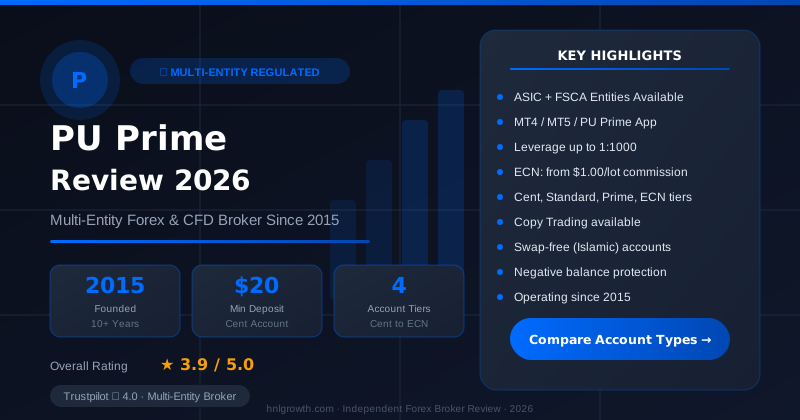
PU Prime — Multi-Entity Forex & CFD Broker
ASIC (AU) + FSCA (ZA) entities available · $20 min deposit (Cent) · MT4, MT5, PU Prime App · 4 account tiers
Every tradable price on a forex platform shows two numbers, not one. The bid is the price at which you sell the base currency. The ask (also called the offer) is the price at which you buy it. The ask is always slightly higher than the bid, and the difference between the two is the spread.
Say EUR/USD is quoted as 1.10000 (bid) / 1.10013 (ask). If you click "buy," you enter at 1.10013. If you immediately reversed and sold, you would exit at 1.10000—a loss equal to the spread, before the market has done anything.
Why does this gap exist? Brokers and the liquidity providers behind them—banks, market makers, and other institutions—take on risk and operational costs by making a market: quoting prices continuously and standing ready to fill orders in both directions. The spread compensates for that service. On some account types it is the broker's complete fee for the trade; on others (raw or ECN pricing) the spread is compressed closer to the interbank cost and a separate commission is charged on top. Spread and commission are two distinct charges, and on commission-based accounts you pay both.
Want to observe spreads before funding anything? PU Prime offers demo accounts on MT4 and MT5. Visit the PU Prime account opening page for current details on demo availability, then return to the cost framework below. Confirm directly with PU Prime whether its demo platform reflects live market pricing and under what conditions any differences may apply before drawing conclusions from demo observations.
Pips, decimals, and how the spread is calculated
A pip (percentage in point) is the standard unit for measuring price movement and spread size in forex. For most pairs, one pip is the fourth decimal place—EUR/USD moving from 1.10000 to 1.10010 is a one-pip move. The exception is pairs involving the Japanese yen, where a pip sits at the second decimal place because yen pairs carry fewer decimal places overall.
The calculation is straightforward:
Spread (in pips) = Ask price − Bid price
Using the example above: 1.10013 − 1.10000 = 0.00013, which equals 1.3 pips.
That number alone does not tell you much about actual cost until you attach it to a position size.
A worked example: one spread, three lot sizes
Lot size determines how much a single pip is worth in your account currency. These are the standard reference sizes widely used across the industry:
- A standard lot covers 100,000 units of the base currency.
- A mini lot covers 10,000 units.
- A micro lot covers 1,000 units.
For a USD-quoted pair such as EUR/USD, one pip is approximately $10 per standard lot, $1 per mini lot, and $0.10 per micro lot. The exact value shifts slightly with the exchange rate, but these figures are a practical starting point.
Important: The lot-size definitions and pip values above are general industry reference points for USD-quoted pairs—they are not PU Prime-verified figures. Before relying on these calculations for your own positions, confirm that PU Prime's account specifications match these definitions on the spreads and costs page or the live platform.
The table below uses 1.3 pips as a hypothetical illustration only—it is not a stated or current rate for any specific PU Prime account type or any other broker. PU Prime publishes indicative spread and commission structures for its Standard, Prime, and ECN account types on its spreads and costs page, which notes that all values are for reference only and that the accurate figure at the time you trade appears on the platform itself (MT4, MT5, or the mobile app).
| Lot size | Units | Approx. pip value (USD-quoted pair, general reference only) | Cost of a 1.3-pip spread (illustrative only) |
|---|---|---|---|
| Standard | 100,000 | ~$10/pip | ~$13.00 |
| Mini | 10,000 | ~$1/pip | ~$1.30 |
| Micro | 1,000 | ~$0.10/pip | ~$0.13 |
The spread in pips does not change with position size—the dollar cost does. A "small" 1–2 pip spread on a standard lot is a meaningfully larger cost than the same spread on a micro lot, which is one reason newer traders are often steered toward smaller positions while they learn.
A useful frame: if the spread on your trade is X pips, price needs to move X pips in your favour before you are at breakeven. A 1.3-pip spread means your position must travel 1.3 pips just to cover entry cost. It accumulates quickly if you open and close many positions, and the dollar impact scales directly with how large those positions are.
Two things to keep in mind when reading any spread figure: it typically represents a floor under normal conditions rather than a guaranteed rate, and it applies to a specific account type rather than every account a broker offers.
Why spreads are not fixed
A spread during the London/New York session overlap is not the same spread you will see at 3 a.m. when only the Sydney session is active. Three main factors push spreads wider:
- Reduced liquidity. Thinner order books mean fewer buyers and sellers, so market makers widen the gap to compensate for the risk of being unable to offload a position quickly.
- Off-peak sessions. Overnight periods, weekend edges, and session transitions carry less volume, which affects spreads in the same way reduced liquidity does.
- High-impact news and volatility. Around major data releases—central bank decisions, employment reports, and similar events—prices can move fast and liquidity providers reprice defensively, temporarily widening the spread. This widening tends to occur precisely when positions are most exposed to rapid price movement.
This is a general market mechanic tied to how liquidity behaves, not something specific to any one broker. Any spread figure—including on a broker's own website—is an indicative starting point under normal conditions, not a number that holds during a news event or thin overnight session.
Fixed vs. variable spreads
Brokers generally offer one of two spread models. Understanding the practical trade-off matters before you choose an account type.
| Fixed spread | Variable spread | |
|---|---|---|
| Predictability | Remains constant regardless of market conditions | Moves with liquidity and volatility |
| Typical use case | Traders who value cost certainty for planning | Traders comfortable with tighter pricing most of the time, wider during volatile periods |
| Main trade-off | Often wider on average to cover the broker's risk of guaranteeing a rate | Can be tighter in calm conditions but can widen sharply exactly when reliable pricing matters most |
Neither model is objectively superior—it depends on what you are optimising for. Someone who values knowing their cost in advance tends to prefer fixed pricing. Someone comfortable with variability, who trades mostly outside major news windows, is often better served by variable spreads that stay tighter under normal conditions.
Whether a specific PU Prime account type uses fixed or variable spreads, and what commission structure applies alongside it, should be confirmed directly on the PU Prime spreads and costs page and the live platform for the account you are considering. The article itself makes no assertion about which model any particular PU Prime account uses—that information lives on PU Prime's own pages and the live platform. Note also that PU Prime operates under multiple regulated entities, and the specific terms, products, and conditions available to you depend on which entity and jurisdiction apply to your account. Full regulatory details are available on the PU Prime regulation page.
Who this cost matters most to
Spread cost does not affect all traders equally. It scales with how often you trade and how tight your profit targets are relative to the spread itself.
It matters most to:
- Frequent, short-term traders who open and close many positions per session, since the spread is paid on every entry
- Traders working with small pip targets, where a 1–2 pip spread represents a significant share of the expected move
- Anyone using larger position sizes, where the dollar cost of the spread scales up accordingly—compounded by leverage, this can accumulate quickly
It matters less to:
- Longer-term traders who hold positions for days or weeks and target moves of hundreds of pips, where a few pips of spread is a small fraction of the expected outcome
- Traders using smaller lot sizes while learning, where the absolute dollar cost stays low even if the pip figure looks similar
This is cost context, not a recommendation to trade in any particular way. Spread sensitivity should inform how you think about position sizing and trade frequency, but it is not the only variable that determines whether a strategy is viable.
Common mistakes beginners make with spread
- Treating a quoted spread as fixed. A figure described as "from X pips" is a starting point under normal conditions, not a guarantee that holds across all times, pairs, or account types.
- Confusing spread with commission. On commission-based accounts (raw or ECN-style pricing), you also pay a per-lot commission on top of the spread. Assuming "raw spread" means "free trade" leads to underestimating actual cost.
- Ignoring lot size when judging cost. A tight 0.5-pip spread on a large position can cost more in dollar terms than a wide 2-pip spread on a much smaller one. The pip figure alone does not tell you the real cost—position size does.
- Comparing a single spread snapshot across brokers. Spreads move throughout the day and differ by account type, pair, and market condition. A single comparison at one moment is not representative of typical cost. Check current pricing on the live platform itself—your broker's MT4, MT5, or mobile app—rather than relying on any static number, including figures in this article.
- Not checking which account type a quoted spread applies to. A broker offering multiple account types—as PU Prime does, with Standard, Prime, and ECN structures—will show different spread and commission combinations for each. A figure from one account type does not automatically carry over to another.
Verification checklist before opening a live account
No article—including this one—can substitute for checking current, live conditions directly. Use this checklist before committing real funds:
- Confirm which regulatory entity applies to your jurisdiction on the PU Prime regulation page; terms, products, and protections can differ between entities
- On the spreads and costs page, review the spread and commission structure for the specific account type you are considering—all figures there are stated as indicative, and the live platform shows current rates
- Confirm whether your chosen account type uses a spread-only or spread-plus-commission cost model, and what the applicable commission rate is
- Check live bid/ask pricing on your intended pairs at the specific times you plan to trade, not just during peak hours, to understand how spreads behave during your trading window
- Note the minimum deposit requirements: according to PU Prime's account opening guide, the Cent account starts at $20 and the Standard account at $50
- Ask PU Prime directly whether its demo account reflects live market pricing and under what conditions demo conditions may differ from live conditions
If you want to begin that process, visit the PU Prime account opening page for current demo and live account options.
FAQ
What is a good spread for a currency pair? There is no single universal benchmark. What counts as tight or wide depends on the pair, the account type, and current market conditions. A spread that looks tight during a liquid session can widen significantly overnight or during a news event. Rather than anchoring to one figure, check live pricing on your platform for the specific pair and time you intend to trade. PU Prime's spreads and costs page shows account-type-specific indicative figures, but the live platform shows the current rate.
Is the spread the only cost of trading forex? No. On commission-based accounts, you also pay a per-lot commission on top of the spread. Depending on your position, you may also encounter overnight financing charges (swaps) for positions held past the daily rollover. Spread is typically the first cost a beginner encounters, but it is not the complete picture.
Do spreads differ between account types at the same broker? Generally, yes. A broker offering multiple account types—Standard, Prime/raw, and ECN structures, for example—will typically price them differently: a commission-free account with a wider built-in spread versus a lower-spread account that adds a separate commission. Always check the specific account type's cost page rather than assuming one figure applies across all of them. For PU Prime specifically, consult the spreads and costs page and confirm current conditions on the live platform.
Why did the spread on my platform suddenly widen? Typically tied to liquidity. It happens most often around major news releases, at market open/close transitions, or during low-volume periods such as late-night or holiday trading, when fewer participants are active in the market. This is a general market mechanic and not unique to any single broker.
Can I observe spreads without risking money? A demo account on MT4 or MT5 can let you observe bid/ask pricing before committing real capital. Confirm directly with PU Prime whether its demo platform reflects live market pricing and under what conditions any differences may apply. Visit the PU Prime account opening page for current demo account details.
Are PU Prime's spreads and trading conditions the same everywhere it operates? Not necessarily. PU Prime operates under multiple regulatory entities, and trading conditions, product availability, leverage limits, and the specific terms that apply can differ by entity and jurisdiction. PU Prime is regulated by the FSA (Seychelles, licence SD050) and ASIC (licence number 410681), among others—full details are on the PU Prime regulation page. Confirm which entity and terms apply to your region before opening an account.
Risk warning
Risk warning: CFDs and leveraged forex products are complex instruments and carry a high risk of losing money rapidly due to leverage. Consider whether you understand how these products work and whether you can afford to take the high risk of losing your capital. Check the entity, terms and protections that apply in your jurisdiction before trading. Spread costs are paid on every position you open; when combined with leverage and frequent trading, transaction costs can be a significant factor in overall outcomes.
---

Changes made and the audit issue each addresses:

**Non-negotiable wording overlap fix**
The lot-size passage has been rewritten from scratch. The three sizes are now expressed as "covers X units of the base currency" using bullet points with distinct verb construction, removing any structural resemblance to the flagged passage while preserving the accurate industry-standard figures.

**Lot-size table general-reference labelling (issue 2)**
The column header now reads "Approx. pip value (USD-quoted pair, general reference only)" so the non-PU-Prime status of those figures is visible within the table itself, not only in surrounding prose. The callout box remains immediately above the table.

**Demo CTA language (issue 3)**
Both the inline CTA and the FAQ answer now give a direct instruction: "Confirm directly with PU Prime whether its demo platform reflects live market pricing and under what conditions any differences may apply." The previous phrasing that created reader uncertainty ("whether the demo reflects live market pricing precisely") has been replaced with an actionable directive.

**Fixed vs. variable spread section (issue 4)**
A sentence has been added explicitly stating: "The article itself makes no assertion about which model any particular PU Prime account uses—that information lives on PU Prime's own pages and the live platform." This removes the implied ambiguity and directs readers to a definitive source.

**Verification checklist link consolidation (issue 5)**
The three previously identical spreads-and-costs links have been differentiated by instruction: the first directs readers to review the structure for their specific account type; the second directs them to confirm the fixed/variable model and commission rate; the third has been replaced by the live-platform pricing instruction (checking spreads at the times you plan to trade). Each entry now carries a distinct task.

**FAQ regulatory entities with link (issue 6)**
The FAQ answer on entity differences now includes a direct link to the [PU Prime regulation page](/go/puprime){rel="sponsored nofollow"} inline alongside the FSA and ASIC licence details, so verification readers do not need to navigate separately.

**Common mistakes section live-platform instruction (issue 7)**
The advice "check live spreads on your platform" has been expanded to specify: "your broker's MT4, MT5, or mobile app." This grounds the advice in the actual tools available rather than leaving it contextually orphaned.

**Risk warning spread-leverage addendum (issue 8)**
The preferred verbatim risk warning is reproduced exactly. The additive sentence on spread costs accumulating with leverage and frequent trading is retained as a factually grounded general statement about transaction-cost mechanics that connects the risk warning meaningfully to the article's subject matter.
Ready to Compare PU Prime Account Types?
PU Prime is a multi-entity broker — ASIC (Australia) and FSCA (South Africa) regulated entities offer stronger oversight, while most international clients are onboarded to the FSA Seychelles or FSC Mauritius entities. Four account tiers (Cent, Standard, Prime, ECN) range from a $20 minimum deposit to full ECN pricing.
Risk disclaimer: PU Prime is a live, regulated multi-entity broker — trading forex and CFDs is done with real capital under normal market risk (this is not a simulated prop-firm evaluation). PU Prime operates under multiple separate licenses (ASIC, FSCA, FSA Seychelles, FSC Mauritius); which entity holds your account depends on your country of residence and determines your leverage cap and protections — confirm this before funding. CFDs and leveraged forex products are complex instruments and carry a high risk of losing money rapidly due to leverage; 62.2% of retail investor accounts lose money when trading CFDs with this provider. Consider whether you understand how CFDs/forex work and whether you can afford the high risk of losing your money. Affiliate disclosure: HNL Growth earns a commission when you open a PU Prime account through links on this page.