HFM vs XM 2026: Fees, Regulation and Platforms Compared
HFM (formerly HotForex) and XM are both multi-regulated, MetaTrader-centred CFD brokers with global retail reach, but they diverge where it matters most: cost structure,...
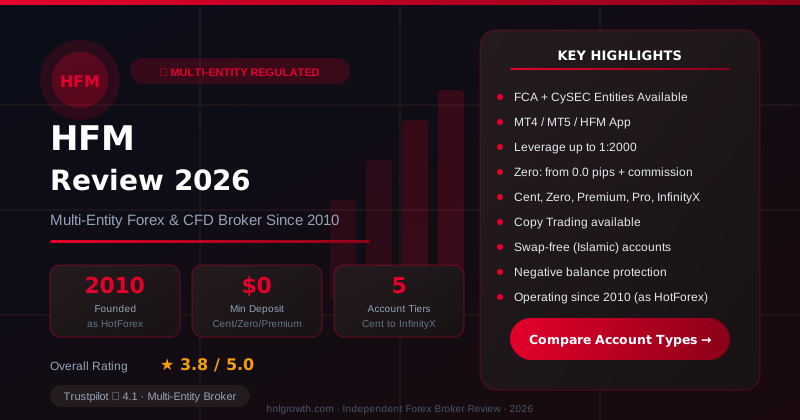
Checked on: 2026-08-14 | Broker terms, regulation, and pricing can change. Always verify at the official HFM site before opening an account.
Affiliate Disclosure: HNL Growth may earn a commission if you open an account through our links, at no additional cost to you. Risk Warning: CFDs and leveraged forex products are complex instruments and carry a high risk of losing money rapidly due to leverage. Between 65-95% of retail investor accounts lose money when trading CFDs, depending on the HFM entity and account type. Trading forex and CFDs may not be suitable for all investors. Consider your objectives, experience, and risk appetite before trading, and ensure you understand the risks involved. Broker Disclosure: HFM (HF Markets Group) is a live, regulated multi-entity broker (not a simulated prop-firm evaluation) — trades are executed with real capital in live market conditions, subject to normal market risk. Protections vary significantly by the specific legal entity that onboards your account.
HFM vs XM 2026: Fees, Regulation and Platforms Compared
HFM (formerly HotForex) and XM are both multi-regulated, MetaTrader-centred CFD brokers with global retail reach, but they diverge where it matters most: cost structure, instrument breadth, and auxiliary tooling. HFM tends to deliver tighter all-in costs on its premium and zero-spread tiers and covers a wider asset range including crypto CFDs, ETFs, and bonds through its offshore entities. XM competes on zero-commission standard accounts, a more mature education programme, and stronger regional licensing depth in Australia and Dubai. Neither broker is universally superior. The right choice turns on which account tier you will actually open, the asset classes you trade, and the regulatory entity you onboard under. This comparison matches comparable tiers side by side, uses broker-published pricing with dates disclosed, and ends with persona-specific recommendations rather than a single-winner verdict.
Data captured Q1 2026 from official broker pricing pages, legal documents, and regulator registers. Conditions may vary by entity and jurisdiction.
The Bottom Line: HFM vs XM in 60 Seconds
HashHedge — Crypto Futures Prop Firm
Up to $200K funded accounts · 85% profit split · Instant USDT payouts · 160+ assets
| Category | Winner | Why |
|---|---|---|
| Regulation breadth | Tie | Both hold CySEC, DFSA, FSCA licences; HFM adds FCA (UK) and CMA Kenya; XM adds ASIC (Australia) |
| All-in cost (premium tier) | HFM | Lower spread + commission on matched zero/raw tiers for EUR/USD |
| All-in cost (standard tier) | XM | Commission-free standard accounts with competitive average spreads |
| Tradable instruments | HFM | Broader range including ETFs, bonds, and crypto CFDs via offshore entities |
| Platforms and tools | Tie | Both offer MT4, MT5, web, mobile; HFM adds a proprietary app, XM adds integrated research tools |
| Copy trading | HFM | HFCopy is more mature with broader strategy-provider pool |
| Education and research | XM | Larger webinar library, daily market analysis, structured courses |
| Funding and withdrawals | XM | Wider zero-fee withdrawal allowance and more regional bank methods |
| Mobile experience | HFM | Proprietary HFM App rated as Best Forex Trading App by Capital Finance |
Overall: HFM suits cost-sensitive scalpers, multi-asset diversifiers, and copy traders. XM suits beginners, swing traders who value education and research, and clients onboarding under ASIC or DFSA who want stronger regional oversight.
Disclosure: This page may contain affiliate links. We may earn a commission if you open an account through our links, at no extra cost to you.
Compare HFM account types and open a live account
How We Matched These Brokers for a Fair Comparison
Broker comparisons frequently pair a premium zero-commission account at one firm against a spread-only standard account at another, producing misleading "winners." This article uses an explicit matching framework:
- Standard vs Standard: HFM Premium (spread-only, from 1 pip) matched against XM Standard (spread-only, no commission).
- Raw/Zero vs Raw/Zero: HFM Zero (raw spread + per-lot commission) matched against XM Zero / Ultra Low (raw spread + per-lot commission where applicable).
Minimum deposits, commission models, and spread baselines are disclosed for every tier before costs are compared. Spread figures are broker-published averages from official pricing pages, not marketing floors ("from 0.0 pips" claims), and the session/date context is noted where available.
Regulatory Standing and Client Protections
Both brokers operate through multiple group entities. What matters for you is which entity you onboard under, because that determines your regulator, investor compensation eligibility, and available features.
| Regulator | Tier | HFM entity | XM entity | Investor compensation |
|---|---|---|---|---|
| FCA (UK) | Tier-1 | HF Markets (Europe) Ltd (via passporting) | Trading Point of Financial Instruments UK Ltd | FSCS up to £85,000 |
| CySEC (Cyprus) | Tier-2 | HF Markets (Europe) Ltd | Trading Point of Financial Instruments Ltd | ICF up to €20,000 |
| ASIC (Australia) | Tier-1 | — | Trading Point of Financial Instruments Pty Ltd | No statutory scheme |
| DFSA (Dubai) | Tier-2 | HF Markets (SV) Ltd / HFM MENA | XM Global MENA | CIF limited coverage |
| FSCA (South Africa) | Tier-2 | HF Markets (SV) Ltd ZA | Trading Point of Financial Instruments Pty Ltd | No statutory scheme |
| FSC Belize | Tier-3 | — | XM Global Limited | None |
| FSA Seychelles | Tier-3 | HF Markets (SV) Ltd | — | None |
| FSC Mauritius | Tier-3 | HF Markets (Mauritius) Ltd | — | None |
| CMA Kenya | Tier-3 | HF Markets (SV) Ltd | — | None |
Jurisdiction matters. Most non-EU, non-UK, non-Australian clients of both groups are onboarded under offshore entities (St. Vincent for HFM; Belize for XM). Offshore clients do not benefit from ICF or FSCS compensation regardless of how many Tier-1 licences the parent group holds. HFM publishes a security of funds page detailing segregated accounts, negative balance protection, and a €5 million insurance programme. XM maintains a comparable segregation policy and excess-of-loss insurance, though its published coverage ceiling differs.
Both brokers exclude residents of the USA, Canada, and several sanctioned jurisdictions. HFM additionally lists Türkiye and the UAE among restricted countries on its international site.
Trading Costs: What You Actually Pay
Advertised floor spreads ("from 0.0 pips") describe the best quote observed, not what most traders pay on most trades. The tables below use broker-published typical/average spreads rather than marketing floors.
Spread and Commission on Matched Account Tiers
Standard (spread-only) tiers — EUR/USD reference
| Broker | Account | Spread (avg.) | Commission | All-in cost |
|---|---|---|---|---|
| HFM | Premium | approx. 1.0–1.2 pips | None | approx. 1.0–1.2 pips |
| XM | Standard | approx. 1.6–1.8 pips | None | approx. 1.6–1.8 pips |
Raw/Zero tiers — EUR/USD reference
| Broker | Account | Spread (avg.) | Commission (round turn) | All-in cost |
|---|---|---|---|---|
| HFM | Zero | approx. 0.1–0.3 pips | $6–$8 per lot | approx. 0.7–1.1 pips |
| XM | Zero / Ultra Low | approx. 0.2–0.5 pips | $7 per lot (Zero) / none (Ultra Low) | approx. 0.9–1.2 pips (Zero) / 0.6–0.8 pips (Ultra Low) |
GBP/USD and USD/JPY spreads track roughly 20–40% wider than EUR/USD at both brokers, consistent with interbank liquidity norms. XM's Ultra Low account (where available) is notably competitive for traders who want low all-in cost without a per-trade commission line item. HFM's Zero tier is the stronger option for high-frequency scalpers prioritising raw spread depth, provided the commission model fits their sizing.
The Costs Nobody Shows You: Swaps, Dormancy, and Conversion Fees
Overnight financing, inactivity charges, and currency conversion often exceed spread costs for swing and position traders.
| Cost category | HFM | XM |
|---|---|---|
| Swap short, 1 lot EUR/USD (indicative) | approx. 1.5 points per night (broker calculator example) | approx. −$4 to −$6 per night (broker calculator, varies by entity) |
| Swap long, 1 lot EUR/USD | Typically negative or small credit | Typically negative |
| Inactivity / dormancy fee | Charged after 3 months of no trading activity; amount varies by entity | Charged after 12 months of inactivity; typically $5 per month thereafter |
| Deposit currency conversion | Applied when wallet currency differs from account base; rate disclosed at deposit | Applied similarly; rate disclosed at transaction |
| Withdrawal fees | Generally broker-fee-free on e-wallets; bank wire fees may apply | One free withdrawal per month on most methods; subsequent withdrawals carry a broker fee |
| Internal transfer fees | Free between own accounts | Free between own accounts |
HFM's swap calculator is updated daily and publishes the rate used for the day. XM's swap schedule is entity-specific. Swap-free (Islamic) accounts are available at both brokers subject to eligibility.
Account Lineup: Which Tier Is Right for You?
| HFM account | Min. deposit | Commission model | Best for |
|---|---|---|---|
| Cent | $0 (effectively low) | Spread-only | Beginners testing live conditions |
| Premium | approx. $0–$100 | Spread-only, from 1 pip | Retail swing and day traders |
| Zero | approx. $100–$200 | Raw spread + per-lot commission | Scalpers and EA traders |
| Premium Pro | $5,000 (Professional) | Tighter spreads, personalised service | High-volume and professional clients |
| PAMM | Varies | Strategy-based | Investors allocating to money managers |
| XM account | Min. deposit | Commission model | Best for |
|---|---|---|---|
| Micro | $5 | Spread-only, micro lots | Beginners and small-capital traders |
| Standard | $5 | Spread-only, standard lots | Retail day and swing traders |
| XM Ultra Low | $50 | Lower spreads, no commission | Cost-focused traders avoiding commission line items |
| Zero (selected regions) | $200 | Raw spread + commission | Scalpers and algorithmic traders |
| Shares (selected regions) | Varies | Per-trade commission | Stock CFD investors |
HFM's tier ladder rewards higher deposits with meaningfully tighter spreads. XM keeps minimum deposits flat across tiers, which is friendlier to traders starting small. The HFM account comparison page lists the current full matrix including leverage caps per entity.
Platforms and Tools
Desktop, Web, and Mobile at a Glance
| Feature | HFM | XM |
|---|---|---|
| MetaTrader 4 | Yes (download) | Yes |
| MetaTrader 5 | Yes (download) | Yes |
| MT4 on macOS | Yes (native installer) | Yes |
| Web trader | Yes (HFM WebTrader) | Yes (proprietary XM web trader + MT4/MT5 web) |
| Proprietary mobile app | Yes (HFM App) | XM app (trading + research) |
| Autochartist | Yes (Premium Tools, eligible accounts) | Yes (selected accounts) |
| VPS hosting | Yes (conditional on volume/deposit) | Yes (conditional) |
| One-click trading | Yes (MT4/MT5) | Yes (MT4/MT5) |
| Social/copy integration | HFCopy | XM Copy Trading |
| Economic calendar | MT5 built-in; HFM site | Integrated in XM web and app |
Both brokers lean on MetaTrader as the execution backbone. HFM differentiates with a purpose-built HFM App that handles trading, wallet funding, PAMM, partner management, and copy trading in a single interface. XM's proprietary web trader leans more heavily on integrated research and daily analysis.
Mobile Trading Experience
The HFM App supports chart drawing without leaving the chart, full portfolio management, push notifications, lot/amount/unit order entry, and the full account suite. Copy trading and PAMM allocation are natively accessible. XM's app pairs MetaQuotes execution with XM's daily market analysis and educational feeds. For traders who want a single mobile surface for every account function, HFM has the edge. For traders who prioritise in-app research, XM is competitive.
What You Can Trade: Instruments and Asset Coverage
| Asset class | HFM (approx.) | XM (approx.) | Notes |
|---|---|---|---|
| Forex pairs | 50+ | 55+ | Both cover majors, minors, and exotics |
| Metals | Gold, silver, platinum, palladium | Gold, silver | HFM has broader metals coverage |
| Energies | Crude, Brent, natural gas | Crude, Brent, natural gas | Comparable |
| Indices | 20+ spot and futures | 20+ | Comparable |
| Stocks | 1,000+ (CFDs) | 1,000+ (CFDs) | Coverage varies by entity |
| ETFs | Available | Limited | HFM has a clear edge |
| Bonds | Available | Limited | HFM edge |
| Crypto CFDs | Available via offshore entities | Available via offshore entities | Not available to EU/UK/ASIC clients under ESMA and equivalent rules |
HFM's wider asset menu — especially ETFs, bonds, and metals — gives multi-asset diversifiers a reason to consolidate at a single broker. XM's instrument range is solid for mainstream forex, indices, and stock CFD traders but narrower on fixed-income and fund-based products.
Getting Money In and Out
| Method | HFM | XM |
|---|---|---|
| Bank wire | 2–5 business days; intermediary fees possible | 2–5 business days; intermediary fees possible |
| Credit/debit card | Instant; generally fee-free | Instant; generally fee-free |
| E-wallets (Skrill, Neteller, etc.) | Instant to same-day; fee-free from broker | Instant to same-day; fee-free from broker |
| Crypto deposits | Available on selected entities | Available on selected entities |
| Local bank transfers | Available in selected markets (Africa, MENA, Asia) | Available in selected markets (MENA, Asia, LatAm) |
| Withdrawal fees | Generally fee-free on e-wallets; bank wires may carry fee | One free withdrawal per month on most methods |
| Processing time | Withdrawals processed 24/7 per HFM security page | Usually within 24 hours on e-wallets |
Both brokers cover deposits through cards, wires, and major e-wallets. XM's monthly free-withdrawal allowance is a practical advantage for traders who move funds frequently. HFM's 24/7 automated withdrawal processing is a practical advantage for traders who value timing flexibility. Regional availability of local bank methods depends on the entity you onboard under.
Copy Trading and Social Features
HFM's HFCopy system is integrated across the HFM App, web portal, and MT4/MT5. It offers a broad strategy-provider marketplace, configurable allocation amounts, and risk controls including maximum drawdown limits and per-strategy stop levels. Copy trading fees are embedded in the spread/commission structure or charged as a performance fee depending on the strategy.
XM's copy trading is newer, accessible via the XM app and web portal, with a curated list of strategy managers. The interface is simpler and more beginner-friendly, but the strategy pool is smaller and customisation options more limited.
For passive investors who want selection depth and granular risk settings, HFCopy is the stronger option. For beginners who prefer a curated, low-complexity experience, XM's offering is adequate.
Learning Resources and Market Research
XM has invested more heavily in structured education: regular live webinars in multiple languages, a tiered course library, daily market analysis videos, and a research desk publishing technical and fundamental commentary. HFM offers webinars, articles, and market analysis, but the depth and frequency of XM's output is greater. For traders who treat education as part of the broker's value proposition, XM leads here — and the difference is material for beginners.
Support When You Need It
Both brokers offer live chat, email, and phone support in multiple languages, with coverage extending across European, MENA, African, and Asian business hours. HFM publishes a Cyprus phone line (+357-244 001 65) and emphasises dedicated account managers for premium-tier clients. XM assigns personal account managers to most funded clients. Response-time SLAs are not independently published by either broker, so any speed claims should be treated as broker-stated rather than verified.
So, Which Broker Should You Choose?
| Trader profile | Recommended broker | Key reason |
|---|---|---|
| Beginner starting small | XM | $5 minimum deposit across most tiers, stronger education, simpler account menu |
| Cost-sensitive scalper / EA trader | HFM | Tighter all-in cost on the Zero tier for EUR/USD and other majors |
| Swing / position trader | XM | Lower overnight financing in several entities and integrated research for idea generation |
| Copy trader / passive investor | HFM | More mature HFCopy marketplace with broader strategy selection and risk controls |
| Multi-asset diversifier | HFM | ETFs, bonds, metals, and crypto CFDs under one roof via offshore entities |
| Client prioritising Tier-1 regulator | Tie | HFM has FCA; XM has ASIC — pick based on your jurisdiction |
Open an HFM account and compare live pricing · Read our full HFM review
If you are still weighing other options, our head-to-head guides on HFM vs Pepperstone and XM vs IC Markets extend the same framework to adjacent brokers.
What We Could Not Independently Verify
The following claims rely on broker-published data and were not independently tested for this article:
- Exact real-time spread variability across London, New York, and Tokyo sessions
- Execution speed, slippage, and requotes under volatile conditions
- Withdrawal request-to-settlement timelines (stated processing times are broker claims)
- Customer support response times across channels
- Long-term swap-rate drift, which changes without notice
Readers who want empirical evidence should run a what-to-verify checklist: open a demo at each broker, capture spreads at three session overlaps over five trading days, place a small live withdrawal on two methods and timestamp each stage, and compare the actual swap debited on a 1-lot EUR/USD short held for five nights.
Frequently Asked Questions
Is HFM or XM more regulated? Both hold CySEC, DFSA, and FSCA licences. HFM additionally holds FCA coverage (via passporting), CMA Kenya, FSA Seychelles, and FSC Mauritius. XM adds ASIC (Australia) and FSC Belize. For most non-EU, non-AU readers, the practical regulator is the offshore entity of each group.
Which broker has lower EUR/USD spreads? On matched zero/raw tiers, HFM's Zero account typically offers tighter all-in cost once spread and commission are combined. On commission-free standard tiers, XM's Ultra Low account is competitive.
Can I trade crypto CFDs with HFM or XM? Both offer crypto CFDs through offshore entities only. EU, UK, and ASIC-regulated clients cannot access crypto CFDs under ESMA-equivalent retail restrictions.
What is the minimum deposit at each broker? XM's Micro and Standard accounts open from $5. HFM's minimum varies by tier — Cent and Premium tiers have low entry points, while the Premium Pro tier requires $5,000 for professional classification.
Do both brokers support MT4 and MT5? Yes. Both brokers also offer a web trader, macOS support, and a proprietary mobile app.
Which broker is better for copy trading? HFM's HFCopy is the more mature product with a larger strategy-provider pool and deeper risk controls. XM's copy trading is simpler and beginner-friendly but smaller in scope.
Which broker has better education? XM leads on webinar volume, structured courses, and daily research output. HFM provides education and analysis, but XM's library is larger and more frequently updated.
Are withdrawals free at both brokers? Both offer fee-free e-wallet withdrawals in most cases. XM typically allows one free withdrawal per month on bank methods; HFM processes withdrawals 24/7 with fees depending on method and entity.
Risk Disclaimer
Risk warning: CFDs and leveraged forex products are complex instruments and carry a high risk of losing money rapidly due to leverage. Consider whether you understand how these products work and whether you can afford to take the high risk of losing your capital. Check the entity, terms and protections that apply in your jurisdiction before trading. Retail client loss percentages published by each broker's EU-regulated entity under MiFID II typically fall between 70% and 85% of retail accounts losing money on CFDs — verify the current figure on the broker's CySEC entity risk page before depositing.
Risk warning: CFDs and leveraged forex products are complex instruments and carry a high risk of losing money rapidly due to leverage. Retail investor accounts lose money when trading CFDs with most providers; the exact percentage varies by HFM entity and account type. You should consider whether you understand how CFDs work and whether you can afford to take the high risk of losing your money. Check the entity, terms and investor protections that apply in your jurisdiction before opening an account or trading.
Ready to Start Your Funded Trading Journey?
Join traders backed by $11M+ in verified payouts and a 4.7/5 Trustpilot rating. Compare HashHedge challenge plans, drawdown rules, and payout terms — apply code ha25 for the current discount.
Risk disclaimer: Challenge fees are non-refundable if you breach the rules. Prop trading involves significant financial risk. Past performance in a simulated environment does not guarantee results on a funded account. Only purchase if you understand the rules fully and can afford to lose the fee. Affiliate disclosure: HNL Growth earns a commission when you purchase a HashHedge challenge through links on this page.