PU Prime vs XM 2026: Fees, Platforms and Regulation Compared
If you're choosing between PU Prime and XM, the honest answer depends on two things before anything else: which legal entity of each broker actually onboards someone in your country, and how much you...
Reviewed using our forex & CFD broker review methodology
Checked on: 2026-08-17 | Broker terms, regulation, and pricing can change. Always verify at the official PU Prime site before opening an account.
Affiliate Disclosure: HNL Growth may earn a commission if you open an account through our links, at no additional cost to you. Risk Warning: CFDs and leveraged forex products are complex instruments and carry a high risk of losing money rapidly due to leverage. 62.2% of retail investor accounts lose money when trading CFDs with this provider. Trading forex and CFDs may not be suitable for all investors. Consider your objectives, experience, and risk appetite before trading, and ensure you understand the risks involved. Broker Disclosure: PU Prime is a live, regulated multi-entity broker (not a simulated prop-firm evaluation) — trades are executed with real capital in live market conditions, subject to normal market risk. Which PU Prime entity holds your account depends on your country of residence and determines your leverage cap and protections.
Last verified: August 2026 | Editorial Team
PU Prime vs XM 2026: Fees, Platforms and Regulation Compared
If you're choosing between PU Prime and XM, the honest answer depends on two things before anything else: which legal entity of each broker actually onboards someone in your country, and how much you trade. PU Prime publishes clear per-account spreads and commissions on its spread and costs page and operates under regulators including the Seychelles FSA, Mauritius FSC, South Africa's FSCA and the UAE's CMA, per its regulation page. XM is a well-known multi-entity broker, but this comparison cannot state its current spreads, commissions, or regulator-by-entity mapping as verified fact, because we did not pull that data from XM's own official pages for this piece. What follows gives you confirmed PU Prime numbers, a framework for checking XM's equivalent figures yourself, and a clear decision path based on residency, volume, and platform needs.
The verdict, in one table
PU Prime — Multi-Entity Forex & CFD Broker
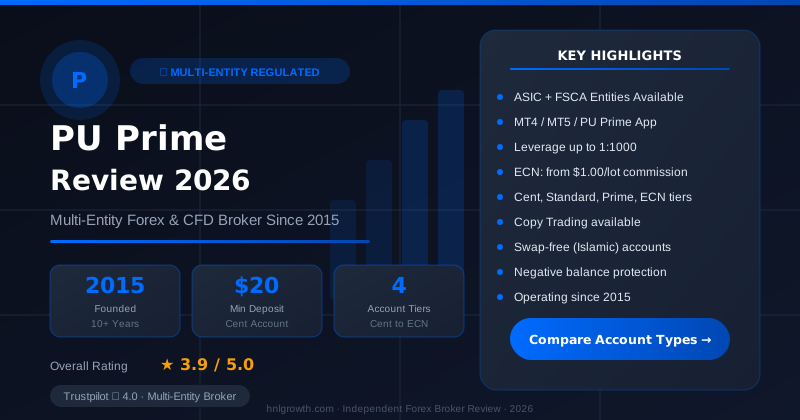
ASIC (AU) + FSCA (ZA) entities available · $20 min deposit (Cent) · MT4, MT5, PU Prime App · 4 account tiers
There is no single universal winner here, because "which broker is better" depends on which entity actually opens your account and what your realistic monthly volume looks like. This table gives you the confirmed PU Prime side and tells you exactly what to check on XM's side before you compare like-for-like.
| Factor | PU Prime | XM |
|---|---|---|
| Entity that covers you | Depends on residency: Seychelles FSA, Mauritius FSC, South Africa FSCA, or UAE CMA. See the PU Prime regulation page to confirm which one applies to your country. | XM operates through several regional entities. Confirm which one is licensed to accept clients from your country of residence on XM's official regulation page before assuming protections apply. |
| Lowest-cost account | Prime account: spreads from 0.0 pips plus $3.50 per lot per side commission, $1,000 minimum deposit. | XM publishes its own raw-spread account terms. Check the current spread, commission and minimum deposit on XM's official pricing page; we have not independently confirmed these figures. |
| No-commission entry account | Standard account: no commission, EUR/USD spreads from 1.3 pips, $50 minimum deposit. | XM's entry-level account terms should be confirmed directly on its official page. |
| Platforms | MT4, MT5, PU Prime App, MetaTrader Web. | MT4 and MT5 are widely offered by XM; confirm the current full platform lineup, including any proprietary app, on XM's official platforms page. |
| Lowest documented entry point | $20 minimum deposit (Cent account). | Not independently confirmed for this comparison. |
Both brokers are worth shortlisting for MT4/MT5 traders. The gap that actually matters is entity-specific, and it only shows up once you check both official pages against your own country and trading size.
Regulation and client protections, entity by entity
Brand-level statements like "PU Prime is regulated" or "XM is regulated" tell you almost nothing, because protections attach to the specific legal entity that opens your account, not to the marketing brand. According to PU Prime's regulation page, the group operates under the Financial Services Authority of Seychelles (FSA), the Financial Services Commission of Mauritius (FSC), the Financial Sector Conduct Authority of South Africa (FSCA), and the Capital Market Authority of the UAE (CMA). The same page notes regional restrictions apply, meaning not every entity accepts clients from every country, and PU Prime's homepage separately states that client funds are segregated and that the group carries independent dispute resolution plus Lloyd's insurance coverage up to $1,000,000 (source: puprime.com).
What the fetched PU Prime sources do not spell out is a per-entity breakdown of negative balance protection or a specific statutory compensation scheme cap for each individual license. If that distinction matters to you, ask PU Prime's support team which entity your account will sit under and request the specific client agreement clause before funding.
For XM, we have not pulled current official regulator pages, license numbers, or entity-specific protection terms for this article, so none of that is stated here as fact. Independent review sites often summarize XM as holding licenses in Cyprus, Australia and one or more offshore jurisdictions, but review-site summaries are not a substitute for XM's own regulation page, and the specific entity that would open your account, along with its compensation scheme and cap, needs to come from XM directly.
Disclosure: This page may contain affiliate links. We may earn a commission if you open an account through our links, at no extra cost to you.
Once you know which PU Prime entity applies to you, you can compare PU Prime account types and open an account directly from the official signup flow, which also shows the current KYC document requirements before you commit any funds.
The same trade, priced at both brokers
Headline spread numbers in isolation ("from 0.0 pips") are close to meaningless without the account type and commission attached. Here's the actual math for PU Prime, using figures from its spread and costs page and account opening guide, for one standard lot of EUR/USD.
PU Prime Standard account: no commission, spread from 1.3 pips on EUR/USD. At roughly $10 per pip for one standard lot, a 1.3-pip spread works out to about $13 of cost baked into the entry price, with nothing added on top. This account has a $50 minimum deposit.
PU Prime Prime account: spreads from 0.0 pips plus a $3.50 per lot, per side commission. On one round-turn standard lot, that's $3.50 to open and $3.50 to close, or $7.00 in fixed commission, on top of whatever the live spread happens to be at the moment you trade (PU Prime states these are best-case, reference figures and directs traders to check live MT4/MT5 pricing). This account requires a $1,000 minimum deposit.
PU Prime ECN account: $1.50 per lot per side commission plus spreads from 0.0 pips, requiring a $10,000 minimum deposit. That's $3.00 in fixed commission per round-turn lot, again on top of the live spread.
For XM, we cannot responsibly plug in a number, because we did not fetch XM's current official pricing page for this comparison and won't invent a commission or spread figure. Instead, use this method on XM's own pricing page: find the account tier closest to PU Prime's Prime or ECN account (commonly marketed by raw-spread brokers as a "zero" or "raw" account), note the current spread and the per-lot commission, then run the identical math above using your own trade size. That gives you a genuine apples-to-apples comparison instead of a borrowed one.
The practical takeaway: minimum deposit alone tells you nothing about cost. A $50 Standard account and a $1,000 Prime account can end up cheaper or more expensive than each other depending purely on your trade frequency, and the same logic applies when you line PU Prime up against any XM tier.
Platforms and execution in practice
PU Prime confirms MetaTrader 4, MetaTrader 5, its own PU Prime mobile app, and MetaTrader Web access, according to its MT4, MT5, and trading app pages. MT5 is positioned as the flagship platform, with broader asset coverage, more order types, an integrated news calendar and a stronger multi-asset strategy tester compared with MT4, though MT4 remains available and fully supports Expert Advisors for automated strategies. PU Prime's homepage also references copy trading as a built-in option, and the account opening guide notes it's accessible from as little as $25 per signal provider.
XM is widely known in the industry for offering MT4 and MT5 as well, and for having built its own supporting app over the years, but we have not independently confirmed the current platform lineup, feature parity, or any web-trader equivalent on XM's official platforms page for this article. If a proprietary web platform or specific charting toolset is a dealbreaker for you, check XM's platforms page directly rather than relying on a secondhand summary.
Neither broker's execution speed during high-volatility events (news releases, gaps) can be stated as fact here. Claims about tick-level execution quality require live testing with timestamped data, which was not performed for this comparison. Treat any "tested execution speed" claim you see elsewhere with the same caution.
Funding and getting your money out
According to PU Prime's account opening guide, deposits can be made by credit or debit card, bank transfer, and e-wallets including Skrill and Neteller, alongside other local payment methods depending on region. Card and e-wallet deposits are described as usually arriving instantly, while bank transfers can take 1 to 3 business days. Minimum deposits scale by account type: $20 for Cent, $50 for Standard, $1,000 for Prime, and $10,000 for ECN.
| Method | PU Prime (per official account opening guide) | XM |
|---|---|---|
| Card (credit/debit) | Usually instant | Not independently confirmed; check XM's official funding page |
| E-wallet (Skrill, Neteller, etc.) | Usually instant | Not independently confirmed; check XM's official funding page |
| Bank transfer | 1 to 3 business days | Not independently confirmed; check XM's official funding page |
| Minimum deposit | $20 to $10,000 depending on account type | Not independently confirmed; check XM's official funding page |
The fetched PU Prime sources do not include a dedicated withdrawal fee schedule or withdrawal processing timeline, so that specific detail should be confirmed directly with PU Prime's support team or its funding terms before you rely on it. The same gap applies to XM: neither its deposit/withdrawal fee schedule nor its processing times were verified for this article. If withdrawal speed is your main concern as a switcher, ask both brokers directly for their current written withdrawal SLA before moving capital, rather than relying on either headline marketing copy or third-party review scores.
Who should pick which
The cost-sensitive, high-frequency trader. If you're trading dozens of lots a month and every fraction of a pip matters, you want the lowest total cost account you actually qualify for by deposit size. On PU Prime, that likely means the Prime account ($1,000 minimum, $7.00 round-turn commission plus live spread) or the ECN account ($10,000 minimum, $3.00 round-turn commission plus live spread) once your volume justifies it. Whether XM's equivalent raw-spread tier beats that depends entirely on its current commission and spread, which you'll need to check on XM's own pricing page and run through the same math shown above.
The low-capital beginner testing the waters. If you want to start small and learn on a live account without committing much, PU Prime's Cent account starts at $20 and the Standard account at $50 with no commission. Confirm XM's own minimum deposit and whether its entry account also charges no commission before assuming it's cheaper at small size, since a wider no-commission spread can cost more than a tight raw spread plus a small fixed fee, depending on your trade size.
The MT5-first trader who wants a mobile app and copy trading built in. PU Prime confirms MT5, MT4, MetaTrader Web, its own app, and copy trading from $25 per signal provider. If a proprietary app and in-house copy trading matter to your workflow, that's a confirmed PU Prime feature set today; verify whether XM currently offers an equivalent before treating platform breadth as a tie.
None of this is a blanket recommendation. If you're outside the regions PU Prime's listed entities cover, or you specifically need a regulator neither broker's fetched entity list includes, that alone should end the comparison in the other broker's favor regardless of pricing.
Compare PU Prime account types and start account opening once you've matched the entity and account tier to your own situation, or read a fuller single-broker breakdown before deciding.
What we could not verify
To keep this comparison honest, here's what is not confirmed fact in this article, and why:
- XM's current regulatory entities, license numbers, and per-entity client protections. No official XM regulation page was fetched for this piece. Any regulator names you see associated with XM elsewhere should be confirmed on XM's own site, not taken from a review aggregator.
- XM's current spreads, commissions, and account minimums. Not sourced from an official XM pricing page here. Use the worked-example method above with XM's live figures rather than any number quoted by a third party.
- XM's full platform lineup and any proprietary app or web trader. Not independently confirmed for this comparison.
- XM's deposit/withdrawal methods, minimums, and fees. Not sourced from an official XM funding page here.
- PU Prime's specific withdrawal fees and processing timelines. The fetched PU Prime sources cover deposits in detail but do not spell out a withdrawal fee schedule; confirm this directly with PU Prime before relying on it.
- Execution speed or slippage during volatile markets, for either broker. This requires live, timestamped testing that was not performed for this article.
- Support response times, for either broker. Stated channel availability can be sourced from official pages, but actual response speed was not tested here.
- Trustpilot scores, withdrawal complaints, or "bonus trap" claims circulating on review platforms. These reflect unverified user sentiment, not confirmed findings, and are not treated as fact anywhere in this article. If you see specific complaint patterns on third-party review sites, use them as a prompt to ask the broker direct questions, not as evidence on their own.
- Swap fee schedules for either broker. These change dynamically and are not quoted here; check each broker's official swap page for current rates on the instruments you trade.
FAQ
Is PU Prime or XM cheaper for active trading? It depends on the account tier and your volume, not a single headline number. PU Prime's Prime account charges $3.50 per lot per side on top of a spread from 0.0 pips, and its ECN account charges $1.50 per lot per side. Run the same math against XM's current raw-spread account terms from its own pricing page to get a real comparison for your trade size.
Are client funds equally protected at both brokers? Not necessarily, and protection depends on the specific entity that opens your account, not the brand name. PU Prime states client funds are segregated and references Lloyd's insurance coverage up to $1,000,000 group-wide, per its homepage and regulation page. XM's entity-specific protections were not verified for this article; confirm them directly with XM before assuming parity.
Which broker's platform is better for MT5 users? Both are commonly associated with MT5 access. PU Prime confirms MT5 as its flagship platform with MT4, its own app, and MetaTrader Web also available. XM's current platform lineup should be checked on its own platforms page, since it was not independently confirmed here.
Can I open an account with either broker from my country? Not automatically. PU Prime notes regional restrictions apply and that not every listed entity accepts every country. The same caveat applies to XM. Check the specific entity available to your country of residence on each broker's own regulation page before assuming either will onboard you.
How much do I need to start? With PU Prime, $20 opens a Cent account and $50 opens a Standard account, per its account opening guide. XM's current minimum deposit was not verified for this comparison; check its official pricing page directly.
Risk warning
Risk warning: CFDs and leveraged forex products are complex instruments and carry a high risk of losing money rapidly due to leverage. Consider whether you understand how these products work and whether you can afford to take the high risk of losing your capital. Check the entity, terms and protections that apply in your jurisdiction before trading.
Ready to Compare PU Prime Account Types?
PU Prime is a multi-entity broker — ASIC (Australia) and FSCA (South Africa) regulated entities offer stronger oversight, while most international clients are onboarded to the FSA Seychelles or FSC Mauritius entities. Four account tiers (Cent, Standard, Prime, ECN) range from a $20 minimum deposit to full ECN pricing.
Risk disclaimer: PU Prime is a live, regulated multi-entity broker — trading forex and CFDs is done with real capital under normal market risk (this is not a simulated prop-firm evaluation). PU Prime operates under multiple separate licenses (ASIC, FSCA, FSA Seychelles, FSC Mauritius); which entity holds your account depends on your country of residence and determines your leverage cap and protections — confirm this before funding. CFDs and leveraged forex products are complex instruments and carry a high risk of losing money rapidly due to leverage; 62.2% of retail investor accounts lose money when trading CFDs with this provider. Consider whether you understand how CFDs/forex work and whether you can afford the high risk of losing your money. Affiliate disclosure: HNL Growth earns a commission when you open a PU Prime account through links on this page.