Best Low-Spread Forex Brokers in 2026
Best Low-Spread Forex Brokers in 2026. An independent, fact-checked look at Vantage Markets for traders evaluating this broker.
Reviewed using our forex & CFD broker review methodology
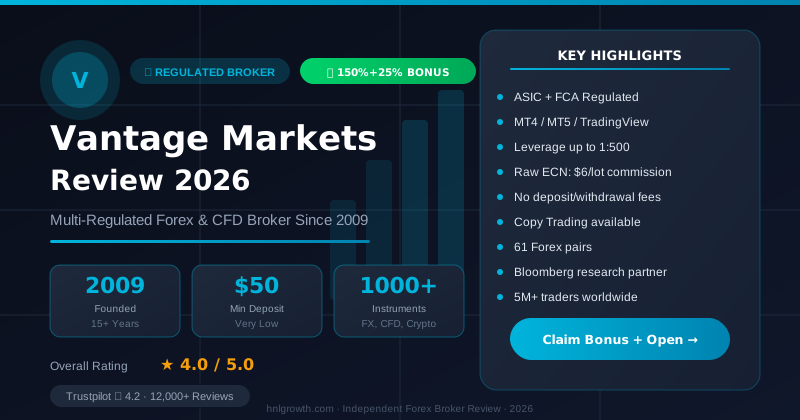
If you trade actively, "low spread" only tells part of the cost story. The real number that hits your P&L is the all-in round-turn cost — spread plus commission (plus swap if you hold overnight) — normalized to dollars per standard lot. A broker advertising spreads "from 0.0 pips" can still be more expensive than a broker quoting "from 1.0 pip" once commission is added back in. This guide shows how to build that comparison yourself, walks through a worked example, and flags where Vantage's own published figures fit into that picture.
What "low spread" actually means (and why it isn't the whole cost)
A spread is the gap between the bid and ask price — what you pay a broker's liquidity providers for facilitating the trade. Marketing pages love headline numbers like "spreads from 0.0 pips," but three things make that figure incomplete on its own:
- It's usually a minimum, not an average. "From" figures represent the tightest spread observed under ideal conditions (deep liquidity, low volatility), not what you'll typically see mid-session.
- It ignores commission. Raw/ECN-style accounts that advertise near-zero spreads almost always charge a separate per-lot commission. A "zero spread" claim without disclosing that commission is not a zero-cost claim.
- It's never static. Spreads widen during the Asian session, around rollover, ahead of major news releases, and during low-liquidity windows. A pair quoted tight at 2pm London time can be materially wider at 10pm.
Here's the practical filter: when you see "as low as," "from," or "0.0 pip" in a broker's marketing, treat it as the floor of a range, not the price you'll pay on a typical trade. The number that matters for comparison is spread + commission, round turn, per standard lot — and that's what the rest of this guide is built around.
Best low-spread forex brokers in 2026 — quick cost comparison
Fee-sensitive traders typically shortlist brokers that fall into one of two pricing models: spread-only (no separate commission, wider spread built in) or raw/ECN-style (near-zero spread plus a disclosed per-lot commission). Names commonly compared in this space include IC Markets, Pepperstone, FP Markets, XTB, and Vantage, among others — each publishing its own fee schedule that changes over time.
To keep this comparison factually accurate, the table below uses Vantage's own published account-type figures, sourced directly from its spreads page and account-types breakdown at the time of writing. For any other broker you're evaluating, pull the equivalent numbers from that broker's own current fee page rather than relying on any third-party article — published spreads and commissions change, and this piece is refreshed monthly rather than in real time.
| Account type | EUR/USD spread (published minimum) | Commission (round turn, standard lot) | Minimum deposit | Best suited for |
|---|---|---|---|---|
| Standard STP | From 1.4 pips | $0 | $50 | Traders who want a single all-in spread and no separate commission line |
| RAW ECN | From 0.0 pip | $6.00 ($3.00 per side) | $50 | Active traders comfortable tracking spread + commission separately |
Source: Vantage spreads and account comparison pages. These are published "from" figures and minimum deposits, not guaranteed averages — actual spreads move with liquidity and session, and commission tiers can change. Confirm current figures before funding an account.
For other pairs at the time of writing, Vantage's spreads page listed published minimums of GBP/USD from 1.6 pips and AUD/USD from 1.4 pips on Standard STP, versus GBP/USD from 0.5 pips and AUD/USD from 0.3 pips on RAW ECN — again, minimums rather than typical averages, and worth re-checking live since the page itself notes majors trade "under 1 pip during high-liquidity periods," implying wider pricing outside those windows.
Disclosure: This page may contain affiliate links. We may earn a commission if you open an account through our links, at no extra cost to you.
How Vantage's published figures compare to other low-spread names
IC Markets, Pepperstone, FP Markets, XTB, and Vantage are commonly shortlisted together in "low spread" searches, but each publishes its own account structure and the figures below were not independently re-verified for every broker at the time of writing — treat this as a starting comparison, not a final answer, and re-check each broker's own live pricing page before acting on it.
| Broker | Spread-only account (EUR/USD, published minimum) | Raw/ECN account (EUR/USD, published minimum) | Raw/ECN commission (round turn, standard lot) | Minimum deposit |
|---|---|---|---|---|
| JustMarkets | From 0.3 pips (Standard) | From 0 pips (Raw Spread) | $6 round turn ($3/side/lot) | $10 Standard / $200 Raw Spread; availability varies by country |
| Exness | From 0.2 pips (Standard) | From 0 pips (Zero/Raw Spread) | Zero from $0.10 round turn; Raw Spread up to $7.00 round turn | $10 Standard / $200 professional accounts; method and country vary |
| Vantage Markets | From 1.4 pips (Standard STP) | From 0.0 pips (RAW ECN) | $6.00 ($3.00 per side) | $50 |
| Pepperstone | From ~1.0-1.6 pips (Standard) — not independently verified | From ~0.0-0.1 pips (Razor) — not independently verified | Commonly cited around $7 round turn — not independently verified | No official minimum; ~$200 commonly cited as a practical starting point, not an enforced figure |
| IC Markets | From ~0.5-1.0 pips (Standard) — not independently verified | From ~0.0 pips (Raw) — not independently verified | Commonly cited around $7 round turn — not independently verified | Commonly cited around $200 — not independently verified |
| FP Markets | From ~1.0 pips (Standard) — not independently verified | From ~0.0 pips (Raw) — not independently verified | Commonly cited around $6 round turn — not independently verified | Commonly cited around $100 — not independently verified |
| XTB | From ~1.0 pips on its standard spread model — not independently verified | Commission-based tier availability varies — not independently verified | Not independently verified | Commonly cited as low or no fixed minimum — not independently verified |
Important caveat on Pepperstone specifically: some third-party articles state Pepperstone's minimum deposit as a hard "$200" figure — this is inaccurate. Per Pepperstone's own FAQ and pricing page, there is no enforced minimum deposit; $200 is only a commonly suggested practical starting amount. Always check a broker's own current terms rather than a number repeated across comparison sites, since this exact kind of error is common in this space.
The takeaway: every broker in this table advertises a "from 0.0" style headline on its raw/ECN tier, and the number that actually differentiates them is the disclosed commission plus how consistently the spread holds outside ideal conditions — neither of which this table (or most public comparison content) can verify without live testing. Run the all-in cost formula from this guide using each broker's own current published figures for your actual pairs and lot size before choosing.
JustMarkets is another low-entry comparison point: its Standard account is published from 0.3 pips with no commission, its Pro account from 0.1 pips with no commission, and its Raw Spread account from 0 pips with $3 per side per lot commission. The minimum deposit is published as $10 for Standard and $200 for Raw Spread. The broker lists several restricted jurisdictions, so confirm country eligibility as well as the exact onboarding entity. Check the live MT4/MT5 quote and current account terms before treating any figure as representative.
Exness publishes Standard from 0.2 pips with no commission, Pro from 0.1 pips with no commission, and Zero/Raw Spread from 0 pips with separate commission. Zero starts from $0.05 per side per lot and Raw Spread publishes up to $3.50 per side per lot; those figures equal $0.10 and up to $7.00 round turn respectively. Standard shows a $10 minimum, while the professional accounts show $200, subject to payment method, location and entity. Exness also lists restricted jurisdictions, so verify onboarding and the exact account conditions before funding.
If the RAW ECN numbers above line up with your trading frequency and pairs, you can compare Vantage's current live spreads here and open a Vantage account to verify actual execution costs — treat it as one option to benchmark against your own shortlist, not an automatic pick, since the cheapest account for you depends on your volume and instruments (covered next).
Spread-only vs spread-plus-commission: the two pricing models, worked
The two models produce different bills for the same trade. Here's the formula:
All-in round-turn cost ($) = (spread in pips × pip value) + round-turn commission
For a standard lot on a USD-quoted major pair, pip value is approximately $10. Say, for illustration, you check live pricing and see a Standard STP EUR/USD spread of roughly 1.4 pips and a RAW ECN spread of roughly 0.3 pips (these are hypothetical numbers for the math, not a live quote — always use what you actually see on the platform):
- Standard STP: 1.4 pips × $10 = $14.00 spread cost, $0 commission → $14.00 total
- RAW ECN: 0.3 pips × $10 = $3.00 spread cost, + $6.00 commission → $9.00 total
In this illustration, RAW comes out cheaper by $5 per standard lot. Flip the spread gap the other way — say RAW spread widens to 0.8 pips during a quieter session — and the two models converge or even reverse. That's the point: you can't compare a spread-only headline number against a raw spread number directly. You have to add commission back into the raw side before the comparison means anything.
Raw/ECN accounts — when the extra commission pays off
Because commission is a flat per-lot charge while spread savings scale with trade size, the raw/ECN model tends to win out for traders placing frequent, standard-lot-sized trades — the tighter spread compounds across every trade the same way the commission does. As a directional rule of thumb, traders placing more than roughly 10–20 standard lots a month (the exact figure depends heavily on which pairs you trade and current spread conditions) tend to find the numbers favor raw/ECN pricing, since the spread savings on each trade start to outweigh the added commission.
Below that range, or if you'd rather not track a separate commission line item on every statement, a spread-only account like Standard STP can land at a similar net cost with less bookkeeping. This is directional guidance, not a fixed threshold — run the formula above with your own typical spread and trade size before deciding, since spread behavior varies by pair, session, and broker.
Gold and major-pair cost examples: why XAU/USD needs separate scrutiny
Gold (XAU/USD) is one of the most heavily traded CFD instruments among active traders, and it behaves differently from FX majors on cost:
- Gold's underlying volatility is typically higher than EUR/USD, and spreads widen more sharply around news and low-liquidity windows.
- Many brokers quote gold pricing in price-point or cent terms rather than pips, which makes head-to-head "pip" comparisons across instruments misleading unless you convert everything to a dollar cost per lot.
- A pair or instrument that looks tight during peak London/New York overlap can widen noticeably in the Asian session or right before rollover — this applies to gold at least as much as it does to FX majors, often more.
Vantage's spreads page lists gold alongside its forex offering, but does not publish a single fixed pip figure for XAU/USD in the same comparison table used for the account-type figures above. If gold spreads matter to your strategy — and for many active traders they matter more than any single FX pair — check the live XAU/USD spread directly on the spreads page at the time you're evaluating an account, and do the same for any other broker with a "low spread gold" claim in its marketing. Don't take a single quoted number as representative of average conditions.
Beyond the spread: swaps, deposits, and other fees
A broker with the tightest published spread isn't necessarily the cheapest one for your actual trading pattern once you factor in:
- Swap/overnight financing. If you hold positions overnight, you'll pay or receive a swap rate that varies by pair, broker, and market conditions, and changes over time. Some brokers offer swap-free account variants for specific religious or strategic reasons; terms and eligibility differ by broker and entity, so confirm directly with support rather than assuming availability.
- Deposits. Vantage states $0 deposit fees on funding, per its forex trading and how-to-trade pages, though both note "other fees may be applicable" depending on payment method and region — check the client portal for method-specific detail before relying on this for your own payment method.
- Withdrawals and inactivity. Specific withdrawal processing times and any inactivity charges vary by broker, payment method, and account currency. These weren't itemized in the pages reviewed for this article, so verify them in your account dashboard before you fund, rather than assuming they mirror deposit terms.
Regulation and entity: why it changes your protections
Most brokers in this comparison, Vantage included, operate more than one legal entity depending on where you live, and each entity typically carries a different regulator, leverage cap, and investor-protection framework. Vantage's about page states general compliance with financial regulation but doesn't spell out, in the material reviewed, which specific entity and licence number applies to every jurisdiction. Don't assume a single regulatory standard applies globally: confirm which entity will actually hold your account and funds during the sign-up flow, and cross-check its licence number against that regulator's public register before depositing. This matters more than a headline spread number if something goes wrong with your account.
How to calculate your true trading cost before you sign up
Use this checklist against any broker, including Vantage:
- Pull the current spread and commission figures directly from the broker's own live fee page — not from marketing copy, a competitor comparison site, or a demo account.
- Apply the formula: (spread in pips × pip value) + round-turn commission, for the specific pair and lot size you actually trade.
- Repeat for your two or three most-traded instruments, since a broker cheap on EUR/USD isn't necessarily cheap on GBP/USD or XAU/USD.
- Estimate your typical monthly lot volume and re-run the comparison at that volume to see whether raw/ECN or spread-only comes out ahead for you.
- Confirm the legal entity and regulator that will hold your specific account.
- If you run EAs, scalp, or use an API, ask the broker's support directly: is automated trading permitted on this platform and account type, are there minimum holding-time rules, and is a VPS or API connection supported? Get this in writing before funding, since public account pages don't always spell out execution rules in detail.
Who this framework is not for: if you trade small, infrequent positions and don't hold overnight, the difference between account types will usually be marginal in dollar terms, and simplicity may matter more than shaving a fraction of a pip. It's also not a substitute for testing execution quality yourself — spread and commission figures say nothing about fill speed, requotes, or slippage during volatile moments, none of which this article measures or claims to have tested.
FAQ
Is a broker's advertised spread the same as what I'll actually pay? No. Advertised "from" figures are typically minimums seen under favorable liquidity conditions. Actual spreads vary by session, pair, and market volatility, and are often wider than the headline number outside peak liquidity windows.
Do zero-spread accounts really have no cost? No. A 0.0-pip spread account almost always carries a separate commission. Add that commission back in before comparing it to a spread-only account — otherwise the comparison is misleading.
How do I know if a raw/ECN or standard account is cheaper for me? Run the all-in cost formula (spread × pip value + commission) for your typical pair and lot size, at your typical trading frequency. There's no universal answer — it depends on the spreads you actually see and how often you trade.
Why are gold (XAU/USD) spreads different from forex majors? Gold typically carries higher volatility than major FX pairs, and spreads widen more during news and thin-liquidity periods. Some brokers also quote gold pricing differently from pips, so convert to a dollar cost per lot before comparing across instruments or brokers.
Does regulation affect the spreads I'm offered? Regulation mainly affects leverage limits and investor protections rather than the spread itself, but the entity you're onboarded to can differ by country, and that entity determines which rules and protections apply to your account. Confirm this during sign-up rather than assuming.
Are EAs and scalping allowed? Policies vary by broker and sometimes by account type. Vantage's MT4 platform supports automated trading via MQL4, per its how-to-trade guide — but specific scalping rules and minimum holding-time requirements aren't detailed on the public pages reviewed, so confirm directly with support before relying on any strategy that's sensitive to execution restrictions.
Where can I check current live spreads before opening an account? Check the broker's own fee page rather than any comparison article, since figures change. For Vantage specifically, the current published figures are on its spreads page.
What should I verify myself before funding any low-spread account? A neutral checklist: current spread and commission on your actual pairs, minimum deposit for the account tier you want, the specific legal entity and regulator behind that account, swap rates if you hold overnight, and EA/scalping policy in writing from support. None of this requires trusting a single marketing claim — it's all confirmable directly with the broker before you deposit.
The approach above gives you a portable cost-comparison framework you can apply to any broker, including Vantage. If Vantage's RAW ECN or Standard STP structure fits your volume and pairs after running the numbers, compare Vantage account types to see which meets your needs — but treat it as one option among several, since the best choice depends on your specific trading pattern, jurisdiction, and the regulatory entity that will hold your account.
Editorial Verification Process
Broker facts in this comparison are checked against each broker's official documentation and public regulator registers, using our 7-criteria broker review methodology. This ranking is based on published terms, conditions, and regulatory status — not a funded live-account test of every broker listed. Where we discuss Vantage specifically, see our broker review methodology for the full source hierarchy and what "verified" means on this site.
Risk warning: CFDs and leveraged forex products are complex and carry a high risk of losing money. Check the terms, entity and protections that apply to your jurisdiction before trading.
Related Vantage Markets Guides
Ready to Trade with Vantage Markets?
Vantage Markets is a multi-regulated forex & CFD broker (FCA, ASIC, FSCA, CIMA, VFSC, FSC) trusted by 5 million+ traders, with Raw ECN pricing from $3/lot, no deposit/withdrawal fees, and full MT4/MT5/TradingView support.
Risk disclaimer: Vantage Markets is a live, regulated broker — trading forex and CFDs is done with real capital under normal market risk (this is not a simulated prop-firm evaluation). CFDs and leveraged forex products are complex instruments and carry a high risk of losing money rapidly due to leverage; most retail investor accounts lose money trading these products. Consider whether you understand how CFDs/forex work and whether you can afford the high risk of losing your money. Affiliate disclosure: HNL Growth earns a commission when you open a Vantage Markets account through links on this page.