Vantage vs Pepperstone 2026: Which Is Better?
Vantage and Pepperstone both hold Tier-1 licenses and run MT4/MT5. Compare cTrader access, minimum deposit, copy trading, and education to decide.
Reviewed using our forex & CFD broker review methodology
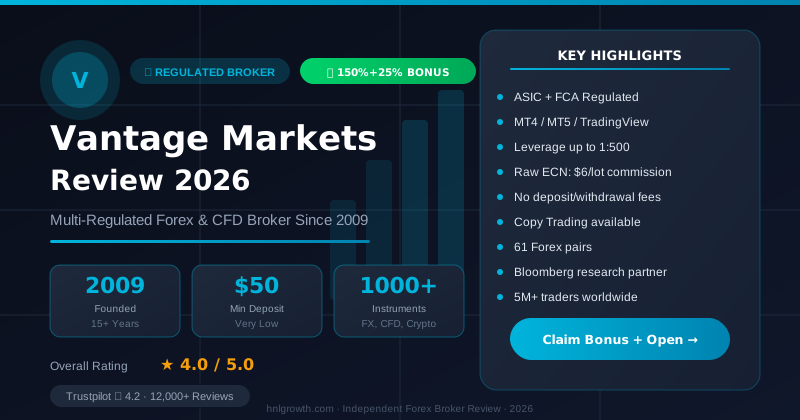
Vantage and Pepperstone are both multi-regulated CFD brokers holding Tier-1 licenses and offering MetaTrader 4/5 with competitive ECN-style pricing. Pepperstone differentiates through cTrader availability and a $0 stated minimum deposit. Vantage offers integrated copy trading, Vantage Academy structured education, and a $50 minimum deposit. The decision hinges on platform preference (cTrader access vs MT4/5/TradingView), trading style (copy trading integration vs third-party signal compatibility), and experience level (beginner-focused structured resources vs intermediate market analysis).
This comparison evaluates regulation, cost structure, platform offerings, account setup, instrument availability, copy trading capabilities, education quality, and withdrawal practicalities to help you determine which broker aligns with your trading frequency, automation preferences, and experience level.
Vantage vs Pepperstone: Quick Decision Overview
Both brokers hold Tier-1 licenses (FCA, ASIC) alongside additional regulators of varying strictness, and provide access to MetaTrader platforms with ECN pricing models. The table below presents core differentiators at a glance.
| Factor | Vantage | Pepperstone | Context |
|---|---|---|---|
| Regulation | FCA (UK) & ASIC (AU) — Tier-1; plus FSCA (ZA), CIMA (Cayman), VFSC (Vanuatu), FSC (Mauritius) — lighter-touch | FCA (UK) & ASIC (AU) — Tier-1; plus CySEC (CY), DFSA (UAE) and others depending on entity | Both offer segregated client funds; protection varies by entity. FSCA/CySEC/DFSA are generally regarded as lighter-touch than FCA/ASIC — exact "tier" labels vary by source |
| Platforms | MT4, MT5, TradingView, Vantage Web Trading, Vantage App | MT4, MT5, cTrader, TradingView, Pepperstone Web, Pepperstone App | Pepperstone exclusive cTrader access |
| Minimum Deposit | $50 | $0 stated; ~$200 practical for viable position sizing | Functionally similar for most retail traders |
| Copy Trading | Integrated copy trading platform | Third-party signal services and EA compatibility | Vantage built-in; Pepperstone requires external setup |
| Education | Vantage Academy structured courses (beginner to intermediate) | Webinars, market analysis, trading guides (intermediate focus) | Vantage more structured; Pepperstone more analytical |
| Target Trader | Beginners, copy traders, traders seeking integrated education | Scalpers, cTrader users, traders prioritizing platform choice | Decision depends on automation preference and platform needs |
Disclosure: This page may contain affiliate links. We may earn a commission if you open an account through our links, at no extra cost to you.
Neither broker is universally "better." Pepperstone suits traders who value platform flexibility (especially cTrader for order flow and depth of market). Vantage suits traders who prioritize integrated copy trading, structured beginner education, and access to over 900 CFD and spread betting products (UK entity figure; other Vantage entities market this as "1,000+ instruments" — the underlying product range is the same, the count varies by how bundled/regional products are categorized).
Regulatory Standing and Client Fund Protection
Both brokers hold Tier-1 FCA and ASIC licenses plus additional regulators, ensuring segregated client funds and regulatory oversight across jurisdictions. The entity you trade under determines your protection level and regulatory recourse.
Vantage Regulatory Entities
Per Vantage's official regulations page, Vantage operates six licensed entities:
| Regulatory Body | Client Protection | Jurisdiction Coverage |
|---|---|---|
| FCA (UK) | FSCS protection up to £85,000 for eligible claims | UK residents |
| ASIC (Australia) | Segregated funds in Australian trust accounts | Australian residents |
| FSCA (South Africa) | Segregated client funds; no deposit insurance scheme | South African residents |
| CIMA (Cayman Islands) | Segregated funds; lighter-touch offshore framework | International clients (restrictions apply) |
| VFSC (Vanuatu) | Segregated funds; lighter-touch offshore framework | International clients (restrictions apply) |
| FSC (Mauritius) | Segregated funds; lighter-touch offshore framework | International clients (restrictions apply) |
Only FCA and ASIC are widely regarded as Tier-1 regulators; FSCA, CIMA, VFSC, and FSC are generally considered lighter-touch jurisdictions with fewer consumer protections. "Tier" labels beyond FCA/ASIC are an informal industry convention that varies by comparison site, not an official classification.
Pepperstone Regulatory Entities
Per Pepperstone's own regulatory disclosure, Pepperstone holds licenses from ASIC, FCA, CySEC, DFSA, and additionally SCB (Bahamas), SCA (UAE), CMA (Kenya), and BaFin (Germany), depending on entity:
| Regulatory Body | Client Protection | Jurisdiction Coverage |
|---|---|---|
| FCA (UK) | FSCS protection up to £85,000 for eligible claims | UK residents |
| ASIC (Australia) | Segregated funds in Australian trust accounts | Australian residents |
| CySEC (Cyprus) | ICF protection up to €20,000 | EU residents |
| DFSA (Dubai) | Segregated client funds; DFSA oversight | UAE residents |
| BaFin (Germany), SCB (Bahamas), SCA (UAE), CMA (Kenya) | Varies by entity | Additional jurisdictions per Pepperstone's own disclosure |
Only FCA and ASIC are widely regarded as Tier-1 for Pepperstone as well; CySEC and DFSA sit in the same lighter-touch-than-FCA/ASIC category as Vantage's FSCA/CIMA/VFSC/FSC, though the specific regulatory regimes are not identical entity-for-entity.
Key Regulatory Differences
Client fund segregation: Both brokers segregate client funds from operational capital in Tier-1 banks. UK FCA and Australian ASIC entities provide the strongest protection frameworks. UK clients receive FSCS protection (up to £85,000 for eligible claims if the broker fails), while Australian clients benefit from ASIC trust account requirements but no government-backed deposit insurance.
Offshore/lighter-touch entities: Vantage's CIMA, VFSC, and FSC entities and Pepperstone's non-FCA/ASIC entities serve international clients outside Tier-1 jurisdictions. These entities operate under lighter regulatory frameworks with lower capital requirements and, in some cases, limited investor protection schemes. Always verify which entity you fall under based on residency before opening an account.
Leverage limits: FCA and ASIC impose retail leverage caps (30:1 for major forex pairs, 20:1 for gold, lower for other CFDs). Offshore entities may offer higher leverage, increasing both profit potential and loss risk. Professional trader classification (available under FCA/ASIC if you meet criteria) can lift these caps but removes retail protections.
Negative balance protection: FCA mandates negative balance protection for UK retail clients. ASIC does not mandate it but most Australian brokers offer it voluntarily. Verify your entity's terms before trading with leverage.
Both brokers maintain equivalent Tier-1 regulatory standing for UK and Australian clients. Safety differences are immaterial at this level; the choice depends on which entity serves your jurisdiction and whether you need professional trader classification or offshore flexibility.
Cost Structure: Spreads, Commissions, and All-In Pricing
Cost differences between Vantage and Pepperstone depend on account type, instrument, and trading volume. Both brokers offer Standard accounts (commission-free with spreads) and ECN-style accounts (tighter spreads plus commission per lot).
Account Type Comparison
Both brokers provide multiple account tiers. Vantage offers Standard and Raw ECN accounts with a $50 minimum; Pepperstone offers Standard and Razor accounts with a $0 stated minimum. ECN-style accounts charge commission per lot traded but provide access to tighter spreads.
Commission is charged per side; a round-turn trade (open + close) incurs double commission. Spreads vary by market conditions, instrument, and session. The figures below represent typical pricing during liquid market hours and may widen during low liquidity or high volatility periods (e.g., news releases, Asian session). Always verify live spreads on your entity's platform before trading.
Cost Analysis for Common Trading Scenarios
Cost structure depends on account type, trading volume, and instrument selection. Active traders benefit from ECN-style accounts with lower spreads and per-lot commission. Occasional traders may find Standard accounts more straightforward despite wider spreads. Cost differences become material only at scale.
For traders executing high volumes on major pairs, commission-based accounts typically offer better all-in pricing than commission-free accounts. For example, an active trader executing 50 EUR/USD round-turn lots per week would incur meaningful cumulative costs on both brokers, making per-lot commission structures and spreads important decision factors.
Scenario: Day trader executing 50 EUR/USD round-turn lots per week
On ECN-style accounts with tight spreads and per-lot commission, total weekly costs scale with volume. A trader at this frequency should calculate monthly costs based on their broker's commission schedule and verify average spreads during their typical trading hours. Cost differences of $1–2 per lot compound significantly at scale.
Scenario: Swing trader executing 5 mixed-pair trades per week on Standard accounts
For low-frequency traders, Standard accounts with no per-lot commission but wider spreads may be more practical. Total monthly costs remain modest at this frequency, making platform features, education quality, and ease of use more influential decision factors than marginal cost differences.
Scenario: Beginner using Vantage copy trading vs learning independently on Pepperstone
Vantage copy trading incurs spreads, commission, and potential performance fees charged by strategy providers. Pepperstone traders using third-party signals pay spreads, commission, and external signal subscription fees. Total cost depends on signal provider fees vs Vantage strategy provider performance fees; no universal advantage exists.
Other Fees and Costs
Overnight swap/rollover: Both brokers charge swap for positions held overnight. Rates vary by instrument and are updated daily based on interbank rates. Swap-free accounts are available for clients who meet religious or jurisdictional criteria but may carry wider spreads or administrative fees.
Deposit/withdrawal fees: Both brokers offer free deposits via most methods. Withdrawal fees depend on payment method and entity (bank transfers may incur intermediary bank charges; e-wallets typically free). Always verify entity-specific fee schedules.
Currency conversion fees: If your account base currency differs from your deposit currency or trading instrument denomination, conversion fees may apply. Both brokers display conversion costs transparently during deposit/withdrawal.
Verdict on costs: For active traders executing high volumes, commission structures and average spreads during your typical trading hours become material decision factors. For low-frequency traders on Standard accounts, costs are comparable. Cost differences are material only at scale; platform, automation, and education quality should weigh equally in your decision.
Trading Platforms and Execution Infrastructure
Both brokers offer MetaTrader 4 and MetaTrader 5 with full EA support. Pepperstone differentiates through cTrader availability; Vantage through TradingView integration and proprietary Vantage Web Trading.
Platform Availability Matrix
| Platform | Vantage | Pepperstone | Best For |
|---|---|---|---|
| MetaTrader 4 | ✓ | ✓ | Classic platform for forex traders; extensive EA library |
| MetaTrader 5 | ✓ | ✓ | Advanced charting, more timeframes, economic calendar integration |
| cTrader | ✗ | ✓ | Depth of market (DOM), advanced order types, cAlgo algorithmic trading |
| TradingView | ✓ (integrated execution) | ✓ (chart-only; execution via MT4/5 or cTrader) | Social charting, Pine Script custom indicators |
| Proprietary Web Platform | Vantage Web Trading | Pepperstone Web Trader | Browser-based trading without downloads |
| Mobile App | Vantage App (iOS/Android) | Pepperstone App (iOS/Android) | On-the-go trading with demo account access |
MetaTrader 4 and MetaTrader 5 Feature Parity
Both brokers provide identical MT4/MT5 functionality:
- Execution modes: Market, instant, and exchange execution (MT5 only)
- Order types: Market orders, pending orders (limit, stop, stop-limit), trailing stops
- Technical indicators: 30+ built-in indicators (MT4), 38+ (MT5), plus 2,000+ free custom indicators via MQL community
- Timeframes: 9 timeframes (MT4: M1 to MN1); 21 timeframes (MT5: M1 to MN1 with additional intraday options)
- Expert Advisors: Full MQL4/MQL5 support for automated trading strategies
- Backtesting: Strategy tester with historical data (MT4 single-threaded; MT5 multi-threaded for faster optimization)
No MT4/MT5 execution or EA compatibility differences exist between Vantage and Pepperstone. Platform choice depends on non-MT factors.
cTrader: Pepperstone's Key Differentiator
cTrader is available exclusively via Pepperstone and offers execution features for specific trading styles:
Depth of Market (DOM): View live order book depth with bid/ask levels, allowing traders to assess liquidity and place orders at specific price levels beyond simple market/limit orders.
Advanced order types: OCO (one-cancels-other), bracket orders, and stop-limit orders provide granular risk management impossible on MT4.
cAlgo algorithmic trading: Write custom trading robots and indicators using C# (more robust than MQL4/5 for complex strategies). Suitable for developers with programming experience.
Charting: Clean interface with detachable charts, advanced drawing tools, and quick trade execution from chart context menus.
Who benefits from cTrader: Scalpers relying on order flow analysis, algorithmic traders comfortable with C#, and traders who value depth of market transparency. Swing traders and position traders gain limited advantage over MT5.
Who does not need cTrader: Beginners (steeper learning curve), copy traders (no integrated copy trading on cTrader), and traders satisfied with MT5's 21 timeframes and 38 indicators.
TradingView Integration
Vantage: Offers direct execution from TradingView charts. Connect your Vantage account to TradingView via broker integration, place trades directly from TradingView's charting interface, and use Pine Script custom indicators without switching platforms.
Pepperstone: TradingView integration is chart-only; execution still requires MT4, MT5, or cTrader. Traders must maintain separate TradingView and Pepperstone platform sessions.
Advantage Vantage: Seamless workflow for traders who rely on TradingView's social charting, backtesting, and Pine Script community. Eliminates platform switching friction.
Proprietary Platforms
Vantage Web Trading: Browser-based platform with TradingView-powered charts, seven flexible position-closing options, and unified account management (all accounts accessible via single login). No download required; suitable for traders who switch devices frequently or prefer lightweight browser-based access.
Pepperstone Web Trader: Browser-based platform with basic charting and order management. Functional but less feature-rich than Vantage Web Trading.
Mobile apps: Both brokers offer iOS and Android apps with full trading functionality, demo account access, market news, and push notifications. Feature parity is high; UI preference is subjective.
Execution Speed and Infrastructure
Both brokers claim low-latency execution via fiber-optic networks and server proximity to major financial hubs. Execution speed differences are immaterial for swing traders and position traders but may matter for scalpers and algorithmic traders.
Order execution policies: Both brokers operate no-dealing-desk (NDD) models on ECN accounts, routing orders directly to liquidity providers. Slippage occurs during volatile market conditions (e.g., NFP releases, central bank announcements) on both platforms. Neither broker guarantees zero slippage or requotes.
Verdict on platforms: Pepperstone wins on platform flexibility through cTrader exclusivity, appealing to scalpers and algorithmic traders who need order flow transparency and advanced execution modes. Vantage wins on TradingView integration, appealing to traders who rely on Pine Script indicators and social charting. For MT4/MT5 users who do not need cTrader or TradingView execution, platform offerings are equivalent.
Account Setup, Minimums, and Funding Practicalities
Minimum Deposit Requirements
| Broker | Stated Minimum | Practical Minimum for Viable Trading | Account Types |
|---|---|---|---|
| Vantage | $50 | $200–$500 for micro-lot position sizing with margin buffer | Standard STP, Raw ECN, Demo, Swap-Free (subject to eligibility) |
| Pepperstone | $0 stated | $200–$500 for micro-lot position sizing with margin buffer | Standard, Razor, Swap-Free, Demo |
Reality check: A $50 deposit allows opening 0.01-lot (micro-lot) positions on major pairs, but provides minimal margin buffer for drawdown. At 30:1 leverage (FCA/ASIC retail limit), $50 margin supports approximately 0.01–0.02 lots on EUR/USD. A single adverse 50-pip move erodes 10% of capital on a micro-lot position.
Practical minimum: $200–$500 provides sufficient margin for multiple micro-lot positions, allows testing strategies without immediate margin calls, and covers typical beginner drawdowns. Pepperstone's $0 minimum eliminates psychological friction but does not change position sizing math. Vantage's $50 minimum is functionally similar.
Account Opening Timeline
Account opening timelines depend on verification speed (KYC, proof of address). Actual timeline depends on document quality and entity-specific compliance workflows.
Verification requirements: Both brokers require government-issued ID (passport, driver's license) and proof of address (utility bill, bank statement dated within 3–6 months). Verification is faster when documents are clear, unobscured, and match account registration details exactly.
Entity-specific differences: UK FCA and Australian ASIC entities enforce stricter KYC requirements than offshore entities. Verification may take longer for UK/AU clients due to enhanced due diligence.
Funding Methods and Deposit Times
Both brokers support multiple funding methods. Deposit and withdrawal processing times vary by payment method and entity.
Geographic variations: UK clients may experience faster bank transfer processing due to Faster Payments Service (FPS). Australian clients benefit from PayID/Osko for near-instant bank transfers. International clients relying on SWIFT transfers face 3–5 day delays and may incur intermediary bank fees.
Currency account options: Both brokers support multi-currency accounts (USD, EUR, GBP, AUD common; verify entity-specific availability). Opening accounts in your deposit currency eliminates conversion fees but may complicate profit/loss calculations if trading instruments denominated in other currencies.
Funding friction: Both brokers impose no deposit fees for most methods. Withdrawal fees depend on payment method and entity (bank transfers may incur fees; e-wallets typically free). Always verify entity-specific fee schedules before depositing.
Demo Accounts
Both brokers offer unlimited demo accounts with virtual capital. Demo accounts provide access to live spreads, platform functionality, and order execution simulation but cannot replicate:
- Slippage during volatility: Demo fills may execute at requested price; live accounts experience slippage during fast markets.
- Emotional trading pressure: Demo losses carry no psychological cost; live losses trigger fear and overtrading.
- Withdrawal friction: Demo accounts bypass KYC, verification delays, and payment method restrictions.
Use demo accounts to: Test platform usability, practice order types and risk management, backtest strategies under current spread conditions. Do not rely on demo accounts to: Predict live execution quality, assess emotional resilience, or verify withdrawal processing times.
Verdict on setup: Account opening friction is comparable. Verification speed depends on document quality and entity-specific workflows, not broker competence. Funding methods are equivalent; choose based on your geography and preferred payment rails. Neither broker offers material setup advantage.
Tradable Instruments and Market Coverage
Both brokers provide access to CFD instruments across forex, indices, commodities, shares, and ETFs. Instrument counts vary by entity due to regional restrictions.
Instrument Availability by Asset Class
Vantage's UK entity offers access to over 900 CFD and Spread betting products, including forex, indices, commodities, shares, ETFs, and bonds (Vantage's global entities market a "1,000+ instruments" figure — the range is broadly the same, the count differs by regional product bundling). Pepperstone provides a comparable range across major asset classes.
| Asset Class | Vantage | Pepperstone | Regional Restrictions |
|---|---|---|---|
| Forex Pairs | Major, minor, exotic pairs | Major, minor, exotic pairs | None; available to all entities |
| Stock CFDs | 1,000+ global shares (US, UK, EU, AU) | 1,000+ global shares | UK/EU retail: US stock CFDs restricted under ESMA; verify entity |
| Index CFDs | Global indices (S&P 500, FTSE 100, DAX, Nikkei) | Global indices | None; available to all entities |
| Commodity CFDs | Metals (gold, silver, platinum, palladium, copper), Energy (crude oil, natural gas), Soft commodities | Metals, Energy | None; available to all entities |
| Crypto CFDs | Crypto pairs (BTC/USD, ETH/USD, BTC/XAU, ETH/XAU) | Crypto pairs | UK/EU retail: crypto CFDs prohibited under FCA/ESMA; available via offshore entities only |
| ETF CFDs | Gold ETFs (GLD, GDX, GDXJ, JNUG, NUGT) | Limited availability | Verify entity-specific availability |
| Bond CFDs | US Treasury, UK Gilt, German Bund CFDs | Not available | Vantage differentiator for portfolio diversifiers |
Regional restrictions: UK FCA and EU CySEC entities prohibit retail crypto CFD trading under consumer protection rules. UK/EU clients can access crypto CFDs only through offshore entities, which operate under lighter regulation and carry higher risk. Always verify which entity serves you before assuming instrument availability.
Leverage limits by asset class (FCA/ASIC retail):
- Major forex pairs: 30:1
- Gold: 20:1
- Non-major forex, major indices: 20:1
- Commodities (excluding gold): 10:1
- Shares: 5:1
- Crypto CFDs: 2:1 (ASIC's lowest retail cap of any asset class, per ASIC's 2021 CFD leverage restrictions)
Offshore entities may offer much higher leverage (Vantage's own Help Center states its offshore VFSC entity offers 1:100 to 1:2000, reducible to 1:1000 or 1:500 if account requirements aren't met), increasing both profit potential and loss risk. Negative balance protection is mandatory under FCA but not universally available via offshore entities. Verify leverage and protection terms before trading.
Verdict on instruments: Pepperstone offers broad forex and share CFD selection. Vantage offers unique bond and gold ETF CFD access. For most retail forex and index traders, instrument range is sufficient on both platforms. Crypto CFD traders must use offshore entities and accept lower regulatory protection.
Copy Trading and Automation Capabilities
Vantage offers integrated copy trading; Pepperstone relies on third-party signal services and EA compatibility. The choice depends on trader experience, time availability, and automation preference.
Vantage Copy Trading Platform
Vantage integrates copy trading directly into its platform ecosystem, allowing traders to browse strategy providers, view performance metrics, and allocate capital to copy trades automatically.
How it works:
- Browse strategy providers: View ranked list of traders offering copy services, with historical performance (win rate, average return, maximum drawdown, trading frequency).
- Allocate capital: Set fixed or proportional copy amount (e.g., copy 10% of provider's position size or $500 fixed per trade).
- Automatic execution: When provider opens a trade, your account replicates it proportionally based on allocation settings.
- Performance fees: Strategy providers may charge performance fees (percentage of profits) or fixed subscription fees. Verify fee structure before copying.
Performance metrics transparency: Copy trading platforms display historical returns but past performance does not guarantee future results. Drawdown statistics, trading frequency, and holding periods help assess strategy fit. Traders should diversify across multiple providers to mitigate single-strategy risk.
Who benefits from copy trading:
- Beginners lacking trading competency who want market exposure while learning
- Traders with limited time who cannot monitor markets actively
- Traders testing new strategies without manual backtesting
Who should avoid copy trading:
- Traders who want full control over entry/exit timing
- Traders unwilling to pay performance fees
- Traders with insufficient capital to diversify across multiple strategy providers
Pepperstone Third-Party Signal Compatibility
Pepperstone does not offer integrated copy trading but supports third-party signal services and Expert Advisors via MT4/MT5 and cTrader cAlgo.
Signal services: Traders can subscribe to MQL5 signals (integrated into MT4/MT5), Telegram signal groups, or commercial signal providers. Signals require manual execution or EA automation. Verify signal provider track record and fee structure before subscribing.
Expert Advisors (EAs): Both MT4/MT5 support MQL4/MQL5-based EAs, which automate trading strategies. Traders can purchase EAs from MQL5 marketplace, hire developers to build custom EAs, or code their own.
cTrader cAlgo: Pepperstone's cTrader platform supports cAlgo, a C#-based algorithmic trading environment. More robust than MQL4/5 for complex strategies but requires programming knowledge. Suitable for developers; steep learning curve for non-programmers.
Comparison:
| Feature | Vantage Copy Trading | Pepperstone Signal/EA Approach |
|---|---|---|
| Setup complexity | Low; browse and allocate via platform | Medium; requires signal subscription or EA configuration |
| Ongoing management | Automatic; monitor performance and adjust allocation | Manual signal execution or EA monitoring |
| Cost | Performance fees to strategy providers | Signal subscription fees + potential EA costs |
| Transparency | Platform displays provider metrics | Signal provider track records vary; verify independently |
| Customization | Limited; copy provider's exact trades | High; build custom EAs or modify existing ones |
Verdict on copy trading: Vantage's integrated platform suits beginners and time-constrained traders seeking low-friction copy trading. Pepperstone's third-party approach suits traders comfortable with EA configuration or custom algorithmic strategies. Neither approach is inherently superior; choice depends on technical competency and automation preference.
Educational Resources and Trader Support
Both brokers offer educational content, but target different experience levels. Vantage emphasizes structured beginner education via Vantage Academy; Pepperstone emphasizes intermediate market analysis and webinars.
Vantage Academy
Vantage Academy provides structured online courses covering forex basics, CFD mechanics, leverage and margin, risk management, technical analysis, chart patterns, and trading psychology.
Course format: Self-paced video lessons, quizzes, and downloadable resources.
Strength: Clear learning path for traders new to CFDs and forex. Structured content reduces information overload and establishes foundational competency before live trading.
Limitation: Content is general; does not cover broker-specific platform functionality or strategy backtesting in depth. Traders must supplement with platform-specific tutorials.
Pepperstone Education Content
Pepperstone offers webinars covering market analysis and trading strategies, daily and weekly reports covering major currency pairs and indices with technical and fundamental analysis, and trading guides covering risk management, psychology, platform usage, and strategy development.
Strength: High-quality market analysis suitable for traders who understand basics and need actionable insights. Webinars allow real-time Q&A with analysts.
Limitation: Less structured than Vantage Academy; traders must self-direct learning path. Beginner content exists but requires navigation through broader resource library.
Customer Support
Both brokers provide 24/5 multilingual customer support via live chat, phone, and email.
Verdict on education: Vantage Academy suits absolute beginners seeking structured, curriculum-based learning. Pepperstone suits intermediate traders who understand basics and want ongoing market analysis and webinar access. Neither broker offers material support advantage for experienced traders.
Which Broker Fits Which Trader?
Vantage Is Better For:
- Beginners: Structured Vantage Academy curriculum provides clear learning path. Integrated copy trading allows market exposure while learning.
- Copy traders: Built-in copy trading platform eliminates third-party signal subscription friction. Performance metrics transparency aids strategy provider selection.
- TradingView users: Direct execution from TradingView charts eliminates platform switching. Pine Script integration supports custom indicator workflows.
- Traders seeking bond/ETF CFD access: Unique instrument availability (US Treasury, UK Gilt, German Bund CFDs; gold ETF CFDs) unavailable at Pepperstone.
Pepperstone Is Better For:
- Scalpers and high-frequency traders: cTrader's depth of market (DOM) and advanced order types (OCO, bracket orders) provide execution advantages over MT4/MT5.
- Algorithmic traders comfortable with C#: cTrader cAlgo offers more robust algorithmic trading environment than MQL4/5.
- Traders prioritizing platform choice: Exclusive cTrader access, plus MT4/MT5 and TradingView, provides maximum flexibility.
- Traders seeking slightly lower stated minimum deposit: $0 stated minimum eliminates psychological friction for new account openers (though practical minimum remains $200–$500 for viable position sizing).
Cost Considerations by Trader Type
Active traders (50+ lots/month): Commission structures and average spreads during typical trading hours become material decision factors. Verify live spreads and calculate total monthly costs based on your trading frequency before choosing.
Occasional traders (5–10 trades/month): Cost differences are immaterial at this frequency. Platform usability, education quality, and copy trading availability should weigh more heavily.
Copy traders: Compare Vantage strategy provider performance fees vs Pepperstone third-party signal subscription costs. Total cost depends on provider fee structure; no universal advantage.
Frequently Asked Questions
Which broker has better regulation?
Both Vantage and Pepperstone hold Tier-1 FCA (UK) and ASIC (Australia) licenses with segregated client funds. UK clients receive FSCS protection up to £85,000 for eligible claims under both brokers' FCA entities. Australian clients benefit from ASIC trust account segregation but no government-backed deposit insurance. Regulatory standing is equivalent for UK and Australian residents; offshore entities carry higher risk.
Which broker has lower spreads?
Spreads vary by account type, instrument, and market conditions. Both brokers offer ECN-style accounts with spreads from 0.0 pips plus per-lot commission. Cost differences depend on commission structure and average spreads during your typical trading hours. Verify live spreads on demo accounts during relevant market sessions before choosing.
Can I use Expert Advisors (EAs) on both platforms?
Yes. Both Vantage and Pepperstone support MQL4/MQL5 Expert Advisors on MT4/MT5 with full backtesting and optimization capabilities. Pepperstone additionally offers cTrader cAlgo for C#-based algorithmic trading. EA functionality is equivalent on MT4/MT5 across both brokers.
Which broker is better for beginners?
Vantage offers more structured beginner education via Vantage Academy and integrated copy trading, providing clearer learning path and lower-friction market exposure for new traders. Pepperstone offers strong market analysis and webinars but less structured beginner curriculum. Vantage suits absolute beginners; Pepperstone suits traders with foundational knowledge seeking ongoing analysis.
Does Pepperstone offer copy trading?
No. Pepperstone does not offer integrated copy trading. Traders can use third-party MQL5 signals via MT4/MT5 or subscribe to external signal providers, but setup and management require manual configuration. Vantage provides built-in copy trading with performance metrics and automatic execution.
Which broker has faster withdrawals?
Withdrawal processing times depend on payment method and entity. Both brokers process e-wallet withdrawals within 1 business day typically; bank transfers take 1–5 business days depending on geography and intermediary banks. SWIFT transfers may incur intermediary bank fees. Verify entity-specific withdrawal terms and fees before depositing.
Can I trade crypto CFDs on both brokers?
UK FCA and EU CySEC entities prohibit retail crypto CFD trading. UK/EU residents can access crypto CFDs only through offshore entities (Vantage VFSC, Pepperstone offshore entities), which operate under lighter regulation and carry higher risk. Australian ASIC entity clients can trade crypto CFDs subject to a 2:1 leverage cap. Verify entity-specific instrument availability based on your residency.
Which broker offers better leverage?
FCA and ASIC impose identical retail leverage caps (30:1 major forex, 20:1 gold, 10:1 commodities, 5:1 shares, 2:1 crypto CFDs) on both brokers' UK and Australian entities. Offshore entities may offer higher leverage but operate under lighter regulation with reduced investor protection. Professional trader classification (available if you meet FCA/ASIC criteria) lifts leverage caps but removes retail protections including negative balance protection.
Summary
Vantage and Pepperstone are both Tier-1 regulated CFD brokers with equivalent safety frameworks for UK and Australian residents. Pepperstone differentiates through cTrader availability, appealing to scalpers and algorithmic traders who need depth of market and advanced order types. Vantage differentiates through integrated copy trading and structured Vantage Academy education, appealing to beginners and time-constrained traders.
Cost differences are marginal for EUR/USD on ECN-style accounts and become material only for traders executing high volumes. Platform preference (cTrader access vs MT4/5/TradingView integration), trading style (copy trading vs independent trading), and experience level (beginner-focused curriculum vs intermediate market analysis) should weigh more heavily than cost for most retail traders.
Neither broker is universally "better." Test both on demo accounts, verify entity-specific terms based on your residency, and choose based on platform usability, education alignment with your experience level, and automation preference.
Editorial Verification Process
Vantage figures in this comparison are fact-checked against Vantage's official documentation, following our 7-criteria broker review methodology; Pepperstone figures should be independently verified on Pepperstone's official site. We have not completed a funded live-account test of either broker — execution-quality, KYC, and processing-time claims reflect published terms and documented behavior, not personally observed live trading.
Sources
Official broker sources
- Vantage Markets UK homepage
- Vantage trading platforms
- Vantage Academy — gold trading platforms
- Vantage regulatory entities and legal documentation
- Pepperstone — who we are
Regulatory sources
- FCA Financial Services Register (UK)
- ASIC Connect register (Australia)
Last verified: 16 August 2026.
Risk warning: CFDs and leveraged forex products are complex and carry a high risk of losing money. Check the terms, entity and protections that apply to your jurisdiction before trading.
Related Vantage Markets Guides
Ready to Trade with Vantage Markets?
Vantage Markets is a multi-regulated forex & CFD broker (FCA, ASIC, FSCA, CIMA, VFSC, FSC) trusted by 5 million+ traders, with Raw ECN pricing from $3/lot, no deposit/withdrawal fees, and full MT4/MT5/TradingView support.
Risk disclaimer: Vantage Markets is a live, regulated broker — trading forex and CFDs is done with real capital under normal market risk (this is not a simulated prop-firm evaluation). CFDs and leveraged forex products are complex instruments and carry a high risk of losing money rapidly due to leverage; most retail investor accounts lose money trading these products. Consider whether you understand how CFDs/forex work and whether you can afford the high risk of losing your money. Affiliate disclosure: HNL Growth earns a commission when you open a Vantage Markets account through links on this page.