Vantage vs Exness 2026: Fees & Regulation
Compare Vantage and Exness on account pricing, regulatory licenses (ASIC, FCA, FSCA, CIMA, VFSC, FSC), and platforms to find the better fit for your trading.
Reviewed using our forex & CFD broker review methodology
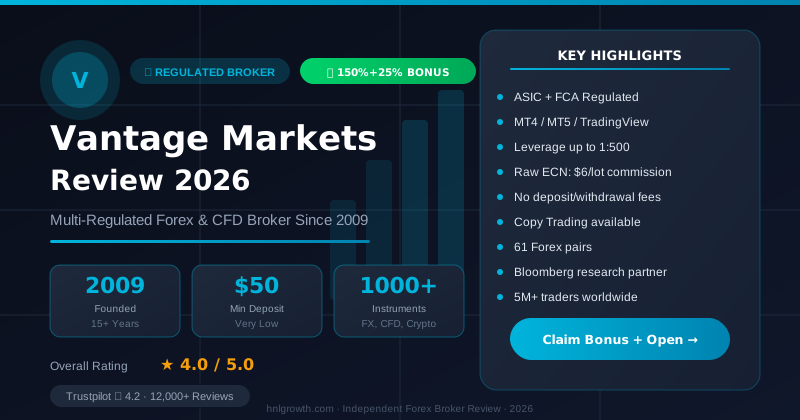
If you're choosing between Vantage and Exness, the honest answer is that neither broker is a universal "winner." Vantage publishes clear account-level pricing and operates under six regulatory entities — ASIC (Australia), FCA (UK), FSCA (South Africa), CIMA (Cayman Islands), VFSC (Vanuatu), and FSC (Mauritius) — per Vantage's official regulations page, depending on the entity you're onboarded to. Exness is a large multi-entity broker in its own right, but this article does not have a verified, current official source for its account terms, regulation, or spreads at time of writing, so any Exness-specific figure below is flagged as unverified rather than stated as fact. Your decision should hinge on which specific legal entity you'll actually sign up under, your account type's cost model, and whether you're a scalper, swing trader, or beginner.
Important limitation: This comparison can only present verified official data for Vantage. All Exness-specific claims about regulation, account types, spreads, leverage, platforms, and withdrawal terms remain unverified and should be confirmed directly on Exness's official website before making any trading decision.
Quick verdict
There's no single "Vantage is better" or "Exness is better" answer that holds across every trader and every jurisdiction. What can be said with confidence:
- Cost-sensitive scalpers and high-frequency traders care most about raw spreads plus commission. Vantage's Raw ECN account advertises spreads from 0.0 pips with commission and other trading fees. Whether Exness beats or loses to that on your specific pair needs to be checked directly on Exness's official trading conditions page, since no verified figure is available here.
- Beginners wanting low entry friction can start on Vantage's accounts with a $50 minimum deposit and a $100,000 demo account to practice first. Exness's current minimum deposit should be confirmed on its own site before comparing.
- Regulatory trust is entity-specific, not brand-specific, for both brokers. Which regulator actually protects you depends on which legal entity signs your account agreement, not on the brand name on the homepage.
Disclosure: This page may contain affiliate links. We may earn a commission if you open an account through our links, at no extra cost to you.
The sections below break down regulation, account types, costs, platforms, leverage, and withdrawals in more detail, followed by a trader-type recommendation.
Regulation and servicing entities
The most common anxiety in this comparison isn't cost, it's safety. That anxiety is legitimate, but "which broker is safer" is the wrong framing. The right question is "which entity of this broker will actually hold my account, and what does that entity's regulator require?"
Per Vantage's official regulations page, Vantage operates under six licensed entities: ASIC (Australia), FCA (UK), FSCA (South Africa), CIMA (Cayman Islands), VFSC (Vanuatu), and FSC (Mauritius). Only FCA and ASIC are widely regarded as Tier-1 regulators with the strictest fund-segregation and enforcement standards; FSCA, CIMA, VFSC, and FSC are generally considered lighter-touch jurisdictions with fewer consumer protections — though "tier" labels beyond FCA/ASIC vary by comparison site rather than reflecting an official classification. Before funding an account, check the specific entity named in your account-opening agreement and cross-reference its license number against the relevant regulator's public register (for example, ASIC's or the FCA's register).
For Exness, this article does not have an official regulatory-entity source to cite, so no specific claim about its regulators, entities, or license numbers is made here. Exness is a large, established multi-entity broker, but stating which regulator applies to which region without a verified official source would risk giving you inaccurate information on exactly the point you're most worried about. Confirm Exness's current entity structure directly on its official regulation page before opening an account.
What regulation does and doesn't guarantee: a license from a reputable regulator typically requires client fund segregation, minimum capital requirements, and a formal complaints process. It does not guarantee profits, instant withdrawals, or that every account type gets identical protections. Protections like negative balance protection or investor compensation schemes are usually tied to the specific entity and jurisdiction, not the brand as a whole. This is true for both Vantage and Exness, and for every multi-entity broker in this space.
Account types
Both brokers use their own naming conventions, which makes like-for-like comparison harder than it should be. Here's how Vantage's published account types map onto a common cost/feature axis.
| Account | Spread model | Commission | Minimum deposit | Best-fit user |
|---|---|---|---|---|
| Standard STP | From ~1.0 pip | $0 (commission-free) | $50 | Beginners and low-frequency traders who prefer simplicity over the lowest raw spread |
| Raw ECN | Raw/ECN, advertised from 0.0 pips | $3.00/lot/side global entity (from $1.00/lot/side on the UK FCA entity — commission varies by entity) | $50 | Cost-sensitive active traders and scalpers who can absorb commission tracking for tighter spreads |
| Pro ECN | From 0.0 pips | $1.50/lot/side (global/offshore entity) | $10,000 | Professional/institutional traders (global entity only — not offered on the UK entity) |
| Premium ECN | From 0.0 pips | $0.75/lot/side | $25,000 | UK FCA entity's own top-tier account (different product from Pro ECN, not the same account under a different name) |
| Demo | N/A | N/A | $0 ($100,000 virtual credit) | Anyone testing strategy or platform fit before committing real funds |
Source: Vantage's trading platform and gold trading platforms guide pages, cross-checked against Vantage's official APAC and UK Help Center account-type articles.
Exness is well known in the industry for offering its own set of account types, but this article does not have a current, verified official source confirming Exness's exact account names, spread models, commissions, or minimum deposits at time of writing. Rather than guess, treat the Exness column as "to be confirmed on Exness's official account-types page" and compare it directly against the Vantage row above once you have that page open.
Spreads and commissions
Spread comparisons are the single biggest driver of "which is cheaper" questions for this pair of brokers, and they're also the easiest place to be misled if figures aren't dated and sourced.
What's verifiable from Vantage's official materials: Raw ECN accounts are advertised with spreads from 0.0 pips, plus a per-lot, per-side commission that differs by entity ($3.00 on the global/offshore entity, from $1.00 on the UK FCA entity). Pro ECN (global entity, $10,000 minimum) charges $1.50/lot/side; Premium ECN (UK FCA entity only, $25,000 minimum) charges $0.75/lot/side — these are two different top-tier accounts from two different entities, not the same account under two names. These are advertised minimums under specific market conditions, not a guaranteed spread at all times. Spreads widen around news events, low-liquidity sessions, and rollover, regardless of which account type you use.
No verified, dated EURUSD or GBPUSD spread figure for Exness is available for this article, so no comparison table entry is provided for Exness's side. Any spread comparison you see elsewhere that presents a specific Exness number without a capture date and market-condition note should be treated with caution, the same way you'd treat an undated Vantage figure.
Why this matters differently by trading style:
- A scalper trading dozens of times a day feels every 0.1 pip difference multiplied across volume. For this profile, raw-spread-plus-commission accounts usually work out cheaper than a spread-only account once volume is high enough to offset the fixed commission.
- A swing or position trader holding for days or weeks is far less sensitive to the spread at entry and more sensitive to overnight swap costs and whether the account type suits infrequent trading.
Because no verified Exness cost data exists here, this article cannot tell you definitively which broker is cheaper for your specific pair and strategy. What it can tell you is the methodology to use: pull both brokers' live, dated spread figures for your exact account type and instrument, then calculate cost including commission for your typical trade size and frequency, not just the headline "from" spread.
See the account and cost breakdown above, then use the decision framework in the trader-type section below to match it to your strategy. If Vantage's Raw ECN structure fits a cost-focused, active-trading profile, you can review current terms and open an account directly:
Minimum deposit and funding
Minimum deposit isn't a single number for either broker, it varies by account type.
For Vantage, the confirmed figures are:
- $50 minimum deposit for Standard STP and Raw ECN accounts
- $10,000 minimum deposit for Pro ECN (global/offshore entity)
- $25,000 minimum deposit for Premium ECN (UK FCA entity only)
- $0 to open a demo account, funded with $100,000 in virtual credit
Exness's minimum deposit figures are not independently verified here. Exness is often discussed as offering low or no minimum deposit on entry-level account tiers, but without a checked official source this article won't state a specific number. Confirm the current minimum on Exness's own account page, since minimums and available payment methods can differ by region and by account currency.
Practical funding check for both brokers, regardless of which figures you find on their sites:
- Confirm which payment methods are actually available in your country, not just globally advertised
- Confirm whether deposits are instant or take processing time, and whether that differs by method
- Confirm whether the broker or your payment provider charges a fee on either deposit or withdrawal
- Confirm the base currency options for your account, since currency conversion can quietly add cost
MT4/MT5 and apps
Platform experience differs functionally, not just in feature-list length, and this is where Vantage's official pages give the most detail.
Vantage supports MetaTrader 4, MetaTrader 5, TradingView (via a live account), its own web trading platform, and a mobile app:
- MetaTrader 4: three execution modes, 30 built-in indicators plus access to 2,000+ free custom indicators, nine timeframes, and MQL4 for building and backtesting Expert Advisors.
- MetaTrader 5: 38 built-in indicators, over 44 graphical objects (Gann, Fibonacci, Elliott tools included), 21 timeframes, MQL5 for EA development, and multi-threaded strategy testing.
- TradingView integration: live-account trading directly from TradingView charts, 100+ indicators, 90+ drawing tools, a Bar Replay feature for reviewing historical price action, and Pine Script for custom indicators and strategies.
- Vantage Web Trading: browser-based, no download, single login across your accounts, seven position-closing options, and continuity across web, mobile, and desktop.
- Vantage App: access to 900+ tradable instruments, daily market commentary and analysis, and a $100,000 virtual demo account built into the app.
The functional difference that matters in practice: MT4 is lighter and more familiar to traders coming from an EA-heavy background, MT5 adds more timeframes, indicators, and faster multi-asset backtesting, and TradingView appeals to traders who already do their charting there and don't want to switch platforms just to place a trade.
Exness's platform stack is not detailed here with an official source. If a specific platform (say, TradingView integration or a particular charting tool) is a dealbreaker for you, verify its current availability on Exness's own platforms page before assuming parity with Vantage.
Leverage
Leverage limits are regulator-dependent, not global, for any multi-entity broker. A single "Vantage offers 1:X leverage" or "Exness offers 1:Y leverage" headline number is misleading unless it's tied to the specific entity and jurisdiction you're being onboarded under. ASIC-regulated entities, for example, typically apply lower retail leverage caps than entities regulated in less restrictive jurisdictions, purely because of local regulatory requirements, not because of a broker's own preference.
What's verifiable from Vantage's own Help Center: retail clients under ASIC (Australia) and FCA (UK) face standard regulatory caps (1:30 for major forex pairs, lower for other instruments). Clients under the VFSC (Vanuatu) offshore entity can access leverage from 1:100 up to 1:2000, though Vantage can reduce that to 1:1000 or 1:500 if certain account requirements aren't met — so 1:500 may appear as a reduced tier rather than the ceiling. No specific leverage number is stated here for Exness, since no official source was checked for this article. Before opening a live account with either broker, confirm:
- Which specific entity is issuing your account agreement
- The maximum leverage that entity's regulator permits for your account type and client classification (retail vs. professional)
- Whether leverage differs by instrument (forex majors are often allowed higher leverage than indices, commodities, or shares)
If leverage flexibility is a priority, this is worth checking directly with both brokers' support teams or official leverage disclosure pages for your specific country before assuming either broker's global marketing figure applies to you.
Withdrawals
Vantage's trading platform page lists withdrawal-related questions in its FAQ. The specific answers to those questions (exact processing windows, fee schedules, and any minimum withdrawal threshold) live on that FAQ rather than in the general page content reviewed here, so this article won't state a specific number of days or a specific fee, since doing so without directly reading that content would risk stating something inaccurate.
The same applies to Exness: no official withdrawal policy page was available to check for this article, so no processing time, method list, or minimum withdrawal figure is stated for Exness here.
What to verify yourself before choosing based on withdrawal speed:
- Read the broker's official withdrawal policy page directly (not a forum thread or a third-party aggregator) for stated processing timeframes
- Check whether withdrawal method must match your original deposit method, which is a common industry requirement for anti-fraud reasons
- Check whether there's a minimum withdrawal amount or a fee for certain methods (bank wire withdrawals, for instance, often carry different costs than e-wallet withdrawals)
- Note that "processing time" stated by the broker usually excludes your bank's or payment provider's own processing delay on top of it
If you see user complaints online about slow withdrawals at either broker, treat that as a prompt to ask the broker directly and check their current official policy, not as confirmed fact. Unverified forum or review-site claims can reflect a real individual experience, a regional payment delay, an account verification issue, or an isolated incident, and shouldn't be generalized into "this broker doesn't pay out."
Vantage vs Exness by trader type
Rather than naming one overall winner, here's how the confirmed facts line up against three common trader profiles.
| Trader profile | Better-fit consideration | Reasoning |
|---|---|---|
| Cost-focused scalper/high-frequency trader | Check both brokers' current published spreads and commission structures for your specific instruments before deciding | Vantage's Raw ECN advertises spreads from 0.0 pips with commission and other trading fees; model the total cost per trade against Exness's published figures once verified |
| Beginner wanting low entry friction and a safety net to practice first | Vantage Raw ECN ($50 minimum) with the $100,000 demo account | A $50 entry point and a free demo account with substantial virtual capital lowers the barrier to testing a strategy before risking real funds |
| Platform-specific trader (TradingView-native charting, or wants MT4/MT5 plus a proprietary web platform in one login) | Vantage, based on its confirmed MT4, MT5, TradingView, web, and mobile app stack | Vantage's platform page confirms functional details (indicator counts, timeframes, EA support, Bar Replay, Pine Script) that let you match the platform to your specific workflow rather than picking on brand name alone |
For any profile where Exness's specific published terms turn out to be more competitive once you check them directly (particularly around minimum deposit or a leverage cap in your jurisdiction), that's a legitimate reason to choose Exness for that use case. This article's Vantage-side data is directly sourced and current; make the Exness-side comparison using Exness's own official pages before deciding.
If Exness's account terms turn out to better fit your specific situation after checking their official site, review those terms directly on Exness's official website.
Editorial Verification Process
This comparison follows our 7-criteria broker review methodology — see that page for our full source hierarchy and what "verified" means on this site.
What we verified, and what we couldn't
In the interest of accuracy on a topic where being wrong has real financial consequences:
Verified from Vantage's official pages (cited above): Standard STP, Raw ECN, Pro ECN, and Premium ECN account names and terms (spreads, commission-per-side, minimum deposits, and which entity offers which account), demo account terms ($100,000 virtual credit), platform feature sets (MT4/MT5/TradingView/web/app with specific technical details), the six regulators named as part of Vantage's oversight (ASIC, FCA, FSCA, CIMA, VFSC, FSC), and VFSC entity leverage range (1:100–1:2000, reducible to 1:1000/1:500).
Not verified for this article: Vantage's specific license numbers per jurisdiction and exact withdrawal processing times and fees. All Exness-specific facts, including its regulatory entities and license numbers, account types and their cost structures, EURUSD/GBPUSD spreads, minimum deposits, leverage limits, and withdrawal terms, since no official Exness source was available to check at the time this article was published.
Where this article references user sentiment about spreads or withdrawal experiences, that reflects a general theme in what traders search for and ask about, not a confirmed fact about either broker's actual performance.
FAQ
Which is the best forex broker, Exness or Vantage? Neither is universally "best." Vantage's published account structure suits cost-focused active traders (via Raw ECN) and beginners wanting a low $50 entry point with a demo account. Whether Exness is a better fit depends on its current official terms, which you should compare directly against the Vantage figures above.
Vantage vs Exness, which is more safe and well regulated? Safety depends on which specific legal entity of each broker you're onboarded under, not the brand name. Vantage discloses oversight from six regulators — ASIC, FCA, FSCA, CIMA, VFSC, and FSC — across its group, with FCA and ASIC widely regarded as the strictest (Tier-1) of the six. Confirm the exact entity and license number in your account agreement against the regulator's public register for both Vantage and Exness before funding an account.
Exness vs Vantage safety, is one better protected against fund loss? Regulated brokers typically require client fund segregation and offer a formal complaints process, but the specific protections (such as investor compensation scheme eligibility or negative balance protection) depend on the entity and jurisdiction, not the broker brand as a whole. This applies equally to Vantage and Exness.
Exness v Vantage, which has lower spreads? Vantage's Raw ECN account is advertised from 0.0 pips with commission and other trading fees. A specific, dated Exness figure isn't available here, so pull Exness's current live spread for your instrument and account type directly from their official site to compare like-for-like.
What's the minimum deposit to start with Vantage vs Exness? Vantage: $50 for Standard STP/Raw ECN, $10,000 for Pro ECN, $25,000 for Premium ECN (UK entity only), $0 for a demo account with $100,000 in virtual funds. Exness's current minimum deposit should be checked on its official account page, since it varies by account type and region.
Do Vantage and Exness offer the same trading platforms? Vantage confirms MT4, MT5, TradingView (live account), its own web platform, and a mobile app, with specific feature counts (indicators, timeframes, EA support). Exness's current platform lineup should be confirmed on its own official site before assuming feature parity.
Risk warning: CFDs and leveraged forex products are complex and carry a high risk of losing money. Check the terms, entity, and protections that apply to your jurisdiction before trading.
Ready to see the full account and platform breakdown in practice? Explore Vantage's account types and demo account →
Related Vantage Markets Guides
Ready to Trade with Vantage Markets?
Vantage Markets is a multi-regulated forex & CFD broker (FCA, ASIC, FSCA, CIMA, VFSC, FSC) trusted by 5 million+ traders, with Raw ECN pricing from $3/lot, no deposit/withdrawal fees, and full MT4/MT5/TradingView support.
Risk disclaimer: Vantage Markets is a live, regulated broker — trading forex and CFDs is done with real capital under normal market risk (this is not a simulated prop-firm evaluation). CFDs and leveraged forex products are complex instruments and carry a high risk of losing money rapidly due to leverage; most retail investor accounts lose money trading these products. Consider whether you understand how CFDs/forex work and whether you can afford the high risk of losing your money. Affiliate disclosure: HNL Growth earns a commission when you open a Vantage Markets account through links on this page.