Vantage vs XM 2026: Spreads, Gold & Regulation
Compare Vantage and XM on gold (XAUUSD) spreads, ASIC/FCA vs offshore regulation, platforms, and costs to see which broker fits your trading style.
Reviewed using our forex & CFD broker review methodology
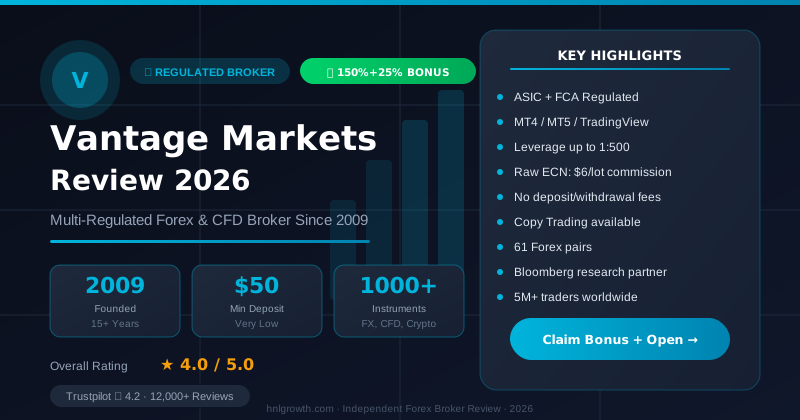
Vantage and XM are both multi-regulated brokers with MT4/MT5 support, but they serve different cost profiles depending on your capital. For gold (XAUUSD) trading: Vantage offers Raw ECN accounts with spreads from 0.0 pips plus commission; XM offers Zero accounts also with spreads from 0.0 pips plus commission. On regulation, Vantage holds ASIC (Tier-1), FCA (Tier-1), FSCA, CIMA, VFSC, and FSC licenses across six entities; XM holds licenses in multiple jurisdictions. The practical choice hinges on your account capital, regulatory preference, and trading volume.
Quick Comparison: Vantage vs XM at a Glance
| Factor | Vantage Markets | XM |
|---|---|---|
| Minimum deposit (entry) | $50 | Varies by account type |
| XAUUSD spread (ECN/Zero) | From 0.0 pips (Raw ECN) | From 0.0 pips (Zero) |
| Commission structure | Commission applies on Raw ECN | Commission applies on Zero |
| Key Tier-1 regulators | ASIC, FCA | Check XM's current regulatory page |
| Other/lighter-touch regulators | FSCA, CIMA, VFSC, FSC (Mauritius) | Check XM's current regulatory page |
| Platforms | MT4, MT5, TradingView, Vantage App | MT4, MT5, XM App |
| Copy trading | Available | Available |
Vantage figures sourced from Vantage official pricing as of May 2026. XM conditions should be verified directly on XM's official website before trading. Spreads and commissions are variable and depend on liquidity conditions.
Regulation and Fund Safety: Which Broker Protects Your Capital?
Regulatory tier matters for two concrete reasons: the strength of fund-protection mechanisms available to you, and the enforcement capacity of the overseeing body. Neither jurisdiction is universally "safer"—what matters is which entity you are opening your account under and what protections attach to that entity.
Vantage regulatory structure
Vantage Markets operates through multiple licensed entities. According to Vantage's official regulations page, the group holds regulatory licenses from ASIC (Australia, Tier-1), FCA (UK, Tier-1), FSCA (South Africa), CIMA (Cayman Islands), VFSC (Vanuatu), and FSC (Mauritius) — six entities in total.
FCA-regulated entities in the UK operate under one of the strictest regulatory frameworks globally, with client fund segregation requirements and potential access to the Financial Services Compensation Scheme (FSCS). ASIC-regulated entities in Australia also require strict fund segregation but do not offer a government-backed compensation scheme for forex/CFD clients. FSCA, CIMA, VFSC, and FSC (Mauritius) are generally regarded by the industry as lighter-touch jurisdictions with fewer consumer protections than FCA/ASIC — the specific "Tier-2" vs "Tier-3" labels vary by comparison site rather than reflecting an official classification, so treat any precise ranking among these four as informal, not a verified fact.
Key point: a Vantage client onboarded under the Vanuatu (VFSC) entity does not benefit from the same protections as one onboarded under the FCA or ASIC entity. Check your account-opening documentation to confirm which legal entity and jurisdiction governs your account before funding.
XM regulatory structure
XM operates through multiple entities across different jurisdictions. To determine which regulators oversee XM and what protections apply to your account, visit XM's official regulatory disclosure page and check the public registers of the relevant authorities before opening an account.
Practical safety comparison
| Broker | Entity Options | Tier-1 Regulators | Lighter-touch Regulators | Fund Segregation |
|---|---|---|---|---|
| Vantage | Six entities: UK, AU, ZA, Cayman Islands, Vanuatu, Mauritius | FCA (UK), ASIC (AU) | FSCA (ZA), CIMA (Cayman), VFSC (VU), FSC (Mauritius) | Yes (all entities, per Vantage's regulations page) |
| XM | Multiple | Verify on XM website | Verify on XM website | Verify on XM website |
Verify current license status and the entity linked to your account through the respective regulator's public register before depositing. Regulatory status and protection schemes can change.
When comparing regulatory safety, check:
- Which specific legal entity will hold your account (this determines your jurisdiction and protections)
- What compensation scheme, if any, applies to your account
- Whether client funds are segregated from company operating capital
- The regulator's enforcement record and operational standards
Disclosure: This page may contain affiliate links. We may earn a commission if you open an account through our links, at no extra cost to you.
Gold Trading Costs: XAUUSD Spreads and Commissions Compared
For gold traders, the relevant cost is not the headline spread alone—it is the effective round-trip cost: spread plus commission, expressed per standard lot (100 oz of gold).
Vantage cost structure
According to Vantage's gold trading platform page, Vantage offers multiple account types for gold trading:
- Standard account — Commission-free structure with spreads applied
- Raw ECN account — Spreads from 0.0 pips plus commission and other trading fees; minimum deposit $50
The specific commission amounts for each account tier should be verified on Vantage's current pricing page or by contacting Vantage directly, as commission structures can change.
XM cost structure
XM offers multiple account types with different pricing structures. To determine current XAUUSD spreads, commission rates, and minimum deposit requirements for each XM account type, visit XM's official website or contact XM support directly before opening an account.
Cost comparison considerations
When comparing gold trading costs between brokers:
| Cost Factor | What to Check | Why It Matters |
|---|---|---|
| Raw spread | Minimum spread advertised vs. typical spread during your trading hours | Advertised "from 0.0" spreads represent best-case; actual spreads vary by session |
| Commission structure | Per-side or round-trip; fixed or variable; applied to partial fills | Determines true per-lot cost alongside spread |
| Session timing | Spread width during London open, NY overlap, Asian session | Liquidity affects spread; test during your actual trading hours |
| News events | Spread behavior during NFP, FOMC, or geopolitical announcements | Gold spreads widen significantly during volatility spikes |
| Minimum trade size | Lot size flexibility (0.01, 0.1, 1.0 standard lots) | Affects position sizing and risk management precision |
What to verify yourself before opening an account:
- Open a demo account on both platforms and record the live XAUUSD spread during the London/New York overlap (13:00–17:00 GMT), when liquidity is typically highest.
- Check the spread during a scheduled high-impact event (e.g., NFP, FOMC) to observe widening behavior.
- Confirm whether commission is charged per side or round-trip, whether it applies to partial fills, and whether there are volume-based commission discounts.
- Calculate your expected monthly trading volume in lots and multiply by the all-in cost (spread + commission) to estimate your true cost difference between brokers.
Compare Vantage account types and see current gold trading conditions → Open a Vantage account
Account Types and Minimum Deposit: Finding Your Entry Point
Vantage account structure
According to Vantage's official documentation, the minimum deposit to open a Vantage account is $50. Vantage offers multiple account types with different pricing structures:
- Standard account — $50 minimum, commission-free with spreads
- Raw ECN account — $50 minimum, spreads from 0.0 pips plus commission
- Additional account tiers may be available; check Vantage's platform page for current offerings
XM account structure
XM offers multiple account types at different entry points. To determine current minimum deposits, commission structures, and account-tier eligibility for your jurisdiction, visit XM's official account-types page before registration.
Account tier decision framework
When choosing between brokers and account types, consider:
| Your Capital | Key Decision Factors | Verification Steps |
|---|---|---|
| Under $500 | Entry barrier, learning curve, simplicity | Confirm minimum deposit and whether demo account is available for practice |
| $500–$5,000 | Balance between cost per trade and capital commitment | Calculate effective cost per lot based on your expected volume; test execution on demo |
| $5,000–$10,000 | Regulatory jurisdiction, per-lot cost optimization | Check which entity will hold your account and what protections apply |
| $10,000+ | Volume-based pricing tiers, execution infrastructure | Ask whether volume discounts or dedicated account services are available |
Important: The optimal account type depends not only on capital but also on:
- Your trading frequency (how many lots per month you expect to trade)
- Your holding period (intraday scalping vs. multi-day swing trading affects swap costs)
- Your regulatory priority (Tier-1 vs. Tier-2 jurisdiction preferences)
- Your platform preference (proprietary tools, TradingView integration, MT4/MT5)
Execution Quality: What to Verify Before Trading
Both brokers describe their ECN/Raw accounts as using non-dealing desk (NDD) routing. In theory, this reduces the broker's incentive to trade against client orders. In practice, execution quality on gold during volatile sessions depends on liquidity provider depth, server proximity, and order type.
What is not independently verified:
- Neither broker publishes an independently audited execution statistics report (e.g., average fill time in milliseconds, percentage of orders filled at requested price during NFP releases, or slippage distribution on XAUUSD).
- Slippage during low-liquidity periods (Asian session, weekend gaps on Sunday open, major economic releases) is a market-wide phenomenon affected by available liquidity, not unique to any single broker.
- Any claim of "zero slippage" or "best execution" without a published independent audit should be approached with caution.
What to verify yourself:
- Open a demo account on both platforms and place market orders on XAUUSD at different times of day: London open, NY overlap, and the Asian session. Observe whether fills are at the quoted price or with slippage.
- Check whether the broker supports maximum deviation settings on MT4/MT5 (slippage tolerance in points). This gives you control over fill parameters on volatile instruments.
- Review any published execution policy document on each broker's website under their legal/disclosures section.
- Test pending orders (limit, stop-limit) to see how they are filled during gap opens or fast markets.
Trading Platforms: MT4, MT5, and Mobile Experience
Both brokers offer MT4 and MT5, which means strategy portability: EAs, custom indicators, and scripts built on one platform will run on both. The differentiation is in proprietary additions.
Platform and tool feature comparison
| Feature | Vantage | XM |
|---|---|---|
| MetaTrader 4 (MT4) | ✓ | ✓ |
| MetaTrader 5 (MT5) | ✓ | ✓ |
| TradingView Integration | ✓ (per Vantage platform page) | Verify on XM website |
| Proprietary Web Platform | ✓ (Vantage Web Trading) | Verify on XM website |
| Mobile App (iOS/Android) | ✓ (Vantage App) | ✓ (XM App) |
| EA / Automated Trading | ✓ (MQL4/MQL5) | ✓ (MQL4/MQL5) |
| Copy Trading | ✓ | ✓ |
| Demo Account | ✓ (per Vantage platform page) | ✓ |
Vantage platform availability sourced from Vantage trading platform page. XM platform features should be verified on XM's current product page.
TradingView integration
According to Vantage's platform page, Vantage offers TradingView integration with the ability to trade directly from TradingView charts. This allows traders who already use TradingView for analysis to execute without switching platforms. Features listed include:
- Over 100 built-in indicators and 90+ drawing tools
- Pine Script for custom indicator and strategy creation
- Bar Replay feature for historical market analysis
For XM's current platform offerings, including any TradingView or third-party integrations, check XM's official platform page.
Mobile apps
Both brokers offer iOS and Android apps. According to Vantage documentation, the Vantage app provides access to trading across multiple asset classes, market commentary, and demo account functionality.
App store ratings change over time; check the current rating and recency of reviews on the App Store and Google Play at the time you are evaluating. Do not rely on ratings cited more than three months ago, as app updates and user feedback evolve quickly.
Deposits and Withdrawals: Methods, Fees, and Speed
| Method | Typical Processing Time | Common Considerations |
|---|---|---|
| Bank Wire Transfer | 2–5 business days | May attract bank intermediary fees; verify whether broker charges for wire deposits/withdrawals |
| Credit/Debit Card | Same day to 1 business day | Faster than wire; availability varies by card issuer and jurisdiction |
| E-wallets (Skrill, Neteller) | Often same day | Generally fast; availability and fees vary by region |
| Cryptocurrency | Varies | Confirm availability for your jurisdiction; policies vary by broker and entity |
| Local Payment Methods | Region-dependent | Brokers offer regional channels in select markets; confirm at registration |
Processing time disclosure: Broker-published processing times typically refer to broker-side processing, not end-to-end transfer time. Actual deposit and withdrawal times depend on payment method, jurisdiction, your bank's processing speed, and any AML/KYC verification requirements.
What to verify yourself:
- Confirm whether your preferred payment method is available for your specific country and the entity you are registered under.
- Check whether there is a minimum withdrawal amount and whether first withdrawals must return to the original deposit method.
- Review whether currency conversion fees apply if your account currency differs from your funding currency.
- Ask whether the broker charges withdrawal fees or applies processing fees for specific payment methods.
Check each broker's current withdrawal policy page for detailed terms, as payment methods and fees can change.
Hidden Costs: Inactivity Fees, Swaps, and VPS Charges
Beyond spreads and commission, these are the costs that affect your 12-month trading economics:
| Cost Type | What to Check | Why It Matters |
|---|---|---|
| Inactivity Fee | Whether the broker charges a fee after periods of no trading; trigger period; fee amount | Can erode account balance if you trade infrequently or pause trading |
| Swap on XAUUSD | Overnight financing cost for holding gold positions (long and short) | Gold carry cost is significant for multi-day positions; check MT4/MT5 contract specs |
| Swap-Free (Islamic) Account | Whether available; whether administration fees apply after a set holding period | Some brokers apply fees on swap-free accounts for longer-term positions |
| Currency Conversion | Conversion spread if account currency differs from deposit/withdrawal currency | Rates vary; confirm the spread applied before funding |
| VPS Service | Whether offered; conditions (balance threshold, trading volume requirement) | Often conditional; confirm free VPS eligibility criteria |
| Withdrawal Fee | Whether broker charges for withdrawals; whether third-party fees apply | Always check current fee schedule before requesting withdrawal |
Swap rates on gold deserve particular attention. XAUUSD carry costs are market-derived and can be substantial, especially on long positions during periods of elevated interest rates. If your strategy involves holding gold positions overnight or for multiple days, check the swap rate on the broker's MT4/MT5 contract specifications and calculate the cumulative cost against your expected price move. This is a cost that does not appear in the spread or commission and is often overlooked in headline comparisons.
For current swap rates on XAUUSD:
- Open MT4 or MT5
- Right-click XAUUSD in the Market Watch window
- Select "Specification" to view swap long and swap short (expressed in points or account currency)
Which Broker Fits Your Trading Profile?
Based on the cost, regulatory, and product data examined above:
Consider Vantage if:
- You prioritize FCA (UK) or ASIC (Australia) Tier-1 regulation and want to verify which entity will hold your account.
- Your workflow uses TradingView for charting and you want to execute directly from that environment, as confirmed on Vantage's platform page.
- You trade a range of instruments beyond gold and want access to multiple asset classes from one account.
- You have sufficient capital to meet Vantage's account-tier requirements and expect to trade at volumes where per-lot cost differences compound.
Consider XM if:
- You prefer XM's regulatory structure and entity offerings after reviewing XM's official regulatory disclosures.
- XM's account minimums and pricing structure align better with your capital and trading frequency.
- You have tested XM's execution on a demo account and found it suits your strategy.
Neither broker suits traders who:
- Require physical gold ownership (both are CFD-only for gold; consider platforms like BullionVault for physical allocation).
- Need stock options, futures contracts, or direct access to US equity markets—these are outside the CFD product scope of both brokers.
- Are uncomfortable with the risks inherent in leveraged CFD trading on volatile instruments like XAUUSD.
- Seek guaranteed spreads or execution—both brokers offer variable conditions that depend on liquidity.
Before making a final decision:
- Open demo accounts on both platforms and test execution during your intended trading hours.
- Verify the legal entity and regulatory jurisdiction that will govern your account.
- Calculate your expected all-in cost per lot (spread + commission + swap for your typical holding period) and multiply by your projected monthly volume.
- Review each broker's current terms and conditions, withdrawal policies, and fee schedules.
- Check independent reviews and regulatory records for both brokers, not relying solely on broker-provided materials.
Ready to test Vantage's platform or compare account types? → Compare Vantage account types
Frequently Asked Questions
What is the exact round-trip cost for 1 lot of gold (XAUUSD) on each broker?
Vantage offers Raw ECN accounts with spreads from 0.0 pips plus commission; the specific commission amount should be verified on Vantage's current pricing page. XM offers Zero accounts also with spreads from 0.0 pips plus commission; verify XM's current commission structure directly with XM. Spreads are variable and depend on liquidity conditions. These figures represent published minimums, not guaranteed rates during all trading sessions.
Which broker is safer—Vantage or XM?
"Safer" depends on which entity you are registered under and what that means for your specific situation. Vantage operates under ASIC (Australia), FCA (UK), FSCA (South Africa), CIMA (Cayman Islands), VFSC (Vanuatu), and FSC (Mauritius) per Vantage's official regulations page. FCA and ASIC are widely regarded as Tier-1 regulators with the strictest enforcement and fund-segregation standards; FSCA, CIMA, VFSC, and FSC are generally regarded as lighter-touch jurisdictions, though "tier" labels are an informal industry convention (used differently by different comparison sites) rather than an official classification — treat any specific tier number for the non-FCA/ASIC entities as a rough guide, not a regulatory fact. XM operates under multiple licenses; check XM's official regulatory page for current details. Both brokers segregate client funds. What matters is which legal entity will hold your account and what protections apply in that jurisdiction. Confirm your specific entity at account registration and verify the regulator's protection scheme on the regulator's public register.
How do slippage and execution compare between Vantage and XM on gold?
Neither broker publishes an independently audited execution statistics report for XAUUSD. Both claim NDD/ECN routing on their raw/zero accounts, which reduces (but does not eliminate) the broker's role in order filling. Slippage on gold is primarily driven by liquidity provider depth and market conditions at the time of execution—particularly during economic releases, session gaps, and low-liquidity windows. The best way to assess execution is to test both platforms with a demo account during the sessions you plan to trade, using the same order types and sizes you intend to trade live.
Are there inactivity fees to worry about?
Check each broker's current fee schedule before opening an account. Inactivity fee policies, trigger periods, and fee amounts can change. If you plan to trade infrequently or pause trading for extended periods, confirm the inactivity policy in writing before funding your account.
Can I use the same EA on both platforms?
Yes. Both brokers support MT4 and MT5 with MQL4/MQL5, which means EAs built in those languages will run on both platforms. However, performance will vary based on execution speed, spread conditions, slippage, server location, and your VPS proximity to the broker's servers. Test your EA on a demo account on each platform, during live market hours, before running it with real capital. Consider differences in spread, commission, and swap that will affect EA profitability.
What copy trading options are available?
Both brokers offer copy trading functionality. The cost structure (signal provider fees, platform markup, minimum copy allocation, performance fees) differs between brokers and should be verified directly. Copy trading does not eliminate market risk or guarantee profits—copied strategies can and do lose money. Review the track record, risk parameters, and fee structure of any strategy you plan to copy before allocating capital.
Pricing, regulatory status, and platform features are subject to change. All spread, commission, account-condition, and regulatory figures should be verified directly with each broker and on the relevant regulator's public register at the time of account opening. This article was last reviewed August 2026.
Editorial Verification Process
Vantage figures in this comparison are fact-checked against Vantage's official documentation, following our 7-criteria broker review methodology; XM figures should be independently verified on XM's official site, as noted throughout. We have not completed a funded live-account test of either broker — execution-quality and processing-time claims reflect published terms and documented behavior, not personally observed live trading.
Sources
Official broker sources
- Vantage trading platforms
- Vantage Academy — gold trading platforms
- Vantage regulatory entities and legal documentation
Regulatory sources
- FCA Financial Services Register (UK)
- ASIC Connect register (Australia)
Last verified: 16 August 2026.
Risk warning: CFDs and leveraged forex products are complex and carry a high risk of losing money. Check the terms, entity and protections that apply to your jurisdiction before trading.
Related Vantage Markets Guides
Ready to Trade with Vantage Markets?
Vantage Markets is a multi-regulated forex & CFD broker (FCA, ASIC, FSCA, CIMA, VFSC, FSC) trusted by 5 million+ traders, with Raw ECN pricing from $3/lot, no deposit/withdrawal fees, and full MT4/MT5/TradingView support.
Risk disclaimer: Vantage Markets is a live, regulated broker — trading forex and CFDs is done with real capital under normal market risk (this is not a simulated prop-firm evaluation). CFDs and leveraged forex products are complex instruments and carry a high risk of losing money rapidly due to leverage; most retail investor accounts lose money trading these products. Consider whether you understand how CFDs/forex work and whether you can afford the high risk of losing your money. Affiliate disclosure: HNL Growth earns a commission when you open a Vantage Markets account through links on this page.