Best CFD Brokers in 2026
Best CFD Brokers in 2026. An independent, fact-checked look at Vantage Markets for traders evaluating this broker.
Reviewed using our forex & CFD broker review methodology
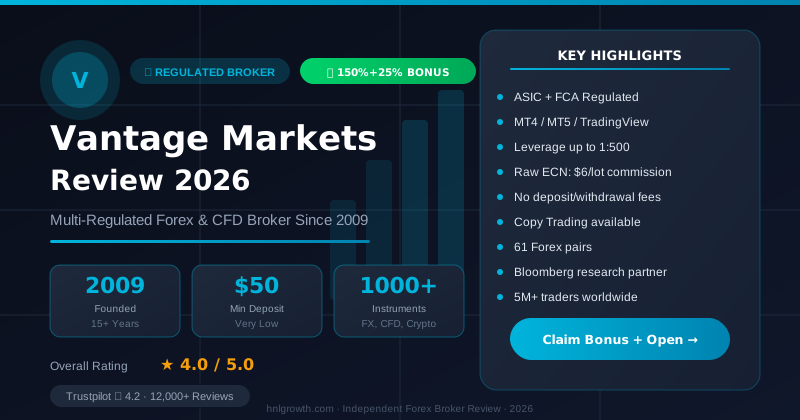
If you're comparing CFD brokers, you already know the basics of leverage and margin. What you actually need is a way to line up regulation, cost, platform fit and asset coverage side by side, so you can shortlist with confidence rather than guessing from marketing pages. This guide compares Vantage against several widely used CFD brokers — IG, CMC Markets, eToro, Saxo, FOREX.com, XTB, FP Markets and Fusion Markets — on the factors that actually change your trading outcome: regulatory entity, total cost, leverage tier, and platform capability. It closes with use-case recommendations rather than a single "best overall" winner, because the right CFD broker depends on how and where you trade.
A note before the tables: brokers frequently operate through several regulated entities with different terms depending on your country of residence. Treat every figure below as a starting point for your own verification, not a final quote. Competitor broker data in this comparison has not been independently verified against official sources; use it for pattern recognition only and confirm current figures directly with each broker before making a decision.
How we compare CFD brokers
Ranking CFD brokers on one number — like the lowest EUR/USD spread — hides more than it reveals, because a broker can win on spread and lose on commission, overnight financing, or the leverage tier available in your jurisdiction. This comparison uses five factors together:
- Regulation and entity structure — which regulator(s) oversee the specific legal entity you'd actually be signing up with, and what protections that regime provides (segregated funds, negative balance protection, compensation schemes).
- Total trading cost — spread, commission (where applicable), and overnight financing combined, since any one of these viewed alone can be misleading.
- Leverage and margin — tied explicitly to your regulatory classification (retail vs. professional) and the entity's home jurisdiction, not stated as a single universal number.
- Platform and tools — which trading platforms are actually available (MT4, MT5, cTrader, TradingView, proprietary), and what functional differences exist between them.
- Asset breadth — how many markets and instrument categories are available, since a broker with narrow coverage may not suit a diversified trading style.
We did not run live trades or measure real-time execution for this comparison. Where a broker's current spread, minimum deposit, or license number matters to your decision, confirm it directly on that broker's own regulatory disclosure pages before funding an account — these details change and vary by entity.
Top CFD brokers compared
The table below is a starting-point scorecard, not a final verdict. It's built for shortlisting, not for citing exact current pricing. Competitor figures have not been verified against official sources.
| Broker | Regulatory approach | Platforms | Asset class breadth | Notable for |
|---|---|---|---|---|
| Vantage | Multiple regulated entities depending on client region | MT4, MT5, mobile app | 900+ instruments across forex, indices, commodities, shares, ETFs and bonds | Broad multi-asset access from a single account, spreads advertised from 0.0 pips* |
| IG | Long-established, multi-jurisdiction regulated broker | Proprietary platform, MT4, some third-party integrations | Wide range across forex, indices, shares, commodities | Large overall market range and long operating history |
| CMC Markets | Multi-jurisdiction regulated broker | Proprietary "Next Generation" platform, MT4 | Broad forex, indices, commodities, shares coverage | Proprietary charting and platform depth |
| eToro | Multi-jurisdiction regulated broker, entity varies by region | Proprietary web/app platform | Forex, indices, commodities, stocks CFDs, crypto | Social/copy-trading features alongside standard CFDs |
| Saxo | Bank-affiliated, multi-jurisdiction regulated | Proprietary SaxoTraderGO/PRO platforms | Wide instrument range including CFDs, listed products | Institutional-style platform depth, tiered account structure |
| FOREX.com | Multi-jurisdiction regulated (part of a larger listed group) | Proprietary platform, MT5 | Forex-led, plus indices, commodities, shares | Forex-specialist heritage with broader CFD range added |
| XTB | Multi-jurisdiction regulated | Proprietary xStation platform | Forex, indices, commodities, stocks/ETF CFDs | Proprietary platform built specifically for CFD/forex traders |
| FP Markets | Multi-jurisdiction regulated | MT4, MT5, cTrader | Forex, indices, commodities, shares | Choice between MT4/MT5 and cTrader for the same account structure |
| Fusion Markets | Multi-jurisdiction regulated | MT4, MT5, cTrader, TradingView integration | Forex, indices, commodities, shares | Positioned around low-cost account tiers and TradingView access |
*Vantage spreads are advertised "from 0.0 pips" with other fees potentially applicable, per Vantage's trading page. This is a headline floor figure, not a guaranteed spread on every instrument or session.
Disclosure: This page may contain affiliate links. We may earn a commission if you open an account through our links, at no extra cost to you.
For Vantage's specific account tiers, platform setup, and current market list, see the Vantage CFD trading page rather than relying on the summary above.
Markets and asset coverage
Asset breadth matters most if you trade across correlated markets (say, gold and mining-heavy indices) or want to consolidate multiple strategies into one account instead of running several brokers.
Vantage lists access to 900+ CFD products across six major asset classes, spanning:
- Forex: 60+ major, minor and exotic pairs, including EUR/USD, GBP/USD and USD/JPY
- Indices: major benchmarks such as SP500, NAS100, DJ30 and GER40
- Commodities: precious metals (gold, silver), energy (crude oil, natural gas, Brent), and soft commodities (sugar, coffee, cotton, cocoa)
- Shares: hundreds of individual stock CFDs including US-listed names, plus access to European, Australian and Asian equity markets
- ETFs: including widely followed funds such as the SPDR S&P 500 ETF and Invesco QQQ Trust
- Bonds: fixed-income CFD instruments
The named competitors in this comparison generally offer similar core categories — forex, indices, commodities, and shares — with eToro also offering crypto CFDs and social/copy-trading exposure, and Saxo typically extending further into listed products beyond CFDs given its bank-affiliated structure. Exact instrument counts and specific tickers vary by broker and by your account's regulated entity, so cross-check the live instrument list on each broker's own platform before assuming a specific market is available to you.
Vantage's spread betting capability is available in the UK through its UK-regulated entity; verify current availability and instrument coverage on the Vantage UK homepage if you require spread betting rather than, or alongside, CFD access.
Fees, spreads and overnight financing
Total CFD trading cost has three components, and comparing only one of them is a common mistake:
- Spread — the gap between bid and ask price, charged on every trade regardless of holding period.
- Commission — a separate per-trade or per-lot fee, applied on some account types (often "raw" or ECN-style tiers) instead of, or alongside, a wider spread.
- Overnight financing (swap) — a daily charge or credit for holding a leveraged position past the daily rollover cutoff, which compounds the longer a position stays open.
Vantage states that spreads start from 0.0 pips on popular products, with the caveat that other fees may apply, and separately advertises $0 deposit fees with no hidden charges. Note that "$0 deposit fees" refers to funding your account, not to trading spreads, commissions or overnight financing, which are separate cost lines.
How cost components combine
To show how the three cost components stack, consider a hypothetical scenario — not a quote from any broker's live pricing. Assume a trader opens a 1-lot EUR/USD CFD position and holds it open overnight:
- Spread: The bid-ask spread cost on entry and exit, which varies by instrument, session liquidity, and account type. Vantage advertises spreads "from 0.0 pips" but actual spread at execution depends on market conditions.
- Commission: May be $0 on a spread-inclusive account type, or a separate per-lot fee on a raw/ECN-style tier. Check your specific account type's commission schedule.
- Overnight financing: A daily swap rate applied at rollover, which accrues per night held and varies by instrument, rate environment, and position direction (long or short).
The point of this framework isn't to provide a dollar figure — it's that spread-only comparisons undercount your real cost if you hold positions overnight or trade on a commission-based account tier. Before choosing an account type, check each broker's own published spread, commission schedule, and swap rate table for the specific instrument and account you'll actually trade, since these figures change with market conditions and differ by entity.
Compare Vantage account types to see current spread, commission, and financing structures for your region.
Leverage and margin by jurisdiction
Leverage limits are set by your regulatory classification and the entity you're onboarded to, not by the broker's marketing page in isolation. As a general framework:
- EU and UK retail clients are typically subject to leverage caps around 1:30 on major currency pairs, with lower caps on other asset classes (commodities, indices, individual shares) under retail-focused CFD product rules.
- Professional client classification (available to traders who meet specific criteria such as trading experience, portfolio size, or financial sector employment) typically unlocks materially higher leverage, but also reduces or removes retail protections like negative balance protection guarantees in some regimes.
- Non-EU/UK entities — for example, brokers or broker divisions regulated in jurisdictions such as Vanuatu, Seychelles, or South Africa — often offer significantly higher retail leverage than EU/UK entities, because those regimes don't apply the same retail leverage caps.
This means the same broker brand can offer very different leverage depending on which of its regulated entities you're actually signed up with. Vantage's own leverage tiers vary by account type and region; confirm the specific figure that applies to your entity on the Vantage trading page rather than assuming a single number applies everywhere. The same applies to IG, CMC Markets, eToro, Saxo, FOREX.com, XTB, FP Markets and Fusion Markets — each operates multiple regulated entities, and the leverage you're offered depends on which one onboards you.
Higher leverage increases both potential gains and potential losses relative to your deposit, and it brings you closer to a margin call — the point at which your account equity falls below the required maintenance margin and the broker may close positions to limit further loss. This mechanic exists across all leveraged CFD accounts regardless of broker.
Platforms and trading tools
Platform fit is often the deciding factor once cost and regulation are roughly comparable, because it determines your actual day-to-day workflow.
| Broker | MT4 | MT5 | cTrader | Proprietary platform | TradingView integration |
|---|---|---|---|---|---|
| Vantage | Yes | Yes | — | — | Charting tools referenced on homepage |
| IG | Yes | — | — | Yes | — |
| CMC Markets | Yes | — | — | Yes (Next Generation) | — |
| eToro | — | — | — | Yes | — |
| Saxo | — | — | — | Yes (SaxoTraderGO/PRO) | — |
| FOREX.com | — | Yes | — | Yes | — |
| XTB | — | — | — | Yes (xStation) | — |
| FP Markets | Yes | Yes | Yes | — | — |
| Fusion Markets | Yes | Yes | Yes | — | Yes |
Confirm current platform availability directly with each broker, since offerings can be added, removed, or restricted by entity and region.
Vantage's own platform setup combines MT4 and MT5 with a mobile app, and includes one-click trading, advanced charting, and price alerts, per the Vantage homepage and trading page. Platform features available to you depend on your account type and regulated entity.
If you're a discretionary trader who lives inside MT4/MT5 indicators and expert advisors, prioritize brokers offering both platforms. If you rely on proprietary risk tools or bank-grade order types, a proprietary-platform broker like Saxo or CMC Markets may fit better. If cTrader's depth-of-market and algo environment matters to you, FP Markets and Fusion Markets are the two in this list that support it alongside MT4/MT5.
Regulation and fund protection
A regulator's name alone tells you little without knowing what it actually requires. Broadly, established CFD regulators typically mandate some combination of:
- Segregated client funds — client money held separately from the broker's own operating funds
- Negative balance protection — preventing a retail client's account balance from going below zero after a market move, where required by the applicable regime
- Compensation or investor protection schemes — a fallback fund covering client losses up to a set limit if a regulated firm fails, where the regime includes one
- Leverage and marketing restrictions — retail-specific caps and risk-warning requirements, as covered in the leverage section above
Vantage states it "fully complies with the strict financial regulations set out by the jurisdictions" in which it operates, per its about page, and separately notes negative balance protection as part of its risk mitigation tools on the trading page. Because Vantage, like the other brokers compared here, operates through multiple regulated entities, the specific regulator, license number, and protections that apply to you depend on which entity onboards you based on your country of residence.
Vantage has been operating for more than 15 years, per its 15th anniversary page, and describes itself as having "more than 15 years of market experience" on its about page. The specific regulated entities, license numbers, and regulators under which Vantage operates are not listed in this comparison; look up the exact entity name and license number in your account-opening documents, then verify it against that regulator's public register before funding the account — this single check is the most reliable way to confirm regulatory status, more reliable than any broker's summary marketing page, including this one.
Best CFD broker by trading style
There's no single "best" CFD broker across every trading style — the right fit depends on what you're optimizing for.
Cost-sensitive traders trading frequently: Prioritize brokers offering a raw-spread or commission-based account tier, since these typically narrow spreads in exchange for a transparent per-lot fee, which is easier to forecast at volume than a wider variable spread. Compare the combined spread-plus-commission cost, not spread alone.
Active or higher-frequency traders wanting execution flexibility: cTrader-supporting brokers (FP Markets, Fusion Markets) or multi-platform setups let you run algorithmic strategies or depth-of-market analysis outside MT4/MT5's native limits.
Beginners and switchers coming from a simpler platform: A broker offering both MT4/MT5 plus built-in educational resources reduces the learning curve of a platform switch. Vantage pairs its MT4/MT5 access with free educational materials and webinars, which can shorten the ramp-up period if you're moving from a more basic app-based broker.
Diversified multi-asset traders: If you trade forex alongside indices, commodities, shares and ETFs from a single account rather than running separate brokers per asset class, prioritize breadth. Vantage's 900+ instrument range across six major asset categories is built around this use case; explore the full Vantage CFD trading page to see current coverage for the specific markets you trade.
None of the above is a universal recommendation — verify current account types, minimum deposits and regional availability for your specific country before deciding, since these details differ by entity and are the parts most likely to have changed since this comparison was last updated.
US and other jurisdiction availability
CFDs are generally not offered to US retail residents. This reflects long-standing US regulatory treatment of off-exchange leveraged retail derivatives, which differs materially from the CFD frameworks used in the UK, EU, Australia and many other markets. In practice, this means US residents searching for "US CFD brokers" typically will not find CFD account access from most internationally regulated CFD brokers, including the ones compared in this article; US-based traders are usually directed toward exchange-traded alternatives such as futures or options instead.
Availability outside the US also varies by broker and by your country of residence, since each broker's regulated entities cover different regions. Always check a broker's own jurisdiction-availability page — rather than a general marketing homepage — before assuming CFD access applies to your specific location.
Switching considerations
If you're moving from an existing CFD broker rather than opening a first account, a few practical points are worth checking before you commit funding to a new provider:
- Funding methods available to your region — confirm which deposit and withdrawal methods your new broker actually supports for your country, since this varies by entity and isn't always listed prominently.
- Account setup requirements — identity verification and account approval steps differ by regulator; a more heavily regulated entity may require more documentation than a lightly regulated offshore one.
- No automatic position transfer — closing positions at your existing broker and opening equivalent new ones is standard; CFD positions generally cannot be migrated broker-to-broker.
- Parallel-run before fully switching — many traders keep a small position or demo account open with the new broker to confirm platform behavior matches expectations before moving full trading volume across.
We haven't measured specific withdrawal processing times for any broker in this comparison, since that wasn't independently verified for this article — check the current stated processing expectations on each broker's own funding page rather than relying on a third-party estimate.
Who this comparison is and isn't for
This comparison is built for traders who already understand CFD mechanics and are narrowing a shortlist based on cost, regulation and platform fit. It is not a beginner's introduction to what a CFD is, and it deliberately avoids ranking brokers on a single metric like lowest spread. It's also not a substitute for reading a broker's own regulatory disclosures — treat every figure here as a starting point for verification, not a final answer, and be aware that broker terms, leverage tiers and available markets can change after publication.
Open a Vantage account to access MT4, MT5, and the full 900+ instrument range, or compare current account types and spreads before deciding.
FAQ
What's the difference between a CFD trading broker and a standard forex broker? Many brokers offer both under one account, since a forex CFD is simply a CFD written on a currency pair. The distinction matters mainly when a broker's forex offering sits under different regulatory rules or leverage tiers than its indices, commodities or share CFDs — check each asset class separately rather than assuming one leverage figure applies to all of them.
How do I know which regulator actually applies to my account? Check the entity name in your account-opening agreement, not the country flag on the homepage. Brokers commonly operate several regulated entities, and the one you're onboarded to determines your leverage cap and protections. Confirm the license number against that regulator's public register.
Is a lower spread always the better deal? Not necessarily. A narrow spread on a commission-charging account can cost more overall than a slightly wider spread on a commission-free account, especially at lower trade frequency. Add spread, commission and overnight financing together for your typical trade size and holding period before comparing brokers.
Can I get higher leverage by requesting professional client status? Some regulators allow retail clients to apply for professional classification if they meet defined criteria, which can unlock higher leverage. This typically also reduces certain retail protections, so it's a trade-off rather than a pure upgrade — confirm the specific terms with the broker before requesting reclassification.
Do all these brokers support mobile trading? Yes, all the brokers named in this comparison offer a mobile app alongside desktop platforms, though the exact feature set (chart types, order types, alerts) can differ between mobile and desktop versions of the same platform. Check the current app store listing and feature notes for your specific broker rather than assuming full feature parity.
Are CFDs available to traders in the US? Generally no for retail residents, due to how US regulation treats off-exchange leveraged CFD products; this differs from the UK, EU, Australia and other markets where CFDs are commonly available under retail-specific rules.
What should I check before funding a new CFD account when switching brokers? Confirm the regulated entity and its license, the leverage and account types available in your region, the funding methods supported for your country, and the current spread/commission structure for the instruments you actually trade — not just the headline "spreads from" figure on the homepage.
Editorial Verification Process
Broker facts in this comparison are checked against each broker's official documentation and public regulator registers, using our 7-criteria broker review methodology. This ranking is based on published terms, conditions, and regulatory status — not a funded live-account test of every broker listed. Where we discuss Vantage specifically, see our broker review methodology for the full source hierarchy and what "verified" means on this site.
Risk warning: CFDs and leveraged forex products are complex and carry a high risk of losing money. Check the terms, entity and protections that apply to your jurisdiction before trading.
Related Vantage Markets Guides
Ready to Trade with Vantage Markets?
Vantage Markets is a multi-regulated forex & CFD broker (FCA, ASIC, FSCA, CIMA, VFSC, FSC) trusted by 5 million+ traders, with Raw ECN pricing from $3/lot, no deposit/withdrawal fees, and full MT4/MT5/TradingView support.
Risk disclaimer: Vantage Markets is a live, regulated broker — trading forex and CFDs is done with real capital under normal market risk (this is not a simulated prop-firm evaluation). CFDs and leveraged forex products are complex instruments and carry a high risk of losing money rapidly due to leverage; most retail investor accounts lose money trading these products. Consider whether you understand how CFDs/forex work and whether you can afford the high risk of losing your money. Affiliate disclosure: HNL Growth earns a commission when you open a Vantage Markets account through links on this page.