Vantage Leverage 2026: Limits & Margin Rules
Vantage's max leverage depends on your regulated entity — FCA/ASIC clients are capped at 1:30, while offshore entities can go much higher.
Reviewed using our forex & CFD broker review methodology
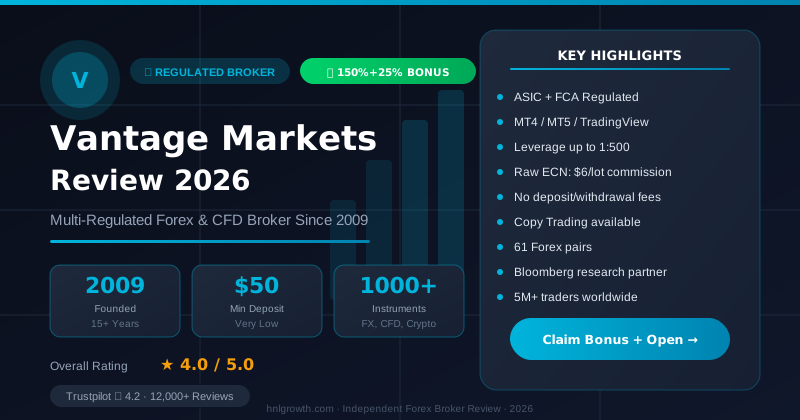
Vantage's maximum leverage depends on which regulated entity opens your account, not on a single advertised number. FCA-regulated clients (Vantage Global Prime LLP) are capped at 1:30 on major currency pairs under UK retail rules. ASIC-regulated clients (Vantage Global Prime Pty Ltd) face similarly conservative retail caps under Australian rules. Clients onboarded through Vantage's Vanuatu (VFSC) entity, which isn't subject to the same retail product-intervention rules, can access leverage up to 1:2000 according to Vantage's help centre. Which of these applies to you depends on your country of residence at signup, and it also varies by asset class within each entity.
Last verified: August 2026. Leverage rules can change with regulatory updates, so re-check the linked sources before you trade.
Current leverage limits by entity
Vantage operates through multiple regulated legal entities, and each one answers to a different regulator with different retail-client obligations. The entity you're assigned to is determined by your country of residence, not by which account type you pick.
| Entity | Regulator | Jurisdiction | Retail leverage on FX majors | Character of the cap |
|---|---|---|---|---|
| Vantage Global Prime LLP | FCA | United Kingdom | Up to 1:30 | Statutory retail cap; lower for other instruments |
| Vantage Global Prime Pty Ltd | ASIC | Australia | Subject to ASIC retail caps | Statutory retail cap under ASIC's product intervention regime; exact current schedule should be confirmed in your account terms |
| Vantage Global Limited (and other non-UK/non-AU entities) | VFSC | Vanuatu (offshore) | Up to 1:2000, per Vantage's help-centre guidance | Offshore jurisdiction; not subject to FCA/ASIC-equivalent retail caps or investor protections |
Vantage's regulations page also references additional entities, including South Africa and Mauritius (VIG Group), though public leverage schedules for those weren't detailed in the sources reviewed for this guide. If you're based outside the UK or Australia, don't assume you'll get VFSC-level leverage automatically — confirm the exact entity you're being onboarded to before funding an account.
The FCA's own leverage help article states plainly that "for retail clients, leverage can range from 1:1 to 30:1 for major currency pairs," with lower limits on other instruments. Vantage's APAC help article, by contrast, states that "all account types offer leverage options ranging from 1:100 to 1:2000." These are two genuinely different regimes, not a typo — one reflects UK retail regulation, the other reflects Vantage's broader, non-UK client base.
The APAC help article also references "Premium Unlimited accounts, which are eligible for leverage of up to 1:2,000,000,000." This tier is not explained in detail in publicly available material. The eligibility criteria, asset coverage, and account requirements for Premium Unlimited are not documented in the sources reviewed here, so confirm those details directly with Vantage support if you're considering this option.
Leverage by asset class
Leverage isn't a single number even within one entity. Regulators that impose retail caps (FCA, and Australia's product intervention order under ASIC) apply lower ceilings to riskier or more volatile instrument groups than to major FX pairs. This tiering is standard across FCA/ASIC-regulated CFD providers generally, not a Vantage-specific policy, and it's why you'll see wording like "leverage limits may be lower for other instruments" in Vantage's own FCA help article rather than a flat figure.
In practice, expect the ranking (highest cap to lowest) to run roughly:
- FX majors — highest available cap for the entity
- FX minors/exotics, gold and major indices — reduced from the majors cap
- Other commodities and minor indices — reduced further
- Single shares/stocks — reduced further still
- Crypto CFDs — lowest cap of any asset class
For FCA and ASIC clients, exact per-asset figures aren't published in a single consolidated Vantage table in the sources reviewed here, so confirm the live schedule in your account's contract specifications before sizing a trade. For VFSC-entity clients, Vantage's APAC help article also notes that "certain products may have fixed leverage" regardless of your account's headline setting — another reason to check the contract specification for the specific instrument you're trading, not just your account-level leverage figure.
Retail vs. professional classification
FCA and Australian rules both allow certain clients to be reclassified out of retail status — as an "elective professional" client under UK rules, or a wholesale/sophisticated client under Australian law — which removes the standard retail leverage caps. This is a general feature of UK and Australian financial regulation, not a leverage tier Vantage invented. Qualifying typically involves meeting tests around trading experience, portfolio size, or trading frequency, and it requires an active application, not a checkbox at signup.
Vantage's public leverage help articles don't set out entity-specific eligibility criteria or the exact leverage professional clients receive once reclassified. If this route matters to your trading plan, request written confirmation of the criteria and resulting leverage cap directly from Vantage support before assuming it changes your available leverage.
Margin and stop-out mechanics: worked examples
Leverage sets your required margin; it doesn't set your stop-out level directly — that's a separate account setting. Required margin is simply: notional position size ÷ leverage. The table below uses a standard 100,000-unit EUR/USD position (roughly a $10 per-pip value) to show how required margin, and the theoretical price move needed to fully consume that margin, changes across three leverage levels.
| Leverage | Notional position | Required margin | Approx. price move to consume 100% of margin |
|---|---|---|---|
| 1:30 | $100,000 | $3,333 | ~333 pips |
| 1:200 | $100,000 | $500 | ~50 pips |
| 1:1000 | $100,000 | $100 | ~10 pips |
Read this as a margin buffer illustration, not a stop-out guarantee. In practice, a broker's margin call and stop-out levels trigger well before your account equity reaches zero — most MT4/MT5 brokers apply a margin-call warning and an automatic stop-out at set percentages of used margin. Vantage's public leverage documentation reviewed here doesn't state its exact current margin-call and stop-out percentages, so confirm those figures directly in your account's terms or client portal before relying on this table for risk sizing. What the table does show reliably: at higher leverage, the same adverse price move consumes a much larger share of your available margin, which is why margin calls arrive faster as leverage increases, even though required margin at trade-open is lower.
Disclosure: This page may contain affiliate links. We may earn a commission if you open an account through our links, at no extra cost to you.
If your country of residence and trading style point you toward a specific Vantage entity and leverage tier, verify the exact entity assignment, asset-class schedule, and margin parameters in your account documentation. Open a Vantage account to see which entity and leverage level applies to you, or compare the account types available for your jurisdiction.
How to change your leverage setting
Vantage's help-centre content confirms that leverage is managed through the client portal and that it can be adjusted downward automatically if account requirements aren't met — for example, a 1:2000 setting dropping to 1:1000 or 1:500. Based on that guidance, the general process is:
- Log in to your Vantage client portal.
- Locate your live account's settings or account management section.
- Find the leverage option for that specific account.
- Select an available leverage tier for your account type and entity.
- Confirm and submit the change.
Vantage's public documentation doesn't specify whether a leverage change is blocked while you hold open positions, or whether there's a cooldown period between changes. Treat that as unconfirmed rather than assumed, and check current restrictions with Vantage support or in-portal guidance before relying on being able to change leverage mid-trade.
Why higher leverage isn't automatically better
The margin table above makes the risk mechanical rather than abstract: raising leverage from 1:30 to 1:1000 on the same position cuts your distance to a fully consumed margin from roughly 333 pips to roughly 10 pips. For a day trader, that's the difference between a bad session and an account wipeout on a single adverse move, particularly around news events or on lower-liquidity instruments where spreads widen. Higher leverage lowers your required capital per trade, but it doesn't change the notional risk you're carrying — it only changes how much of a buffer you have before that risk forces a liquidation.
This is also where the "up to 500:1" or similar headline figures circulating around Vantage need a direct caveat: those levels are only accessible through the non-tier-1 VFSC entity structure, not through FCA or ASIC onboarding. VFSC is an offshore jurisdiction and does not provide the same tier of regulatory oversight or investor protection as the FCA or ASIC. If you're a UK or Australian resident, this range is not something you can opt into by asking for it.
Separately, some user reviews reference account adjustments described as compliance actions affecting funds or leverage. There is no regulatory evidence confirming these claims in the sources reviewed for this guide. If this matters to your decision, ask Vantage support directly for its current margin-call, stop-out, and compliance-adjustment policy in writing before trading with high leverage.
Who this leverage structure is not for
If you're a UK or Australian resident expecting to trade at the higher leverage tiers commonly advertised for Vantage, you won't get them through your local regulated entity — that's a structural fact of FCA and ASIC retail rules, not a Vantage-specific restriction. Traders who need consistent leverage across a large notional book without hitting reduced-tier resets should also confirm the specific conditions that trigger an automatic leverage reduction, since Vantage's own documentation says this can happen if account requirements aren't met.
What to verify yourself before funding an account
- Which Vantage entity you'll be onboarded to, based on your country of residence, via the regulations page
- The current leverage schedule by asset class for that specific entity and account type, in your client portal's contract specifications
- The exact margin-call and stop-out percentages applied to your account type
- Whether elective-professional or wholesale-client reclassification is available to you, and what leverage it results in
- Any restrictions on changing leverage with open positions, confirmed directly with support
FAQ
What leverage is available at Vantage? It depends on your regulated entity. FCA clients get up to 1:30 on major FX pairs; VFSC (offshore) clients can access up to 1:2000 per Vantage's help-centre documentation; ASIC clients are subject to Australia's own retail leverage caps, which should be confirmed in your account terms.
Does leverage differ by asset class? Yes. Within any single entity, FX majors carry the highest available cap, with minors, commodities, indices, shares, and crypto CFDs stepped down from there. Vantage also notes that some products carry fixed leverage regardless of your account setting.
Can I request a leverage change? Leverage is managed through the client portal, and Vantage's documentation confirms it can be adjusted based on account requirements. Vantage hasn't published whether open positions or cooldowns restrict changes, so confirm that directly with support.
Why is my leverage capped lower than advertised? If you're onboarded to the FCA or ASIC entity, statutory retail leverage caps apply by law and are materially lower than the VFSC entity's range. The FCA cap is set by UK product intervention rules; the ASIC cap is set by Australia's product intervention order. This is a regulatory distinction, not a Vantage-specific penalty.
If you've confirmed your entity assignment and understand the margin mechanics that apply to your account, the next decision is whether Vantage's leverage structure matches your position-sizing and risk-management approach. Compare Vantage account types to see the full account specifications for your jurisdiction.
Update History
- 15 Aug 2026 — Corrected Pro ECN pricing, entity count, and FSCA license number referenced in this article.
Editorial Verification Process
This article is fact-checked against Vantage's official documentation, following our 7-criteria broker review methodology. We have not completed a funded live-account test covering this specific feature — where a claim depends on live-account behavior, we cite Vantage's official terms and independently-reported user experience rather than presenting it as something we personally verified. See our broker review methodology for the full source hierarchy.
Risk warning: CFDs and leveraged forex products are complex and carry a high risk of losing money. Check the terms, entity and protections that apply to your jurisdiction before trading.
Related Vantage Markets Guides
Ready to Trade with Vantage Markets?
Vantage Markets is a multi-regulated forex & CFD broker (FCA, ASIC, FSCA, CIMA, VFSC, FSC) trusted by 5 million+ traders, with Raw ECN pricing from $3/lot, no deposit/withdrawal fees, and full MT4/MT5/TradingView support.
Risk disclaimer: Vantage Markets is a live, regulated broker — trading forex and CFDs is done with real capital under normal market risk (this is not a simulated prop-firm evaluation). CFDs and leveraged forex products are complex instruments and carry a high risk of losing money rapidly due to leverage; most retail investor accounts lose money trading these products. Consider whether you understand how CFDs/forex work and whether you can afford the high risk of losing your money. Affiliate disclosure: HNL Growth earns a commission when you open a Vantage Markets account through links on this page.