Best High-Leverage Forex Brokers in 2026
Best High-Leverage Forex Brokers in 2026. An independent, fact-checked look at Vantage Markets for traders evaluating this broker.
Reviewed using our forex & CFD broker review methodology
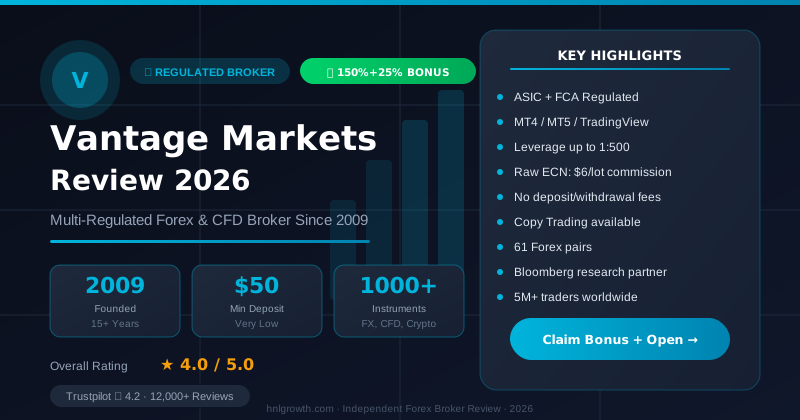
High leverage in forex isn't really a broker feature — it's a jurisdiction feature. A regulated retail entity in the UK, EU, or Australia is legally capped at roughly 30:1 on major currency pairs, while an offshore-regulated entity of the same brand (Seychelles, Vanuatu, Mauritius, and similar) can advertise 200:1, 500:1, or higher to retail clients. The practical question for an active trader isn't "which broker has the biggest leverage number," it's "which legal entity of that broker will actually onboard me, at what leverage, with what margin-call behavior, and with or without negative balance protection." This guide works through that decision in order: leverage mechanics, jurisdiction caps, margin math, and protections — before any account comparison.
Leverage Explained
Leverage lets you control a position larger than your deposited capital. A 30:1 ratio means $1 of margin controls $30 of notional exposure; at 500:1, that same $1 controls $500. The upside is capital efficiency — you can take a meaningful position size without tying up the full notional value. The downside is that losses scale with the same ratio as gains, calculated against your margin, not against the full notional value.
Here's the mechanic that matters most for risk sizing: an adverse price move gets multiplied by your leverage ratio when measured against the margin you've committed. A 1% move against a 30:1 position costs you roughly 30% of the margin allocated to that trade. The same 1% move against a 500:1 position wipes out the entire margin and can exceed it.
The table below is an illustrative calculation, not a broker-specific figure, showing how equity allocated to a position erodes as leverage increases:
| Leverage | 0.5% adverse move | 1% adverse move | 2% adverse move |
|---|---|---|---|
| 30:1 | -15% of margin used | -30% of margin used | -60% of margin used |
| 100:1 | -50% of margin used | -100% (margin fully lost) | -200% (exceeds margin — potential negative balance if unprotected) |
| 200:1 | -100% (margin fully lost) | -200% (exceeds margin) | -400% (exceeds margin) |
| 500:1 | -250% (exceeds margin) | -500% (exceeds margin) | -1,000% (exceeds margin) |
At 200:1 and 500:1, a single 1-2% move against you can consume more than the margin you allocated to that position — which is precisely why negative balance protection and margin call behavior matter as much as the headline leverage number (both covered further down).
The other point worth being explicit about: leverage limits attach to the legal entity you're onboarded under, not the marketing brand. Many multi-entity brokers, including Vantage, operate more than one regulated entity across different jurisdictions. For its UK-regulated retail entity, Vantage states that leverage for retail clients "can range from 1:1 to 30:1 for major currency pairs," with lower limits on other instruments, according to its official leverage help center article. That figure applies specifically to that regulated entity and account type — it is not a global statement about every entity operating under the Vantage name, and any leverage figure quoted for a different regulator or entity would need to be confirmed on that entity's own terms page before you rely on it.
Leverage Limits by Jurisdiction
Leverage caps are set by regulators, not by broker preference, and they apply to the specific regulated entity a client account sits under.
| Jurisdiction / regulator | Retail leverage cap (major FX pairs) | Professional-client leverage | Notes |
|---|---|---|---|
| UK (FCA) | Up to 30:1 | Higher, on a case-by-case reclassification basis | Lower caps typically apply to minor pairs and other asset classes |
| EU (ESMA-aligned national regulators, e.g., CySEC) | Up to 30:1 | Higher, on a case-by-case reclassification basis | Caps have applied since ESMA's 2018 product intervention measures, made permanent by national regulators |
| Australia (ASIC) | Up to 30:1 | Higher for wholesale/professional clients | ASIC tightened retail CFD leverage rules in 2021 |
| United States (NFA/CFTC) | Up to 50:1 major pairs, 20:1 minor pairs | Not applicable in the same way — the US framework doesn't offer a retail-to-professional leverage upgrade path for forex | Set by NFA Compliance Rule 2-43(b) for NFA member firms |
| Offshore entities (Seychelles FSA, Vanuatu FSC, Mauritius FSC, BVI FSC, and similar) | Commonly 200:1 to 500:1+ | Not typically applicable | Regulatory oversight and dispute-resolution mechanisms are generally lighter than in the categories above |
Regulatory leverage frameworks are periodically revised, so treat the caps above as the general current picture rather than a fixed rule, and verify the specific figure with the regulator or the broker's own current disclosures before trading.
Professional-client accounts, briefly: the higher leverage tiers you'll see quoted for FCA, CySEC, or ASIC-regulated entities aren't freely available to any retail applicant — they require reclassification as a "professional" or "elective professional" client, typically based on criteria like trading frequency, portfolio size, or relevant financial industry experience. Qualification criteria are set by each firm within the regulator's framework and are not standardized across brokers, so if a professional account is part of your plan, confirm the specific criteria directly with the broker rather than assuming eligibility.
Margin Requirements
Leverage and required margin are two sides of the same calculation. Required margin is the amount your account needs to set aside to open a position, and it's derived directly from the leverage ratio:
Required margin = (Lot size × contract size × price) ÷ Leverage
Worked example, using 1 standard lot of EUR/USD (100,000 units) at a price of 1.1000:
- At 30:1 leverage: (100,000 × 1.1000) ÷ 30 = $3,666.67 required margin
- At 100:1 leverage: (100,000 × 1.1000) ÷ 100 = $1,100.00 required margin
- At 500:1 leverage: (100,000 × 1.1000) ÷ 500 = $220.00 required margin
The lower the required margin, the smaller the deposit needed to open the same position size — and the smaller the price move needed to erode that margin entirely, which is the same relationship shown in the loss-magnification table earlier in this guide.
There's a second margin concept that matters more once a trade is open: maintenance margin, tracked via your account's margin level (equity divided by used margin, expressed as a percentage). When margin level falls to a broker-defined "margin call" threshold, the broker typically warns you or restricts new positions. If it keeps falling to a lower "stop-out" threshold, the broker will begin closing positions automatically to prevent the account from going further negative. These thresholds are set independently by each broker in its own margin policy and vary by entity, account type, and sometimes by instrument — there's no single industry-standard figure, so this is a document to read on the specific entity's site rather than a number to assume.
Negative Balance Protection and Other Safeguards
Negative balance protection (NBP) caps your maximum loss on an account at the funds you've deposited — without it, a large enough adverse move at high leverage can leave you owing the broker more than your deposit, particularly relevant given the 100%+ equity impacts shown in the loss-magnification table above.
NBP is not universal, and it is not automatically inherited across every entity that shares a brand name. It's typically a condition attached to specific regulatory regimes — commonly required for FCA and ASIC-regulated retail entities, for example — and offshore siblings of the same broker frequently do not carry the same guarantee, or apply it on different terms. This is one of the most important things to confirm in writing (via the entity's terms, Key Facts Statement, or Product Disclosure Statement) before trading at higher leverage tiers, rather than assuming it carries over from a regulated sibling entity.
Vantage Markets UK Ltd states that it provides "negative balance protection, price alerts and stop loss tools" as part of its risk management features, according to its official UK forex trading page. That statement applies to the UK FCA-regulated entity; if you're evaluating a different Vantage entity or a different broker's offshore entity, confirm the equivalent protection separately rather than assuming it applies.
Disclosure: This page may contain affiliate links. We may earn a commission if you open an account through our links, at no extra cost to you.
If you've identified the jurisdiction and entity you'd actually be eligible to trade under, confirmed the leverage cap that applies to you, and reviewed the margin and protection terms for that specific entity, you can open a Vantage account to access the broker's UK FCA-regulated offering. The site notes that Vantage offers MT4 and MT5 platform access, over 40 currency pairs, and Raw ECN account spreads described as starting "from 0.0" — a floor figure rather than a typical average, so treat it as a starting point for your own verification of current live pricing rather than an expected cost. Note that commission charges apply to Raw ECN accounts and are not reflected in the spread figure alone.
Evaluating Brokers by Regulatory Category
Rather than repeat unverified per-brand leverage numbers, the table below organizes by regulatory category — the variable that actually determines what leverage you're eligible for — so you can identify which category applies to you before comparing named brokers.
| Regulatory category | Typical retail major-pair leverage cap | Professional-client potential | Negative balance protection |
|---|---|---|---|
| FCA (UK) | Up to 30:1 | Higher, subject to professional reclassification criteria set by the firm | Commonly applies to FCA-authorised firms; confirm per entity |
| CySEC / ESMA-aligned (EU) | Up to 30:1 major pairs | Higher, subject to professional reclassification | Commonly applies to CySEC retail clients; confirm per entity |
| ASIC (Australia) | Up to 30:1 major pairs (retail) | Higher for wholesale/professional clients | Varies by firm; confirm in the PDS |
| NFA/CFTC (United States) | Up to 50:1 major pairs, 20:1 minor pairs | No equivalent retail-to-professional leverage carve-out under current US rules | Not a standard requirement; check the firm's disclosures |
| Offshore entities (e.g., Seychelles FSA, Vanuatu FSC, Mauritius FSC, BVI FSC) | Commonly 200:1 to 500:1+ offered directly to retail clients | Not typically applicable — high leverage is already offered at retail | Frequently absent or limited; confirm in the entity's own terms |
When comparing brokers, identify which of their regulated entities would actually onboard a client with your residency, then check that entity's own current leverage and margin disclosures on the relevant regulator's public register (for example, the FCA Register for UK entities or ASIC Connect for Australian entities) rather than relying on a headline number attached to the brand as a whole.
High-Leverage Broker Shortlist: 8 Names Traders Commonly Compare
Once you know which regulatory category applies to you, it's useful to see how specific brand names map onto that framework — not as a ranked "best" list, but as a starting point for your own verification. Every broker below operates multiple entities, and the leverage figure that actually applies to you depends entirely on which entity onboards you. Figures below are directional and were not independently re-verified for every entity at the time of writing; confirm the current number on each entity's own terms page before assuming it applies to you.
| Broker | Regulated entity tier available | Offshore/higher-leverage entity available | Reported offshore leverage range | Negative balance protection (regulated entity) |
|---|---|---|---|---|
| JustMarkets | Entity and licence depend on country | Eligible entities may offer higher leverage | Published up to 1:3000 — verify current entity and terms | Confirm for your exact entity |
| Vantage Markets | Yes — FCA (UK), ASIC (Australia) | Yes — VFSC (Vanuatu), other entities | Reported up to 1:2000 on some entities per Vantage's own disclosures — confirm current figure and entity | Yes, on FCA-regulated entity per its UK forex trading page |
| Pepperstone | Yes — FCA, ASIC | Yes — via other group entities in some regions | Varies by entity; not independently verified for this article | Yes, on FCA/ASIC-regulated entities; confirm per entity |
| IC Markets | Yes — ASIC, CySEC | Yes — Seychelles FSA entity | Commonly reported up to 1:1000 on the Seychelles entity — not independently verified for this article | Confirm per entity; not assumed |
| XM Group | Yes — CySEC | Yes — other group entities | Commonly reported up to 1:1000 on non-EU entities — not independently verified for this article | Confirm per entity; not assumed |
| Exness | Entity availability varies; official disclosure lists Seychelles, Curaçao, BVI, Belize and Mauritius entities | Yes, only where eligible and permitted | Exness advertises high or 1:Unlimited leverage in some conditions; actual cap depends on entity, equity, instrument and regulation | Confirm per entity; not assumed |
| FP Markets | Yes — ASIC, CySEC | Yes — other group entities | Not independently verified for this article | Confirm per entity; not assumed |
| IG Group | Yes — FCA, ASIC, NFA/CFTC (US) | No widely-marketed high-leverage offshore retail entity identified | Not applicable in the same way — IG's structure leans toward top-tier-regulated entities | Yes, on FCA/ASIC-regulated entities; confirm per entity |
| XTB | Yes — FCA (UK), KNF (Poland/EU passport) | No widely-marketed high-leverage offshore retail entity identified | Not applicable in the same way | Yes, on FCA/EU-regulated entities; confirm per entity |
How to read this table: the "reported offshore leverage range" column reflects figures commonly cited in industry sources, not numbers independently re-confirmed against each broker's live terms page for this article. Treat every cell as a starting point for your own verification, not a claim you can act on directly — leverage terms, entity structures, and eligibility change, sometimes without much notice. Vantage is included here because it publishes this site, not because it tops this table on leverage or protections; IG and XTB, for example, lean toward top-tier regulation rather than headline leverage, which may suit a different priority than the one this guide is framed around.
JustMarkets publishes leverage up to 1:3000 on eligible entities, but that figure must not be treated as universal. Confirm the entity, balance-based cap, margin-call level, stop-out level, and negative-balance terms before using any higher-leverage account. Check JustMarkets account options if its entity-specific terms fit your jurisdiction and risk plan.
Compare Vantage account types if the FCA-regulated, 30:1-capped tier with confirmed negative balance protection fits what you're looking for — or use the verification steps above to check any of the other seven names against your own residency and risk tolerance.
Who High Leverage Is Unsuitable For
High leverage is a tool for a specific kind of trading approach, not a universal upgrade. It's generally a poor fit for:
- Undercapitalized accounts. As the margin math above shows, a small account at high leverage has very little room between "normal volatility" and a margin call or stop-out. A larger position size doesn't fix undercapitalization — it just moves the liquidation point closer.
- Inexperienced traders. Understanding leverage mechanics on paper is different from managing a position where a routine 1-2% market move can erase the entire margin allocated to it in minutes. This is a skill built with small size and tight risk controls, not a starting point.
- Traders with low risk tolerance. If a fast, unplanned loss would materially affect your financial situation or decision-making, high leverage amplifies exactly the outcome you're trying to avoid.
- Strategies that need wide stops. Swing or position trades that require stop-loss distances of several percent are structurally incompatible with very high leverage, since a normal, expected retracement can trigger stop-out well before the trade thesis has played out.
- Anyone unclear on their broker's negative balance protection status. Trading at 200:1-500:1 without confirmed protection means a bad move can leave you owing money beyond your deposit — a materially different risk profile than a protected account at the same leverage.
None of this means high leverage is never appropriate — short-duration, tightly-stopped strategies with clearly defined position sizing are the use case it's built for. It means the suitability question should be answered before the broker-selection question, not after.
FAQ
What leverage should I use for my trading style? There's no single correct figure — it depends on your stop-loss distance, position size, and how much of your account you're willing to risk per trade. A useful discipline is sizing positions so that your intended stop-loss, not your broker's maximum leverage, determines how large a position you take.
Can I lose more than my deposit? Yes, if your account is not covered by negative balance protection and a fast enough adverse move occurs before your position is closed. Where NBP applies, your loss is capped at your deposited funds; where it doesn't, it isn't. This varies by entity — confirm it directly rather than assuming it.
What's the difference between regulated (30:1) and offshore (200:1-500:1+) brokers? Regulated retail entities in the UK, EU, and Australia are capped near 30:1 on major pairs by their regulator, generally alongside compensation schemes, dispute-resolution mechanisms, and (commonly) negative balance protection. Offshore entities can offer materially higher leverage to retail clients, typically with lighter regulatory oversight and protections that need to be confirmed individually rather than assumed.
How do margin calls and stop-out levels work? A margin call is a warning (or restriction) triggered when your margin level falls to a broker-defined threshold. A stop-out is a lower threshold at which the broker begins closing positions automatically. Both thresholds are set by each broker in its own margin policy and differ by entity and account type — there's no fixed industry number to rely on.
What are typical spreads and commissions on EUR/USD and XAU/USD? This varies by broker, account type, and market conditions, and published "from" figures on a broker's marketing page are typically the tightest observed spread, not a guaranteed average. Check the broker's current live pricing page, and factor in commission (where applicable) and overnight swap charges if you hold positions beyond the same trading day, since total cost includes financing charges not captured by spread and commission alone.
Is the broker regulated, and what protection do I have? Check the regulator's own public register (for example, the FCA Register or ASIC Connect) directly, rather than relying on a broker's marketing page or a third-party trust score, since license status and entity names can change.
Does the broker support MT4, MT5, or cTrader? Platform availability differs by broker and sometimes by entity. Vantage's official forex trading page confirms MT4 and MT5 access; for other brokers or platforms like cTrader, check the specific broker's current platform page.
Can I trade with Expert Advisors or scalp without restriction? This depends on the broker's account terms and sometimes on the specific account type. Rules on EA use, minimum hold times, and strategies like grid or martingale trading are set out in each broker's own terms and conditions — read the current version for the account type you'd actually open rather than assuming a policy from general reputation.
What's the minimum deposit and are there inactivity fees? These figures change and differ by broker and account type, so check the broker's current official pricing or account page rather than an older third-party summary.
How does leverage scale with account balance? Some brokers reduce maximum leverage as account equity rises (tiered caps), to limit exposure on larger accounts. Whether a specific broker uses tiered caps, and at what balance thresholds, needs to be confirmed directly with that broker, since this isn't standardized across the industry.
Summary
High leverage is determined by the regulated entity you trade under, not by the broker's brand name. UK, EU, and Australian retail clients are typically capped at 30:1 on major pairs, while offshore entities can offer 200:1 to 500:1 or higher. Before comparing brokers, identify which entity would onboard you based on your residency, verify its current leverage cap and negative balance protection status on the regulator's own register, and confirm margin call and stop-out thresholds in the entity's official terms. The margin mechanics and loss-magnification examples provided earlier in this guide show why these details matter as much as the headline leverage number.
If you're ready to explore a regulated UK option, compare Vantage account types to review the leverage, spreads, and protections available under the FCA-regulated entity.
Editorial Verification Process
Broker facts in this comparison are checked against each broker's official documentation and public regulator registers, using our 7-criteria broker review methodology. This ranking is based on published terms, conditions, and regulatory status — not a funded live-account test of every broker listed. Where we discuss Vantage specifically, see our broker review methodology for the full source hierarchy and what "verified" means on this site.
Risk warning: CFDs and leveraged forex products are complex and carry a high risk of losing money. Check the terms, entity and protections that apply to your jurisdiction before trading.
Related Vantage Markets Guides
Ready to Trade with Vantage Markets?
Vantage Markets is a multi-regulated forex & CFD broker (FCA, ASIC, FSCA, CIMA, VFSC, FSC) trusted by 5 million+ traders, with Raw ECN pricing from $3/lot, no deposit/withdrawal fees, and full MT4/MT5/TradingView support.
Risk disclaimer: Vantage Markets is a live, regulated broker — trading forex and CFDs is done with real capital under normal market risk (this is not a simulated prop-firm evaluation). CFDs and leveraged forex products are complex instruments and carry a high risk of losing money rapidly due to leverage; most retail investor accounts lose money trading these products. Consider whether you understand how CFDs/forex work and whether you can afford the high risk of losing your money. Affiliate disclosure: HNL Growth earns a commission when you open a Vantage Markets account through links on this page.