Best Regulated Forex Brokers in 2026
Best Regulated Forex Brokers in 2026. An independent, fact-checked look at Vantage Markets for traders evaluating this broker.
Reviewed using our forex & CFD broker review methodology
A forex broker is only "regulated" if a specific legal entity holds an active, verifiable license from a named financial authority—FCA, ASIC, CySEC, MAS, or NFA—that you can look up on that regulator's public register right now. Marketing claims about "regulation" mean nothing until you confirm the entity name, license number, and jurisdictional scope yourself. The same brand can operate multiple entities under different regulators, each with different client protections, leverage caps, and compensation ceilings, so knowing which entity serves your country is the only way to assess actual safety. This guide walks through how to verify licenses in under five minutes, explains what each major regulator actually requires, and profiles brokers whose entity-level licensing we've checked against official sources at time of publication.
What "Regulated" Actually Means (and What It Doesn't Promise)
Regulation is a legal framework, not a quality seal. When a forex broker says it's regulated, the claim means a specific corporate entity has been licensed by a financial authority to offer forex and CFD products in defined jurisdictions. That license comes with enforceable obligations: client fund segregation, capital adequacy rules, audit requirements, and complaint procedures.
What regulation does not guarantee:
- Profit or positive returns. Regulation governs how brokers operate, not whether your trades make money.
- Zero complaints or perfect service. Licensed brokers can still have disputes; regulation provides a recourse pathway, not complaint immunity.
- Unlimited compensation. Compensation schemes, where they exist, typically cap protection. Amounts above these ceilings may not be recoverable if the broker fails.
- Universal application. A broker licensed by the FCA to serve UK clients operates under different rules than the same brand's CySEC entity serving EU traders or its ASIC entity serving Australians.
The value of regulation lies in verifiable accountability: you can check the license on an official register, confirm which entity you're signing up with, and escalate complaints to an external authority if the broker doesn't resolve them internally.
How to Verify a Broker's License Yourself in Under Five Minutes
Before funding any account, verify the broker's regulatory status directly on the regulator's public register. Marketing pages can be outdated or misleading; the register is the source of truth.
Step-by-Step Verification Checklist
Find the legal entity name. Check the broker's "About Us," "Legal," or "Regulation" page. Look for phrases like "operated by" or "authorized and regulated by." Note the exact legal entity name—it's often not the same as the brand name.
Note the license or registration number. This is usually a 6–8 digit reference (FCA), a 5-digit number (CySEC), or an ACN/AFSL pair (ASIC).
Go to the regulator's public register:
- FCA (UK): register.fca.org.uk
- ASIC (Australia): connectonline.asic.gov.au
- CySEC (Cyprus): cysec.gov.cy/en-GB/entities/investment-firms/
- MAS (Singapore): eservices.mas.gov.sg/fid
- NFA (US): nfa.futures.org/basicnet
Search by entity name or license number. Confirm the status is "Authorized" or "Current," not "Suspended," "Withdrawn," or "No Longer Authorised."
Check permitted activities. The register will list what the firm is allowed to do—retail forex, CFDs, investment advice, etc. If forex/CFD dealing isn't listed, the license doesn't cover your intended activity.
Verify jurisdiction. Some licenses only permit business in specific countries. An offshore entity licensed by VFSC (Vanuatu) or FSC (Belize) may not offer the same protections as FCA or ASIC, even if it's technically "regulated."
If any step fails—entity name doesn't match, license number not found, status inactive—do not fund the account. No marketing claim replaces a current register entry.
Regulator-by-Regulator Comparison: What Each Authority Actually Requires
Not all regulatory frameworks are equal. Tier-1 regulators (FCA, ASIC, MAS, NFA) impose stricter capital, reporting, and client-protection rules than offshore authorities. Here's what each major regulator mandates:
| Regulator | Retail Leverage Cap (Majors) | Fund Segregation Required | Compensation Scheme + Ceiling | Negative Balance Protection | Jurisdiction |
|---|---|---|---|---|---|
| FCA (UK) | 1:30 | Yes (segregated Tier 1 banks) | FSCS: eligibility case-by-case | Required for retail | United Kingdom |
| ASIC (Australia) | 1:30 | Yes | FCS applies to ADIs only; most CFD brokers not covered | Not mandated by regulation | Australia |
| CySEC (Cyprus) | 1:30 | Yes (ESMA rules) | ICF: eligibility case-by-case | Required for retail (ESMA) | Cyprus, EU passporting |
| MAS (Singapore) | 1:20 forex, lower for other CFDs | Yes | No statutory compensation scheme for forex/CFD clients | Not mandated | Singapore |
| NFA/CFTC (US) | 1:50 forex | Yes | No compensation scheme; broker must maintain net capital | Not mandated | United States |
Key Distinctions
FCA (Financial Conduct Authority, UK): The FCA enforces leverage caps (1:30 on major forex pairs, 1:20 on non-major pairs and gold, 1:10 on indices, 1:5 on equity CFDs), mandatory negative balance protection for retail clients, and client fund segregation at authorized banks. The FCA publishes a public register of authorized firms and a separate warning list of unauthorized entities. Clients may be eligible for compensation through the Financial Services Compensation Scheme (FSCS) if the broker fails and cannot return funds; eligibility is assessed case-by-case.
ASIC (Australian Securities and Investments Commission): ASIC imposes a 1:30 leverage cap on major currency pairs, 1:20 on indices, 1:10 on commodities, 1:5 on equities, and 1:2 on crypto CFDs. Client funds must be segregated in Australian trust accounts. The Financial Claims Scheme (FCS) covers eligible deposits up to AU$250,000, but only for authorized deposit-taking institutions (ADIs). Most CFD brokers are not ADIs, so FCS coverage typically does not apply to forex or CFD accounts.
CySEC (Cyprus Securities and Exchange Commission): CySEC-licensed brokers follow ESMA product intervention rules, including the same 1:30 leverage cap and negative balance protection. The Investor Compensation Fund (ICF) may provide compensation if the broker cannot meet its obligations; eligibility and claim limits are assessed case-by-case. Many CySEC firms passport their licenses across the EU, but Brexit ended UK access to this passporting.
MAS (Monetary Authority of Singapore): MAS-regulated brokers face a stricter 1:20 leverage cap on forex and lower caps on other CFDs. Fund segregation is required, but there is no statutory compensation scheme for retail forex/CFD losses. MAS publishes a Financial Institutions Directory listing all licensed entities.
NFA/CFTC (US): US brokers must register with the NFA and maintain net capital requirements under CFTC oversight. Leverage is capped at 1:50 for major pairs and 1:20 for exotics. Client funds must be segregated, but there is no government-backed compensation fund. US regulation also prohibits hedging (holding simultaneous long and short positions in the same pair) and limits access to certain forex pairs and CFDs.
Professional vs. Retail Accounts
Most regulators define a "retail client" by default. To qualify as a professional client (or "elective professional" under FCA/CySEC), you typically must meet criteria that may include significant trading experience, portfolio size, and relevant professional qualifications. Specific thresholds vary by regulator and should be verified on the regulator's official site before application.
Professional classification removes leverage caps and may remove negative balance protection and compensation-scheme eligibility. You accept higher risk in exchange for greater flexibility. Check the specific regulator's rules before applying for professional status.
The Shortlist: Entity-Level Regulatory Profiles
The brokers below have been selected based on publicly verifiable regulation at the entity level. We checked each broker's official legal/regulatory disclosure page at the time of writing (May 2026). This is not an exhaustive list of all regulated brokers; it reflects those we reviewed during this research pass.
Note: The same brand may operate multiple entities under different regulators. The entity you sign up with depends on your country of residence. Always confirm which legal entity serves your jurisdiction before opening an account, and verify the entity's current regulatory status on the relevant regulator's public register.
Disclosure: This page may contain affiliate links. We may earn a commission if you open an account through our links, at no extra cost to you. All regulatory information should be independently verified before making any trading decision.
Vantage Markets
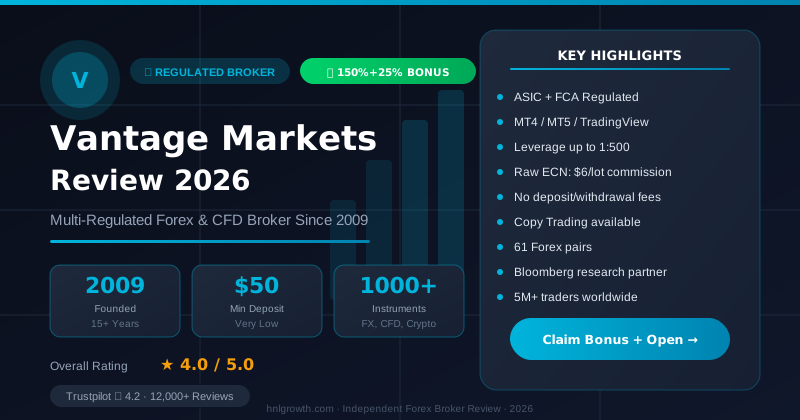
Entities: According to Vantage Markets' About page, the Vantage group operates under multiple regulatory licenses globally, including ASIC (Australia), FCA (UK), FSCA (South Africa), and VFSC (Vanuatu). Readers should verify the specific entity name, license number, and current regulatory status on the relevant regulator's public register for their jurisdiction before opening an account.
Instruments: Forex pairs, commodities (including spot gold via XAU/USD, XAU/USD247, XAU/AUD, XAU/EUR, XAU/JPY), indices, share CFDs, ETF CFDs, bonds. Vantage offers ECN pricing on its Raw ECN account, with spreads from 0.0 pips plus commission and other trading fees.
Platforms: MT4, MT5, TradingView, Vantage Web Trading, Vantage App (mobile).
Client Protections: Segregated client funds (where required by jurisdiction). The specific protections, compensation scheme eligibility, and leverage caps that apply to your account depend on which Vantage entity serves your country. Verify these details on the entity's regulatory disclosure page and with the relevant regulator.
Why It's Included: Multi-jurisdictional licensing structure with regulatory coverage including ASIC and FCA entities. Competitive ECN spreads and a range of platforms suitable for active traders.
Limitations: Entity and license verification required per jurisdiction. Protections vary by entity.
IG Group
Entities: IG Markets Ltd (UK), IG Markets Limited (Australia), IG US LLC (US). Entity names and license numbers should be verified on the broker's legal disclosure page and cross-checked against the relevant regulator's public register (FCA, ASIC, NFA) before opening an account.
Instruments: 80+ currency pairs, 40+ indices, commodities, shares, options, ETFs. IG operates both a spread-betting arm (UK) and a CFD/DMA service.
Client Protections: Segregated client funds. Protections vary by entity and jurisdiction. Verify compensation scheme eligibility, negative balance protection, and leverage caps for the specific entity serving your country.
Why It's Included: Established 1974; one of the longest-regulated brokers in the industry. Multi-entity structure with clear jurisdiction separation.
Limitations: Spreads can be wider than ECN brokers. Inactivity fees may apply.
Pepperstone
Entities: Pepperstone Financial Services Limited (UK), Pepperstone Group Limited (Australia). Entity names and license numbers should be verified on the broker's legal disclosure page and cross-checked against the relevant regulator's public register (FCA, ASIC) before opening an account.
Instruments: Forex, indices, commodities, shares, crypto CFDs. Razor account offers ECN pricing with commission.
Client Protections: Segregated funds. Protections vary by entity. Verify compensation scheme eligibility for the entity serving your jurisdiction; FCS coverage typically does not apply to CFD brokers in Australia.
Why It's Included: Tight spreads, low commission, and support for cTrader and MT4/MT5. Active-trader favorite.
Limitations: Compensation scheme participation varies by entity. Professional client reclassification removes retail protections.
XTB
Entities: XTB Limited (UK), XTB S.A. (Poland, passported across EU). Entity names and license numbers should be verified on the broker's legal disclosure page and cross-checked against the relevant regulator's public register (FCA, KNF) before opening an account.
Instruments: Forex, indices, commodities, shares, ETFs. Proprietary xStation 5 platform alongside MT4.
Client Protections: Segregated funds. Protections vary by entity and jurisdiction. Verify compensation scheme eligibility for the entity serving your country.
Why It's Included: Educational resources and competitive spreads on major pairs.
Limitations: Limited to xStation or MT4; no MT5 or cTrader. EU entity operates under different regulatory framework than UK entity.
Interactive Brokers (IBKR)
Entities: Interactive Brokers (U.K.) Limited (UK), Interactive Brokers LLC (US). Entity names and license numbers should be verified on the broker's legal disclosure page and cross-checked against the relevant regulator's public register (FCA, SEC, FINRA) before opening an account.
Instruments: Forex, stocks, options, futures, bonds, funds. Direct market access to over 150 markets globally.
Client Protections: Segregated funds. Protections vary by entity and jurisdiction. Verify compensation scheme eligibility, insurance coverage, and leverage caps for the specific entity serving your country.
Why It's Included: Institutional-grade execution, transparent pricing, and broad asset coverage. Suited for professional or high-net-worth traders.
Limitations: Complex platform (TWS); steep learning curve for beginners. Account minimums vary by entity.
CMC Markets
Entities: CMC Markets UK plc (UK), CMC Markets Stockbroking Limited (Australia). Entity names and license numbers should be verified on the broker's legal disclosure page and cross-checked against the relevant regulator's public register (FCA, ASIC) before opening an account.
Instruments: Forex, indices, commodities, shares, treasuries. Proprietary Next Generation platform.
Client Protections: Segregated funds. Protections vary by entity. Verify compensation scheme eligibility for the entity serving your jurisdiction.
Why It's Included: Strong UK presence, proprietary platform with advanced charting.
Limitations: Spreads less competitive than ECN brokers. Platform lock-in (no MT4/MT5 support).
Client Fund Protections, by Jurisdiction
Understanding how your funds are protected requires separating three distinct mechanisms: segregation, compensation schemes, and negative balance protection. They are not the same, and not all apply automatically.
Segregation
Segregation means the broker keeps client funds in separate accounts from its own operating capital. If the broker fails, client funds are not available to general creditors. FCA, ASIC, CySEC, MAS, and NFA all require segregation, but the quality of segregation depends on where the funds are held (Tier 1 banks vs. smaller institutions) and how frequently the broker reconciles accounts.
What segregation does: Protects client funds from broker insolvency to the extent they were properly segregated before failure.
What it doesn't do: Guarantee instant return of funds or cover losses from trading. Segregation is an accounting rule, not insurance.
Compensation Schemes
Compensation schemes are government- or industry-backed funds that may repay eligible clients if a regulated firm fails and client funds cannot be returned. Eligibility, coverage limits, and claim processes vary by jurisdiction and must be verified for the specific entity and regulator involved.
UK (FCA): The Financial Services Compensation Scheme (FSCS) may cover eligible claims. Eligibility and claim limits are assessed case-by-case. Not all forex/CFD losses qualify.
Cyprus (CySEC): The Investor Compensation Fund (ICF) may provide compensation if the broker cannot meet its obligations. Eligibility and claim limits are assessed case-by-case.
Australia (ASIC): The Financial Claims Scheme (FCS) covers eligible deposits at authorized deposit-taking institutions (ADIs), but most CFD brokers are not ADIs, so FCS coverage typically does not apply to forex or CFD accounts. Check whether your broker is an ADI and participates in the FCS before assuming coverage.
Singapore (MAS): No statutory compensation scheme for retail forex/CFD clients.
US (NFA): No compensation fund for forex. Broker failures are handled through liquidation and SIPC (for securities) but not forex-specific claims.
Key Insight: Being regulated does not automatically mean your deposits are covered by a compensation scheme. You must confirm scheme applicability and claim eligibility for the specific entity you sign up with by checking the regulator's official documentation.
Negative Balance Protection
Negative balance protection prevents your account balance from falling below zero during extreme market volatility or gapping. If a position closes at a loss greater than your account equity, the broker absorbs the deficit instead of pursuing you for it.
FCA, CySEC: Mandatory for retail clients.
ASIC: Not mandated by regulation. Some brokers offer it voluntarily; check individual broker terms.
MAS, NFA: Not mandated. Check individual broker terms.
Professional Clients: Often excluded from negative balance protection. Professional reclassification removes this safety net.
Leverage, Spreads, and Costs at a Glance
Regulatory jurisdiction determines your maximum leverage, but broker choice determines actual spreads, commissions, and overnight financing rates. The table below reflects information from broker disclosures reviewed in May 2026. Spreads, fees, and terms can change; verify current pricing on the broker's official fee schedule before opening an account.
| Broker | Account Type | Typical Spread Example | Commission | Minimum Deposit | Retail Leverage (FCA/ASIC) |
|---|---|---|---|---|---|
| Vantage Markets | Raw ECN | From 0.0 pips (variable) | Yes (plus other trading fees) | $50 | Varies by entity (check entity terms) |
| IG Group | Standard | Variable | None on standard | Varies by entity | Varies by entity |
| Pepperstone | Razor | Variable | Yes | Varies by entity | Varies by entity |
| XTB | Standard | Variable | Varies by instrument | Varies by entity | Varies by entity |
| Interactive Brokers | Pro | Variable | Yes | Varies by entity | Varies by entity |
| CMC Markets | Standard | Variable | None on standard | Varies by entity | Varies by entity |
Note: "From 0.0 pips" or similar language represents best-case advertised rates under ideal market conditions and is not guaranteed. Live spreads vary by liquidity, session, and market conditions. ECN accounts show raw interbank spreads plus a fixed commission. Always factor in commission when comparing ECN to spread-only accounts. Overnight financing (swap) charges or credits apply when holding leveraged positions overnight and can significantly impact carry-trade profitability. Review the broker's full fee schedule, contract specifications, and terms before trading.
Warning Signs of Weak or Misrepresented Regulation
Not every "regulated" claim is equal. Here are red flags that should trigger deeper verification:
1. No Entity Name or License Number on the Website
If the broker's legal page says "regulated by the FCA" but doesn't provide an entity name or license number, you cannot verify the claim. A genuine license disclosure includes both.
2. Offshore License Presented as Equivalent to FCA/ASIC
Licenses from VFSC (Vanuatu), FSC (Belize), FSA (Seychelles), or IFSC (Belize) are technically "regulation" but impose far weaker capital, audit, and client-protection requirements than FCA, ASIC, or CySEC. If the broker offers a choice of entities, the offshore entity is usually the least protected.
3. Register Status Is "Suspended," "Withdrawn," or "Ceased"
Always check the live register, not a cached screenshot. A broker whose license has been withdrawn or suspended is operating illegally in that jurisdiction.
4. Permitted Activities Don't Include Forex or CFD Dealing
Some firms hold payment-service or advisory licenses that do not authorize them to execute forex or CFD trades. The register will list permitted activities—verify "retail forex," "CFD dealing," or equivalent language.
5. Marketing Claims About "Tier 1 Bank Segregation" Without Naming the Bank
Legitimate brokers disclose where client funds are held (e.g., "segregated at Barclays" or "held in trust at National Australia Bank"). Vague "Tier 1 bank" language without specifics is a weak signal.
6. No Regulator Contact Details or Complaint Procedure
Regulators require brokers to publish a clear complaint-escalation path, including regulator contact information. If the broker's terms don't mention the Financial Ombudsman Service (UK), AFCA (Australia), or equivalent, it's a warning sign.
7. Leverage Advertised Above Regulatory Caps (e.g., 1:500 Retail in UK)
If a broker offers 1:500 leverage to UK residents, it's not operating under FCA retail rules. High leverage ads targeting retail clients in jurisdictions with caps suggest the broker is routing clients to an offshore entity without clear disclosure.
Complaint and Withdrawal: What Happens If Things Go Wrong
Regulation matters most when something goes wrong. Here's the general escalation path for disputes with regulated brokers:
Step 1: Internal Complaint (Broker Support)
Contact the broker's compliance or customer-support team in writing (email or online form). Check the broker's published complaint-handling procedure for acknowledgment and resolution timelines, which vary by jurisdiction.
Step 2: External Escalation (Ombudsman or Regulator)
If the broker doesn't resolve the issue or you're unsatisfied with the response, escalate to the relevant authority:
- UK (FCA): Financial Ombudsman Service for complaints about conduct. The FCA itself handles regulatory breaches; report via the FCA website.
- Australia (ASIC): Australian Financial Complaints Authority (AFCA) for dispute resolution. ASIC investigates regulatory breaches.
- Cyprus (CySEC): Financial Ombudsman of the Republic of Cyprus. CySEC also accepts direct complaints about license holders.
- Singapore (MAS): Financial Industry Disputes Resolution Centre (FIDReC).
- US (NFA): NFA's complaint portal.
Step 3: Compensation Scheme (If Eligible)
If the broker fails before resolving your claim and cannot return your funds, you may be eligible for compensation through a statutory scheme where applicable. Claim processes are initiated through the respective scheme administrator after the regulator declares the firm in default. Eligibility and claim limits vary by jurisdiction and must be verified case-by-case.
Key Limitation: Regulatory escalation and compensation claims can take months. Regulation provides a legal pathway, not instant resolution.
Withdrawal Process Transparency
Legitimate brokers publish withdrawal timelines and methods in their terms. Withdrawal processing times vary by payment method and broker. If a broker consistently delays withdrawals beyond stated timelines or introduces unexpected "verification" requirements after a withdrawal request, escalate immediately. Persistent withdrawal delays may constitute a regulatory breach.
Frequently Asked Questions
Can I Get in Legal Trouble Trading With an Unregulated Broker?
It depends on your jurisdiction. In many jurisdictions, it's not illegal for retail traders to open accounts with unregulated brokers, but you lose all regulatory protections: no compensation scheme coverage, no ombudsman access, no segregation requirement, no leverage caps or negative balance protection. If the broker disappears with your funds, you have no recourse. Some jurisdictions, including the US, impose restrictions on trading with unregistered entities. Check your local laws before opening an account with any broker.
How Do I Check a Broker's FCA License Number?
Go to register.fca.org.uk and search by firm name or FRN (Financial Reference Number). Verify the status is "Authorised" and check the "Permissions" tab to confirm the firm is authorized for "Dealing in investments as principal" or "Dealing in investments as agent" covering retail forex or CFDs.
What Are the Leverage Limits for Professional Accounts?
Professional accounts typically remove retail leverage caps imposed by regulators. Leverage availability varies by broker and instrument. However, professional classification also removes negative balance protection and may exclude you from compensation schemes. Check the regulator's professional-client definition and the broker's terms before applying; criteria vary by jurisdiction and typically include capital thresholds, trading experience, and professional qualifications.
Do FCA-Regulated Brokers Have Competitive Spreads?
Yes. Regulation does not inherently widen spreads. Many regulated brokers offer ECN accounts with competitive pricing. However, strict capital and audit requirements may lead some regulated brokers to pass compliance costs through slightly higher commissions or wider spreads on low-liquidity pairs. Compare fee schedules directly across brokers.
What Is the Difference Between FCA and ASIC Regulation?
Both impose similar leverage caps (1:30 majors), require segregation, and enforce robust audit and reporting standards. Key differences:
- Compensation schemes: The UK has the FSCS; Australia has the FCS, which applies to ADIs only (most CFD brokers are not covered).
- Negative balance protection: Mandatory under FCA; not mandated by ASIC, though some brokers offer it voluntarily.
- Enforcement style: FCA is historically aggressive in sanctioning non-compliance and publishing public warnings.
Both are Tier-1 regulators. Your choice may depend on which entity your broker offers to clients in your region.
Are My Funds Automatically Protected If the Broker Is Regulated?
No. Regulation requires certain practices like segregation, but compensation scheme coverage is not automatic. Eligibility depends on the jurisdiction, the specific scheme, and the circumstances of the broker's failure. Segregation protects your funds from broker creditors, but it doesn't cover trading losses, fraud unrelated to the broker's insolvency, or amounts above applicable scheme limits. Verify the protections that apply to your account by checking the regulator's official documentation.
Final Verification Checklist: Use This Before Funding Any Account
Before you deposit, run through this checklist:
- Entity name confirmed on the broker's legal/regulation page.
- License number noted (FRN for FCA, AFSL for ASIC, license number for CySEC, etc.).
- Register status checked on the regulator's official site—status is "Authorized" or "Current."
- Permitted activities include retail forex or CFD dealing.
- Jurisdiction confirmed—the entity serves clients in my country.
- Segregation requirement confirmed in the broker's terms.
- Compensation scheme eligibility checked (verify applicability to your account and entity).
- Leverage cap verified for the entity serving your jurisdiction.
- Negative balance protection confirmed for retail accounts (check entity terms).
- Withdrawal process and timelines published in the broker's terms.
- Complaint procedure includes regulator or ombudsman contact details.
If any checkbox fails, request clarification from the broker's compliance team before funding. No marketing claim replaces a verified register entry.
Choosing a regulated broker is the first step toward safer forex trading. Regulation provides verifiable accountability, external oversight, and recourse mechanisms that unregulated entities cannot match. The checklist and regulator comparison above are designed to help you verify claims yourself, understand the protections that apply to your jurisdiction, and make informed decisions based on evidence rather than marketing.
Editorial Verification Process
Broker facts in this comparison are checked against each broker's official documentation and public regulator registers, using our 7-criteria broker review methodology. This ranking is based on published terms, conditions, and regulatory status — not a funded live-account test of every broker listed. Where we discuss Vantage specifically, see our broker review methodology for the full source hierarchy and what "verified" means on this site.
Risk warning: CFDs and leveraged forex products are complex and carry a high risk of losing money. Check the terms, entity, and protections that apply to your jurisdiction before trading.
Related Vantage Markets Guides
Ready to Trade with Vantage Markets?
Vantage Markets is a multi-regulated forex & CFD broker (FCA, ASIC, FSCA, CIMA, VFSC, FSC) trusted by 5 million+ traders, with Raw ECN pricing from $3/lot, no deposit/withdrawal fees, and full MT4/MT5/TradingView support.
Risk disclaimer: Vantage Markets is a live, regulated broker — trading forex and CFDs is done with real capital under normal market risk (this is not a simulated prop-firm evaluation). CFDs and leveraged forex products are complex instruments and carry a high risk of losing money rapidly due to leverage; most retail investor accounts lose money trading these products. Consider whether you understand how CFDs/forex work and whether you can afford the high risk of losing your money. Affiliate disclosure: HNL Growth earns a commission when you open a Vantage Markets account through links on this page.