Best Forex Brokers in 2026: Full Comparison
The best forex broker depends on your regulatory priorities, cost tolerance, and trading style. Compare FCA/ASIC brokers on fees and platforms.
Reviewed using our forex & CFD broker review methodology
The best forex broker depends on your regulatory priorities, cost tolerance, and trading style. UK and Australian traders prioritizing client protections will lean toward FCA- or ASIC-regulated brokers like IG, Pepperstone, and CMC Markets, which offer FSCS coverage up to £85,000 and leverage capped at 1:30. Cost-conscious traders comfortable with offshore regulation can access tighter spreads and higher leverage through brokers like Vantage, XM, and Exness, regulated under CySEC or FSC licenses. The decision turns on three factors: regulatory tier and complaint recourse, all-in trading costs (spread + commission + overnight financing), and platform execution model fit (MT4/MT5 vs. proprietary). No single broker ranks first across all dimensions—match broker strengths to your account size, trade frequency, and jurisdiction.
This guide breaks down how to verify regulatory legitimacy, compare hidden costs, and choose the broker that aligns with your risk appetite and trading workflow.
How We Compare Brokers and Why It Matters
Affiliate disclosure: This page may contain affiliate links. We may earn a commission if you open an account through our links, at no extra cost to you. Our broker rankings and analysis remain independent of commercial relationships. We encourage you to verify all regulatory claims on official registers before funding any account.
This comparison is based on publicly available broker specifications, regulatory disclosures, and official fee schedules current as of May 2026. Spreads and commission figures are extracted from broker websites and MT4/MT5 contract specifications. Regulatory license numbers are verified against public registers including the FCA Financial Services Register, ASIC's professional registers, CySEC entity database, and relevant offshore authority databases. Where data is incomplete or outdated, we state the limitation rather than inferring from incomplete information.
Regulatory tiers determine your legal protections if a broker fails or disputes arise. FCA and ASIC brokers (Tier-1) offer statutory compensation schemes, strict leverage caps, and negative balance protection. CySEC brokers (Tier-2) provide €20,000 Investor Compensation Fund coverage and align with MiFID II rules. Offshore brokers regulated by FSC Mauritius or VFSC Vanuatu offer higher leverage and lower costs but lack statutory compensation and ombudsman access. Understanding these tiers helps you choose consciously rather than defaulting to "FCA is always best" or dismissing offshore regulation entirely.
What to verify yourself:
- Confirm entity names and license numbers on official public registers before opening an account
- Test spreads during your typical trading hours using a demo account
- Read the full client agreement to understand fund segregation, withdrawal terms, and dispute procedures
- Check complaint statistics where available (FCA publishes complaints data; ASIC publishes breach reports)
Regulatory Tiers and What They Mean for Your Money
FCA and ASIC (Tier-1): Maximum Client Protections
Brokers authorized by the UK Financial Conduct Authority or Australian Securities and Investments Commission offer the highest regulatory protections for retail traders. Key features:
- Compensation schemes: FCA provides FSCS protection up to £85,000 per person per firm if the broker fails. ASIC regulation requires client money to be held in segregated trust accounts but does not provide statutory compensation equivalent to FSCS.
- Leverage caps: 1:30 on major forex pairs, 1:20 on minors, 1:10 on exotics, 1:5 on crypto CFDs under FCA rules. ASIC applies similar restrictions. These caps reduce margin-call risk on small accounts but limit position sizing flexibility for experienced traders.
- Negative balance protection: Mandatory under FCA and ASIC regulation. You cannot lose more than your account balance.
- Complaint recourse: UK clients escalate unresolved disputes to the Financial Ombudsman Service (free, binding on the broker). Australian clients use AFCA (Australian Financial Complaints Authority).
- Segregated funds: Client money held in separate accounts at tier-1 banks, isolated from the broker's operational capital.
Who benefits: Traders prioritizing legal recourse and willing to accept 1:30 leverage caps. Accounts above £50,000 justify FSCS coverage. Swing and position traders who hold overnight benefit from negative balance protection during gap events.
Who may not: Active scalpers who need 1:100+ leverage for micro-lot strategies, or traders in jurisdictions where FCA/ASIC entities refuse onboarding.
Examples: IG Group (FCA 195355), Pepperstone Group Limited (ASIC 414530), CMC Markets UK plc (FCA 173730).
Verify any FCA license at register.fca.org.uk and ASIC licenses at connectonline.asic.gov.au.
CySEC (Tier-2): MiFID-Aligned, Lower Coverage
Cyprus Securities and Exchange Commission regulation sits between Tier-1 and offshore. CySEC brokers must comply with MiFID II, the same EU framework that governs FCA conduct, but offer lower compensation.
- Compensation scheme: Investor Compensation Fund (ICF) covers €20,000 per investor per firm, verified at investor-compensation-company.gov.cy.
- Leverage caps: Same as FCA—1:30 major pairs, 1:20 minors, 1:10 exotics under ESMA rules.
- Negative balance protection: Mandatory under ESMA rules.
- Complaint recourse: Cyprus Financial Ombudsman, though cross-border dispute resolution can be slower than UK/AU ombudsmen.
- Segregated funds: Required, typically held at Cypriot or EU banks.
Who benefits: European traders who want MiFID protections at lower minimum deposits than UK brokers typically require. Cost-conscious traders willing to trade the €20,000 ICF limit for tighter spreads than many FCA brokers offer.
Who may not: Traders holding balances above €20,000 who need higher compensation coverage, or non-EU clients facing onboarding restrictions.
Examples: XTB Limited (CySEC 169/12), Plus500CY Ltd (CySEC 250/14).
Verify CySEC licenses at cysec.gov.cy/en-GB/entities/investment-firms/.
Offshore (FSC, VFSC, CIMA): Higher Leverage, Weaker Recourse
Offshore brokers regulated by Mauritius FSC, Vanuatu VFSC, or Cayman Islands CIMA offer flexibility unavailable under Tier-1 or Tier-2 regimes.
- Compensation schemes: None. Client funds rely on segregation policies and the broker's solvency.
- Leverage caps: Often 1:500 or 1:1000. Magnifies both profit and loss—wipeout risk on small accounts is high.
- Negative balance protection: Not mandatory. Some brokers offer it voluntarily; others do not. Check the client agreement.
- Complaint recourse: No ombudsman. Disputes escalate to the regulator, arbitration, or litigation—slower and costlier than Tier-1 paths.
- Segregated funds: Required by most offshore regulators, but enforcement and bank-tier quality vary.
Who benefits: Experienced traders who understand leverage risk, need position sizing above 1:30, and prioritize cost over legal recourse. Traders in regions excluded by FCA/ASIC entities (Africa, Southeast Asia, Middle East) with no Tier-1 alternatives.
Who may not: Beginners unfamiliar with margin calls and leverage math. Traders holding large balances (£50,000+) who need statutory insurance. Anyone uncomfortable with limited dispute resolution.
Examples: Vantage International Group Limited (CIMA 1383491), XM Global Limited (FSC Mauritius C50400838), Exness (Pty) Ltd (FSA Seychelles SD025).
Verify Mauritius FSC licenses at fscmauritius.org, Vanuatu VFSC at vfsc.vu, and CIMA at cima.ky.
Regulatory tier decision framework: If your account is under £20,000 and you trade major pairs intraday, CySEC or offshore regulation may offer better cost-to-protection ratios. If you hold £50,000+ or swing-trade with overnight exposure, FCA/ASIC Tier-1 coverage justifies the higher spreads and leverage caps. Match the tier to your account size and risk appetite—not to marketing promises.
Top Forex Brokers by Regulatory Tier
FCA and ASIC Regulated Brokers
IG Group
- Entity: IG Markets Ltd (FCA 195355) | IG Markets Limited (ASIC 515106)
- Minimum deposit: £0 (UK), AU$0 (Australia)
- EUR/USD spread (Standard): Advertised from 0.6 pips
- Platforms: ProRealTime, MT4, IG web and mobile app
- Account types: Standard, margin, options, barriers
- Differentiator: Largest CFD product range (17,000+ markets including forex, indices, commodities, shares). Proprietary platform with advanced charting and L2 Dealer access. FSCS protection up to £85,000 per UK client.
Verify at register.fca.org.uk.
Pepperstone
- Entity: Pepperstone Group Limited (ASIC 414530)
- Minimum deposit: $0
- EUR/USD spread: Advertised from 1.0 pips on Standard account | Razor account advertised from 0.0 pips with commission structure
- Platforms: MT4, MT5, cTrader, TradingView
- Account types: Standard, Razor (ECN), Islamic, demo
- Differentiator: cTrader integration with ECN transparency and depth-of-market visibility. Low minimum deposit suits beginners testing live execution.
Verify ASIC license at connectonline.asic.gov.au.
CMC Markets
- Entity: CMC Markets UK plc (FCA 173730) | CMC Markets Stockbroking Limited (ASIC 238054)
- Minimum deposit: £0 (UK), AU$0 (Australia)
- EUR/USD spread (Standard): Advertised from 0.7 pips
- Platforms: CMC Markets Next Generation (proprietary), MT4
- Account types: Spread betting, CFD, demo
- Differentiator: Proprietary Next Generation platform with over 115 technical indicators, pattern recognition scanner, and Reuters news integration. Spread betting available for UK tax residents.
Verify at register.fca.org.uk.
CySEC Regulated Brokers
XTB Limited
- Entity: XTB Limited (CySEC 169/12, FCA 522157)
- Minimum deposit: $0
- EUR/USD spread (Standard): Advertised from 0.9 pips (no commission)
- Platforms: xStation 5 (proprietary), MT4
- Account types: Standard, Islamic, demo
- Differentiator: xStation 5 offers TradingView chart integration, in-app news from Reuters and Dow Jones, and one-click trading. Extensive educational content (webinars, video courses, market analysis) aimed at intermediate traders. FCA entity available for UK clients, CySEC entity for EU/international.
Verify at cysec.gov.cy/en-GB/entities/investment-firms/.
Offshore Regulated Brokers
JustMarkets
- Entity: JustMarkets publishes a multi-entity structure: Seychelles FSA (SD088), Mauritius FSC (GB22200881), CySEC (401/21), and BVI FSC (SIBA/L/24/1177). The onboarding entity depends on your country of residence; verify the exact entity and licence before funding.
- Minimum deposit: $10 on Standard and Standard Cent accounts; $200 on Pro and Raw Spread accounts, according to the broker's published deposit guide.
- EUR/USD spread: Standard from 0.3 pips with no commission; Pro from 0.1 pips with no commission; Raw Spread from 0 pips with $3 per side per lot commission. Compare on an all-in basis.
- Platforms: MT4 and MT5.
- Account types: Standard Cent, Standard, Pro, Raw Spread.
- Differentiator: Low entry point and a Cent account for smaller-size testing, with 60+ forex pairs and additional CFD markets. Published leverage can reach 1:3000 for eligible entities, but the applicable cap and protections vary by jurisdiction. JustMarkets says it charges no broker fees on deposits or withdrawals, although banks or payment providers may charge separately. The broker also lists Australia, Canada, Japan, India, the UK, the US, and sanctioned jurisdictions among restricted locations, so confirm eligibility before treating it as an option.
Verify the entity, current terms, licence, and country eligibility on the relevant regulator's public register and JustMarkets' current site before depositing.
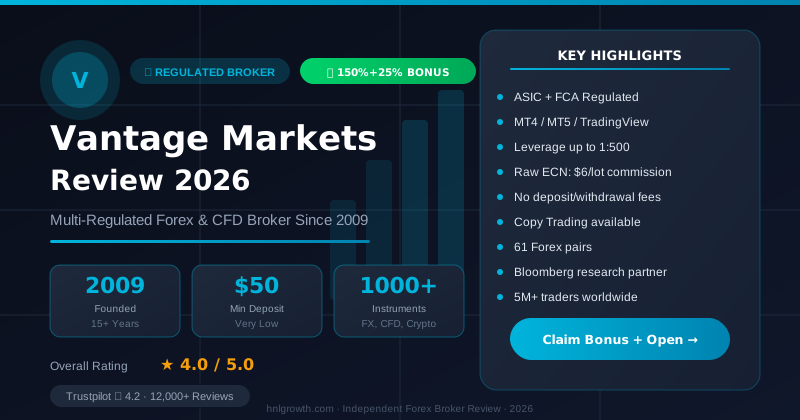
Vantage
- Entity: Vantage Global Prime Pty Ltd (ASIC 428901) | Vantage International Group Limited (CIMA 1383491)
- Minimum deposit: From $50 according to broker website
- EUR/USD spread: Standard account advertised from 1.4 pips | Raw ECN account advertised from 0.0 pips with commission
- Platforms: MT4, MT5, TradingView, Vantage app
- Account types: Standard STP, Raw ECN, Pro ECN, Islamic, demo
- Differentiator: ASIC-regulated entity for Australian traders; CIMA-regulated entity for international clients. Raw ECN account advertised with spreads from 0.0 pips. Copy trading available via MT4/MT5 signals. Multi-jurisdictional regulation serves clients in Asia-Pacific, Africa, and Middle East regions.
Verify ASIC license at connectonline.asic.gov.au (search entity name or ACN) and CIMA license at cima.ky.
XM
- Entity: XM Global Limited (FSC Mauritius) | Trading Point of Financial Instruments Ltd (CySEC 120/10)
- Minimum deposit: $5
- EUR/USD spread: Standard account advertised from 1.6 pips | Zero account advertised from 0.0 pips with commission
- Platforms: MT4, MT5, XM app
- Account types: Micro, Standard, XM Zero, Islamic, demo
- Differentiator: Micro account allows 0.01 lot trades with $5 minimum deposit—lowest barrier to entry for live trading. CySEC entity available for EU clients; FSC Mauritius entity for international. Multilingual support.
Verify CySEC license at cysec.gov.cy and FSC Mauritius at fscmauritius.org.
Exness
- Entity: Exness publishes Exness (SC) Ltd (Seychelles FSA SD025), Exness B.V. (Curaçao CBCS 0003LSI), Exness (VG) Ltd (BVI FSC SIBA/L/20/1133), Forexite Ltd (Belize FSC 9110312), and Exness (MU) Ltd (Mauritius FSC GB20025294). The onboarding entity depends on country of residence.
- Minimum deposit: $10 on the Standard account page; Standard Cent varies by payment method and location; Pro, Zero, and Raw Spread are published from $200.
- EUR/USD spread: Standard from 0.2 pips with no commission; Pro from 0.1 pips with no commission; Zero and Raw Spread from 0 pips with separate commission. These are published minimums, not guaranteed averages.
- Platforms: MT4, MT5, Exness Terminal, and Exness Trade.
- Account types: Standard, Standard Cent, Pro, Zero, Raw Spread, plus demo and swap-free availability subject to terms.
- Differentiator: Multiple account pricing models and high leverage in eligible conditions. Exness states that payment-method, provider, KYC, and country factors affect funding and withdrawals; do not treat instant-processing language as a guaranteed end-to-end bank time.
Verify the entity and licence on the official Exness regulation page and the relevant regulator's public register. Exness lists the USA, Canada, Iran, North Korea, Europe, the UK, Russia, Belarus, and other jurisdictions as unavailable or restricted.
Geographic restrictions: US, Japan, Canada (Ontario), Belgium, and Singapore are commonly excluded by many offshore brokers. FCA/ASIC entities may restrict onboarding to UK/Australia residents only. Check the broker's entity-specific terms before opening an account.
Cost Comparison: Spreads, Commissions, and Hidden Fees
Headline spreads mislead. A 0.0-pip spread paired with commission and overnight financing may cost more than a wider spread with no commission if you hold positions overnight. All-in cost = spread + commission + overnight financing (for multi-day positions) + withdrawal fees + inactivity fees.
What to Compare When Evaluating Broker Costs
When comparing broker pricing, verify these components:
Spread: The difference between bid and ask price. Check the broker's pricing page or MT4/MT5 contract specifications for typical spreads during your trading hours. Spreads widen during news events and low-liquidity periods.
Commission: Charged per lot on Raw/Zero/ECN accounts. Usually expressed per side (e.g., $3.50/lot/side = $7 round-turn per standard lot). Verify on the broker's fee schedule.
Overnight financing (swap): The cost or credit of holding a position past 5 PM New York time. Long positions in currencies with lower interest rates relative to the counter-currency typically incur negative swap. Check MT4/MT5 contract specifications or the broker's swap schedule.
Inactivity fees: Some brokers charge monthly fees after 12–24 months of account inactivity. Verify in the client agreement, not the FAQ.
Withdrawal fees: Most regulated brokers do not charge withdrawal fees for standard methods (bank wire, card). Some offshore brokers charge for small withdrawals. Verify on the fee schedule.
Broker Cost Overview (Based on Advertised Rates)
| Broker | Standard Account Spread (EUR/USD) | Raw/Zero Account Spread | Raw/Zero Commission | Inactivity Fee |
|---|---|---|---|---|
| Vantage | From 1.4 pips | From 0.0 pips | Check current fee schedule | Check client agreement |
| IG | From 0.6 pips | N/A | N/A | Check client agreement |
| Pepperstone | From 1.0 pips | From 0.0 pips | Check current fee schedule | Check client agreement |
| XTB | From 0.9 pips | N/A | N/A | Check client agreement |
| CMC Markets | From 0.7 pips | N/A | N/A | Check client agreement |
How to calculate your own all-in cost:
- Open a demo account with the broker you're evaluating
- Check the live spread on EUR/USD (or your preferred pair) during your typical trading hours over several days
- Extract the overnight swap rate from MT4/MT5 contract specifications (right-click the symbol, select "Specification")
- If using a Raw/ECN account, add the commission per lot from the fee schedule
- Calculate: (Average spread in pips × $10 per pip for 1 standard lot) + commission + (overnight swap × number of nights held)
Account Type Breakeven Analysis
Raw/Zero accounts with commission become cost-effective above a certain trade size. The breakeven point depends on the spread difference between Standard and Raw accounts and the commission charged.
Example framework (using hypothetical figures for illustration):
If a Standard account has a 1.4-pip spread and a Raw account has a 0.0-pip spread plus $6 commission per round-turn:
- 1 standard lot Standard cost: 1.4 pips × $10 = $14
- 1 standard lot Raw cost: 0.0 pips × $10 + $6 commission = $6
- Savings per trade: $8
At 0.1 lots:
- Standard cost: $1.40
- Raw cost: $0.60
- Raw is cheaper
At 10 trades per month at 1 lot each, Raw saves $80/month versus Standard.
Recommendation: Calculate the breakeven for your typical trade size using current broker pricing. If you trade micro lots (0.01–0.1), Standard accounts often have lower all-in costs. If you trade 1+ standard lots regularly, Raw/ECN accounts typically cost less.
Overnight Financing Impact on Multi-Day Positions
Swap rates (overnight financing) can erode profit on swing trades held for multiple days. EUR/USD swap rates vary by broker and change based on interbank interest rate differentials.
What to verify:
- Check the swap rate for your intended pair in MT4/MT5 contract specifications or the broker's website
- Calculate the daily cost for your position size
- Multiply by the number of nights you plan to hold the position
Exotic pairs and commodities like gold (XAU/USD) typically carry higher swap rates than major currency pairs.
Example: If a broker charges -$3 per lot per night for long EUR/USD, holding 1 lot for 5 nights costs $15 in financing. A 20-pip gain ($200) minus $15 financing yields a net $185 profit. If your typical gain is 10–15 pips, financing costs can reduce your profit by 10–15%.
If you hold positions for 3+ days regularly, prioritize brokers with lower swap rates over brokers with the tightest spreads.
Withdrawal Method Comparison
| Method | Typical Approval Time | Typical Settlement Time | Typical Fee | Minimum Withdrawal | Reversal Risk |
|---|---|---|---|---|---|
| Bank wire | 1–2 business days | 3–5 business days | Usually free; some offshore brokers charge for small amounts | $50–$100 | Low |
| Debit/Credit card | 1–2 business days | 3–5 business days | Usually free | $10–$50 | Medium (chargebacks possible) |
| E-wallet | 1–2 business days | Instant to 24 hours after approval | Usually free at broker; e-wallet may charge conversion fees | $10–$20 | Low |
| Crypto | 1–2 business days | 10 minutes to 2 hours after approval | Network fee applies | $50–$100 | None (irreversible) |
Timelines and fees vary by broker. Always check the broker's withdrawal terms in the client agreement before funding your account.
Platform and Execution: MT4/MT5 vs. Proprietary Tools
MetaTrader 4 and MT5: The Industry Baseline
MT4 remains the most widely supported platform—nearly every broker offers it, and the majority of Expert Advisors (EAs), custom indicators, and third-party tools are built for MT4. MT5 is MetaQuotes' successor, offering more timeframes, an economic calendar, depth of market (DOM), and better backtesting, but fewer brokers support it and EA compatibility is lower.
MT4 advantages:
- Universal broker support. You can switch brokers without relearning the platform.
- Largest EA and indicator library. Algorithmic traders find more resources.
- Lightweight and stable. Runs on older PCs and mobile devices with minimal lag.
MT4 limitations:
- Outdated interface. Limited order types compared to MT5.
- Fewer timeframes (9 standard intervals).
- No native integration with TradingView or other third-party charting beyond plugins.
MT5 advantages:
- Modern order types including pending stop-limit orders.
- Economic calendar and market depth for ECN accounts.
- Better backtesting with multi-currency strategy testing.
MT5 limitations:
- Fewer brokers support it compared to MT4.
- Lower EA compatibility. Older EAs require recoding from MQL4 to MQL5.
- Slightly heavier resource usage on mobile and older hardware.
Proprietary Platforms: When to Use Them
IG Next Generation offers 115+ indicators, pattern recognition scanner, and Reuters news integration. Best for fundamental and technical traders who want news and charts in one window. Proprietary to IG—no EA support, and switching brokers means relearning the platform.
Pepperstone cTrader provides ECN transparency with depth-of-market view, one-click execution, and advanced order types. Best for active day traders who need order-flow visibility. Limited EA library compared to MT4.
XTB xStation 5 integrates TradingView charts, Dow Jones news, and one-click trading. Best for traders who want TradingView indicators without opening a separate browser tab. Proprietary platform with limited algo trading support.
Vantage App offers MT4/MT5 integration and mobile trading features. Best for mobile-first traders. Desktop users often prefer full MT4/MT5 desktop platforms.
Execution Model: Market Maker vs. STP vs. ECN
Market Maker (Dealing Desk): Broker takes the opposite side of your trade. Fixed spreads during volatile periods. Examples: IG, CMC Markets on Standard accounts.
Straight-Through Processing (STP): Broker routes orders to liquidity providers without a dealing desk. Variable spreads widen during news events. Examples: Vantage Standard, XTB.
Electronic Communication Network (ECN): Direct market access with transparent order book. Tightest spreads, but commission applies. Examples: Pepperstone Razor, Vantage Raw ECN, cTrader brokers.
Practical impact: Market Maker models offer predictable spreads. STP and ECN brokers pass liquidity provider prices directly, so spreads widen during news but execution transparency is higher. If you trade high-impact news releases (NFP, FOMC, GDP), test execution on a demo account during these events before committing capital.
Account Types and How to Choose
Standard (Spread-Only, No Commission)
- Spread: Wider (typically 1.0–1.4 pips EUR/USD advertised)
- Commission: $0
- Overnight financing: Standard swap rates
- Minimum deposit: $0–$50 depending on broker
- Leverage cap: 1:30 (FCA/ASIC), higher for offshore brokers
- Best for: Beginners testing live trading, traders with smaller position sizes, accounts under $1,000.
Raw/Zero (Tight Spread + Commission)
- Spread: Advertised from 0.0 pips EUR/USD
- Commission: Check broker fee schedule (typically $3–$3.50/lot/side)
- Overnight financing: Same as Standard
- Minimum deposit: $200–$10,000 depending on broker and account tier
- Leverage cap: Same as Standard
- Best for: Active traders with larger position sizes, scalpers, algorithmic traders.
When Raw becomes cost-effective: Calculate your average trade size and frequency. If you trade 1+ standard lots regularly, Raw/ECN accounts typically offer lower all-in costs. If you trade micro lots (0.01–0.1), Standard accounts often cost less after factoring in commission.
Islamic (Swap-Free)
- Spread: Same as Standard or Raw
- Commission: Same as Standard or Raw
- Overnight financing: $0 swap; admin fee may apply after a holding period (check broker terms)
- Minimum deposit: Same as Standard or Raw
- Leverage cap: Same as Standard or Raw
- Best for: Traders observing Sharia compliance, swing traders in certain jurisdictions.
Cost consideration: Islamic accounts replace swap with admin fees after a certain holding period (often 7 days). Check the broker's Islamic account terms to understand when admin fees begin and how they compare to standard swap rates for your typical holding period.
Account Type Decision Framework
| Criterion | Standard | Raw/Zero | Islamic |
|---|---|---|---|
| EUR/USD spread | 1.0–1.4 pips (typical advertised) | 0.0–0.1 pips (typical advertised) | Same as Standard/Raw |
| Commission | $0 | Check broker fee schedule | Same as Standard/Raw |
| Overnight financing | Swap applies | Swap applies | $0 swap; admin fee after holding period |
| Minimum deposit | $0–$50 (varies) | $200–$10,000 (varies) | $200–$1,000 (varies) |
| Best for | Beginners, smaller position sizes | Active traders, larger position sizes | Sharia compliance |
Recommendation: Open a demo account and test both Standard and Raw with your typical trade size and holding period. Compare all-in costs for 10 representative trades using current broker pricing. Choose the account type with the lower total cost for your trading pattern.
Funding and Withdrawal: What to Expect
Methods Available by Broker
| Broker | Bank Wire | Debit/Credit Card | E-Wallet (Skrill, Neteller, PayPal) | Crypto (BTC, USDT) |
|---|---|---|---|---|
| Vantage | ✓ | ✓ | ✓ | ✓ |
| IG | ✓ | ✓ | ✗ | ✗ |
| Pepperstone | ✓ | ✓ | ✓ | ✗ |
| XTB | ✓ | ✓ | Limited | ✗ |
| CMC Markets | ✓ | ✓ | Limited | ✗ |
Availability varies by jurisdiction and entity. Verify available methods in your region on the broker's website before opening an account.
KYC Requirements and Approval Timeline
All regulated brokers require proof of identity (passport, national ID, driver's license) and proof of address (utility bill, bank statement dated within 3 months). Upload documents during account opening or before first withdrawal.
Typical approval timeline:
- Tier-1 brokers (FCA/ASIC): 1–3 business days for manual review
- Tier-2 brokers (CySEC): 1–2 business days
- Offshore brokers: 1–3 business days; some offer automated verification
Document rejection causes: Blurry scans, expired documents, and name mismatches (e.g., passport shows middle initial, bank statement does not) trigger re-upload requests, adding 1–3 days. Submit high-resolution color scans with all four corners visible and ensure name formatting matches across all documents.
What to Verify Before Funding
Before depositing funds, verify:
- License status: Check the public register (FCA, ASIC, CySEC, FSC, CIMA) and confirm entity name matches the website footer and client agreement
- Segregated funds policy: Read the client agreement section on client money to confirm funds are held in segregated accounts
- Withdrawal terms: Check the fee schedule and client agreement for withdrawal minimums, fees, and processing timelines
- Dispute resolution: Identify the complaint procedure and escalation path (ombudsman for Tier-1, regulator for Tier-2/offshore)
- Negative balance protection: Confirm whether this protection is offered, especially for offshore brokers where it is not mandatory
How to Choose the Right Broker for Your Needs
By Trading Style
Day traders and scalpers:
- Prioritize tight spreads and low commission (Raw/ECN accounts)
- MT4/MT5 or cTrader for fast execution and order management
- STP or ECN execution model for transparency
- Candidates: Pepperstone Razor, Vantage Raw ECN, XTB Standard
Swing traders (holding 2–10 days):
- Balance spread costs with overnight financing rates
- Check swap rates for your typical pairs and holding period
- Negative balance protection important for gap-risk management
- Candidates: IG, CMC Markets, Vantage Standard
Position traders (holding weeks to months):
- Prioritize low swap rates and regulatory protections
- FSCS or ICF coverage for longer capital exposure
- Consider Islamic accounts if admin fees are lower than cumulative swap
- Candidates: IG, CMC Markets, Pepperstone
Algorithmic traders:
- MT4/MT5 with EA support or API access
- ECN execution model for transparent order routing
- Low latency and VPS hosting options
- Candidates: Pepperstone, Vantage (check API availability)
By Account Size
Under $1,000:
- Prioritize low minimum deposit and micro-lot capability
- Standard accounts often more cost-effective at small position sizes
- Demo account testing essential before live funding
- Candidates: XM Micro, Vantage Standard, XTB
$1,000–$10,000:
- Balance cost and regulatory protection
- Raw/ECN accounts become cost-effective if trading 0.5+ lots
- CySEC regulation offers MiFID protections with lower barriers
- Candidates: Pepperstone Razor, Vantage Raw ECN, XTB
$10,000–$50,000:
- FCA/ASIC regulation for enhanced protections
- Raw/ECN accounts recommended for active trading
- Consider multiple brokers for diversification
- Candidates: IG, Pepperstone, CMC Markets
Above $50,000:
- FCA regulation with FSCS coverage up to £85,000 essential
- Segregation and compensation scheme verification critical
- Professional/Pro accounts may offer better pricing
- Candidates: IG, Pepperstone, CMC Markets
By Geographic Location
UK residents:
- FCA-regulated entities required
- FSCS protection up to £85,000
- Spread betting option (tax treatment)
- Candidates: IG (FCA 195355), CMC Markets (FCA 173730)
EU residents:
- CySEC or other MiFID-regulated entities
- ICF coverage up to €20,000
- Leverage capped at 1:30 under ESMA
- Candidates: XTB (CySEC 169/12), Plus500CY
Australian residents:
- ASIC-regulated entities required
- Segregated funds in Australian trust accounts
- Leverage restrictions apply
- Candidates: Pepperstone (ASIC 414530), IG (ASIC 515106)
Asia, Africa, Middle East:
- FCA/ASIC brokers may restrict onboarding
- Offshore regulation (FSC, VFSC, CIMA) more accessible
- Higher leverage available but weaker protections
- Candidates: Vantage (CIMA 1383491), XM (FSC Mauritius), Exness (FSA Seychelles)
Verification Checklist: What to Confirm Before You Trade
Before funding any forex broker account, complete this verification checklist:
Regulatory Verification
□ Confirm entity name on broker's website footer matches license register
□ Search entity name and license number on official register (FCA, ASIC, CySEC, FSC, CIMA)
□ Verify license status is "Authorized" or "Active," not "Suspended" or "Withdrawn"
□ Confirm authorized activities include "retail forex" or "CFD provision"
□ Check for regulatory warnings or enforcement actions on the regulator's website
Cost Verification
□ Open demo account and observe live spreads during your typical trading hours
□ Extract overnight swap rates from MT4/MT5 contract specifications for your intended pairs
□ Locate commission structure in fee schedule (if using Raw/ECN account)
□ Check withdrawal fees and minimums in fee schedule
□ Verify inactivity fee terms in client agreement
□ Calculate all-in cost for 10 representative trades using current pricing
Account Security and Funds
□ Read client agreement section on fund segregation
□ Confirm which compensation scheme applies (FSCS, ICF, or none)
□ Verify compensation limit for your account balance
□ Check negative balance protection policy
□ Identify complaint escalation procedure (ombudsman or regulator)
□ Confirm two-factor authentication availability
Platform and Execution
□ Test order execution speed on demo account
□ Verify platform stability during your typical trading hours
□ Check available order types match your strategy requirements
□ Confirm EA/indicator compatibility if using algo trading
□ Test mobile app functionality if trading on mobile
Withdrawal Testing
□ Read withdrawal terms in client agreement
□ Identify required KYC documents
□ Confirm available withdrawal methods in your jurisdiction
□ Check withdrawal processing timeline
□ Verify there are no withdrawal fees that would impact your strategy
Open a Vantage demo account to test pricing and execution before committing capital.
Summary: Match Broker to Your Priorities
No single broker is "best overall." Your optimal choice depends on the tradeoffs you're willing to make between regulatory protection, cost, leverage, and platform features.
If regulatory protection is your top priority: Choose FCA or ASIC brokers (IG, Pepperstone, CMC Markets). Accept 1:30 leverage caps and slightly wider spreads in exchange for FSCS coverage, negative balance protection, and ombudsman access.
If cost minimization is your top priority: Choose Raw/ECN accounts at brokers with tight spreads and low commissions (Pepperstone Razor, Vantage Raw ECN). Verify overnight financing rates if you hold multi-day positions. CySEC or offshore regulation offers lower barriers to entry.
If high leverage is required: Offshore brokers (Vantage CIMA entity, XM, Exness) offer 1:500+ leverage. Understand that higher leverage magnifies losses as well as profits. Negative balance protection is not mandatory—verify whether your chosen broker offers it.
If you're a beginner: Start with an FCA or ASIC broker offering demo accounts, educational resources, and low minimum deposits. IG, XTB, and Vantage Standard accounts all permit micro-lot trading. Test on demo before funding a live account.
Action steps:
- Verify entity name and license number on the official register for your shortlisted brokers
- Open demo accounts with 2–3 candidates
- Test spreads and execution during your typical trading hours for at least 1 week
- Calculate all-in costs for your typical trade size, frequency, and holding period
- Read the full client agreement, focusing on fund segregation, withdrawal terms, and complaint procedures
- Start with the minimum deposit and test the full funding-trading-withdrawal cycle before committing larger capital
HFM: Another Multi-Entity Option Worth Comparing
If none of the six brokers above fit your regulatory or account-type needs, HFM (HF Markets Group) is worth adding to your shortlist. International clients are typically onboarded under HF Markets (SV) Ltd (St. Vincent & the Grenadines, registration number 22747 IBC 2015), with EU professional clients served via HF Markets (Europe) Ltd (CySEC) and South African clients via an FSCA-regulated entity — the same multi-entity structure pattern seen across most brokers in this comparison, so confirm which entity applies to you before depositing.
HFM offers four account types — Cent, Zero, Pro, and Premium — with spreads from 1.4 pips on Cent/Premium, from 0.6 pips on Pro, and from 0.0 pips (commission-based, delayed quotes) on Zero. Minimum deposit is $0 on Cent, Zero, and Premium, and $100 on Pro. Platforms include MT4, MT5, the HFM App, and WebTrader. Maximum leverage on the international entity runs up to 1:2000 — a Tier-3 risk indicator, not a benefit, for undercapitalized accounts.
| HFM at a glance | Detail |
|---|---|
| Regulatory tier | Tier-2 (CySEC/FSCA entities) / Tier-3 (SVG entity) |
| EUR/USD spread | From 1.4 pips (Cent/Premium); from 0.0 pips + commission (Zero) |
| Minimum deposit | $0 (Cent/Zero/Premium); $100 (Pro) |
| Platforms | MT4, MT5, HFM App, WebTrader |
| Compensation scheme | CySEC ICF €20k (EU entity only); none on the SVG entity |
If HFM's account variety matches what you're looking for, you can open an HFM account or compare HFM account types before funding.
Editorial Verification Process
Broker facts in this comparison are checked against each broker's official documentation and public regulator registers, using our 7-criteria broker review methodology. This ranking is based on published terms, conditions, and regulatory status — not a funded live-account test of every broker listed. Where we discuss Vantage specifically, see our broker review methodology for the full source hierarchy and what "verified" means on this site.
Risk warning: CFDs and leveraged forex products are complex instruments and carry a high risk of losing money rapidly due to leverage. Between 74–89% of retail investor accounts lose money when trading CFDs with most providers. You should consider whether you understand how CFDs work and whether you can afford to take the high risk of losing your money. Check the regulatory terms, entity structure, and investor protections that apply to your jurisdiction before opening an account or trading.
Related Vantage Markets Guides
Ready to Trade with Vantage Markets?
Vantage Markets is a multi-regulated forex & CFD broker (FCA, ASIC, FSCA, CIMA, VFSC, FSC) trusted by 5 million+ traders, with Raw ECN pricing from $3/lot, no deposit/withdrawal fees, and full MT4/MT5/TradingView support.
Risk disclaimer: Vantage Markets is a live, regulated broker — trading forex and CFDs is done with real capital under normal market risk (this is not a simulated prop-firm evaluation). CFDs and leveraged forex products are complex instruments and carry a high risk of losing money rapidly due to leverage; most retail investor accounts lose money trading these products. Consider whether you understand how CFDs/forex work and whether you can afford the high risk of losing your money. Affiliate disclosure: HNL Growth earns a commission when you open a Vantage Markets account through links on this page.