Best Forex Brokers in the UK 2026
Best Forex Brokers in the UK 2026. An independent, fact-checked look at Vantage Markets for traders evaluating this broker.
Reviewed using our forex & CFD broker review methodology
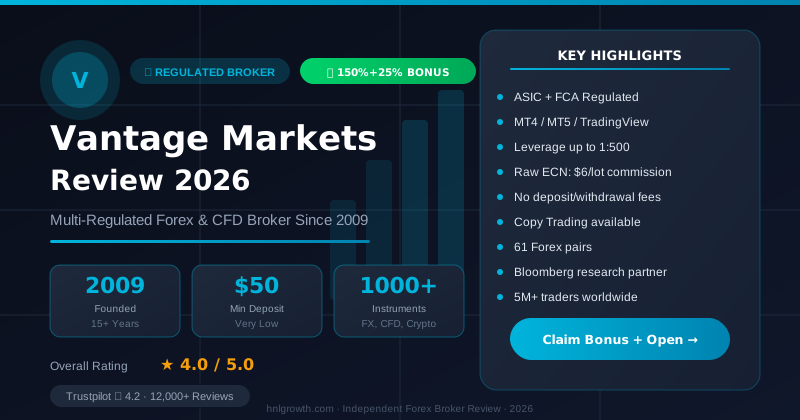
If you're searching for the best forex broker in the UK, the real question isn't "who ranks highest" — it's "which brokers are currently FCA-authorised to serve UK retail clients, and which UK-facing entity would actually hold my money." Eligibility comes first. A .co.uk domain, a UK office, or a "best broker" badge from a review site doesn't confirm FCA authorisation on its own. Only the FCA Register does that. This guide walks through how to verify a broker yourself, what UK-specific protections you're entitled to once authorisation is confirmed, and how to compare cost, platform, and funding options within that already-eligible shortlist.
UK forex regulation: the eligibility gate before any comparison
Before comparing spreads or platforms, a UK-based trader needs to answer one question: is the entity that will hold my account actually authorised by the Financial Conduct Authority to deal with UK retail clients? This is a legal-certainty question, not a preference question, and it should be resolved before anything else.
It's useful to think of any broker in three separate categories, not a sliding scale of "more or less trustworthy":
1. FCA-authorised UK entity. The specific legal entity that opens your account holds a live FCA authorisation with permissions that cover the products you want to trade (retail CFDs, spot forex, or spread betting). This entity is subject to FCA conduct rules, client money rules, and — where eligible — Financial Services Compensation Scheme (FSCS) protection.
2. International entity reachable from the UK. Many global brokers operate multiple legal entities across different regulators (for example, a Cyprus, Australian, or offshore entity). Their marketing may be visible from the UK, and you may technically be able to open an account, but that entity is not the FCA-authorised one, so UK retail protections generally do not apply to it.
3. Not appropriate for UK residents. Some platforms actively exclude UK residents, or fall outside any framework a UK trader should rely on. If a broker's terms don't clearly name a UK-facing authorised entity, treat that as a signal to look elsewhere rather than assume it will work out.
These categories matter because a broker can be genuinely large, well-known, and reputable in other markets while the entity a UK visitor actually gets onboarded to is not the FCA-regulated one. Brand recognition and regulatory status are two different facts.
How to check FCA authorisation yourself
Don't take a broker's own homepage as proof. Verify directly:
- Go to the FCA Register and search the exact legal entity name (not just the trading brand) — for example, "[Brand] UK Limited," not just "[Brand]."
- Confirm the Firm Reference Number (FRN) matches what the broker discloses in its own terms or footer.
- Check the "Permissions" tab for authorisation to deal in investments as principal or agent, and for CFD/spread betting-specific permissions if relevant.
- Confirm the trading name shown on the register matches the brand you're being asked to fund — mismatches are the most common source of confusion.
- Check the firm's status is "Authorised," not "Applied for," "Cancelled," or a related "Appointed Representative" arrangement with narrower permissions.
This five-minute check is the single most useful thing a UK trader can do before comparing anything else on this page.
Who this guide is (and isn't) for
This article is written for UK residents who already understand forex/CFD basics and are choosing between platforms — not for beginners deciding whether to trade at all, and not for traders outside the UK, since none of the protections discussed here (FSCS, UK leverage caps, UK negative balance protection) transfer to accounts opened with non-UK entities. If you're based outside the UK, the FCA framework described below does not apply to you, and you should check your own local regulator instead.
Top UK-serving forex brokers: verification status
Search results for "top 10 forex brokers in UK" or "forex brokers UK regulated" often present ranked lists without showing the underlying verification work. Below is a more honest starting point: a list of brands commonly associated with UK forex trading, alongside what can and can't be confirmed from public marketing pages alone.
| Brand | UK-facing presence (as marketed) | FCA verification status |
|---|---|---|
| Vantage Markets | UK-facing site (vantagemarkets.co.uk) advertising CFDs and spread betting to UK residents, with client funds described as held in segregated accounts with "accredited credit institutions" per the Vantage IB partnerships page | Confirm the exact authorised entity name and Firm Reference Number on the FCA Register before funding an account |
| IG | Long-established UK-headquartered brand | Not verified for this article — check FCA Register |
| Interactive Brokers | Multi-jurisdictional broker with a UK-facing arm | Not verified for this article — check FCA Register |
| Saxo | UK-facing entity referenced in marketing | Not verified for this article — check FCA Register |
| FOREX.com | UK-facing brand of a larger multi-entity group | Not verified for this article — check FCA Register |
| CMC Markets | UK-headquartered, listed company | Not verified for this article — check FCA Register |
| XTB | UK-facing entity referenced in marketing | Not verified for this article — check FCA Register |
| City Index | UK-facing brand | Not verified for this article — check FCA Register |
| Pepperstone | Multi-entity broker with UK marketing presence | Not verified for this article — check FCA Register |
| eToro | Multi-entity broker; UK-serving entity requires confirmation | Not verified for this article — check FCA Register |
| Admirals | Multi-entity broker with UK marketing presence | Not verified for this article — check FCA Register |
| Tickmill | Multi-entity broker with UK marketing presence | Not verified for this article — check FCA Register |
None of these statuses should be treated as final. Regulatory permissions, entity structures, and group ownership can change, and this table reflects what is publicly marketed rather than a live register pull performed at the moment you read this. Always re-check the FCA Register before opening or funding an account, even for brands with a long UK track record.
Vantage Markets UK
Vantage's UK-facing site describes itself as an "award winning" CFD and spread betting broker offering forex, indices, gold and silver, energy, ETFs, soft commodities, and shares CFDs through a single account, with spreads advertised "from 0.0 pips" (subject to other fees) — details drawn from Vantage's own homepage and about page. The site also states client funds are held in segregated accounts with accredited credit institutions, per its introducing broker page.
Two things worth separating: Vantage clearly markets a UK-facing product set, including spread betting, which is a structure specifically built around UK and Irish retail tax and regulatory rules — that's a meaningful signal of UK orientation. What isn't independently confirmed here is the live FCA authorisation status and Firm Reference Number for the specific UK entity you'd be onboarded to. Before funding an account, look up the exact entity name shown in Vantage's UK account-opening terms on the FCA Register and confirm its permissions cover the products you plan to trade.
Disclosure: This page may contain affiliate links. We may earn a commission if you open an account through our links, at no extra cost to you.
Once you've confirmed eligibility through the FCA Register, compare Vantage account types to find the structure that matches your trading style and capital commitment.
Client protections: what FCA authorisation is meant to guarantee
These protections apply to the FCA-authorised UK entity specifically — not to an offshore sister entity of the same brand, and not automatically to every account type. Confirm which entity and account type you're opening before assuming any of the below applies to you.
FSCS compensation. The Financial Services Compensation Scheme can compensate eligible retail clients if an authorised UK investment firm fails. Confirm the current compensation limit directly on fscs.org.uk rather than relying on any broker's marketing copy, as this threshold is reviewed periodically. FSCS coverage only applies to the UK-authorised entity itself — it does not extend to a related international entity of the same group.
Negative balance protection. Under FCA retail conduct rules, retail clients trading CFDs and forex are entitled to negative balance protection, meaning you cannot lose more than the funds in your trading account. This protection is specifically tied to retail client classification; traders who elect "professional" status — typically by meeting experience, portfolio size, or trading frequency criteria — can lose that protection along with the retail leverage caps described below. Confirm directly with the broker and against current FCA rules which classification applies to your account.
Segregated client funds. UK rules require authorised firms to keep client money separate from the firm's own operating funds, typically held with an approved bank or credit institution. Segregation reduces (but does not eliminate) the risk that client funds are used for the firm's own purposes if the firm runs into financial trouble — it is not the same as a guarantee that funds are instantly recoverable in every failure scenario. Treat segregation as one layer of protection among several, not a standalone guarantee.
Retail leverage caps. FCA rules on retail CFD leverage set maximum ratios by instrument class. These figures should be confirmed against current FCA rules at fca.org.uk since leverage policy is subject to review. Broadly, retail caps have been set at 1:30 for major currency pairs, 1:20 for gold and major stock indices, and 1:5 for individual equities.
A worked GBP example. Say a UK retail trader opens a position with a notional value of £10,000 on a major currency pair at the retail cap of 1:30. Margin required is £10,000 ÷ 30 = roughly £333. If the price moves 1% against the position, the loss is 1% of £10,000 = £100 — about 30% of the margin committed. Now compare a hypothetical 1:100 ratio (not available to UK retail accounts, but sometimes seen in professional or non-UK offerings): the same £10,000 position would only require about £100 of margin, so the identical £100 loss from a 1% adverse move would wipe out the entire margin. This is the practical point of the retail cap — it's not about limiting your position size outright, it's about slowing down how fast a given price move can erode the capital actually backing the trade.
Cost comparison: what to check, not what to assume
Live spread and commission figures move throughout the trading day and change with market conditions, so this article does not publish a "tested" spread table — any such table would need to be based on a specific measurement at a specific moment, under disclosed volatility conditions. Rather than presenting numbers as static facts, use this checklist against each broker's own current pricing page:
- Spread type: fixed, variable, or raw spread plus commission. Variable spreads widen during news events and low-liquidity hours; ask how a broker discloses that behaviour.
- Reference pairs: check EUR/USD and GBP/USD specifically, since these are the pairs most UK traders will use most often, and pull current figures from the broker's live pricing page rather than an averaged marketing claim.
- Commission structure: some account types charge per-lot commission on top of a tighter spread (ECN-style), others build the cost entirely into the spread. Compare the all-in cost, not just the headline spread.
- Overnight financing (swap): relevant if you hold positions past end of day; ask whether Islamic (swap-free) accounts are available if this matters to you, and how the broker replaces swap costs on those accounts.
- Currency conversion: if your account base currency isn't GBP, ask whether deposits, withdrawals, or profit/loss get converted, and at what rate.
- Minimum deposit and account minimums: these vary by account tier and can change; check the broker's current account-opening page directly rather than a marketing headline. Vantage's homepage advertises spreads "from 0.0 pips," explicitly flagged with "other fees may be applicable" — a reminder that a headline spread figure rarely tells the whole cost story on its own.
Platforms and trading tools
Platform choice is a legitimate differentiator, but only after the eligibility gate above is cleared — a broker with the slickest app is irrelevant if the entity onboarding you isn't the right one for a UK resident.
Common platform types across UK-facing brokers include MetaTrader 4 (MT4), MetaTrader 5 (MT5), cTrader, and proprietary web or app platforms. Vantage's own site highlights a platform built around TradingView charting, one-click trading, and real-time price alerts, per its homepage; it does not itemise MT4/MT5 availability in the pages reviewed here, so confirm current platform options directly on the broker's platforms page before choosing an account type around a specific tool.
When comparing platforms, practical criteria worth weighing include:
- Charting depth and technical indicator library
- Mobile app parity with desktop (can you manage every order type from a phone)
- Support for automated strategies or Expert Advisors, if relevant to you
- One-click execution speed for fast-moving markets
- Whether research, news, and sentiment tools are built in or external
A demo account is the lowest-friction way to test any of this yourself: most UK-facing brokers, including Vantage per its own site, offer a demo account funded with virtual credit and access to the same asset classes as a live account. Testing a demo before funding a live account lets you evaluate execution feel and platform usability without financial exposure, and it's worth doing even after the regulatory question is settled.
Funding a UK account
Typical funding routes for UK-facing brokers include UK bank transfer (Faster Payments or standard bank transfer), debit/credit card, and various e-wallets, though exact methods and processing times vary by broker and should be confirmed on that broker's current funding page rather than assumed from general market practice. A few things worth checking before you commit funds:
- Processing SLA: ask specifically how long deposits and withdrawals take to clear for UK bank transfers and cards, and whether there's a cut-off time for same-day processing.
- Withdrawal method matching: many brokers require withdrawals to return via the same method used to deposit, which affects how quickly you can access funds.
- Currency handling: if you fund in GBP but trade instruments priced in USD or EUR, ask how conversion is calculated and whether a separate fee applies.
- KYC requirements: UK brokers are required to verify identity and address before releasing funds or processing withdrawals; have proof of ID and a recent proof of address ready, since delays here are a common source of frustration that has nothing to do with the broker's trading conditions.
None of these details are static across the industry, so treat this as a checklist to run against your shortlisted broker's own terms rather than a set of fixed numbers.
How to choose: a decision checklist
Work through these gates in order, not simultaneously:
- Eligibility confirmed. Have you found the exact legal entity name on the FCA Register, checked its permissions, and confirmed it's "Authorised" and not cancelled or pending?
- Protections understood. Do you know whether your account type is retail (with negative balance protection and FSCS eligibility) or professional (without the retail leverage caps), and which entity actually holds your funds?
- Cost tolerance set. Have you compared all-in cost — spread plus commission plus any overnight financing — for the pairs you actually plan to trade, using the broker's current pricing rather than a marketing average?
- Platform fit tested. Have you tried the platform on a demo account and confirmed it supports the order types, charting, and mobile access you need day to day?
- Fund with intent. Only after the above, and only through an amount you've deliberately chosen to risk, given that leveraged products can produce losses larger than your initial deposit expectations in fast-moving markets even with negative balance protection in place.
Skipping straight to step 3 or 4 — comparing spreads or app design before confirming the entity is FCA-authorised — is the most common mistake in "best broker" shopping, and it's the one this guide is structured to prevent.
FAQ
Is forex trading legal in the UK? Yes, retail forex and CFD trading is legal in the UK when conducted through an appropriately authorised firm. Legality of the activity itself is separate from whether a specific broker's UK-facing entity is currently FCA-authorised — always confirm the latter for the specific firm you're considering.
What's the difference between FCA-regulated and FSCS-protected? FCA authorisation means a firm is permitted to conduct regulated financial activities and must follow FCA conduct rules. FSCS protection is a separate compensation scheme that may pay out to eligible clients if an authorised firm fails financially. A firm can be FCA-authorised without every product or account type being FSCS-eligible, so check both separately via the FCA Register and FSCS.
What happens if my broker fails? If the failed firm was FCA-authorised and your account was FSCS-eligible, you may be able to claim compensation up to the current FSCS limit. If the firm was an international entity not covered by FCA/FSCS, UK compensation protections generally won't apply, and recovery would depend on that entity's own jurisdiction's framework — another reason entity verification matters before you fund an account.
Do UK traders pay tax on forex profits? Tax treatment depends on your personal circumstances, the product used (spread betting is treated differently from CFDs for tax purposes in the UK), and current HMRC rules. This is a factual area, not a comparison point between brokers, and this article does not provide tax advice — check current guidance on gov.uk or speak with a qualified tax adviser about your specific situation.
Are eToro or Pepperstone FCA-authorised for UK residents? This has not been independently confirmed for this article. Rather than assume a well-known brand name is automatically FCA-authorised for the entity that would open your account, check the exact entity name on the FCA Register yourself before proceeding with either.
What's the maximum leverage for UK retail traders? Retail leverage caps under FCA rules are broadly 1:30 for major forex pairs, 1:20 for gold and major indices, and 1:5 for individual equities. These are subject to regulatory review, so confirm current figures at fca.org.uk rather than treating them as permanently fixed.
Should I trust third-party "best broker" rankings or review-site scores? Treat rankings, trust scores, and aggregated review ratings as third-party opinions and methodologies, not as regulatory confirmation. They can be a useful input for platform experience or customer service reputation, but they are not a substitute for checking a firm's authorisation status directly on the FCA Register.
Regulatory details in this article — including FSCS compensation limits and FCA retail leverage caps — are subject to change and should be reconfirmed against the FCA and FSCS websites at the time you read this, particularly given the monthly refresh cycle this page follows.
After confirming eligibility and comparing costs, you can open a Vantage account once you've verified the UK entity on the FCA Register and understand which protections apply to your account classification.
Editorial Verification Process
Broker facts in this comparison are checked against each broker's official documentation and public regulator registers, using our 7-criteria broker review methodology. This ranking is based on published terms, conditions, and regulatory status — not a funded live-account test of every broker listed. Where we discuss Vantage specifically, see our broker review methodology for the full source hierarchy and what "verified" means on this site.
Risk warning: CFDs and leveraged forex products are complex and carry a high risk of losing money. Check the terms, entity and protections that apply to your jurisdiction before trading.
Related Vantage Markets Guides
Ready to Trade with Vantage Markets?
Vantage Markets is a multi-regulated forex & CFD broker (FCA, ASIC, FSCA, CIMA, VFSC, FSC) trusted by 5 million+ traders, with Raw ECN pricing from $3/lot, no deposit/withdrawal fees, and full MT4/MT5/TradingView support.
Risk disclaimer: Vantage Markets is a live, regulated broker — trading forex and CFDs is done with real capital under normal market risk (this is not a simulated prop-firm evaluation). CFDs and leveraged forex products are complex instruments and carry a high risk of losing money rapidly due to leverage; most retail investor accounts lose money trading these products. Consider whether you understand how CFDs/forex work and whether you can afford the high risk of losing your money. Affiliate disclosure: HNL Growth earns a commission when you open a Vantage Markets account through links on this page.