Best Forex Brokers for Beginners in 2026
Best Forex Brokers for Beginners in 2026. An independent, fact-checked look at Vantage Markets for traders evaluating this broker.
Reviewed using our forex & CFD broker review methodology
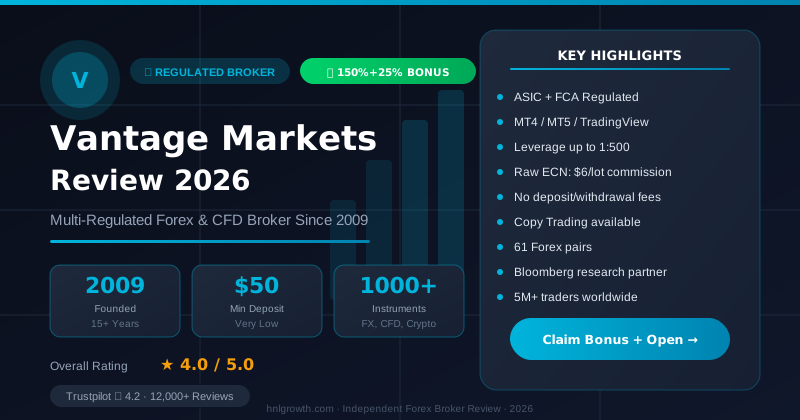
Last reviewed: August 2026. Regulatory status, minimum deposits, and fee structures change frequently — always verify current details directly with the broker and on the relevant regulator's public register.
If you're looking for the best forex broker for beginners, there isn't one universal winner. The right broker is the one that matches where you actually are right now: how much money you're comfortable starting with, how confident you feel using a trading app on your phone, and whether you're even ready to open a live account yet.
What matters at this stage is narrower than what matters to an experienced trader. You need verified regulation, a genuine demo account, a clear and manageable minimum deposit, a mobile app that doesn't fight you, and education that builds understanding step by step. This guide sets out those criteria, shows you how to compare any broker against them, and points you toward a demo account before any live-money decision.
This page is for you if you already understand the basics of forex trading and want help narrowing down broker choice. If you haven't covered core mechanics yet — pips, leverage, and margin — it's worth reading a dedicated beginner's guide to forex trading first, since this article deliberately doesn't re-teach that material in depth. It's also not the right page if you're already trading live and comparing advanced platform features or algorithmic tools.
Site disclosure: This website is operated by Vantage Markets. Where Vantage Markets is described specifically in the article, those details are sourced from its own official pages and cited accordingly. This page may also contain affiliate links to other brokers; we may earn a commission if you open an account through those links, at no extra cost to you. Vantage-specific claims and generic broker-selection guidance are kept separate throughout.
What Beginners Actually Need From a Broker
An experienced trader might prioritize raw spreads, API access, or exotic pair availability. A beginner's checklist looks different, because the biggest risks at this stage are choosing an unregulated platform, getting overwhelmed by a cluttered app, or moving to live trading before you're ready.
Non-negotiables
Verified regulation. The broker — or the specific legal entity you'd be signing up with — should be licensed by a recognized financial authority. You should be able to confirm this independently on the regulator's own public register, not just take the broker's word for it.
What "top-tier regulation" means in practice: a license from an authority such as the FCA (UK), ASIC (Australia), CySEC (EU/EEA), or CFTC/NFA (US) typically brings with it requirements for client fund segregation (your money held separately from the broker's operating funds), access to a formal investor compensation scheme up to a defined limit, and a regulated dispute-resolution process if something goes wrong. Offshore or less-scrutinized registrations may carry none of these. The specific entity you open an account with — not the brand name — determines which regulator's rules apply to you. Always identify the entity, find the claimed regulator, and search that regulator's own public register directly.
A genuine demo account. Ideally unlimited or long-duration, using realistic pricing, so you can practice placing and closing trades with simulated funds before committing real capital.
A manageable minimum deposit. Minimum deposits vary significantly by broker, account type, and region, so treat any number you see quoted online as a starting point to verify directly on the broker's official account or pricing page — not a fixed industry standard.
Nice-to-haves
- A clean, mobile-first app, since most beginners will do most of their research and trading from a phone.
- Structured educational content, not just a scattered blog of articles.
- Responsive support in your language, especially in your first weeks.
Quick glossary
A handful of terms come up constantly when comparing brokers. For deeper mechanics and examples, see the full beginner's guide; here's the short version:
| Term | Plain-English meaning |
|---|---|
| Pip | The smallest standard price movement in a currency pair, usually the fourth decimal place for most pairs. |
| Spread | The gap between the buy and sell price; one of the main costs of trading, charged on every trade you open. |
| Leverage | Lets you control a larger position with a smaller deposit; it amplifies both gains and losses, and losses can exceed your deposit. |
| Demo account | A practice account using simulated funds under live market conditions. Your simulated balance is at risk within the demo environment, not real money; but the practice carries no financial cost. |
| Negative balance protection | A safeguard that stops your real account balance from going below zero after a loss; availability depends on the broker entity and regulator. |
How to Evaluate Any Broker: A Criteria Framework
Rather than crowning one "best" broker, it's more useful to apply consistent criteria to any candidate you're researching. When you search, you'll come across well-known names — Vantage Markets, eToro, Plus500, AvaTrade, XTB, OANDA, IG, Pepperstone, and others. Treat any such list as a starting point for your own research, not a verdict. Regulatory status, minimum deposits, spreads, and account protections differ by entity and change over time.
Apply this framework to every broker you consider:
| What to check | Why it matters for a beginner | Where to look |
|---|---|---|
| Regulatory license and entity | Determines fund segregation, compensation scheme access, and dispute-resolution options if something goes wrong | Regulator's official public register (FCA, ASIC, CySEC, CFTC, etc.) — not the broker's own website badge |
| Demo account terms | Lets you practice with simulated funds and check the platform suits you before funding a live account | Broker's account-opening or demo page |
| Minimum deposit | Sets your real barrier to entry; varies by entity, account type, and region | Broker's official pricing or account page |
| Spread and fee structure | Directly affects how much a trade needs to move before you're in profit | Broker's live pricing page — check whether figures are current |
| Mobile app quality | You'll likely do most of your practicing and trading here | App store listings, and testing the demo on your own phone |
| Education format | Structured courses with a clear progression beat a random pile of articles for genuine learning | Broker's academy or learning center |
| Risk controls | Look for negative balance protection and clear leverage settings — always check by entity, not brand | Broker's risk disclosure and terms and conditions |
One example of what to look for in practice: Vantage Markets (the publisher of this site) publishes the following specifics on its forex trading page: access to 40+ currency pairs including majors, minors, and exotics; MT4 and MT5 platform access; free educational material through its academy; and risk management tools including negative balance protection, price alerts, and stop-loss tools. Exact terms — including which protections apply and under which entity — vary by jurisdiction, so check the terms for your region before proceeding.
Applying the framework to named brokers
The criteria above work on any broker. The table below applies them to seven names, including Vantage, that beginners commonly research side by side. Figures for brokers other than Vantage reflect general industry patterns and were not independently re-verified against each broker's current pages for this article — confirm every non-Vantage row directly on the regulator's register and the broker's own site before applying.
| Broker | Regulator(s) commonly cited | Demo account | Beginner-oriented education | Notable for beginners |
|---|---|---|---|---|
| Vantage Markets | FCA, ASIC, FSCA, others (entity-dependent) | Yes — confirmed, multiple virtual balance tiers | Academy with structured guides | 40+ FX pairs, MT4/MT5, negative balance protection on FCA entity |
| eToro | FCA, ASIC, CySEC, SEC, FINRA | Yes — commonly cited, not independently verified | Social/copy-trading community as a learning aid | CopyTrader lets beginners follow experienced traders' allocations |
| Plus500 | FCA, ASIC, CySEC | Yes — commonly cited, not independently verified | Simplified proprietary app | Minimalist interface often cited as approachable for first-time users |
| XTB | FCA, KNF (Poland/EU) | Yes — commonly cited, not independently verified | Structured educational content frequently cited | Proprietary xStation platform designed around usability |
| AvaTrade | ASIC, FSCA, CBI | Yes — commonly cited, not independently verified | AvaAcademy structured courses commonly cited | Beginner-oriented proprietary app (AvaTradeGO) alongside MT4/MT5 |
| OANDA | CFTC/NFA (US), FCA | Yes — commonly cited, not independently verified | Educational content and market analysis commonly cited | Long operating history, transparent historical pricing tools |
| Pepperstone | FCA, ASIC, CySEC | Yes — commonly cited, not independently verified | Educational content available, though platform leans toward active traders | Raw-spread accounts; may suit a beginner who plans to grow into active trading |
| IG Group | FCA, ASIC, NFA/CFTC (US) | Yes — commonly cited, not independently verified | IG Academy structured courses commonly cited | Long-established, broad market access, strong research tools |
How to use this table: none of these seven names is the automatic right answer for every beginner, including Vantage. A beginner prioritizing social/copy-trading exposure may find eToro's model more directly useful than Vantage's; a beginner who wants the simplest possible interface may prefer Plus500 or XTB's proprietary apps over a MetaTrader-first setup. Apply the self-assessment and weighting steps from the decision framework further down this guide to each row, and verify the current details for whichever 2-3 names you shortlist before opening a demo.
Ready to explore account options? Open a Vantage account — or continue reading to work through the full criteria before making any decision.
Risk note: Forex and CFD trading involves significant risk of loss. Leverage amplifies both gains and losses, and losses can exceed your initial deposit. Consider whether trading is appropriate for your circumstances before opening a live account.
Demo Accounts: Practicing Before You Risk Money
For a beginner, the demo account isn't a formality to skip through — it's the whole point of the first stage of your trading journey. A demo account lets you trade using simulated funds under live market conditions, so you can test your understanding of price charts, practice placing and closing orders, and get comfortable with a platform's mobile interface — all without risking real capital.
What to check in a demo account
- Duration and access. Some demo accounts expire after a set period; others run indefinitely. Longer, unrestricted access gives you more room to build genuine consistency.
- Realistic pricing. A demo that mirrors live market spreads and execution is far more useful than one with artificially perfect fills.
- Ease of switching to live. Check whether moving from demo to a funded account is a straightforward toggle within the same app, since a confusing transition adds friction right when you need clarity.
Concrete readiness signals before moving to live trading
Use these as a checklist, not a loose guideline:
- You've placed and closed trades across a variety of market conditions — not just one favorable run.
- You can navigate the mobile app without hesitation: opening a position, setting a stop-loss, adjusting a limit, and checking your open trade history.
- You've read and understood the broker's risk disclosures, including how leverage and margin work for your specific account type and entity.
- You've reviewed at least ten of your own closed demo trades in writing — noting what you planned, what happened, and what you'd do differently. This is the beginning of a trade journal: a simple record (even a spreadsheet) of entry reason, exit reason, and outcome. Reviewing it regularly is one of the most practical habits a beginner can build before moving to live capital.
- You're seeing results that are consistent over several weeks, not just several good days.
There's no single correct timeframe that suits everyone. One broker academy page suggests at least six months of consistent demo practice before considering a transition to live trading. That figure isn't a universal industry rule — it's a guideline from one educational source — but it reflects the principle that consistency over time matters more than a single positive result. If you're not there yet, that's a normal part of the process.
The psychological gap demo trading can't fully close
A demo account removes financial risk during practice, but it doesn't replicate what it feels like to have real money at stake. Beginners frequently notice three patterns once they move to live trading:
- Fear of loss can cause hesitation at entry points that would have been straightforward on demo.
- FOMO (fear of missing out) can push trades open on momentum without a clear setup, especially during fast-moving news events.
- Overconfidence after a strong demo run can lead to oversized positions early in live trading.
None of these mean demo practice is pointless — it's essential. But being aware of the psychological shift before you experience it gives you a better chance of recognizing it when it happens rather than reacting impulsively.
Fees Beginners Should Actually Check
A low minimum deposit and low ongoing fees are two different things, and beginners often confuse them. A broker can make it easy to open an account with a small amount while still charging costs that erode capital faster than expected once trading begins.
The fee types that actually matter at this stage:
| Fee type | What it is | Why it matters |
|---|---|---|
| Spread | The difference between the buy and sell price on a currency pair | Charged on every trade you open, even a winning one |
| Commission | A separate per-lot fee some account types charge alongside a tighter spread | Common on "raw" or ECN-style accounts; check whether it applies to your account type |
| Overnight/swap (rollover) | An interest-rate-based charge for holding a position open past the trading day's close | Relevant if you hold trades for more than a day |
| Withdrawal or inactivity fees | Administrative charges some brokers apply to withdrawals or dormant accounts | Easy to overlook until you try to take money out |
A simple cost-drag illustration
The following uses round, hypothetical numbers to illustrate a principle only. These figures are not sourced to any specific broker's actual pricing.
Say you're trading a small 0.10-lot position on EUR/USD, where each pip is worth roughly $1 at that size. If one broker's average spread is around 1.0 pip and another's is around 2.0 pips, that single trade costs roughly $1 versus roughly $2 in spread alone. On one trade, that's negligible. Across 50 similar trades over a few months of practice, the difference grows to roughly $50 versus $100 — before any commission or overnight charges are added. Small per-trade differences compound with volume.
Always check a broker's own live pricing page for current spreads. They move with market conditions and differ by account type, so a figure quoted in a third-party article may not reflect what you'd actually pay.
Platforms and Mobile Apps
For a mobile-first beginner, "beginner-friendly" mostly comes down to whether the app gets out of your way. A cluttered interface, unclear order confirmation screens, or a demo-to-live toggle buried in settings can turn a simple practice trade into a frustrating experience.
MetaTrader vs. proprietary apps: MetaTrader 4 and MetaTrader 5 are widely used, industry-standard platforms offered by many brokers — including Vantage Markets, which provides MT4 and MT5 account access alongside its own trading tools. Because tutorials and community content commonly reference them, MT4/MT5 benefit from a large body of third-party learning material. Proprietary apps built by an individual broker can sometimes offer a more streamlined, beginner-oriented interface, but the broader learning ecosystem around them tends to be smaller. Neither is objectively easier for every beginner; it depends on whether you value broad community support or a tailored first-time experience.
A mobile usability checklist to run yourself on a demo account:
- Can you place and close a trade with minimal taps, without ambiguous confirmation screens?
- Are charts legible on a small screen without excessive pinching and zooming?
- Do push notifications for price alerts or margin warnings appear clearly and promptly?
- Can you switch between demo and live accounts without digging through menus?
- Is there a straightforward way to review open positions and trade history?
Test these directly on a demo account before funding anything live. No amount of reading substitutes for ten minutes of tapping around the actual app on your own phone.
Education and Support
Good beginner education follows a structured path: a logical sequence from market basics through terminology, platform mechanics, and risk management — ideally with practical exercises rather than a purely passive reading list.
When comparing brokers, check whether their educational content:
- Follows a clear progression rather than jumping between advanced and beginner topics at random.
- Includes actionable steps and examples, not just abstract theory.
- Is available in your language, since translated or region-specific content quality can be uneven.
Support matters more than usual in your first weeks. Check what channels are available (live chat, phone, email), what hours they operate, and whether responses are timely. This is exactly the period when you're likely to have basic account or platform questions.
For the actual mechanics of forex trading — currency pairs, chart types, and strategy styles — those are covered in detail in the dedicated beginner's guide to forex trading and the step-by-step guide to learning forex trading. This page focuses on broker selection, not re-teaching that material.
Risk Controls to Look For
Risk controls are where a broker's structure directly affects how much you could lose, so they deserve specific attention rather than a quick glance at marketing copy.
Negative balance protection. This prevents your account balance from falling below zero after a loss, meaning you can't end up owing the broker more than you deposited. It's a meaningful protection for a beginner using leverage, but whether it applies to you depends on the specific broker entity and the regulator overseeing it — not the brand as a whole. Check this against the terms for the entity you'd actually be signing up with. Vantage Markets lists negative balance protection among its risk management tools, but the applicable terms vary by jurisdiction and entity.
Default leverage settings. Leverage lets you control a larger position with a smaller deposit, but it equally amplifies potential losses — and losses in CFD trading can exceed your initial deposit. Lower default leverage is generally safer for a beginner. Leverage caps and defaults differ by regulator: for example, ESMA-aligned rules under some European and UK regulators set specific limits that differ from those under offshore-registered entities. This is another point where the specific entity matters more than the broker's overall reputation.
Stop-loss orders and margin calls. A stop-loss is a pre-set instruction to close a position if the price moves a set distance against you — limiting potential losses rather than eliminating them. Position sizing, deciding how much of your account to risk on any single trade, works alongside stop-losses as a core discipline. Check how a broker's platform handles margin calls (the point at which you're required to add funds or a position is automatically closed), since this varies by broker and account type.
How to Choose: A Simple Decision Framework
Instead of relying on a single ranked list, self-assess and then weigh the criteria in order of importance.
Step 1 — Self-assessment:
- How much capital can you genuinely afford to have at risk, understanding you could lose some or all of it?
- How much time can you realistically commit to learning and practicing each week?
- How comfortable are you with the reality of a position moving against you? Would that discomfort push you into impulsive decisions?
Step 2 — Weight the criteria in this order:
- Regulation and demo account quality first. These affect whether the broker is trustworthy and whether you can practice safely.
- Cost transparency second. Understand the fee structure before comparing app design or extra features.
- Platform usability, education, and support as tiebreakers between brokers that already pass the first two filters.
Step 3 — Test before you commit: Since demo accounts typically carry no cost or long-term commitment, testing two or three platforms side by side — particularly their mobile apps — is a sensible way to compare usability directly rather than relying on descriptions alone. Use the readiness checklist above before considering a move to live trading.
FAQ
What makes a broker beginner-friendly? A combination of verified regulation by a recognized authority (with the entity confirmed directly on the regulator's public register), a demo account with realistic pricing and reasonable duration, a manageable minimum deposit, a mobile app that's easy to navigate, transparent fees, and structured education. No single feature makes a broker beginner-friendly on its own; the combination matters.
What's a typical minimum deposit and why does it vary? Minimum deposits vary by broker, by the specific legal entity you open an account with, by account type, and by region — and they change over time. There's no fixed industry-standard figure. Treat any number you see quoted online as a starting point to verify directly on the broker's official account or pricing page.
Is demo trading enough, or do I need a live account to learn? Demo trading is where genuine learning happens for most beginners, since it removes financial cost while you build familiarity with the platform and market behavior. One broker academy source suggests at least six months of consistent demo practice before considering live trading — a useful guideline from that source, though not a universal industry standard. Live trading eventually adds a psychological dimension — the reality of real money at risk — that demo trading can't fully replicate. That's a reason to be well-prepared before starting, not a reason to skip demo practice.
How do I check if a broker is properly regulated? Identify the specific legal entity you'd be opening an account with (not just the brand name). Find the regulator it claims to be licensed by. Then search that regulator's own public register directly — for example, the FCA register for UK-regulated entities, the ASIC register for Australian entities, or the CySEC register for EU/EEA entities. A logo or badge on a broker's website is not verification. Checking the relevant authority's official register is the only reliable step.
What's the best forex trading app for beginners? There isn't a single universal answer. "Best" depends on your priorities — whether that's a familiar MetaTrader-based setup or a simpler proprietary app — and on the specific entity's terms available in your region. The most reliable approach is to test a demo account on your own phone and judge it against the usability checklist in this guide.
What's the difference between a top-tier license and an offshore registration? A top-tier license (FCA, ASIC, CySEC, CFTC/NFA) typically requires the broker to: segregate client funds from its own operating capital; participate in a formal investor compensation scheme up to a capped limit; and provide access to a regulated dispute-resolution process. An offshore registration in a less-scrutinized jurisdiction may impose none of these requirements. When something goes wrong, the difference between the two can be significant. Always check which entity and regulator actually govern your account — not the brand's most prominent marketing badge.
Editorial Verification Process
Broker facts in this comparison are checked against each broker's official documentation and public regulator registers, using our 7-criteria broker review methodology. This ranking is based on published terms, conditions, and regulatory status — not a funded live-account test of every broker listed. Where we discuss Vantage specifically, see our broker review methodology for the full source hierarchy and what "verified" means on this site.
Risk warning: CFDs and leveraged forex products are complex and carry a high risk of losing money. Check the terms, entity, and protections that apply to your jurisdiction before trading.
Related Vantage Markets Guides
Ready to Trade with Vantage Markets?
Vantage Markets is a multi-regulated forex & CFD broker (FCA, ASIC, FSCA, CIMA, VFSC, FSC) trusted by 5 million+ traders, with Raw ECN pricing from $3/lot, no deposit/withdrawal fees, and full MT4/MT5/TradingView support.
Risk disclaimer: Vantage Markets is a live, regulated broker — trading forex and CFDs is done with real capital under normal market risk (this is not a simulated prop-firm evaluation). CFDs and leveraged forex products are complex instruments and carry a high risk of losing money rapidly due to leverage; most retail investor accounts lose money trading these products. Consider whether you understand how CFDs/forex work and whether you can afford the high risk of losing your money. Affiliate disclosure: HNL Growth earns a commission when you open a Vantage Markets account through links on this page.