Best Forex Brokers in South Africa 2026
Best Forex Brokers in South Africa 2026. An independent, fact-checked look at Vantage Markets for traders evaluating this broker.
Reviewed using our forex & CFD broker review methodology
South African forex traders have two compliant pathways: brokers authorized by the Financial Sector Conduct Authority (FSCA) or offshore-regulated entities (ASIC, CySEC, FCA) that accept SA residents. The core distinction is regulatory protection versus leverage flexibility. FSCA-licensed brokers operate under local conduct rules, while offshore brokers may offer different leverage options but are governed by their home regulator. Both options can be accessed legally. Your decision hinges on verifying regulatory status, confirming ZAR deposit support, understanding account protections, and comparing costs after you've filtered for compliance.
This guide routes you through eligibility verification first, then cost and platform comparison within the compliant set. You'll learn how to check a broker's regulatory status, what protections apply to your account type, and which brokers match your trading profile—whether you prioritize simplicity as a beginner, tight costs as an active trader, or advanced access as a professional.
Disclosure: This page may contain affiliate links. We may earn a commission if you open an account through our links, at no extra cost to you.
Is Forex Trading Legal in South Africa?
Yes. Forex trading is fully legal for South African residents. The regulatory framework allows two compliant routes:
- FSCA-authorized brokers holding a Financial Service Provider (FSP) license, which permits them to offer over-the-counter derivatives including leveraged forex to SA clients under local supervision.
- Offshore-regulated brokers supervised by recognized authorities (ASIC, CySEC, FCA) that accept SA residents under their home jurisdiction rules.
Both are permitted. The difference lies in which regulator oversees your account, what protections apply, and the account terms you'll face.
What Makes a Broker FSCA-Compliant
An FSCA-authorized broker must:
- Hold a valid FSP number issued by the FSCA
- Appear on the public Financial Services Provider Register with a license scope covering relevant derivatives activities
- Segregate client funds according to regulatory requirements
- Comply with local conduct rules, including fair treatment obligations and complaints handling procedures
FSCA authorization does not automatically mean the broker operates from South Africa or maintains a local office. Many FSCA-licensed entities are subsidiaries of international groups with local legal presence but centralized operations offshore.
Offshore Brokers Serving SA Residents
Offshore brokers regulated by ASIC (Australia), CySEC (Cyprus), or the FCA (UK) may offer services to SA residents under their home jurisdiction frameworks. Most offshore brokers serve SA traders under execution-only arrangements.
Key considerations:
- Account terms vary by entity: Offshore entities operate under their home regulator's rules, which may differ from FSCA requirements.
- Different protections: Each regulator enforces its own client protection framework. ASIC, CySEC, and FCA each have distinct rules around leverage, negative balance protection, and compensation.
- Cross-border complaint handling: Complaints go to the home regulator (ASIC, CySEC, FCA), not the FSCA.
Neither route is inherently safer. Each regulatory framework has different strengths. Verify which specific entity will hold your account and what protections that entity provides.
How to Verify a Broker's Regulatory Status
Before depositing funds, confirm the broker's authorization:
- Find the regulatory details: Check the broker's website footer or regulatory disclosures page. Licensed entities must display their authorization details prominently.
- Search the relevant register: For FSCA entities, visit the FSCA Financial Services Provider search tool and verify the license is active. For offshore entities, check the relevant regulator's public register.
- Check license scope: Confirm the license covers the products you intend to trade. Some authorizations cover only advisory services, not execution.
- Verify entity name match: Confirm the entity name on the register matches the one you'll contract with when opening your account. Brokers often operate through multiple legal entities in different jurisdictions.
FSCA Warning List
The FSCA maintains an alerts page listing unauthorized entities and enforcement actions. Before signing up, search the broker name. If it appears with a warning, avoid that entity regardless of features or pricing.
Account Protections and Risk Frameworks
Account protections vary by regulatory entity and account classification. Understanding what applies to your account determines your risk exposure.
Regulatory Protection Frameworks
Different regulators enforce different client protection rules:
ASIC (Australia):
- Segregated client funds required
- Product intervention rules apply to retail accounts
- Some brokers maintain professional indemnity insurance
CySEC (Cyprus):
- Segregated client funds required
- Retail accounts subject to ESMA-derived product intervention rules
- Investor Compensation Fund provides coverage for eligible claims
FCA (United Kingdom):
- Segregated client funds required
- Retail accounts subject to product intervention rules
- Financial Services Compensation Scheme provides coverage for eligible claims
FSCA (South Africa):
- Client fund segregation required
- Conduct rules apply to licensed entities
- No statutory compensation fund currently in place
Verify the specific protections for the entity serving your account. Brokers with multiple licenses may offer different coverage depending on which entity you contract with.
Client Fund Segregation
Reputable brokers segregate client funds from company operating capital. Segregation protects your deposits if the broker becomes insolvent, but recovery processes and timeframes vary by jurisdiction. Check the broker's client agreement to understand how segregation is implemented and what procedures apply if the broker fails.
Professional vs. Retail Account Classification
Some regulators distinguish between retail and professional clients, with different protections and requirements for each classification.
Professional classification typically requires meeting experience, portfolio size, or professional background thresholds. Professional accounts may forfeit certain retail protections. Only pursue professional classification if you meet the regulatory criteria and understand the trade-offs.
Before applying for professional status, verify:
- The specific qualification criteria for your broker and regulatory entity
- Which protections you will forfeit
- Whether the account terms align with your trading objectives
Open a Vantage account to explore account types with different protection and feature combinations.
Top Forex Brokers by Trader Profile
Not all brokers suit all traders. The right choice depends on your experience, trading frequency, and priorities: education and simplicity for beginners, cost efficiency for active traders, or advanced execution for professionals.
Best for Beginners: Education and Accessibility
Beginner-friendly brokers prioritize educational content, intuitive platforms, and low entry barriers.
Key features to look for:
- Educational resources: Video courses, webinars, glossaries, and market analysis
- Demo accounts: Virtual funds to practice without risk
- Simplified interfaces: Platforms that don't require extensive technical knowledge
- Accessible minimums: Entry points that allow you to start with modest capital
- Risk management tools: Built-in stop-loss, take-profit, and position size calculators
Representative broker categories:
Brokers focusing on beginner education often offer social trading features, proprietary platforms with guided workflows, and structured learning paths. Before selecting, verify current regulatory status and read the account terms to understand which entity will serve you.
Best for Cost-Conscious Active Traders
Active traders (multiple trades per week) need competitive spreads and transparent fee structures to preserve profit margins.
Key features to look for:
- Transparent pricing: Clear disclosure of spreads and any commission charges
- Multiple account tiers: Options to choose between commission-based tight spreads or wider spreads with no separate commission
- Execution quality: Fast order processing with minimal slippage
- ZAR accounts: Avoid currency conversion fees on deposits and withdrawals
- Fee transparency: Clear disclosure of withdrawal fees, inactivity charges, and other costs
Cost structures vary significantly. Some brokers offer accounts with tight spreads starting from fractions of a pip plus a per-lot commission. Others offer slightly wider spreads with no separate commission. Compare the total cost per trade (spread plus any commission) rather than spread alone.
Best for Professionals: Advanced Execution
Professional traders prioritize execution quality, platform depth, and advanced order types.
Key features to look for:
- Advanced execution: Direct market access or ECN-style routing with transparent pricing
- API support: For custom algorithm integration
- Professional platforms: Advanced charting, market depth, and order management tools
- Multi-currency accounts: Hold and trade in multiple currencies
- Dedicated support: Direct access to trading desks
Professional-grade accounts often require higher minimum deposits and may involve different account classifications with distinct protection frameworks. Verify the specific terms before upgrading.
Named Brokers Commonly Serving South African Traders
The profile categories above describe what to look for; the table below names eight brokers frequently researched by South African traders against those same categories, including at least one FSCA-licensed local entity where applicable. Regulatory and account details below were not independently re-verified for every broker at the time of writing — treat this as a starting shortlist and confirm current FSCA (or other) licence status directly on the FSCA's public register before opening any account.
| Broker | FSCA-licensed entity (if any) | Other regulators | ZAR account | Best-fit profile |
|---|---|---|---|---|
| Vantage Markets | Yes — Vantage Markets (Pty) Ltd, FSCA | ASIC, FCA, CIMA, VFSC, FSC Mauritius (via other group entities) | Confirm on account opening | Multi-asset access, structured account tiers (Standard STP / Raw ECN) |
| IG Group | Not confirmed for this article | FCA, ASIC | Not independently verified | Longstanding regulation, broad market access |
| AvaTrade | Not confirmed for this article | ASIC, FSCA (per some sources — verify directly), CBI | Not independently verified | Beginner-oriented proprietary app, copy trading via DupliTrade/ZuluTrade |
| Exness | Not confirmed for this article | FCA, CySEC, FSA (Seychelles) | Commonly offered — not independently verified | Wide leverage range, active-trader account tiers |
| FXTM (ForexTime) | Commonly cited as FSCA-licensed — verify directly | FCA, CySEC | Commonly offered — not independently verified | Regional presence and local support historically marketed to SA traders |
| XM Group | Not confirmed for this article | CySEC, ASIC | Not independently verified | Wide account-tier selection, educational content |
| Tickmill | Not confirmed for this article | FCA, CySEC | Not independently verified | Low-commission Pro account frequently cited by active traders |
| HFM (HotForex) | Commonly cited as FSCA-licensed — verify directly | CySEC, DFSA | Commonly offered — not independently verified | Wide range of account types and regional marketing to African traders |
Why this table matters more than a single-broker writeup: FSCA licensing is the one factor specific to South African traders that a global "best forex broker" list usually skips. Vantage holds an FSCA-licensed entity (Vantage Markets (Pty) Ltd), which is a genuine differentiator worth noting — but so, per commonly cited (not independently re-verified here) industry reporting, do FXTM and HFM. None of the three should be treated as automatically "best" for you: compare the specific entity, ZAR account availability, and cost structure that applies to your residency before deciding, using the FSCA register as the authority rather than any single article, including this one.
ZAR Account Availability and Local Deposit Methods
Trading in ZAR eliminates currency conversion fees on deposits, withdrawals, and realized profits. Not all brokers offer ZAR base currency accounts.
Local deposit methods and considerations:
| Method | Typical Speed Range | Notes |
|---|---|---|
| South African bank transfer (EFT) | Several business days | Broker and bank processing times vary |
| Visa/Mastercard (SA-issued) | Variable | Check broker terms for specific processing times |
| E-wallets | Variable | Requires e-wallet account setup first |
Confirm current fees, processing times, and supported methods on the broker's funding page before depositing. Terms change, and what's available can vary by account type and verification status.
Spreads, Commissions, and Cost Structures
Cost per trade is a material variable expense for active traders. Total cost equals spread (the difference between buy and sell price) plus commission (if applicable).
Understanding Broker Cost Models
Brokers use different pricing structures:
- Commission per lot: You pay a set fee per standard lot (100,000 units) traded. This model typically pairs with tighter spread accounts.
- Commission-free markup: The broker widens the spread and earns through the markup. No separate line-item commission.
- Hybrid models: Some brokers offer both options across different account tiers.
Spreads are variable and widen during low liquidity periods, high volatility events, and market gaps. The pricing you see during major trading session overlaps may not reflect conditions during overnight hours or economic releases.
Cost Comparison Framework
When comparing brokers, calculate total cost per trade:
Example:
- Broker A: 0.1-pip spread + $3 commission per side = effective cost of approximately 0.4 pips per side
- Broker B: 0.9-pip spread with no commission = 0.9 pips per side
For a trader executing 10 standard lots per day, the difference compounds rapidly. Run the calculation based on your expected trading volume and typical position size.
Hidden Costs to Factor In
Beyond spreads and commissions, consider:
- Currency conversion fees: Depositing or withdrawing in a currency different from your account base currency may incur conversion charges
- Withdrawal fees: Some brokers charge per withdrawal; others offer free withdrawals above minimum thresholds
- Inactivity fees: Dormant account charges after extended periods without trading
- Overnight swap/rollover: Holding leveraged positions overnight incurs financing charges based on interest rate differentials
Review the broker's full fee schedule before opening an account. These charges are typically disclosed in the client agreement or fee schedule document.
Minimum Deposit Considerations
Entry barriers vary by broker and account type. Lower minimums increase accessibility but may limit which account tiers or features you can access initially.
Start with amounts you can afford to lose. Forex trading carries substantial risk, and many beginners lose their initial deposits as they learn risk management and develop strategies.
Trading Platforms and Tools
Platform quality affects order execution, charting capability, and overall trading experience. Most South African traders prioritize MetaTrader familiarity, but alternative platforms can offer valuable features.
MetaTrader 4 vs. MetaTrader 5
MetaTrader 4 (MT4):
- Industry standard with extensive third-party indicator and expert advisor (EA) ecosystem
- Simpler interface with lower learning curve
- Limitation: Fewer order types and timeframes than MT5
MetaTrader 5 (MT5):
- Multi-asset support (forex, stocks, commodities, indices in one account where broker offers)
- More timeframes and additional order types
- Built-in economic calendar and depth of market (where broker provides)
- Limitation: Smaller EA ecosystem; some legacy MT4 tools do not port to MT5
Most brokers offer both. If you use custom indicators or EAs built for MT4, stick with MT4. If you need more timeframe granularity or trade multiple asset classes, MT5 may suit better.
Alternative Platforms
Some brokers offer proprietary or third-party platforms:
- cTrader: ECN-focused platform with market depth visibility and algorithmic trading support
- TradingView integration: Some brokers integrate TradingView charts with direct order execution
- Broker-proprietary platforms: Custom-built interfaces often include integrated research and simplified workflows
Web-based platforms require no software download and run in any browser. Consider security when using shared computers.
Mobile App Quality
Mobile trading is essential for position monitoring and order management when away from your desk. Evaluate:
- Order types supported: Can you set stop-loss, take-profit, and modify orders from mobile?
- Charting tools: Are essential indicators and drawing tools available?
- Notification system: Does the app alert you to filled orders, margin status, or market events?
- Security features: Biometric authentication and secure logout
MetaTrader mobile apps are functionally similar across brokers. Proprietary mobile apps vary significantly. Test the demo version if mobile trading is a priority.
Social and Copy Trading Features
Copy trading automates trade replication: you allocate capital to follow experienced traders, and their positions are mirrored in your account proportionally.
Copy trading does not eliminate risk. You inherit the followed trader's risk profile. Past performance does not predict future results. Diversify across multiple signal providers and monitor allocations regularly.
Verify that any copy trading feature is offered by a properly regulated broker. The feature itself does not override the need for regulatory verification.
Research and Educational Resources
Quality educational content accelerates learning for beginners and provides context for experienced traders:
- Structured courses: Progressive learning paths from basic concepts to advanced strategies
- Market analysis: Daily technical and fundamental analysis to contextualize price movements
- Webinars: Live sessions covering strategy, platform tutorials, and market outlook
- Economic calendar: Shows scheduled data releases that drive volatility
Educational quality and depth vary. Access demo accounts to assess whether the broker's content and tools match your needs.
How to Open an Account and Start Trading
Account opening requires compliance verification. Processing time varies depending on document quality and verification workflows.
Step 1: Choose Your Broker and Account Type
Filter by:
- Regulatory status: Which entity will hold your account and what protections apply?
- ZAR support: Does the broker offer ZAR base currency accounts or local payment methods?
- Cost structure: Which pricing model aligns with your trading frequency?
- Platform: Which platform meets your technical requirements?
Open demo accounts to test execution and platform usability before depositing.
Step 2: Complete Registration and Verification
Broker registration typically requires:
- Proof of identity: South African ID book, driver's license, or passport
- Proof of residence: Utility bill, bank statement, or municipal rates statement (recent)
- Additional information: Some brokers request tax reference numbers or additional disclosures
Upload clear, high-resolution documents via the broker's client portal. Processing speed varies by broker verification procedures.
Step 3: Fund Your Account
After verification approval, deposit via your chosen method. The broker will provide specific instructions including:
- Account details for bank transfers (use your account number or client ID as payment reference)
- Card deposit procedures via secure portal
- E-wallet transfer instructions (if supported)
Processing times vary by method and broker. Small initial deposits let you test the funding process before committing larger capital.
Step 4: Access Platform and Begin Trading
After your deposit clears:
- Access your platform: Download the broker's platform or log into the web trader using provided credentials
- Verify account balance: Confirm your deposit is visible
- Use risk management tools: Set stop-loss and take-profit levels on every trade
- Start small: Trade smaller position sizes until you're comfortable with execution and risk management
Tax Obligations for South African Residents
Forex trading profits are taxable in South Africa. Classification depends on your trading activity:
- Capital gains: Occasional trading with longer holding periods may qualify as capital gains
- Income: Frequent trading may be classified as business income
The South African Revenue Service (SARS) assesses trading pattern, frequency, and intent. There is no universal bright-line rule. Maintain detailed trade records (entry, exit, profit/loss, instruments traded) and consult a South African tax advisor or accountant familiar with trading income. For SARS guidance, visit sars.gov.za.
Brokers do not withhold tax or issue SARS-compliant statements. Tax reporting is your responsibility.
Frequently Asked Questions
What leverage should I use as a beginner?
Start with low effective leverage regardless of the account maximum. Even if higher leverage is available, limit your actual exposure until you understand risk management. High leverage magnifies losses as much as gains.
Can I trade forex part-time while employed?
Yes. Forex markets operate 24 hours, five days per week. You can trade during evening hours (London and New York sessions overlap with SA evening time) or adopt swing trading approaches that require less continuous monitoring.
How much capital do I need to start?
Minimum deposits vary by broker and account type. Practically, ensure you start with capital you can afford to lose entirely. Under-capitalization forces position sizing compromises and increases risk of account depletion during normal learning curves.
Do I need to pay tax on demo account profits?
No. Demo accounts use virtual funds. Only realized profits in live accounts are taxable.
What happens if my broker becomes insolvent?
Client fund segregation separates your balance from the broker's operating capital. However, recovery processes depend on the regulatory framework and jurisdiction. Check what specific protections apply to the entity holding your account.
Can I withdraw my funds anytime?
Account terms typically allow withdrawals after verification, subject to the broker's processing procedures. Some brokers require withdrawals to return to the original deposit method for anti-money-laundering compliance. Review the broker's withdrawal policy before depositing.
How do I avoid scams and unregulated entities?
Before depositing:
- Verify the broker's regulatory authorization via the relevant regulator's public register
- Check regulatory warning lists
- Avoid brokers promising guaranteed profits, risk-free trading, or unrealistic bonus terms
- Test withdrawal processing with a small deposit before committing larger capital
If a broker refuses to process a withdrawal or closes your account without clear explanation, escalate to the relevant regulator and document all correspondence.
Do I need a professional account, or is retail sufficient?
Retail accounts suit most traders. Professional accounts may offer different terms but involve different regulatory classifications and protection frameworks. Only pursue professional classification if you meet the qualification criteria and understand the trade-offs.
Choosing the Right Broker for Your Situation
Your ideal broker depends on your trading profile, regulatory preference, and cost priorities:
If you're a beginner prioritizing education and simplicity: Choose a broker with strong educational content, intuitive platforms, and accessible minimums. Copy trading or social features can provide learning opportunities, but remember these do not eliminate risk.
If you're an active trader focused on cost efficiency: Select a broker with transparent pricing and competitive total cost per trade. Verify ZAR account support to avoid conversion fees on every transaction. Compare spreads and commissions based on your expected trading volume.
If you're experienced and require advanced execution: Look for brokers offering ECN-style access, API support, and professional-grade platforms. Verify the specific entity and account terms that will apply to you.
Verify current regulatory status before opening any account. Entity structures and licenses can change, affecting the protections available to you.
Start with a demo account to test platform stability, order execution, and available tools. Only deposit after you've confirmed the broker meets your regulatory, cost, and platform requirements.
Compare Vantage account types to explore how different account structures align with your trading objectives.
HFM: FSCA Access Plus Multi-Entity Structure
HFM is another broker South African traders commonly compare, accepting SA residents and offering an FSCA-regulated servicing entity alongside its CySEC (Cyprus), FCA (UK), DFSA (Dubai), and FSA (Seychelles) licenses. As with every multi-entity broker in this guide, the specific entity you're onboarded under — not the brand name — determines your protections, so confirm this at sign-up rather than assuming FSCA coverage applies by default.
| HFM for SA traders | Detail |
|---|---|
| FSCA licensed entity | Available for SA residents — confirm current FSP number directly with HFM |
| Offshore licenses | CySEC, FCA, DFSA, FSA (Seychelles) |
| Platforms | MT4, MT5, HFM App, WebTrader |
| EUR/USD spread | From 1.4 pips (Premium); from 0.0 pips + commission (Zero) |
| Award | HFM App recognised by Capital Finance as Best Forex Trading App |
Open an HFM account and check your assigned entity to confirm the FSCA protections and account terms that apply to South African residents specifically.
Editorial Verification Process
Broker facts in this comparison are checked against each broker's official documentation and public regulator registers, using our 7-criteria broker review methodology. This ranking is based on published terms, conditions, and regulatory status — not a funded live-account test of every broker listed. Where we discuss Vantage specifically, see our broker review methodology for the full source hierarchy and what "verified" means on this site.
Risk warning: CFDs and leveraged forex products are complex and carry a high risk of losing money. Check the terms, entity and protections that apply to your jurisdiction before trading.
Related Vantage Markets Guides
Ready to Trade with Vantage Markets?
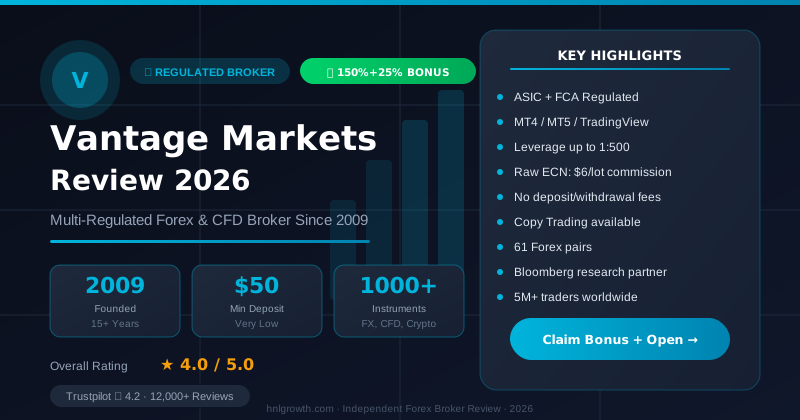
Vantage Markets is a multi-regulated forex & CFD broker (FCA, ASIC, FSCA, CIMA, VFSC, FSC) trusted by 5 million+ traders, with Raw ECN pricing from $3/lot, no deposit/withdrawal fees, and full MT4/MT5/TradingView support.
Risk disclaimer: Vantage Markets is a live, regulated broker — trading forex and CFDs is done with real capital under normal market risk (this is not a simulated prop-firm evaluation). CFDs and leveraged forex products are complex instruments and carry a high risk of losing money rapidly due to leverage; most retail investor accounts lose money trading these products. Consider whether you understand how CFDs/forex work and whether you can afford the high risk of losing your money. Affiliate disclosure: HNL Growth earns a commission when you open a Vantage Markets account through links on this page.