How to Trade Forex: Orders, Pairs, Pips & Risk
How to Trade Forex: Orders, Pairs, Pips & Risk. An independent, fact-checked look at Vantage Markets for traders evaluating this broker.
Reviewed using our forex & CFD broker review methodology
Forex trading is the simultaneous buying of one currency and selling of another. In practice, retail traders access the forex market through a broker as Contracts for Difference (CFDs) — you speculate on price movements without owning the underlying currency. To trade effectively, you need to understand how currency pairs are quoted, how pip and lot sizes convert price moves into cash, which order types achieve which goal, how leverage amplifies both gains and losses, and what risk controls to apply before any real capital is at stake. This article walks through each of those mechanics in sequence, using a single worked example to show how they interact in one real trade.
How the Forex Market Works
The forex market has no central exchange. Instead it operates as an over-the-counter (OTC) network of banks, institutions, liquidity providers, and retail brokers — connected electronically across time zones. This decentralised structure is why brokers can offer continuous pricing and why spreads, rather than exchange commissions, are the primary cost mechanism.
The market runs 24 hours a day, five days a week, opening with the Sydney session on Monday morning (AEST) and closing after the New York session on Friday afternoon (EST). Four major trading sessions overlap across that window:
- Sydney — lightest liquidity; Pacific currencies most active
- Tokyo — Asian session; JPY pairs most active
- London — highest-volume single session; EUR, GBP pairs most active
- New York — overlaps with London for several hours; USD pairs peak liquidity
The London–New York overlap (roughly 13:00–17:00 UTC, shifting slightly with daylight saving time) is typically when major pairs see tightest spreads and greatest price movement. Session boundaries shift by an hour in either direction when clocks change in the UK, US, or Australia, so always check current times against a live session clock rather than a fixed table.
Important distinction for retail traders: When you trade forex via a CFD broker, you are not transacting in the interbank market directly. You are entering a contract with your broker that mirrors the price of a currency pair. This is how retail forex access works in practice — including via Vantage Markets.
Reading a Currency Pair
Every forex quote has the same structure: Base currency / Quote currency.
In EUR/USD = 1.0850:
- EUR is the base — the currency being bought or sold
- USD is the quote — the currency used to price the base
- The quote means: 1 euro costs 1.0850 US dollars
Bid and ask prices are always shown together. The bid is the price a broker will buy the base currency from you (your sell price). The ask is the price the broker will sell the base currency to you (your buy price). The difference is the spread — the broker's primary compensation on most trades.
If EUR/USD shows Bid: 1.0848 / Ask: 1.0850, the spread is 2 pips. You enter a long (buy) trade at 1.0850 and immediately face a 2-pip cost before price moves in your favour.
Pair categories affect liquidity and therefore cost:
- Major pairs (EUR/USD, GBP/USD, USD/JPY, etc.) — highest liquidity, tightest spreads, most transparent pricing
- Minor pairs (EUR/GBP, AUD/JPY, etc.) — moderate liquidity, somewhat wider spreads
- Exotic pairs (USD/TRY, EUR/ZAR, etc.) — lower liquidity, meaningfully wider spreads, higher volatility risk
For beginners, major pairs offer the most transparent conditions to learn on. Vantage offers 40+ currency pairs including majors, minors and exotics.
Pips, Pipettes, and Lot Sizes
A pip (percentage in point) is the standardised unit of price movement in forex:
- For most pairs (EUR/USD, GBP/USD, etc.): 1 pip = 0.0001
- For JPY pairs (USD/JPY, EUR/JPY, etc.): 1 pip = 0.01
Most platforms also display a fractional pip (pipette) — one-tenth of a pip — so EUR/USD might show 5 decimal places (e.g. 1.08503) and USD/JPY four (e.g. 149.503).
Pip value only becomes meaningful when you attach a lot size — the number of currency units in a trade:
| Lot Type | Units of Base Currency | Approx. Pip Value (EUR/USD, USD account) | Typical Use Case |
|---|---|---|---|
| Standard | 100,000 | ~$10 per pip | Experienced traders with larger accounts |
| Mini | 10,000 | ~$1 per pip | Intermediate traders, moderate accounts |
| Micro | 1,000 | ~$0.10 per pip | Beginners, small accounts, risk testing |
Pip values are approximate, calculated when USD is the quote currency. For other account currencies or non-USD quote pairs, pip values vary. Nano lots (100 units, ~$0.01 per pip) may be available depending on your broker and account type. Verify exact pip values and available lot sizes against your broker's contract specifications before trading.
Why this matters for risk: A 50-pip stop-loss on a standard lot costs $500 if the trade goes against you. The same stop on a micro lot costs $5. Lot size is the primary lever for managing how much money each pip of adverse movement costs you.
Order Types and When to Use Each
Understanding when to use each order type is as important as knowing the definition. The wrong order in a fast-moving market can result in a very different fill than intended.
| Order Type | Executes When | Best Used For | Key Risk |
|---|---|---|---|
| Market order | Immediately at current market price | Entering or exiting quickly; high-liquidity pairs | Slippage in volatile conditions; no price guarantee |
| Limit order | Price reaches your specified level (or better) | Entering at a target price; taking profit at a level | May not fill if price never reaches the level |
| Stop order | Price passes through your specified level | Entering a breakout; cutting a loss at a defined point | Slippage past the trigger level in fast markets |
| Stop-limit order | Price hits stop trigger, then a limit order activates | Breakout entries where you need price control | May not fill at all if the market gaps through the limit |
| Trailing stop | Price reverses by a set distance from the best price reached | Locking in profit as price moves in your favour | Can be triggered by temporary spikes; gap risk overnight |
Stop vs stop-limit in volatile markets: A plain stop order guarantees execution but not price — in a fast market it can fill several pips beyond your level. A stop-limit order gives you price control but introduces fill risk: if the market gaps through both your stop and your limit levels, the order will not execute and you remain in the trade. For major pairs in normal conditions, the gap risk is modest. For news events or low-liquidity periods (session opens, market close), it is material.
Going Long and Short: A Worked Example
This example is used throughout the rest of the article to show how the mechanics interact. It is illustrative only and does not represent typical results.
Scenario: You believe EUR/USD will rise from current levels.
Trade setup:
- Pair: EUR/USD
- Direction: Long (buy EUR, sell USD)
- Entry price (ask): 1.0850
- Lot size: 1 mini lot (10,000 units)
- Spread at entry: 2 pips (bid 1.0848 / ask 1.0850)
- Pip value: ~$1.00 per pip (mini lot, USD account)
You place a market buy order. You enter at 1.0850.
Price rises to 1.0900. You close by placing a market sell order at the bid of 1.0898 (assuming spread remains 2 pips).
P&L calculation:
- Entry: 1.0850 (ask)
- Exit: 1.0898 (bid)
- Gross move: 48 pips (the bid-ask spread is already embedded in your entry and exit prices)
- At $1.00/pip: gross P&L = $48.00 (before transaction costs and swap if held overnight)
Going short works in reverse: If you believed EUR/USD would fall, you would sell at the bid (1.0848) and close by buying at the ask. You profit if the pair falls; you lose if it rises. CFDs allow you to take either direction.
Leverage and Margin Explained
Leverage allows you to control a position larger than your deposited capital. It is expressed as a ratio (e.g. 30:1) meaning $1 of your capital controls $30 of market exposure.
Margin is the deposit required to open and maintain a leveraged position — not a fee, but collateral held by the broker.
Worked example (continuing EUR/USD trade):
- Position size: 1 mini lot = 10,000 EUR
- Notional value at 1.0850: $10,850
- At 30:1 leverage: margin required = $10,850 ÷ 30 = ~$362
- At 20:1 leverage: margin required = $10,850 ÷ 20 = ~$543
Your cash profit or loss on a fixed position size is determined by the pip movement and your lot size, not by leverage. In this example, the 48-pip move yields $48 whether you use 30:1 or 20:1 leverage. What changes is the margin you must post: at 30:1 you tie up $362; at 20:1 you tie up $543. Leverage therefore affects your return on margin and your capital efficiency, not the cash outcome of the trade itself.
Margin call and stop-out: When losses reduce your account equity below a threshold (the broker's margin call level), you will receive an alert to add funds or reduce positions. If equity falls further to the stop-out level, the broker will begin automatically closing positions to prevent your balance from going negative.
Negative balance protection: In certain jurisdictions and for retail clients under specific regulations, brokers may be required to ensure you cannot lose more than your deposited funds. This is jurisdiction-specific — it does not apply universally across all entities or account types. Check the specific terms for your regulatory entity.
Jurisdiction note: Leverage limits for retail forex CFD traders differ by regulator. Retail clients in certain jurisdictions may be subject to regulatory leverage caps — for example, 30:1 on major forex pairs under some regimes. Other Vantage entities may operate under different regulatory frameworks. Always verify which entity and leverage terms apply to your account. See Vantage trading conditions for current specifications.
What Forex Trading Actually Costs
Trading costs are not just the spread headline figure. Multiple cost types interact in every trade, and their combined effect grows with holding period and lot size.
1. Spread The bid-ask difference, embedded in your entry and exit prices. On a 2-pip spread at mini lot size on EUR/USD, the round-trip spread cost is $2. Account type affects this: Vantage's RAW ECN accounts offer spreads from 0.0 pips with a per-lot commission; Standard STP accounts have wider spreads with zero commission.
2. Commission (where applicable) On RAW ECN accounts, Vantage charges USD $3.00 per standard lot per side. On a 1-mini-lot trade that is $0.30 per side, or $0.60 round-trip.
3. Overnight swap (rollover) If you hold a position past the broker's daily rollover time, a swap charge or credit is applied. Swap reflects the interest rate differential between the two currencies in the pair. If you are long EUR/USD and EUR interest rates are lower than USD rates, you typically pay a swap. If rates favour your direction, you receive a swap credit. Swap rates change with central bank policy and vary by broker — always check the current rates in your platform or on your broker's specification page before holding positions overnight.
4. Currency conversion If your account currency differs from a trade's quote currency, gains and losses are converted at the prevailing rate, which may carry a small conversion spread.
Cost anatomy for the worked example (RAW ECN account, mini lot):
| Cost Item | Amount |
|---|---|
| Spread (2 pips round-trip, embedded in entry/exit) | $2.00 |
| Commission (RAW ECN, $0.30 per side × 2) | $0.60 |
| Swap (if held overnight) | Variable — check current rates for your broker and pair |
| Total known costs | $2.60 + swap |
On a $48 gross gain, known costs reduce your net outcome to approximately $45.40 before swap. On a shorter-term scalp with smaller pip gain, these costs represent a larger proportion. This is why matching your account type to your holding period matters: high-frequency, short-duration trading suits commission + tight spread accounts; lower-frequency position trading may suit spread-only accounts where the per-trade cost is simpler to track.
Many retail CFD accounts lose money when trading these products. Cost awareness is one reason to manage position size and risk carefully.
Managing Risk Before You Enter a Trade
Risk management is not a feature you add after you have a strategy — it is the constraint that makes any strategy survivable across a run of losing trades.
Position sizing: the percentage rule
Decide in advance what percentage of your account you are willing to lose on a single trade. A common starting framework is 1–2% of account balance per trade. This is not a rule imposed by brokers — it is a self-imposed constraint.
Formula:
Max loss amount = Account balance × Risk %
Position size = Max loss amount ÷ (Stop-loss distance in pips × Pip value)
Example: $2,000 account, 1% risk = $20 max loss. Stop-loss at 20 pips. At $1/pip (mini lot), 20 pips = $20. So 1 mini lot fits the constraint exactly.
If your stop requires 50 pips, the same $20 budget means you would need to trade a smaller size — approximately 0.4 mini lots — to keep the risk consistent.
Stop-loss placement logic
Stop-losses should be placed at a level that, if reached, tells you the trade thesis was wrong — not simply at a round number or a "comfortable" distance. Common methods:
- Below/above a structural level — a recent support or resistance the trade depends on holding
- ATR-based — a multiple of the pair's average true range, reflecting actual volatility
- Fixed pip distance — simpler, but ignores market structure and volatility
A tight stop increases win-rate aspirations but also increases the chance of being stopped out by normal price noise. A wide stop requires smaller position size to keep dollar risk constant.
Risk-reward ratio
Before entering, identify both your stop-loss and your target. If your stop is 20 pips and your target is 40 pips, your risk-reward is 1:2 — you risk $1 to potentially make $2. A 1:2 ratio means you only need to be right more than one-third of the time to break even on expected value (ignoring costs).
Risk-reward does not guarantee outcomes; it is a framework for ensuring that when you are right, your gains outweigh your losses over time.
Moving from Demo to Live: A Practice Framework
A demo account uses virtual funds to simulate trading on live market prices. Its value is learning mechanics — not predicting live profitability. Demo accounts do not replicate the psychological pressure of real capital at risk, and fills may differ slightly from live execution, particularly in fast markets.
What demo is genuinely useful for:
- Learning the platform without financial consequences
- Testing whether you can consistently execute your strategy rules
- Building familiarity with order types, margins, and position sizing before money is on the line
- Identifying process errors (wrong lot size, wrong direction, missing stop-loss) in a zero-cost environment
Demo-to-live readiness: a self-assessment checklist
This checklist is a self-assessment tool, not a broker requirement. Use it before committing real capital.
- Can place all five order types (market, limit, stop, stop-limit, trailing stop) without hesitation
- Understands the margin requirement for each intended trade size before placing the order
- Has defined maximum risk per trade as a percentage of account balance and can calculate position size accordingly
- Has traded the strategy across at least 20–30 demo trades spanning different market conditions (trending and ranging sessions)
- Understands how overnight swap affects multi-day positions on the specific pairs being traded
- Can identify a point in the chart at which the trade thesis is invalidated — and has a stop-loss at that level, not elsewhere
- Has reviewed the total cost of a round-trip trade (spread + commission + swap for intended hold period) and confirmed it is consistent with the strategy's expected pip targets
No checklist eliminates the transition difficulty — live trading involves real financial loss risk that demo cannot replicate. The checklist confirms mechanics competence, not market edge.
Disclosure: This page may contain affiliate links. We may earn a commission if you open an account through our links, at no extra cost to you.
When you are ready to apply these mechanics with real capital, compare Vantage account types to find the spread, commission, and minimum deposit structure that matches your intended trading approach.
Frequently Asked Questions
What is the minimum amount needed to start trading forex?
The minimum deposit required depends on the broker and account type. At Vantage, the RAW ECN account has a minimum deposit of USD $50. A technically low minimum does not mean a small deposit is appropriate for live trading — your deposit should be large enough that proper position sizing (1–2% risk per trade) results in meaningful but survivable trades. Check current account requirements at Vantage before opening an account.
What is web trading forex and how does it work?
Web trading forex refers to trading via a browser-based platform without downloading software. Vantage offers access to markets through its web platform as well as downloadable MetaTrader 4 and MetaTrader 5 platforms and the Vantage mobile app. Web-based access is useful for trading from machines where you cannot install software. You can find a walkthrough of available platforms in the Vantage platform guide.
I want to start trading forex — how long should I spend on demo first?
There is no universal rule. The benchmark is competence, not time. Focus on whether you can consistently apply your strategy rules, calculate position sizes correctly, and handle losing trades without breaking your risk parameters — not on hitting a specific number of demo days. Some traders are ready after two weeks; others benefit from longer. The readiness checklist above gives a more useful framework than a fixed time target.
Is day trading forex for beginners realistic?
Day trading — closing all positions within the same session — is technically accessible but operationally demanding. It requires fast decision-making, consistent execution, and a clear strategy for every trade. Transaction costs matter more in day trading because you pay the spread and commission on every trade. Beginners who try day trading without solid mechanics often find that costs and psychological pressure combine against them. Starting with longer time frames (4-hour, daily charts) is lower-pressure while building skills.
How does leverage affect my risk as a beginner?
Leverage multiplies both gains and losses relative to your deposited margin. Higher leverage means a smaller adverse price move can exhaust the margin posted for a trade. This is why position sizing and stop-losses are essential when using leverage. Regulatory leverage caps for retail clients exist in certain jurisdictions specifically to limit this amplification — the applicable cap depends on your jurisdiction and which regulatory entity your account is held with.
What percentage of retail forex traders lose money?
Many retail CFD accounts lose money when trading these products. The exact percentage varies by broker, time period, and client population, and must be sourced from the specific broker entity's current regulatory disclosure rather than a generic estimate. Check the risk disclosure on the Vantage entity page that applies to your jurisdiction for the current figure.
What is the difference between spot forex and forex CFDs?
Spot forex involves the actual exchange of currencies, typically settling two business days after the trade (T+2). Retail traders accessing forex through a CFD broker are not transacting in the spot market directly — they are entering a derivative contract that mirrors spot forex prices. CFDs do not involve delivery of the underlying currency and are typically subject to overnight swap charges in lieu of currency settlement. This distinction matters for understanding costs, regulation, and the applicable protections in your jurisdiction.
Editorial Verification Process
This is an educational guide, not a single-broker review. Where it references Vantage or other specific brokers, those claims are fact-checked against official documentation and public regulator registers using our 7-criteria broker review methodology, rather than a funded live-account test. See that page for our full source hierarchy and what "verified" means on this site.
Risk warning: CFDs and leveraged forex products are complex and carry a high risk of losing money. Check the terms, entity and protections that apply to your jurisdiction before trading.
All figures, rates, and conditions referenced in this article are subject to change. Verify current trading conditions, leverage limits, swap rates, and regulatory disclosures on the official Vantage Markets page for your jurisdiction before opening an account or placing a trade.
Related Vantage Markets Guides
Ready to Trade with Vantage Markets?
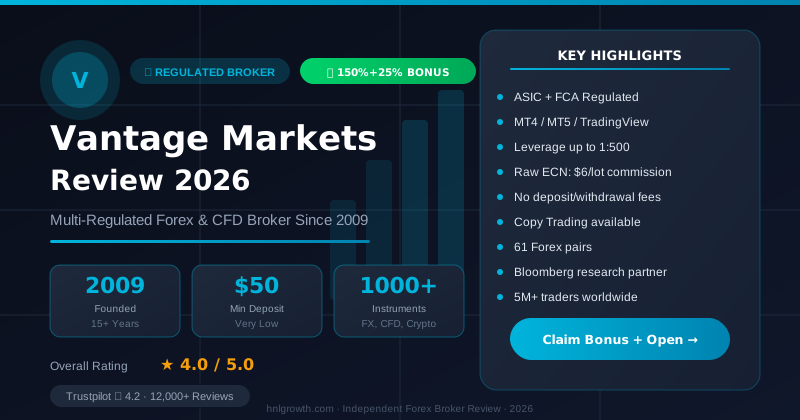
Vantage Markets is a multi-regulated forex & CFD broker (FCA, ASIC, FSCA, CIMA, VFSC, FSC) trusted by 5 million+ traders, with Raw ECN pricing from $3/lot, no deposit/withdrawal fees, and full MT4/MT5/TradingView support.
Risk disclaimer: Vantage Markets is a live, regulated broker — trading forex and CFDs is done with real capital under normal market risk (this is not a simulated prop-firm evaluation). CFDs and leveraged forex products are complex instruments and carry a high risk of losing money rapidly due to leverage; most retail investor accounts lose money trading these products. Consider whether you understand how CFDs/forex work and whether you can afford the high risk of losing your money. Affiliate disclosure: HNL Growth earns a commission when you open a Vantage Markets account through links on this page.