Forex Trading Account: Types & Setup
A forex trading account connects you to currency markets through a regulated broker. See account types, minimum deposits, and what to verify.
Reviewed using our forex & CFD broker review methodology
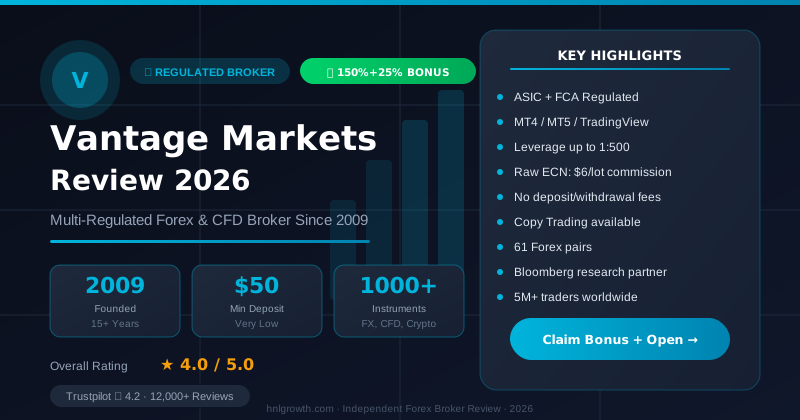
A forex trading account is a brokerage account that connects retail traders to the currency markets through a regulated intermediary. It functions as a margin-collateral facility: you deposit funds, the broker extends leverage against that deposit, and your orders are routed to liquidity providers in the interbank market. The account type you choose determines your minimum deposit, lot size, pricing model, and the leverage available to you. Before depositing a single pound or dollar, it pays to understand what you are actually paying per trade, what documents you need, and whether the broker holding your money is regulated in a jurisdiction that protects you. This guide covers all of that in plain terms.
What a Forex Trading Account Actually Does
Unlike a standard share-dealing account where you buy and hold an asset, a forex trading account operates on margin. You do not pay the full value of a position—you post a fraction of it (the margin) as collateral, and the broker covers the remainder using leverage. If the trade moves against you beyond your margin, you face a margin call or automatic stop-out.
In practice, most retail traders access currency markets through Contracts for Difference (CFDs), which replicate price movements without requiring physical currency exchange. This means you can go long or short on EUR/USD, GBP/JPY, or any other pair without holding the underlying currencies.
A forex account differs from a stock brokerage account in several important ways: positions are held in currency pairs rather than company shares, margin requirements are expressed as a ratio (e.g., 3.33% for 1:30 leverage), and the account is marked to market continuously while markets are open. Costs are embedded in the spread or charged as commission per lot—not as a percentage of assets under management.
The Main Account Types and Who They Suit
Brokers typically offer several account structures, each designed for a different combination of capital size, trading frequency, and experience level.
Forex Account Types at a Glance
| Account Type | Typical Min. Deposit | Lot Size | Pricing Model | Best Suited For |
|---|---|---|---|---|
| Standard | $100–$500 | 1 standard lot (100,000 units) | Spread-only | Intermediate traders with moderate capital |
| Mini | Industry range varies | 0.1 lot (10,000 units) | Spread-only | Beginners building position-sizing skills |
| Micro | $10–$50 | 0.01 lot (1,000 units) | Spread-only | Complete beginners; low-risk skill-building |
| STP (Straight Through Processing) | Check broker terms | From 0.01 lot | Varies by broker | Traders wanting direct market access |
| Raw spread + commission | $200–$500 | From 0.01 lot | Raw interbank spread + commission per lot | Active/high-volume traders focused on minimising per-trade cost |
| Managed/PAMM | Check broker terms | N/A (handled by money manager) | Performance fee + management fee | Passive investors; not hands-on traders |
Figures are indicative market ranges, not broker-specific commitments. Verify exact conditions, including minimum deposit, lot size, and pricing model, directly with your chosen broker before opening an account.
Who these account types are NOT for:
- Raw spread + commission accounts are not suitable for very low-volume traders. If you trade one or two lots a week, the per-lot commission can outweigh the tighter spreads.
- Managed/PAMM accounts are not for traders who want direct control of their positions. You are delegating execution to a third party, which carries its own risks including manager performance and fee drag.
Demo First, Live Second: How to Use Each Stage
A demo account lets you trade with simulated funds in real-time market conditions. It is the single most practical tool available to a beginner, and there is no rational argument for skipping it.
What demo accounts are genuinely useful for:
- Learning platform mechanics (order types, charting tools, position sizing)
- Testing a trading strategy across different market conditions
- Building familiarity with margin and leverage before real money is involved
What demo accounts cannot fully replicate:
- Slippage: live fills can differ from demo fills, especially during news events or low-liquidity periods. Demo results do not predict live performance.
- Emotional pressure: trading without real consequences removes the psychological element that affects most live traders. Discipline under demo conditions does not automatically transfer to live trading.
- Execution quality: some brokers use a separate pricing feed for demo accounts. Always verify whether the demo environment mirrors the live pricing model.
According to Vantage's forex education guide, beginners should practise on a demo account for a sustained period—commonly at least six months—to build consistency before considering a transition to live trading.
The signal for switching to live trading is not a specific profit figure. It is consistent application of a defined strategy with disciplined risk management across a meaningful sample of trades. When you are closing positions at planned exit points rather than reacting emotionally, you are ready to consider a small live account.
How Brokers Make Money: Spread-Only vs Commission Models
This is the single most important cost concept to understand before selecting an account type.
Spread-only accounts embed the broker's revenue in the bid-ask spread. If EUR/USD has a spread of 1.2 pips, you pay that 1.2 pips every time you open and close a position. There is no additional line item.
Commission + raw spread accounts charge a smaller spread (often 0.0–0.2 pips on EUR/USD) plus a fixed commission per lot traded, typically expressed as a per-side or round-turn figure.
Worked Cost Example: 1 Standard Lot EUR/USD
Assume you open and close a 1-lot EUR/USD trade (100,000 units). Each pip on EUR/USD is worth approximately $10.
| Model | Spread | Commission (round-turn) | Total Round-Trip Cost |
|---|---|---|---|
| Spread-only (Standard) | 1.2 pips | $0 | ~$12.00 |
| Raw spread + commission | 0.1 pips | $7.00 | ~$8.00 |
| Raw spread + commission | 0.1 pips | $14.00 | ~$15.00 |
Illustrative figures only. Actual spreads and commissions vary by broker, instrument, and market conditions. Verify current conditions with your broker before trading.
The practical takeaway: a "zero commission" standard account is not automatically cheaper. At moderate to high trading frequency, a raw spread account with a reasonable commission charge often produces a lower total cost per trade. The break-even calculation depends on: how many lots you trade, what the raw spread actually is in live conditions, and what the per-lot commission rate is.
At one lot per week, the difference is marginal. At twenty lots per week, it becomes material.
Leverage, Margin and Why the Numbers Vary by Region
Leverage is expressed as a ratio (1:30, 1:500) and determines how much market exposure you can control per unit of deposited margin. A 1:30 ratio means a £1,000 deposit controls a £30,000 position.
Leverage magnifies both gains and losses equally. A 1% adverse move on a 1:30 leveraged position results in a 30% loss of margin. Losses can exceed your initial deposit. Positions can be automatically closed (stopped out) if your account equity falls below the broker's required maintenance margin.
Leverage Limits by Regulatory Region (Retail Traders)
| Regulatory Body | Jurisdiction | Major Forex Pair Cap | Notes |
|---|---|---|---|
| FCA | United Kingdom | 1:30 | Retail leverage caps apply to major forex pairs; rules subject to change |
| ESMA / National NCAs | EU / EEA | 1:30 | Implemented by national regulators; conditions vary by member state |
| ASIC | Australia | 1:30 | Retail leverage reduced in 2021; professional client classification may differ |
| Offshore (e.g., Vanuatu, Cayman, Seychelles) | Various | Often 1:200–1:500+ | Lower or no investor protection; no mandatory compensation scheme; higher leverage carries higher risk |
Regulatory rules change. Verify current limits directly with the regulator or your broker before trading. The limits above apply to retail clients; professional client classification may allow higher leverage, subject to eligibility criteria.
Offshore brokers and investor protection: higher leverage at an offshore-regulated entity comes with a trade-off. There may be no investor compensation scheme, fewer conduct rules, and limited recourse if a dispute arises. This is not a blanket condemnation of offshore brokers, but it is a material difference that belongs in any account-selection decision.
What You Need to Open an Account: Documents and Suitability
Opening a forex trading account requires identity verification under anti-money laundering (AML) and Know Your Customer (KYC) regulations. This is a legal requirement for regulated brokers, not an optional step.
Standard documents required:
- Proof of identity: Government-issued photo ID — passport, national identity card, or driving licence
- Proof of address: A recent utility bill, bank statement, or official government letter (typically dated within the last three months)
- Financial suitability questionnaire: Regulated brokers in the UK, EU, and Australia are required to assess whether a product is appropriate for you. This involves questions about your trading experience, financial situation, and understanding of leverage and risk
What to expect from KYC:
Documents are typically submitted through a secure upload portal during the application process. Submitting clear, unobstructed document images reduces delays.
If you fail the appropriateness assessment on your first attempt, most regulated brokers allow you to retake it or proceed with a warning and reduced functionality. In some cases, the broker may restrict access to higher-risk products until experience criteria are met.
Funding, Withdrawals and the Costs In Between
Deposit Methods
Most regulated brokers accept bank transfer, debit/credit card, and e-wallets. Card and e-wallet deposits tend to be instant or near-instant; bank transfers can take one to three business days.
Minimum deposits vary significantly by broker and account type. A low minimum deposit is not, by itself, a reliable quality indicator—see the checklist section below.
Withdrawal Timelines
Withdrawal processing times are broker-specific and depend on the method used. Always verify the broker's stated withdrawal policy before depositing, particularly regarding whether the same payment method used to deposit must also be used to withdraw. Check the broker's terms and conditions for their specific processing times and any applicable fees.
Ongoing Costs to Factor In
These are frequently overlooked by beginners comparing account types:
- Overnight swap/rollover: Holding a forex CFD position past the daily rollover time incurs a swap charge or credit based on the interest rate differential between the two currencies in the pair. Swap rates vary by instrument, direction, and broker.
- Inactivity fees: Some brokers charge a monthly or quarterly fee if an account has no trading activity for a defined period. Check the broker's terms and conditions.
- Currency conversion fees: If your account base currency differs from the currency in which a trade is denominated, a conversion fee may apply on deposit, withdrawal, or at the trade level.
Always verify swap rates, inactivity fee policy, and withdrawal processing times directly in your broker's official terms and conditions, as these vary by broker and entity.
How to Pick the Right Account: A Decision Checklist
Use this checklist to evaluate any broker and account type before depositing. It is deliberately sequenced: regulation comes first because everything else depends on it.
Before You Open a Forex Account: 8-Point Check
- Regulatory status and licence number — verify directly on the regulator's official public register (FCA Register, ASIC Connect, CySEC register). A licence number on a broker's website is not sufficient; confirm it independently.
- Pricing model and typical spread/commission — establish the all-in round-trip cost per lot for the instruments you intend to trade, using the worked example framework above.
- Minimum deposit and funding methods — confirm the deposit minimum for your chosen account type, not the headline figure for the cheapest account.
- Leverage offered and margin call/stop-out policy — know the exact levels at which the broker will issue a margin call and automatically close positions.
- Platform availability — confirm the platform runs on your preferred device (desktop, mobile, tablet) and that MT4, MT5, or a proprietary platform is available as required by your trading approach.
- Withdrawal process and timeline — read the withdrawal policy, not just the deposit process. Check whether there are fees, method restrictions, or minimum withdrawal amounts.
- Customer support hours and channels — confirm whether support is available during the hours you intend to trade and whether live chat, phone, or email is offered.
- Demo account availability — a broker that does not offer a demo account before deposit is a yellow flag for beginners.
Disclosure: This page may contain affiliate links. We may earn a commission if you open an account through our links, at no extra cost to you.
Ready to compare account conditions? Vantage offers account types for traders at different experience levels. Compare Vantage account types to see minimum deposits, pricing models, and platform options.
Account-Type Decision Table
| Trader Profile | Capital Available | Trading Style | Recommended Starting Point |
|---|---|---|---|
| Complete beginner | Any | Learning, low frequency | Micro or demo account |
| Beginner, some experience | £100–£500 | Low to moderate frequency | Mini or STP account (verify broker terms) |
| Intermediate, cost-focused | £500+ | Moderate to high frequency | Raw spread + commission account |
| High-frequency active trader | £500+ | Scalping, algorithmic | Raw spread + commission with low latency execution |
| Passive, no hands-on trading | £1,000+ | N/A | Managed/PAMM (with rigorous due diligence on manager) |
This table provides a starting framework, not a definitive recommendation. Your actual choice depends on factors specific to your financial situation, risk tolerance, and the broker's conditions.
A Note on Switching Brokers
If you are moving from an existing broker, factor in: closing open positions before the transfer (most brokers do not support position transfers), ensuring pending withdrawals have cleared, and checking whether any bonus or promotional funds carry conditions that restrict withdrawal. Switching purely for a lower spread is rational only if the all-in cost calculation—including any new account minimum deposit and transfer friction—supports it.
Frequently Asked Questions
What is the minimum deposit for a forex trading account? It varies significantly by broker and account type. Micro accounts at some brokers start from as little as $10–$50. Standard accounts and accounts offering tighter spreads with commissions more commonly require £100–£500 or more. A higher minimum does not guarantee better conditions, and a lower minimum does not signal a worse broker—evaluate total cost structure and regulatory status first.
Is forex trading legal in my country? Forex trading via regulated brokers is legal in most major jurisdictions, including the UK, EU member states, and Australia. The legal framework and permissible instruments differ materially by country.
In India, the Reserve Bank of India (RBI) and the Securities and Exchange Board of India (SEBI) restrict retail participation in forex markets to exchange-traded currency derivatives on recognised exchanges. Trading OTC forex CFDs through offshore brokers occupies a legal grey area under Indian law and may not offer the same regulatory protections as exchange-traded products.
If you are unsure about the rules in your jurisdiction, seek guidance from a qualified local adviser or the relevant national regulator before opening an account.
How long does a forex account stay open in demo mode? Demo account duration varies by broker. Check the terms when you register for specific expiry or inactivity policies.
How long does the account opening process take? For most regulated brokers using automated identity verification, an account can be approved relatively quickly after submitting documents. Manual document review for more complex cases can take longer. Having clear, valid ID and proof of address ready speeds up the process.
What is the difference between a forex account and a CFD account? In retail trading, there is rarely a practical distinction. Most brokers offer forex access through CFDs—contracts that track the price of a currency pair without physical delivery. The account is typically the same; the label reflects the instrument being traded. Some brokers label accounts as "forex and CFD accounts" to reflect the full range of instruments available.
What percentage of forex traders lose money? Regulated brokers in the UK, EU, and Australia are required to disclose the percentage of retail client accounts that lose money when trading CFDs and leveraged forex products. This figure typically appears on broker websites and in risk disclosures. Check the disclosure for any broker you are considering—it is a factual data point, not marketing copy.
Does tax apply to forex trading profits? Tax treatment of forex trading profits varies significantly by jurisdiction, account structure (spread betting vs CFD in the UK, for example), and individual circumstances. This article does not constitute tax advice. Consult a qualified tax adviser in your jurisdiction for guidance specific to your situation.
Editorial Verification Process
This is an educational guide, not a single-broker review. Where it references Vantage or other specific brokers, those claims are fact-checked against official documentation and public regulator registers using our 7-criteria broker review methodology, rather than a funded live-account test. See that page for our full source hierarchy and what "verified" means on this site.
Risk warning: CFDs and leveraged forex products are complex and carry a high risk of losing money. Losses can exceed your initial deposit. Check the terms, entity and protections that apply to your jurisdiction before trading.
This guide draws on information from Vantage Markets UK — Trading Accounts, Vantage Standard STP Account, and Vantage Learn Forex Trading. Leverage rules are subject to change; verify current regulatory limits directly with the FCA, ESMA, ASIC, or your broker at time of reading.
Related Vantage Markets Guides
Ready to Trade with Vantage Markets?
Vantage Markets is a multi-regulated forex & CFD broker (FCA, ASIC, FSCA, CIMA, VFSC, FSC) trusted by 5 million+ traders, with Raw ECN pricing from $3/lot, no deposit/withdrawal fees, and full MT4/MT5/TradingView support.
Risk disclaimer: Vantage Markets is a live, regulated broker — trading forex and CFDs is done with real capital under normal market risk (this is not a simulated prop-firm evaluation). CFDs and leveraged forex products are complex instruments and carry a high risk of losing money rapidly due to leverage; most retail investor accounts lose money trading these products. Consider whether you understand how CFDs/forex work and whether you can afford the high risk of losing your money. Affiliate disclosure: HNL Growth earns a commission when you open a Vantage Markets account through links on this page.