How to Start Forex Trading in 2026
The safest path: learn currency pairs and leverage first, practise on a demo account, then risk only capital you can afford to lose live.
Reviewed using our forex & CFD broker review methodology
The core answer up front: Forex trading means buying one currency while simultaneously selling another, aiming to profit from exchange rate movements. For a beginner in 2026, the safest path is: build foundational knowledge first, practise extensively in a demo environment, then — and only then — risk capital you can genuinely afford to lose on a live account. This is not a passive income hack or a shortcut to financial freedom. The majority of retail traders who trade CFDs and leveraged forex products lose money. That fact should sit at the front of every decision you make throughout this journey.
Risk warning: CFDs and leveraged forex products are complex and carry a high risk of losing money. Check the terms, entity and protections that apply to your jurisdiction before trading.
What Forex Trading Actually Is
Forex (short for foreign exchange) is the global market where currencies are bought and sold against one another. You never buy a single currency in isolation — you always trade a pair. EUR/USD, GBP/USD, USD/JPY — each represents a price relationship between two currencies.
Here is a simple round-trip example with both outcomes shown:
You believe the British pound will rise against the US dollar. GBP/USD is currently priced at 1.2700. You buy 0.1 lot (10,000 units). Each pip movement is worth roughly $1 at this lot size.
- If the price rises to 1.2750: You close the position. The 50-pip gain equals approximately $50 profit — before costs.
- If the price falls to 1.2650: You close to limit the loss. The 50-pip decline equals approximately $50 loss — plus costs.
Neither outcome is guaranteed. The market does not know your position exists. Prices move based on economic data, central bank decisions, geopolitical events, and the collective actions of millions of participants — not on your expectations.
Trading Versus Investing: Understanding the Difference
These two words get used interchangeably, but they describe fundamentally different activities. Choosing the wrong path for your temperament and circumstances is one of the most common early mistakes.
| Dimension | Trading | Investing |
|---|---|---|
| Typical holding period | Seconds to weeks | Months to years |
| Frequency of decisions | High — often daily | Low — periodic reviews |
| Primary analysis style | Technical charts, short-term patterns | Fundamentals, long-term value |
| Emotional demand | Very high — requires rapid decisions under pressure | Lower — time allows reflection |
| Tax treatment | Varies significantly by jurisdiction and instrument | Varies significantly by jurisdiction and instrument |
| Capital at risk timeline | Immediate and continuous | Long-term; short-term volatility tolerated |
Important: Tax treatment for trading versus investing differs by country, instrument type, and individual circumstances. For UK residents, spread betting profits are currently treated differently from CFD profits — but this article cannot provide tax advice. Consult a qualified tax adviser for your situation.
Trading demands more time, more discipline, faster decision-making, and a higher tolerance for watching positions move against you in real time. If that description creates more anxiety than excitement, investing may be the better starting point.
Five Steps Every Beginner Should Follow
These steps are sequential. Skipping ahead does not accelerate your progress — it amplifies your risk.
Step 1: Build Conceptual Literacy (Before Opening Any Account)
You need to understand what you are trading before you trade it. This means learning:
- How currency pairs are priced and quoted (bid/ask, spread)
- What leverage is and how it amplifies both gains and losses
- What a pip is, what a lot size means, and how to calculate position value
- The difference between a market order and a limit order
- How to read a basic price chart
Practical output: Write down definitions of ten core terms in your own words. If you cannot explain leverage without looking it up, you are not ready for Step 2.
The goal here is not to consume every piece of content available — that path leads to information overload and paralysis. Commit to one structured learning source and work through it systematically before moving on.
Step 2: Open a Demo Account and Practise
A demo account gives you access to live market prices, real order types, and actual platform mechanics — using virtual funds. It is the most important tool available to a beginner, and it costs nothing.
What a demo account accurately replicates:
- Current market prices and spreads
- Order types: market, limit, stop
- Platform navigation and charting tools
- Position sizing mechanics
What a demo account does not replicate:
- The emotional pressure of watching real money move
- Occasional execution differences on real fills (slippage during high-volatility events)
- The psychological pull toward revenge trading after a loss
Use the demo phase seriously. Treat virtual capital as if it were real. Traders who approach demo accounts casually — taking positions ten times larger than they would with real money, ignoring stop-losses — are not practising trading. They are practising bad habits.
Try a demo account — no real money required. Practise with live market prices before committing any capital. Open a Vantage demo account
Disclosure: This page may contain affiliate links. We may earn a commission if you open an account through our links, at no extra cost to you. CFDs involve significant risk and may not be suitable for all investors.
Step 3: Write a Trading Plan Before Going Live
A trading plan is not aspirational. It is operational. It answers specific questions in advance so that you are not making those decisions under market pressure.
Your plan should specify:
- Which markets you will trade (start with one)
- What your entry criteria are (what signal or condition must be present?)
- Where you will place your stop-loss on every trade — before you enter
- What your maximum risk per trade is (most risk guidelines suggest 1–2% of account balance)
- What your maximum daily loss limit is (at which point you stop trading for that day)
Practical output: A one-page written document you can refer to during every trading session.
Step 4: Open a Small Live Position — With Capital You Can Afford to Lose
Only after completing Steps 1–3 should you consider a live account. Start small. The purpose of your first live trades is not profit — it is to experience how differently emotions behave with real money on the line.
Keep position sizes minimal. Apply your plan exactly as written. Your first goal is rule-following, not profit-making.
Step 5: Review, Learn, and Iterate
After every session — certainly after every week — review what happened. Not just the outcomes, but the process. Did you follow your plan? Did you deviate, and why? What would you do differently?
A trading journal — even a simple spreadsheet — is not optional for serious learners. It is the primary mechanism through which you accumulate genuine trading knowledge rather than just accumulated experience.
How Much Money Do You Actually Need to Start?
This is one of the most-searched questions in this space, and the honest answer requires separating two different questions: what is technically possible and what is practically sensible.
"Can I start trading with $1?" Some brokers do offer micro-lot and nano-lot account options with very low technical minimums. However, a $1 or $10 account makes proper risk management almost impossible. If your rule is to risk 1% of your account per trade, 1% of $100 is $1. At standard lot sizes, a single pip on EUR/USD is worth roughly $10. You cannot apply meaningful position sizing rules at these capital levels without nano-lot access — and even then, the margin for error is essentially zero.
"Can I start trading with no money?" In practice, yes — through a demo account. A demo account is the legitimate answer to this question. It provides full market access, real prices, and genuine practice with no capital requirement.
What is a prudent starting balance for a first live account? This varies by individual circumstances. The key principle is that the capital you deposit must be money you can afford to lose entirely without affecting your financial wellbeing. It should not be emergency savings, borrowed money, or funds earmarked for essential expenses.
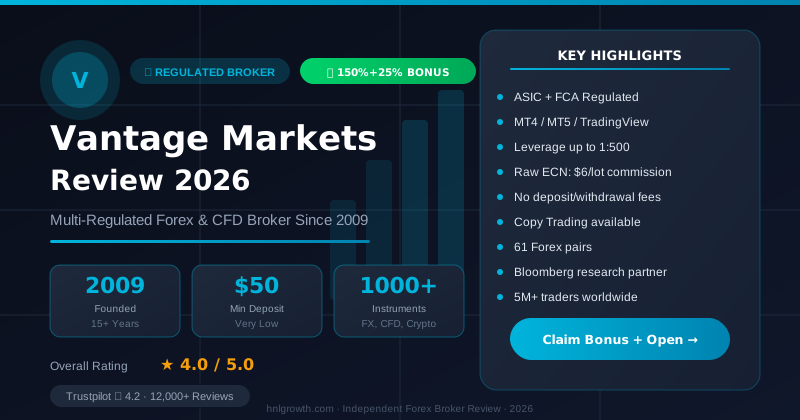
Brokers set their own technical minimums — Vantage Markets states a minimum deposit of USD $50 for a live account — but a technical minimum and a sensible starting balance are different things. Starting with a larger base makes it easier to apply proper position sizing. Starting with the absolute minimum under leverage pressure is a path to fast account depletion.
Minimum deposit figures are time-sensitive and set by individual brokers. Always verify the current figure directly on the broker's official website before depositing. Figures change and third-party sources may not reflect current terms.
Choosing a Broker and Platform Safely
This is where the risk of fraud and poor outcomes is highest for beginners. Scams targeting new traders are a documented, ongoing problem. Scepticism is rational, and verification is non-negotiable.
How to Verify a Broker Is Regulated
Follow this sequence — do not shortcut it:
- Find the broker's claimed regulator and published licence number (usually in the website footer or "About" page)
- Go directly to the regulator's official register — do not use Google results that could be spoofed
- Search for the firm by name and licence number
- Confirm the licence is currently active (not lapsed or cancelled)
- Confirm the licence covers the products you intend to trade (forex, CFDs)
- Check whether the firm is required to hold client funds in segregated accounts
For UK-regulated brokers, the relevant register is the FCA Financial Services Register. FCA-regulated firms are required under the FCA's Client Assets Sourcebook (CASS) to hold retail client funds in accounts segregated from the firm's own money. This is a regulatory requirement, not a voluntary choice. It matters because segregation provides some protection if a firm becomes insolvent — though it does not eliminate all risk.
Note on FSCS compensation: The Financial Services Compensation Scheme (FSCS) can provide protection if an FCA-regulated firm fails and cannot return client money. However, FSCS does not cover trading losses. Losses from your own trades are not compensable, regardless of the circumstance. Verify the current FSCS compensation limits and eligibility criteria at fscs.org.uk before relying on this protection.
For readers outside the UK: broker availability, regulatory protections, and compensation schemes differ significantly by jurisdiction. Verify which regulatory authority covers your location and confirm any broker you consider is authorised by that body. This article's primary regulatory context is UK/FCA — readers in other regions should consult their local financial authority.
Broker Red Flags
| Red Flag | Why It Matters |
|---|---|
| No regulatory licence number published | Cannot verify authorisation; unregulated brokers offer no formal protections |
| Promises of guaranteed returns or fixed monthly profit | No licensed broker can guarantee returns; this is a defining scam characteristic |
| Pressure to deposit within a time limit | Legitimate brokers do not manufacture urgency; high-pressure tactics are a manipulation signal |
| No disclosure on client fund segregation | Regulated brokers must confirm this; absence suggests either non-compliance or non-regulation |
| Customer support details absent or non-functional | Inability to contact support before depositing predicts inability to resolve issues after |
| Withdrawal process undocumented or reported as obstructed | Withdrawal obstruction is the most common complaint pattern in broker fraud cases |
Compare regulated brokers before depositing. Use a structured comparison to evaluate regulation status, fees, and platform features side by side. View regulated broker options
CFDs involve significant risk and may not be suitable for all investors.
Understanding Your Real Trading Costs
Most beginners underestimate trading costs because they think of cost as commission only. In reality, you typically pay on three dimensions, and all three affect your profitability.
The three main cost types:
- Spread: The difference between the buy (ask) price and sell (bid) price. You pay this every time you open a position. On a 0-commission account, the spread is the primary cost.
- Commission: Some account types charge a fixed per-trade commission in addition to a tighter spread. Neither structure is universally cheaper — it depends on trade frequency and size.
- Overnight swap (rollover): If you hold a leveraged position open past the daily rollover time (typically around 22:00 GMT), a swap charge or credit is applied based on the interest rate differential between the two currencies in the pair. Holding positions overnight carries an ongoing cost that compounds over days.
Illustrative Cost Calculation
This is a worked example for educational purposes. Actual costs vary by broker, account type, and market conditions.
| Cost Component | Assumption | Calculation | Approximate Cost |
|---|---|---|---|
| Trade | EUR/USD, 0.1 lot | 10,000 EUR | — |
| Spread | 1.2 pips | 1.2 × $1/pip (0.1 lot) | $1.20 |
| Commission | $0 (spread-only account) | — | $0.00 |
| Overnight swap | 1 night hold, est. ~$0.50 | Varies by rate differential | ~$0.50 |
| Total cost | ~$1.70 | ||
| Margin used (1:30 leverage) | ~$333 notional exposure | — | |
| Cost as % of margin | $1.70 / $333 | ~0.51% |
That 0.51% sounds small. But on a trade that targets a 1% gain on margin, your break-even moves to 1.51%. At higher frequency or with wider spreads, costs become a material drag on performance. Understanding this before you deposit is far better than discovering it after.
Risk Management Before You Risk a Penny
Risk management is not an advanced topic. It is the first topic. Apply these three rules before placing any live trade.
Rule 1: The 1–2% position sizing rule Calculate the maximum amount you are willing to lose on a single trade as a percentage of your total account balance. Most risk management frameworks suggest 1–2%. If your account contains $500, your maximum loss per trade is $5–$10. This determines your position size and stop-loss distance — not the other way around.
Capital adequacy note: On a $100 account with a 1% risk rule, your maximum loss is $1 per trade. At standard forex lot sizes, this forces either nano-lot access or no live trading at all. This is one of the clearest practical arguments for using a demo account until you have built a capital base that makes proper risk management viable.
Rule 2: Stop-loss on every trade, set before entry A stop-loss is a pre-set price level at which your position closes automatically to limit your loss. It must be placed before you enter the trade — not after you see how the position moves. Moving a stop-loss further away because the market is going against you is one of the most common ways beginner accounts collapse.
Rule 3: Maximum daily loss limit Set a point at which you stop trading for the day regardless of how you feel about recovering losses. A common starting framework is 3% of account balance per day. When you hit it, you stop. This rule exists specifically to prevent one bad session from becoming an account-ending event.
Common Mistakes That End Beginner Accounts Early
Technical knowledge is not the primary reason most beginners fail. Emotional and psychological errors are. These four patterns are the most common.
Overconfidence after early wins A few profitable trades early on can create a dangerous illusion of competence. The market rewards early traders randomly — early success often reflects luck in favourable conditions, not skill. The countermeasure: track your win rate across at least 50 trades before drawing any conclusions about your edge. One good week proves nothing.
Paralysis after the first loss A loss — particularly the first real-money loss — can trigger a freeze response. Traders abandon working systems after a losing trade because loss feels like failure. The countermeasure: accept at the outset that even a positive-expectancy strategy will have losing trades. Judge your system by its long-run performance, not by individual outcomes.
FOMO entry on news spikes A sharp price move on economic news creates a powerful urge to "jump in before it's too late." News-spike entries are often the most dangerous trades a beginner can take — spreads widen, volatility is chaotic, and by the time you've processed the news, the move is frequently already over. The countermeasure: wait for the spike to settle before considering entry. Not acting is a valid trading decision.
Revenge trading after a drawdown After a string of losses, the desire to "get back to even" by taking larger positions or staying in losing trades longer is called revenge trading. It reliably turns manageable losses into account-ending events. The countermeasure: your daily loss limit rule (see Risk Management above) is the structural defence against this. When the limit is hit, you stop — period.
How to Know When You Are Ready to Go Live
The answer is not a time target. "I've been demo trading for three months" is not readiness criteria — it is a calendar entry. Readiness is a performance and discipline threshold.
Demo-to-Live Readiness Checklist
Use this as a gate, not a formality. All items should be answered honestly.
| Readiness Criterion | Yes / No |
|---|---|
| Can you explain your entry and exit rules without referring to notes? | |
| Have you completed at least 50 demo trades following your written plan? | |
| Is your demo win rate consistent across two separate 4-week periods? | |
| Have you experienced a 5-trade losing streak without deviating from your plan? | |
| Do you understand every fee type your chosen broker charges? | |
| Have you verified your broker's regulatory status on the official register? | |
| Is the capital you plan to deposit genuinely risk capital — not emergency funds or debt? |
If any answer is no, identify which criteria you have not yet met and continue demo trading until you can answer yes to all of them. Extended demo use is not a sign of failure — it is a sign of discipline. The beginner who spends four months on a demo account before going live is statistically better positioned than the one who goes live after two weeks.
When your checklist is complete, here is how to open a verified live account. Start with the smallest position your plan allows. Your first live goal is disciplined execution, not profit. Open a live account with Vantage Markets
Risk warning: CFDs and leveraged forex products are complex and carry a high risk of losing money. Check the terms, entity and protections that apply to your jurisdiction before trading.
Disclosure: This page may contain affiliate links. We may earn a commission if you open an account through our links, at no extra cost to you.
Market Suitability at a Glance
Different markets suit different experience levels. This table provides a general orientation — not a recommendation. Volatility levels, leverage, and liquidity vary constantly.
| Market | Typical Trading Hours | General Volatility | Retail Leverage Cap (EU/UK)* | Minimum Practical Stake | Beginner Suitability |
|---|---|---|---|---|---|
| Forex major pairs (EUR/USD, GBP/USD) | 24 hrs Mon–Fri | Moderate, predictable patterns | Up to 30:1 | Very small (0.01 lot) | Moderate — high liquidity, clear data drivers |
| Forex minor pairs (EUR/GBP, AUD/JPY) | 24 hrs Mon–Fri | Moderate–higher | Up to 20:1 | Very small | Lower — wider spreads, less liquidity |
| Gold (XAU/USD) | 23 hrs Mon–Fri | High, news-reactive | Up to 20:1 | Small | Moderate — clear macro drivers but sharp spikes |
| Stock indices CFDs (SP500, NAS100) | Market hours + extended | Moderate–high | Up to 20:1 | Variable | Low–moderate — influenced by many underlying stocks |
| Individual share CFDs | Exchange hours only | High (single-company risk) | Up to 5:1 | Variable | Low — earnings, news, sector volatility |
| Cryptocurrency CFDs | 24/7 | Very high | Up to 2:1 | Small | Low — extreme volatility, thin liquidity at times |
Leverage caps for retail clients in the EU and UK are set by regulators (ESMA product intervention measures apply in EU; FCA rules apply in the UK post-Brexit). Confirm the current applicable caps with your broker and the relevant regulatory authority at the time of trading — rules can change.
Frequently Asked Questions
How long does it take to learn forex trading? There is no fixed timeline. The honest answer is: it takes as long as it takes to meet the readiness criteria above. Some traders are ready to go live after two months of structured demo practice; others take six months or longer. Rushing this timeline is one of the most reliable ways to lose money. Focus on the quality of your practice, not the speed.
I want to start trading forex — what is my very first step? Open a demo account. Not a live account — a demo. Before you deposit anything, you need to understand how the platform works, how to place and close a trade, how to read a price quote, and what spread means in practice. All of that is available for free through a demo account.
Can I trade forex from Dubai or other non-UK regions? Forex trading is available in many jurisdictions, but the regulatory protections available to you depend entirely on which regulatory body covers you in your location. The primary regulatory context of this article is the UK/FCA framework. Traders in the UAE, for example, are governed by different authorities (such as the DFSA for Dubai Financial Centre firms, or the SCA for mainland UAE). Before opening any account, identify which regulator has jurisdiction over your location and verify that your chosen broker is authorised by that body. Do not assume that a UK-regulated broker's protections automatically extend to your jurisdiction — the entity you trade with and the regulatory framework that applies may differ.
Is a demo account the same as a live account? In terms of price feeds, order types, and platform mechanics: largely yes. In terms of execution on extreme fills and — most importantly — emotional experience: no. Demo accounts do not replicate the psychological pressure of watching real money move. Many traders find their discipline and decision-making changes significantly when real capital is at stake. This is normal and expected. It is one reason the readiness checklist includes completing a full losing streak on demo before going live.
What should I look for when choosing a platform? Prioritise these in order: (1) the broker operating the platform is verifiably regulated by a recognised authority; (2) the fee structure is transparent and documented before you deposit; (3) the platform is available on the devices you will actually use; (4) customer support is reachable through a functional channel before you need it urgently.
What to Verify Yourself Before Opening an Account
Since no first-hand testing data is available for this article, here is a structured checklist of what you should independently confirm before depositing:
- Visit the FCA Financial Services Register directly at register.fca.org.uk and search for your intended broker by name and licence number. Confirm: active status, permitted activities include CFD/forex, and the registered entity matches the website entity.
- Check the broker's current minimum deposit on their official terms page — not on a third-party comparison site. Minimums change.
- Read the broker's CFD risk disclosure. It will contain a specific percentage of retail accounts that lose money on their platform. Take note of this figure.
- Confirm whether your account would be held under a UK entity or an offshore entity — this affects which protections apply to you.
- Test the demo account for at least two weeks before evaluating the live account offering.
- Contact customer support with a non-urgent question before you need help urgently — this tests response time and quality at low stakes.
HFM: A Broker to Consider for Account Variety
If you're comparing brokers beyond Vantage while going through this checklist, HFM is another regulated multi-entity broker worth confirming against your own criteria. HFM's international entity lists leverage up to 1:2000 (a risk indicator to manage carefully, not a benefit) and offers four account types — Cent, Zero, Pro, and Premium — with a minimum trade size of 0.01 lots (micro), making it accessible for beginners sizing small positions. HFM operates through multiple regulated entities; HF Markets (Europe) Ltd, for example, currently accepts only Eligible Counterparties and Professional per se clients, so confirm which entity would serve you before opening an account.
Risk warning: CFDs and leveraged forex products are complex and carry a high risk of losing money. Check the terms, entity and protections that apply to your jurisdiction before trading.
Disclosure: This page may contain affiliate links. We may earn a commission if you open an account through our links, at no extra cost to you.
Article ID: EDU-054 | Cluster: Forex Basics | Last reviewed: August 2026. Time-sensitive claims — including minimum deposit figures, leverage caps, regulatory status, and FSCS limits — should be verified against official sources at the time of reading. This article does not constitute financial advice.
Related Vantage Markets Guides
Ready to Trade with Vantage Markets?
Vantage Markets is a multi-regulated forex & CFD broker (FCA, ASIC, FSCA, CIMA, VFSC, FSC) trusted by 5 million+ traders, with Raw ECN pricing from $3/lot, no deposit/withdrawal fees, and full MT4/MT5/TradingView support.
Risk disclaimer: Vantage Markets is a live, regulated broker — trading forex and CFDs is done with real capital under normal market risk (this is not a simulated prop-firm evaluation). CFDs and leveraged forex products are complex instruments and carry a high risk of losing money rapidly due to leverage; most retail investor accounts lose money trading these products. Consider whether you understand how CFDs/forex work and whether you can afford the high risk of losing your money. Affiliate disclosure: HNL Growth earns a commission when you open a Vantage Markets account through links on this page.