PU Prime South Africa 2026: FSCA Status, Funding and Accounts
PU Prime is accessible to South African residents through its website and account opening process, and PU Prime's own regulation page names the Financial Sector Conduct Authority (FSCA) of South...
Reviewed using our forex & CFD broker review methodology
Checked on: 2026-08-17 | Broker terms, regulation, and pricing can change. Always verify at the official PU Prime site before opening an account.
Affiliate Disclosure: HNL Growth may earn a commission if you open an account through our links, at no additional cost to you. Risk Warning: CFDs and leveraged forex products are complex instruments and carry a high risk of losing money rapidly due to leverage. 62.2% of retail investor accounts lose money when trading CFDs with this provider. Trading forex and CFDs may not be suitable for all investors. Consider your objectives, experience, and risk appetite before trading, and ensure you understand the risks involved. Broker Disclosure: PU Prime is a live, regulated multi-entity broker (not a simulated prop-firm evaluation) — trades are executed with real capital in live market conditions, subject to normal market risk. Which PU Prime entity holds your account depends on your country of residence and determines your leverage cap and protections.
Last verified: August 2026 | Editorial Team
PU Prime South Africa 2026: FSCA Status, Funding and Accounts
PU Prime is accessible to South African residents through its website and account opening process, and PU Prime's own regulation page names the Financial Sector Conduct Authority (FSCA) of South Africa among the authorities it says oversee its operations. That is a brand-level claim, not the same as confirming that the specific entity opening your account currently holds an active FSCA license in good standing. Before funding anything, you need to separate three different questions: is PU Prime available to South Africans, does a specific PU Prime entity hold current FSCA authorization, and can you personally use that entity's account and payment rails without friction. This guide walks through all three, plus costs, account types and the account opening process.
Can South Africans Legally Use PU Prime Right Now?
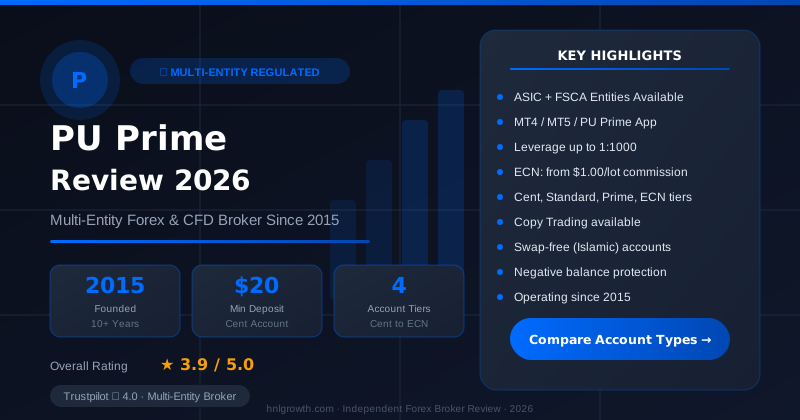
PU Prime — Multi-Entity Forex & CFD Broker
ASIC (AU) + FSCA (ZA) entities available · $20 min deposit (Cent) · MT4, MT5, PU Prime App · 4 account tiers
Split this into three layers instead of treating "PU Prime" as one single legal status.
Brand availability. PU Prime's website is reachable from South Africa and the sign-up flow accepts South African applicants. That confirms availability, nothing more.
Entity authorization. PU Prime's legal documentation page lists several separate legal entities, including PU Prime Limited, PU Prime Ltd, PU Prime LLC, and PU Prime (Pty) Ltd. The regulation page states that PU Prime is authorized by the Financial Services Authority of Seychelles (FSA), the Financial Services Commission of Mauritius (FSC), the Financial Sector Conduct Authority of South Africa (FSCA), and the Capital Market Authority of the UAE (CMA). The naming convention suggests PU Prime (Pty) Ltd is the entity associated with South Africa, but the source material reviewed for this article does not display a specific FSCA license number or a live status check. That detail matters, because a license can lapse, be suspended, or be limited in scope, and none of that is visible from a brand's own marketing page.
Practical usability. Even if the entity is correctly authorized, you still need to confirm your onboarding documents, funding method and account currency actually work smoothly from a South African bank account or e-wallet.
The honest answer for a Trust Checker: PU Prime says it holds FSCA authorization for South African clients, but you should confirm the current license number and status yourself before depositing. Treat the brand's own pages as a starting point, not as independent proof.
Before You Deposit — A 3-Point Eligibility Check
Run through this before you open a link to fund anything:
- Entity match — When you open an account, check the entity named in your account opening agreement or terms of business. Confirm it matches the entity you intend to rely on for South African protections (PU Prime (Pty) Ltd, per the naming on the legal documentation page), not one of the offshore entities.
- License currency — A license claim is only useful if it is current. Search the FSCA's public register directly (not PU Prime's own pages) using the entity name to confirm it is active, and check for any conditions or restrictions attached to it.
- Funding fit — Confirm your intended deposit method (card, bank transfer, e-wallet) is listed as supported for South Africa at the time you sign up, and that your deposit size clears the minimum for the account type you want.
If any of these three don't resolve cleanly, that's a reason to pause, not a reason to assume the best case.
Who Actually Regulates Your Account
"Regulated broker" is doing a lot of work in most marketing copy, and it hides an important distinction: not every license carries the same weight.
An onshore regulator like the FSCA supervises financial services providers operating within its own jurisdiction, requires local conduct standards, and gives South African clients a domestic complaints pathway — in South Africa's case, that generally runs through the FSCA itself or, for authorized financial services providers under the FAIS Act, the FAIS Ombud. An offshore license, such as one issued by the Seychelles FSA or the Mauritius FSC, authorizes a company to operate from that jurisdiction under that jurisdiction's rules, which are typically lighter and enforced from outside South Africa. Neither type of license is inherently fraudulent, but they are not interchangeable, and a client onboarded under an offshore entity does not automatically inherit the protections associated with a different, onshore entity — even if both entities share the same brand name.
Here is what's stated on PU Prime's own pages, alongside what still needs independent confirmation:
| Entity (as named by PU Prime) | Claimed Regulator | License Reference in Reviewed Sources | Where to Verify Independently | Likely Applies To |
|---|---|---|---|---|
| PU Prime (Pty) Ltd | FSCA (South Africa) | Not displayed in the pages reviewed | FSCA public register (fsca.co.za) | South African residents |
| PU Prime Limited / PU Prime Ltd | FSA (Seychelles) and/or FSC (Mauritius) | Not displayed in the pages reviewed | Seychelles FSA / Mauritius FSC public registers | Clients outside onshore-regulated markets |
| PU Prime LLC | CMA (UAE) | Not displayed in the pages reviewed | UAE Capital Market Authority register | UAE and regional clients |
To check this yourself: go to the FSCA's public register, search by the exact entity name shown in your account agreement (not just "PU Prime"), and confirm the license is active and unrestricted. Do the same with the account opening terms you're asked to accept — the entity named there, not the brand name on the homepage, is the one whose terms actually govern your funds.
Disclosure: This page may contain affiliate links. We may earn a commission if you open an account through our links, at no extra cost to you.
If you've checked the FSCA register yourself and confirmed the entity and license status that apply to your account, you can proceed to compare PU Prime account types before funding anything.
What It Costs to Trade — Spreads, Commission, and Swaps
PU Prime publishes its cost structure on its spread and costs page, and states explicitly that listed values are for reference only and that MT4, MT5 or the mobile app show the most accurate live figures. Combined with the account-type figures on PU Prime's account opening guide, the general cost shape looks like this:
| Account | Spread Type | Commission | Illustrative Round-Trip Cost, 1 Standard Lot EUR/USD |
|---|---|---|---|
| Cent / Standard | From 1.3 pips on EUR/USD | None | Roughly $13, from spread alone |
| Prime | Raw spread from 0.0 pips | $3.50 per lot, per side | Roughly $7 in commission, plus whatever the live spread adds |
| ECN | Raw spread from 0.0 pips | $1.50 per lot, per side | Roughly $3 in commission, plus whatever the live spread adds |
These are illustrative estimates built from PU Prime's stated minimum spread and commission figures, not a measured or tested result. Actual spreads move with market conditions, and swap (overnight financing) charges apply separately on positions held past end of day, with the exact rate varying by instrument and direction. Before trading any size that matters to you, open the live pricing in MT4/MT5 or the spread and costs page and check current numbers for your instrument.
Account Types Side-by-Side for South African Deposit Sizes
South African traders often ask how far a typical deposit stretches. Because no official current USD/ZAR conversion source was available for this article, the ZAR figures below use an illustrative rate of roughly USD 1 = ZAR 18 for reference only — check a live conversion rate before deciding, since currency movements will change these figures.
| Account | Minimum Deposit (USD) | Illustrative ZAR Reference | Spread Type | Commission | Best Suited For |
|---|---|---|---|---|---|
| Cent | $20 | ≈ R360 | Same as Standard | None | Testing the platform with small stakes |
| Standard | $50 | ≈ R900 | From 1.3 pips | None | Most beginners |
| Prime | $1,000 | ≈ R18,000 | From 0.0 pips (raw) | $3.50/lot/side | Frequent traders wanting tighter spreads |
| ECN | $10,000 | ≈ R180,000 | From 0.0 pips (raw) | $1.50/lot/side | High-volume, professional-style trading |
PU Prime also offers copy trading starting from as little as $25 per signal provider, according to its account opening guide, which is a lower-commitment entry point if managing your own trades isn't the goal.
Note that PU Prime's promotional deposit bonus pages (its 100% deposit bonus and 50% deposit bonus offers) are time-limited marketing promotions with their own terms and conditions. They are not part of the core account structure and shouldn't be the deciding factor in whether PU Prime is a legitimate, workable option for you — resolve the entity and eligibility questions first.
Getting Money In and Out From South Africa
PU Prime's account opening guide states that deposits can be made by credit or debit card, bank wire, and e-wallets such as Skrill and Neteller, among other methods. Card and e-wallet deposits are described as arriving instantly, while bank transfers are stated to take 1 to 3 business days. PU Prime does not publish, in the material reviewed here, a South Africa-specific breakdown of local payment rails (such as instant EFT providers), so you should confirm at sign-up which methods are actually offered to South African accounts and whether any fees apply on your side or the receiving bank's side.
On withdrawals specifically: this article did not have access to independently verified processing-time data for South African accounts. User discussions on third-party forums and review sites mention withdrawal delays and account manager unresponsiveness, but these are individual, unconfirmed reports rather than an established pattern, and no official service-level agreement for response or processing times was found in the sources reviewed. If timely fund access matters to you, ask PU Prime's support directly, before funding, what your specific account's withdrawal method and expected timeline will be, and get it in writing where possible.
Where PU Prime Fits and Where It Doesn't
It's a reasonable fit if you're comfortable doing your own entity and license verification before depositing, you're starting with a modest amount through the Cent or Standard account, and you don't need a South Africa-specific local support line or Afrikaans-language service (PU Prime's contact page lists English, French, Italian, German, Spanish, Chinese, Portuguese, Japanese, Thai, Vietnamese, Malay, Tagalog and Arabic — no local South African language is listed).
It's probably not a fit if you need certainty about onshore regulatory protection before you'll deposit anything, you're not willing to independently check the FSCA register, or you're relying on the deposit bonus pages as your main reason to sign up rather than the account and cost structure itself. It's also not the right choice if you can't tolerate any ambiguity around which entity, and which jurisdiction's rules, will actually apply to a dispute.
Opening an Account Step by Step
According to PU Prime's own account opening guide, the process runs:
- Register on the PU Prime signup page with your name, email, phone number and password, and choose your account currency and platform (MT4 or MT5).
- Upload documents — a valid government-issued ID (passport, national ID or driving licence) and a proof of address dated within the last three months, such as a utility bill or bank statement.
- Wait for verification — PU Prime states this usually takes a few hours during business days, sometimes up to 24–48 hours.
- Fund your account and start trading once verification clears, using your chosen deposit method.
Open a PU Prime account once you've confirmed the entity, license status and funding method that apply to you.
Frequently Asked Questions
Is PU Prime FSCA regulated for South African clients? PU Prime's own regulation page states it is authorized by the FSCA among other regulators, but this article could not independently confirm a current license number or status. Check the FSCA public register yourself before relying on this.
What's the minimum deposit to start? The Cent account starts at $20 and the Standard account at $50, per PU Prime's account opening guide. Prime requires $1,000 and ECN requires $10,000.
How long does verification take? PU Prime states verification usually takes a few hours on business days, up to 24–48 hours in some cases.
Are the deposit bonuses worth signing up for? The 100% and 50% deposit bonus pages are promotional offers with their own terms and time limits. They shouldn't be the basis for deciding whether PU Prime suits you — resolve the entity and eligibility questions first.
How do I check if my account's entity is really FSCA-authorized? Find the exact entity name in your account terms, then search that name directly on the FSCA's public register rather than relying on PU Prime's marketing pages.
Do withdrawal delays happen? Some user reports mention delays or slow account manager responses, but these are unverified individual accounts, not confirmed broker policy. Ask support directly about your account's expected timeline before depositing.
Risk Warning
Risk warning: CFDs and leveraged forex products are complex instruments and carry a high risk of losing money rapidly due to leverage. Consider whether you understand how these products work and whether you can afford to take the high risk of losing your capital. Check the entity, terms and protections that apply in your jurisdiction before trading.
Ready to Compare PU Prime Account Types?
PU Prime is a multi-entity broker — ASIC (Australia) and FSCA (South Africa) regulated entities offer stronger oversight, while most international clients are onboarded to the FSA Seychelles or FSC Mauritius entities. Four account tiers (Cent, Standard, Prime, ECN) range from a $20 minimum deposit to full ECN pricing.
Risk disclaimer: PU Prime is a live, regulated multi-entity broker — trading forex and CFDs is done with real capital under normal market risk (this is not a simulated prop-firm evaluation). PU Prime operates under multiple separate licenses (ASIC, FSCA, FSA Seychelles, FSC Mauritius); which entity holds your account depends on your country of residence and determines your leverage cap and protections — confirm this before funding. CFDs and leveraged forex products are complex instruments and carry a high risk of losing money rapidly due to leverage; 62.2% of retail investor accounts lose money when trading CFDs with this provider. Consider whether you understand how CFDs/forex work and whether you can afford the high risk of losing your money. Affiliate disclosure: HNL Growth earns a commission when you open a PU Prime account through links on this page.