Forex Trading in Nigeria 2026: Legality, Funding and Risk
Forex trading is legal for Nigerian residents. The Central Bank of Nigeria (CBN) manages foreign exchange policy and the Securities and Exchange Commission (SEC) oversees capital...
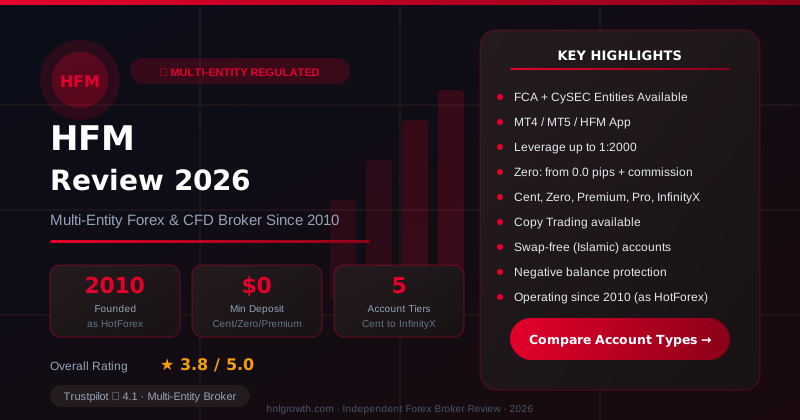
Checked on: 2026-08-08 | Broker terms, regulation, and pricing can change. Always verify at the official HFM site before opening an account.
Affiliate Disclosure: HNL Growth may earn a commission if you open an account through our links, at no additional cost to you. Risk Warning: CFDs and leveraged forex products are complex instruments and carry a high risk of losing money rapidly due to leverage. Between 65-95% of retail investor accounts lose money when trading CFDs, depending on the HFM entity and account type. Trading forex and CFDs may not be suitable for all investors. Consider your objectives, experience, and risk appetite before trading, and ensure you understand the risks involved. Broker Disclosure: HFM (HF Markets Group) is a live, regulated multi-entity broker (not a simulated prop-firm evaluation) — trades are executed with real capital in live market conditions, subject to normal market risk. Protections vary significantly by the specific legal entity that onboards your account.
Forex Trading in Nigeria 2026: Legality, Funding and Risk
Forex trading is legal for Nigerian residents. The Central Bank of Nigeria (CBN) manages foreign exchange policy and the Securities and Exchange Commission (SEC) oversees capital markets, but neither body licences or supervises retail online forex brokers. Nigerian traders therefore access global currency markets through offshore-regulated brokers, meaning fund protections depend entirely on the foreign jurisdiction that covers their account.
The practical path involves choosing a broker with credible regulation, understanding the real cost of naira-to-dollar funding conversions, and selecting platforms suited to West Africa Time (WAT) trading sessions. This guide walks through the regulatory landscape, evaluation criteria, broker comparison using HFM as a reference point, account setup, and WAT-based session planning.
The Nigerian Forex Landscape in 2026
HashHedge — Crypto Futures Prop Firm
Up to $200K funded accounts · 85% profit split · Instant USDT payouts · 160+ assets
Nigeria's large, young population and persistent naira volatility have sustained strong interest in retail forex trading. The NGX (Nigerian Exchange Group) handles equities, but currency pairs — traded as CFDs through international brokers — remain the most accessible speculative market for individual traders. The CBN's management of multiple exchange rate windows (official, I&E, and parallel markets) adds complexity to the funding side but does not restrict individuals from trading forex online.
Who Actually Regulates Forex for Nigerian Retail Traders?
The CBN sets foreign exchange policy, manages reserves, and intervenes in currency markets. SEC Nigeria regulates capital market operators — stockbrokers, fund managers, and issuers of securities — under the Investments and Securities Act. However, neither institution licences or supervises the type of retail online CFD/forex brokerage that Nigerian traders typically use.
This creates a regulatory gap: when a Nigerian resident opens an account with an international broker, their relationship is governed by the laws and regulatory framework of the jurisdiction where that broker's servicing entity is registered — not by Nigerian law.
What This Means for Your Fund Protection
Your protections as a Nigerian trader depend on three factors:
- The broker's servicing entity and its regulator. A global brand may operate under multiple licences (FCA, CySEC, ASIC, DFSA, FSCA, and others). Nigerian clients are typically onboarded to a specific entity — often one with less stringent requirements than the broker's EU or UK arm.
- Investor compensation schemes. Jurisdictions like the UK (FSCS, up to £85,000) and Cyprus (ICF, up to €20,000) offer compensation if a regulated firm fails. These schemes generally cover only clients of the specific entity under that regulator.
- Dispute resolution. If a disagreement with your broker cannot be resolved internally, your recourse is through the regulator or courts of the entity's jurisdiction — not through SEC Nigeria or the CBN.
Before opening any account, confirm exactly which entity will hold your funds and what protections that jurisdiction provides.
A Framework for Choosing Your Broker from Nigeria
Check the Entity, Not Just the Brand
Global broker brands operate multiple legal entities under different regulators. The brand name on the website may not be the entity that holds your deposit. Here is a verification checklist:
- Find the legal entity name in the broker's terms and conditions or regulatory disclosure page.
- Look up that entity on the relevant regulator's public register. The FCA maintains a public register at register.fca.org.uk; CySEC publishes its register at cysec.gov.cy; ASIC offers a similar lookup for Australian entities.
- Confirm the entity is currently authorised and check for any disciplinary history.
- Verify whether investor compensation applies and at what amount.
- Check whether client funds are held in segregated accounts.
Calculate the Real Cost of Trading
The advertised spread is only part of the picture. Your total cost per trade includes:
- Spread — the difference between bid and ask price, typically measured in pips.
- Commission — charged per lot on raw/ECN-style accounts; zero-commission accounts usually have wider spreads.
- Overnight (swap) fees — applied when positions are held past the daily rollover time.
- NGN conversion markup — if your account is denominated in USD but you fund in naira, the payment processor applies its own exchange rate, which may differ from the CBN official or interbank rate.
The "True Cost of a Trade" concept — adding spread cost, commission, and one night's swap for a standard lot — gives a more honest comparison than spread alone.
Confirm Your Funding and Withdrawal Options
Not all deposit methods process smoothly to and from Nigerian bank accounts. Key considerations:
- Available methods: bank wire, Visa/Mastercard, e-wallets (Skrill, Neteller), and in some cases crypto transfers.
- Processing times: e-wallets are typically fastest (minutes to hours); bank wires may take 2–5 business days.
- Currency: most international trading accounts are USD- or EUR-denominated. If you deposit in NGN, conversion occurs at the processor's rate.
- Withdrawal path: confirm that withdrawals can return to your original deposit method or a Nigerian bank account, and check for intermediary bank fees on wires.
Broker Comparison — The Numbers That Matter
The table below compares HFM against other brokers frequently cited for Nigerian clients. HFM figures are drawn from official HFM trading accounts documentation. Competitor figures reflect commonly published ranges from official broker websites and should be independently verified, as spreads and conditions change regularly.
| Broker | Regulating Entity (Example Jurisdictions) | Min Deposit | EUR/USD Spread (Standard) | Commission per Lot (RT) | NGN Funding | Typical Withdrawal Time |
|---|---|---|---|---|---|---|
| HFM | FSCA, FSA, CySEC, DFSA (entity-dependent) | $0 (Premium, Zero, Cent); $100 (Pro); $500 (InfinityX) | From 0.3 pip (InfinityX); from 1.4 pip (Premium) | Varies by account type | Yes — NGN account currency available on InfinityX | Varies by method |
| Exness | FSA, CySEC, FSCA | $1 | Variable, typically 0.6–1.2 pip (Standard) | Zero on Standard; commission on Raw | Limited — USD accounts typical | E-wallets: minutes; wires: 1–3 days |
| IC Markets | ASIC, CySEC, FSA | $200 | From 0.0 pip (Raw Spread) | $7.00 RT per lot (Raw) | No direct NGN | 1–3 business days |
| FXTM | FCA, CySEC, FSCA, FSA | $10 (Micro); $100 (Standard) | From 1.0 pip (Standard) | Varies | Limited | 1–5 business days |
Data reflects commonly published broker terms. All figures are subject to change. Verify current conditions on each broker's official website before making a decision.
Spreads, Commissions, and Overnight Fees
HFM offers five account types with distinct cost structures:
- InfinityX — spreads from 0.3 pip, minimum deposit $500, NGN-denominated accounts available, leverage up to unlimited (subject to T&Cs).
- Zero — spreads from 0 on forex, suitable for cost-sensitive traders on major pairs.
- Pro — spreads from 0.6 pip, minimum deposit $100.
- Premium — spreads from 1.4 pip, no minimum deposit.
- Cent — spreads from 1.4 pip, contract size of 1,000 units per lot, designed for small-capital testing.
Overnight swap rates vary by pair, position direction, and account type. HFM publishes these rates on its platform; check the swap column in your MT4/MT5 terminal before holding positions overnight.
Platforms and Mobile Experience
| Broker | MT4 | MT5 | cTrader | TradingView | Proprietary App | Copy Trading |
|---|---|---|---|---|---|---|
| HFM | Yes | Yes | No | No | HFM App + WebTrader | Available |
| Exness | Yes | Yes | No | No | Exness Trade App | Available |
| IC Markets | Yes | Yes | Yes | Yes | — | Available (via MT4/MT5 signals) |
| FXTM | Yes | Yes | No | No | FXTM Invest App | FXTM Invest copy trading |
HFM provides access to MetaTrader 4, MetaTrader 5, HFM WebTrader, and the HFM mobile app across all account types. The HFM Platform integrates account management and trading in one interface. Traders who prefer cTrader or direct TradingView integration would need to look at brokers offering those platforms.
Getting Money In and Out from Nigeria
| Method | Direction | Currency | Processing Time | Notes |
|---|---|---|---|---|
| Bank wire transfer | Deposit / Withdrawal | USD, EUR | 2–5 business days | Intermediary bank fees may apply on wires |
| Visa / Mastercard | Deposit (withdrawal varies) | USD, EUR | Instant deposit | Card withdrawals depend on issuing bank |
| Skrill / Neteller | Deposit / Withdrawal | USD, EUR | Minutes to hours | Widely used by Nigerian traders; lower fees than wires |
| Crypto transfer | Deposit / Withdrawal | USDT, BTC | Minutes | The CBN reversed its 2021 crypto banking ban in late 2023; check current bank policies |
| Local bank transfer (NGN) | Deposit | NGN | Varies | Availability depends on broker and payment processor; conversion to USD at processor's rate |
HFM lists NGN as an available account currency on its InfinityX account, which can reduce or eliminate conversion costs if your trading capital is held in naira. For other account types, deposits in NGN are converted at the payment processor's rate — compare this against the CBN official rate at the point of deposit to understand the markup.
HFM Through a Nigerian Trader's Lens
Disclosure: This page may contain affiliate links. We may earn a commission if you open an account through our links, at no extra cost to you.
Account Conditions and Pricing
HFM presents five account tiers. For Nigerian traders, the key considerations are:
- NGN account currency on InfinityX — a genuine differentiator that reduces FX conversion friction.
- Zero minimum deposit on Cent, Zero, and Premium accounts — accessible for traders starting with small capital.
- Leverage up to 1:2000 on most accounts (unlimited on InfinityX, subject to terms). High leverage amplifies both gains and losses — understand margin call and stop-out levels before using it.
- Swap-free option available on specific instruments and account types, relevant for traders seeking Sharia-compliant arrangements.
HFM's security of funds framework includes segregated client accounts, negative balance protection, and an insurance programme covering up to EUR 5 million against fraud and errors. The broker states that withdrawals are processed 24/7, though actual settlement times depend on the payment method and any intermediary banks involved.
How HFM's Costs Compare
HFM's InfinityX and Zero accounts offer competitive spreads on major pairs, particularly EUR/USD. The Premium and Cent accounts, with spreads from 1.4 pip and zero commission, are comparable to standard offerings at similar brokers. Where HFM stands out for Nigerian traders is the NGN account option and the low entry threshold on several account types.
Where HFM may not be the best fit: traders who require cTrader or direct TradingView integration will need to look elsewhere, and the $500 minimum on InfinityX (the only NGN-denominated account) may be a barrier for those specifically seeking NGN funding with smaller starting capital.
Compare HFM account types and open a live account
Funding and Withdrawing as a Nigerian Client
HFM supports multiple deposit and withdrawal methods. The availability of specific options may vary based on your country of residence and account type. Key points for Nigerian clients:
- Check HFM's payment methods page for current Nigeria-available options.
- If depositing in NGN to a USD-denominated account, note the exchange rate applied at the point of transaction.
- HFM's published framework includes 24/7 withdrawal processing, but receiving funds in your Nigerian bank depends on payment processor and banking timelines.
- Test with a small deposit and withdrawal first to confirm processing times and any fees on your specific method.
For a detailed breakdown of HFM's full trading conditions and platform experience, see our complete HFM review.
From Registration to Your First Trade
What You Need to Open an Account
International brokers typically require the following documents for account verification:
- Government-issued ID: Nigerian international passport, National ID card (NIN), or voter's card.
- Proof of address: a recent bank statement or utility bill showing your name and residential address (dated within the last 3–6 months).
- Additional fields: some brokers request your BVN (Bank Verification Number) during registration.
Verification timelines vary — some brokers approve accounts within hours, while others may take 1–3 business days. Accounts are usually limited in functionality (no withdrawals) until verification is complete.
Funding Your Account and Placing a Trade
- Choose your deposit method based on speed, fees, and whether you are depositing in NGN or USD.
- Be aware of conversion costs. If your account is in USD and you fund from a naira bank account, the processor's exchange rate applies. Compare it to the CBN official rate.
- Start with a position size appropriate to your account. On a standard account, 1 lot equals 100,000 units. On HFM's Cent account, 1 lot equals 1,000 units — a more manageable size for learning on live markets.
- Set stop-loss and take-profit levels before entering the trade. This is essential risk management, not optional.
Trading on West Africa Time
Nigeria operates on West Africa Time (WAT, UTC+1), which positions traders favourably for the most liquid forex sessions.
| Session | WAT Hours (approx.) | Recommended Pairs | Typical Volatility | Best Suited For |
|---|---|---|---|---|
| London | 08:00 – 17:00 | EUR/USD, GBP/USD, EUR/GBP | High | Active day trading; major pair entries |
| London–New York overlap | 13:00 – 17:00 | EUR/USD, GBP/USD, USD/CAD | Highest | News-driven trades; breakout strategies |
| New York standalone | 17:00 – 22:00 | USD/JPY, EUR/USD, USD/CAD | Moderate–High | Continuation trades; US data releases |
| Asian (Tokyo/Sydney) | 00:00 – 08:00 | USD/JPY, AUD/USD, NZD/USD | Low–Moderate | Swing trade reviews; position management |
London session (morning in Nigeria): This is the highest-opportunity window. The London open at 08:00 WAT brings peak European liquidity. Major pairs tighten in spread and offer the most reliable technical setups.
London–New York overlap (afternoon in Nigeria): Between roughly 13:00 and 17:00 WAT, both London and New York are open simultaneously. This is when the majority of daily forex volume transacts. Key economic data releases (US non-farm payrolls, CPI, FOMC decisions) typically land between 13:30 and 15:00 WAT.
Asian session (night in Nigeria): Lower liquidity makes this session less suitable for active entries on majors, but USD/JPY and AUD/USD can offer opportunities. Swing traders may use this window to review and adjust open positions rather than initiate new ones.
Note: WAT hours shift by one hour during daylight saving time periods in London (late March to late October) and New York (mid-March to early November). Adjust your schedule accordingly.
Common Mistakes Nigerian Forex Traders Make
- Over-leveraging on small accounts. Leverage of 1:2000 means a $100 account can control $200,000 in positions — but a 50-pip adverse move can wipe the account. Use position sizing that limits risk per trade to 1–2% of your capital.
- Ignoring NGN conversion costs. A 2–3% markup on the exchange rate when funding your account is a cost that must be recovered through trading before you are profitable.
- Trading during low-liquidity hours. The Asian session in WAT (midnight to 8 AM) produces wider spreads and less reliable price action on major pairs.
- Skipping verification before depositing. Unverified accounts face withdrawal delays. Complete KYC before funding.
- Choosing a broker based on bonuses alone. Bonus terms often restrict withdrawals. Evaluate spreads, entity regulation, and funding practicality first.
- Failing to verify the broker's regulatory entity. Confirm the entity name on the regulator's public register — do not rely solely on marketing claims.
Practising Without Financial Risk — The Demo Account Path
Before committing real capital, a demo account lets you test platform functionality, order execution, and your strategy under live market conditions — without exposing your funds to loss.
HFM offers a demo contest called "Virtual to Real," where participants trade on demo accounts for a chance to win trading bonuses credited to a live account. The contest runs monthly and is open to both new and existing HFM clients. Prizes of $2,000, $1,000, and $500 in trading bonuses are awarded to the top three performers by percentage gain.
Even outside of contests, a demo account is the right starting point. Use it to:
- Familiarise yourself with MT4, MT5, or the HFM app interface.
- Test your strategy on the pairs and sessions you plan to trade.
- Understand how margin, leverage, and stop-out levels work in practice.
- Verify that the broker's execution speed and platform stability meet your needs.
Frequently Asked Questions
Is forex trading legal in Nigeria? Yes. No Nigerian law prohibits individuals from trading forex. However, neither the CBN nor SEC Nigeria licences retail online forex brokers, so Nigerian traders use internationally regulated brokers and are protected by the laws of the broker's entity jurisdiction.
How much money do I need to start trading forex in Nigeria? HFM's Premium, Zero, and Cent accounts have no minimum deposit. The Pro account requires $100, and InfinityX requires $500. In practice, starting with at least $100–$200 allows more realistic position sizing and risk management on a standard account.
Which is the best forex broker for Nigerian traders? The answer depends on your priorities. HFM is a strong option for traders who want NGN-denominated accounts, low entry thresholds, and MT4/MT5 access. Traders who need cTrader or TradingView integration may prefer alternatives. Use the comparison framework in this guide to evaluate based on your specific needs.
What are the best trading sessions for Nigerian traders? The London session (08:00–17:00 WAT) and the London–New York overlap (13:00–17:00 WAT) offer the highest liquidity and tightest spreads on major pairs. These windows align with Nigerian business hours.
Can I deposit in naira (NGN) with a forex broker? Some brokers accept NGN deposits, but most international trading accounts are USD- or EUR-denominated. HFM's InfinityX account offers NGN as an account currency. For other accounts, NGN deposits are converted at the payment processor's rate.
Is forex trading suitable for beginners? Forex trading carries significant risk. CFD loss disclosures from regulated brokers typically show that 70–80% of retail accounts lose money. Beginners should start with a demo account, learn risk management, and only trade with capital they can afford to lose.
How do I verify that a broker is legitimate? Check the broker's legal entity name in its terms and conditions, then search for that entity on the relevant regulator's public register (FCA, CySEC, ASIC, FSCA, DFSA). Confirm the registration is current and note any disciplinary actions.
Are forex trading profits taxable in Nigeria? Nigeria's Capital Gains Tax Act does not explicitly address retail forex CFD profits for individuals. Tax obligations may depend on your personal circumstances. Consult a qualified Nigerian tax adviser for guidance specific to your situation.
How We Researched This Guide
This guide was compiled using HFM's official website, including the trading accounts page, security of funds documentation, and demo contest page. Regulatory context is based on publicly available information from the CBN, SEC Nigeria, and international financial regulators.
Competitor references reflect commonly published information from official broker websites. All broker conditions — spreads, commissions, minimum deposits, and processing times — are subject to change. Figures in this article were last verified in August 2026. Before making any decision, confirm current terms directly on each broker's official website.
No live account testing from a Nigerian IP was conducted for this guide. Registration flows, verification timelines, and deposit/withdrawal processing times are described based on published broker documentation, not first-hand testing.
Risk warning: CFDs and leveraged forex products are complex instruments and carry a high risk of losing money rapidly due to leverage. Consider whether you understand how these products work and whether you can afford to take the high risk of losing your capital. Check the entity, terms and protections that apply in your jurisdiction before trading.
Risk warning: CFDs and leveraged forex products are complex instruments and carry a high risk of losing money rapidly due to leverage. Retail investor accounts lose money when trading CFDs with most providers; the exact percentage varies by HFM entity and account type. You should consider whether you understand how CFDs work and whether you can afford to take the high risk of losing your money. Check the entity, terms and investor protections that apply in your jurisdiction before opening an account or trading.
Ready to Start Your Funded Trading Journey?
Join traders backed by $11M+ in verified payouts and a 4.7/5 Trustpilot rating. Compare HashHedge challenge plans, drawdown rules, and payout terms — apply code ha25 for the current discount.
Risk disclaimer: Challenge fees are non-refundable if you breach the rules. Prop trading involves significant financial risk. Past performance in a simulated environment does not guarantee results on a funded account. Only purchase if you understand the rules fully and can afford to lose the fee. Affiliate disclosure: HNL Growth earns a commission when you purchase a HashHedge challenge through links on this page.