ECN vs STP Brokers: What the Account Labels Really Mean
ECN and STP are execution labels, but on retail CFD accounts the practical difference is pricing: raw spread plus commission vs a marked-up spread.
Reviewed by Hà Ngọc Lộc· Senior SEO Editor
Reviewed using our forex & CFD broker review methodology
ECN (Electronic Communication Network) and STP (Straight-Through Processing) describe how a broker says it routes your orders to liquidity providers rather than taking the other side itself. For a retail trader, the label matters less than the pricing model it usually comes with. "ECN/Raw" accounts quote a near-raw spread and charge a separate commission per lot. "STP/Standard" accounts charge no commission but a wider spread. Neither label tells you whether the broker hedges every trade, and with a CFD you are always contracting with the broker entity, never trading on an exchange.
The Practical Difference
| "ECN" / Raw account | "STP" / Standard account | |
|---|---|---|
| Spread | From ~0.0 pips (variable) | Wider, includes the broker markup |
| Commission | Yes, per lot per side | Usually none |
| Typical minimum deposit | Often higher | Often lower |
| Best for | Frequent trading, scalping, larger size | Occasional trading, simpler costs |
| Your counterparty | The broker entity (CFD) | The broker entity (CFD) |
Compare the All-In Cost, Not the Label
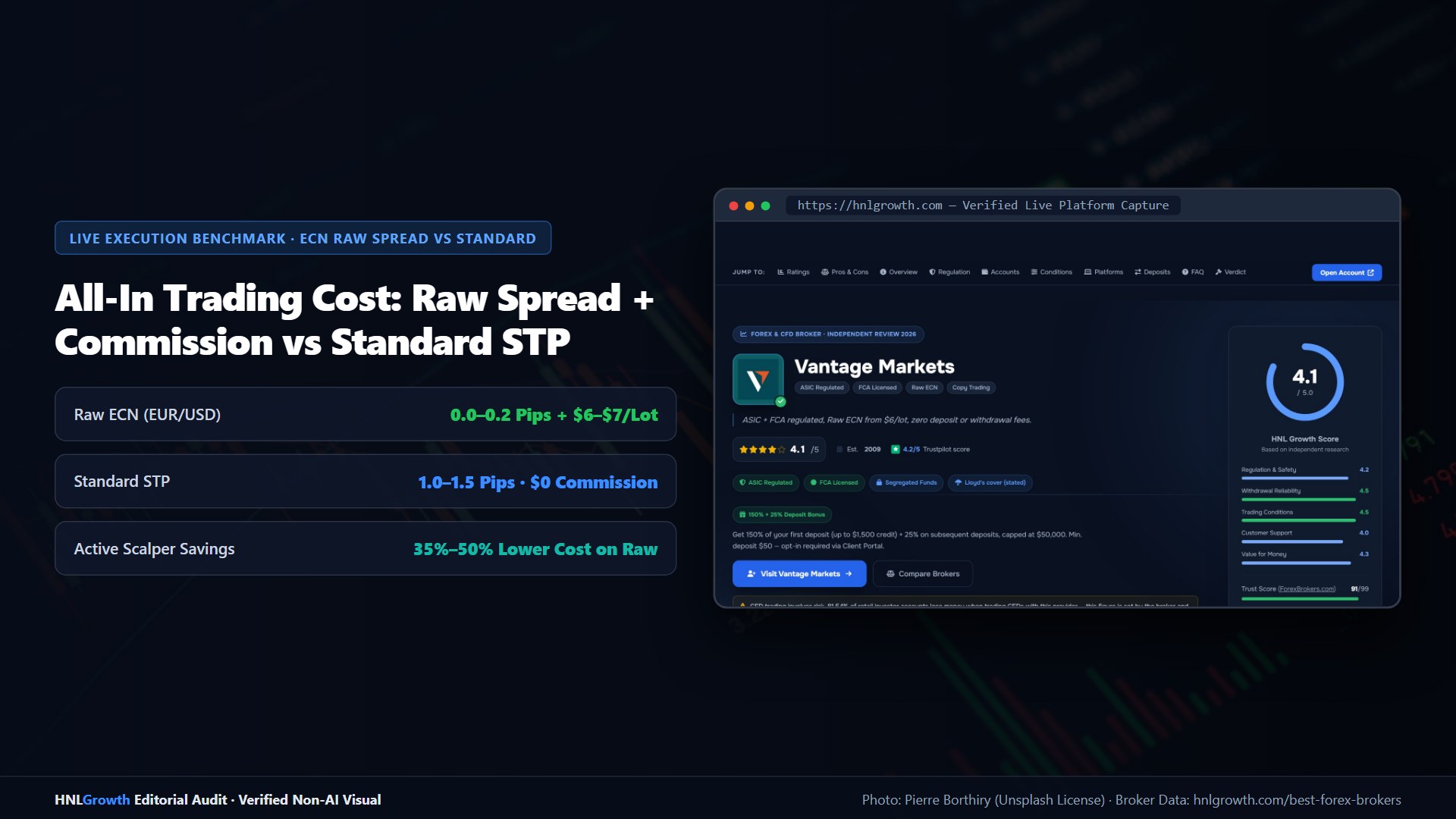
The figure that matters is spread + commission (round turn), measured in pips or dollars per standard lot.
- Raw account: average raw spread + (commission per side × 2). Example: 0.1 pip spread with $3 per side ≈ 0.1 pip + $6 ≈ about 0.7 pips on EURUSD, where 1 pip is roughly $10 per lot.
- Standard account: average spread only. Example: a 1.3 pip average spread ≈ 1.3 pips.
Use average spreads at the times you actually trade, not the "from" figure. Then add swap if you hold positions overnight.
What Our Brokers Publish
| Broker | "Raw/ECN-style" account | Published commission | "Standard/STP-style" account |
|---|---|---|---|
| Vantage | Raw ECN (from $50) | $3 per side per lot | Standard STP, no commission |
| PU Prime | Prime / ECN | $3.50 per side (Prime) · $1 per side (ECN, higher minimum) | Standard / Cent, no commission |
| Exness | Raw Spread / Zero | Raw: up to $3.50 per side; Zero: from $0.05 per side | Standard, no commission |
| JustMarkets | Raw Spread ($200) | $3 per side per lot | Standard / Pro, no commission |
| HFM | Zero | Commission on Zero (indicative ~$6 round turn) | Premium / Cent / Pro, no commission |
These are broker-published terms from our dated reviews (checked August–October 2026). They vary by entity and can change.
Myths to Ignore
- "ECN means no conflict of interest." Brokers can internalise some flow whatever the label says. Read the order execution policy instead.
- "STP is worse." If you trade a few times a week, a no-commission account can cost the same or less.
- "0.0 pips is free." Commission is the price. A "from 0.0" spread is a minimum, not an average.
Picking an Account Type
Estimate your monthly volume in lots, work out the round-turn cost on both account types for the pairs you trade, and choose the cheaper one. Check that the account's minimum deposit and leverage cap suit your plan. Compare costs across brokers in our low-spread broker guide.
Related: VT Markets account types — Standard STP vs RAW ECN at $6 round turn.
Related: ECN brokers compared · Forex broker fees
Further reading: FCA guidance on CFDs and leveraged products · FCA ScamSmart.
ECN vs STP Brokers: Your Questions Answered
Is an ECN account cheaper than STP?
Often for active traders, because raw spread plus commission can total less than a marked-up spread. Compare round-turn cost on the pairs and hours you trade.
Is a true ECN broker better for scalping?
Tight raw pricing helps scalping, but execution quality, slippage and broker rules on short-hold trades matter just as much — read the execution policy.
Does 0.0 pip spread mean no cost?
No. Raw accounts charge commission per lot, and 0.0 is a minimum, not an average.
Sources: broker-published account and commission pages summarised in our dated Vantage, PU Prime, Exness, JustMarkets and HFM reviews. CFDs carry a high risk of losing money rapidly due to leverage.
Related Guides
Sources & verification
- Last checked
- Written by
- HNL Growth Team
- Reviewed by
- Hà Ngọc Lộc
- Length
- 3 min read · 679 words
Rules, prices and payout terms on this page were checked against the official websites, help-centre articles and published terms of the firms mentioned, on the date above. Prop firms and brokers change conditions often — confirm the current version on the official site before you buy or deposit. Read our broker review methodology and affiliate disclosure.
Official sources & documentation verified
- FCA guidance on CFDs and leveraged products(fca.org.uk · Official Regulator)
- FCA ScamSmart(fca.org.uk · Official Regulator)
Explore Related Hubs & Free Trading Tools
Check Each Broker for Your Country
Listed in no particular order. Each broker onboards you through a different legal entity depending on where you live — confirm the entity, its regulator, leverage cap and withdrawal terms before funding.
Vantage
$50 Standard/Raw · MT4/MT5 + TradingView · FCA/ASIC & offshore entities
PU Prime
$20 Cent · $50 Standard · MT4/MT5 + app · ASIC/FSCA/offshore entities
Exness
Standard from $10 · MT4/MT5 + Exness Terminal · entity varies by country
Risk disclaimer: CFDs and leveraged forex are complex instruments and carry a high risk of losing money rapidly. Protections, leverage and available products depend on the entity that holds your account. Affiliate disclosure: HNL Growth may earn a commission when you open an account through broker links on this page.