Trailing Stop-Loss in Forex: Manual Structure vs Automated Rules
Compare manual structure trailing stops, 2x ATR buffers, and automated MT4/MT5 trailing rules, plus how they interact with prop firm drawdowns.
Reviewed by Hà Ngọc Lộc· Senior SEO Editor

A trailing stop-loss in forex is a dynamic risk-management rule that ratchets your protective Stop-Loss order forward in the direction of a winning trade while never moving backward when price retraces. Unlike a static take-profit strategy in forex that caps your maximum upside at a fixed price, a trailing stop lets you capture extended multi-session trends while progressively locking in realized profit. However, choosing between an automated point-based MT4/MT5 trailing stop, a 2x ATR volatility trail, and a manual structure trail determines whether you ride the trend or get wicked out prematurely.
1. How a Trailing Stop Works (Step-by-Step Mechanics)
When you open a long position on EUR/USD at 1.0800 with an initial stop-loss placement at 1.0770 (30 pips risk) and attach a 30-pip (300-point) automated trailing stop, the mechanism operates through three distinct phases:
- Activation Threshold: Nothing happens while EUR/USD trades between
1.0800and1.0829. Your stop remains at1.0770. An automated 30-pip trailing stop activates only once your trade achieves at least 30 pips of floating profit (1.0830), at which point the platform moves your Stop-Loss up to breakeven (1.0800). - One-Way Ratchet Adjustment: As EUR/USD climbs to
1.0865(+65 pips), your trailing stop ratchets upward pip-for-pip to1.0835(locking in +35 pips of realized gain). - Pullback Freeze & Exit: If EUR/USD pulls back from
1.0865to1.0840, the trailing stop stays frozen at1.0835. If the pullback deepens to1.0835, the stop triggers as a Market Order and closes your trade for a +35-pip profit.
Critical Warning: MT4/MT5 Automated Trailing Stops Are Client-Side!
One of the costliest technical misconceptions among beginners is assuming that MetaTrader 4 and MetaTrader 5 store automated trailing stop rules on the broker's server.
- Your current Stop-Loss price is stored on the broker's server.
- However, the automated Trailing Stop logic (
Right-click trade → Trailing Stop → 200 points) runs client-side inside your open desktop MT4/MT5 terminal. If you close your laptop or lose internet connection, your Stop-Loss stays frozen at its last updated level and will not continue trailing unless your terminal is running 24/7 on a Virtual Private Server (VPS).
| Trailing Stop Method | Where Logic Runs | Adapts to Market Volatility? | Respects Swing Highs/Lows? | Risk of Premature "Wick-Out" | Best Trading Style Fit |
|---|---|---|---|---|---|
| Automated Point Trail (MT4/MT5) | Client-side (PC or VPS must stay on) | No (Fixed point distance) | No | High (Normal 50% pullbacks hit fixed point trails) | Fast news breakouts & 1-minute momentum scalps |
| Manual Structure Trail (Dow Theory) | Server-side (Manual SL modification) | Yes (Follows candle swings) | Yes (Behind Higher Lows / Lower Highs) | Low (Exits only when trend structure breaks) | 15M intraday trends & 4H/Daily swing trading |
ATR Volatility Trail (2x ATR(14)) |
Server-side (Manual or EA update) | Yes (Expands in high volatility) | Moderate | Low (Sized outside average candle noise) | Systematic trend-following on Gold, FX & Indices |
Moving Average Trail (20 EMA Close) |
Manual candle-close check or EA | Yes (Follows trend slope) | Moderate | Low-to-Moderate | Strong directional momentum trends |
2. Three Superior Alternatives to Fixed-Pip Trailing Stops
Because currency trends advance in zig-zag waves (an impulsive push followed by a 38.2% to 61.8% Fibonacci pullback), a fixed 20-pip automated trailing stop almost always gets clipped right at the bottom of a healthy pullback before the trend resumes. Professional traders replace fixed-pip trails with three market-adaptive methods:
Method 1: Manual Market-Structure Trailing (Higher Lows & Lower Highs)
In a healthy uptrend (see how to read forex charts), price prints a sequence of Higher Highs (HH) and Higher Lows (HL). Under structure trailing:
- You never move your stop-loss while price is merely pulling back.
- You wait until price rallies and closes above the previous Swing High (confirming a new Higher High). Only then do you manually drag your Stop-Loss up to sit 3 to 5 pips below the newly confirmed Higher Low.
- Because a valid uptrend should not break its most recent Higher Low, getting stopped out under this rule means the trend structure itself has genuinely reversed.
Method 2: The 2.0x ATR Chandelier / Volatility Trail
Using the 14-period ATR indicator in forex, you trail your stop at a distance of 1.5x to 2.5x ATR behind the highest high (for longs) or lowest low (for shorts) since entry.
- Worked Example on Gold (XAU/USD): Suppose you are long XAU/USD on the 1-hour chart at
$2,620, the 1-hourATR(14)is$8.00, and you use a2.0x ATR($16.00) trail. When Gold reaches$2,660, your trailing stop sits at$2,660 - $16.00 = $2,644. Because$16.00is twice the average hourly volatility range, ordinary intraday noise cannot shake you out.
Method 3: The 20 EMA or 50 EMA Candle-Close Trail
In parabolic trends, traders trail their stop just behind a dynamic moving average such as the 20-period Exponential Moving Average (20 EMA), exiting only when a full candle body closes on the opposite side of the 20 EMA.
3. How Trailing Stops Interact with Prop Firm Trailing Drawdowns
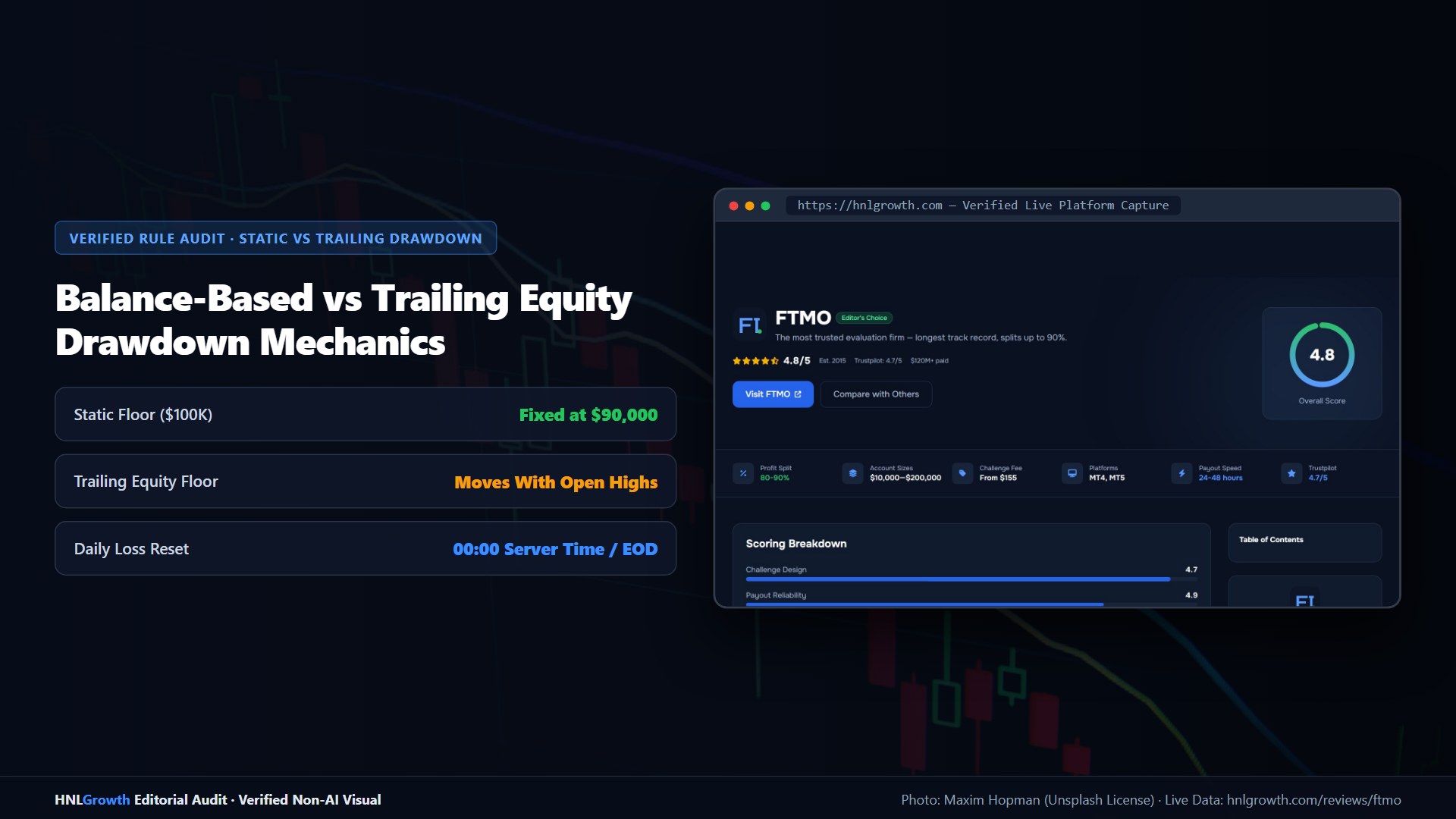
If you trade an evaluation or funded account with a proprietary firm that enforces a Trailing Maximum Drawdown (as opposed to a static balance drawdown—see static vs trailing drawdown), your trade-level trailing stop strategy directly determines whether your account survives:
- High-Water Mark Equity Lock Trap: On an intraday trailing drawdown account, if your trade runs up +$4,000 in unrealized floating profit, your account's maximum drawdown floor trails upward by $4,000 alongside that floating peak. If you do not trail your trade's Stop-Loss or take partial profits and let the trade retrace all the way back to your original entry price (
$0realized profit), you have just burned $4,000 of your permanent account drawdown cushion! - Matching Your Stop Trail to Your Account Rule: On trailing-drawdown prop accounts, always combine a partial close at
1.5Rwith an active structure or ATR trailing stop so unrealized floating peaks convert into realized cash rather than evaporating against a raised drawdown floor. Use our drawdown calculator to simulate this exact effect.
| Broker / Prop Firm | Drawdown / Stop-Out Architecture | Free VPS for Server-Side EA Trailing? | Best Trailing Stop Approach | Review Link |
|---|---|---|---|---|
| FTMO | Static 10% Max Loss (2-Step) / Trailing on 1-Step | Paid external VPS (or cTrader cloud) | Manual structure trailing behind 1H/4H swings | FTMO Review |
| FundedNext | Static Balance-Based Drawdown (Stellar 1-Step & 2-Step) | Supports MT4/MT5 EAs & cTrader | 50% partial close + structure trail on runner | FundedNext Review |
| The5%ers | Static 10% Max Loss (High Stakes) | Supports MT5 automated trailing EAs | Structure + 2x ATR trail without floating peak penalty | The5%ers Review |
| Exness | Live Broker (0% Stop-Out, Negative Balance Protection) | Free Exness VPS (with $500+ balance & volume) | Run MT4/MT5 trailing EAs 24/7 on free Exness VPS | Exness Review |
| HFM (HF Markets) | Live Broker (20% Stop-Out, Cent & Pro tiers) | Free VPS for qualifying deposit tiers | Ideal for testing ATR chandelier trailing EAs | HFM Review |
Remember that trailing a stop-loss still relies on a conditional market order at exit: as the Commodity Futures Trading Commission (CFTC) warns retail currency traders, market gaps over weekends or during major economic announcements can execute a triggered stop-loss at the next available price beyond your trailed level (see slippage in forex). Compare account drawdown models across top firms on our best prop firms directory or comparison tool.
Trailing Stop-Loss in Forex: Your Questions Answered
What is the difference between a static Stop-Loss and a Trailing Stop-Loss?
A static Stop-Loss stays fixed at the exact price level where you placed it unless you move it manually. A Trailing Stop-Loss automatically or systematically moves forward as your trade gains profit, reducing your open risk and eventually locking in guaranteed positive pips while never moving backward if price reverses.
Does the MT4 or MT5 trailing stop work when my computer is turned off?
No. In MetaTrader 4 and MetaTrader 5, the automated Trailing Stop feature runs inside your local client terminal, not on the broker's server. If you turn off your computer or close the software, your Stop-Loss remains active on the server at its last updated price, but it will stop trailing higher until you reconnect or run MT4/MT5 on a 24/7 VPS.
Why is an MT4/MT5 trailing stop measured in "points" instead of "pips"?
On 5-decimal forex quotes (such as 1.08505 on EUR/USD) and 3-decimal JPY quotes (152.405), MetaTrader defines 1 point as 0.1 pips (1 pipette). Therefore, if you want to set a 25-pip trailing stop in MT4 or MT5, you must select or type 250 points.
How many pips should I set my trailing stop in forex?
Avoid using the same fixed pip count across all pairs and timeframes. Instead, multiply the current timeframe's 14-period ATR by 1.5 to 2.0 (for example, if EUR/USD's 1-hour ATR is 14 pips, use a 21-to-28 pip trail), or manually trail your stop 3 to 5 pips behind each newly formed swing higher low or lower high.
Should I use a Take-Profit order if I am already using a Trailing Stop?
Yes, many systematic traders combine both: they close 50% of the position at a fixed 1.5R or 2.0R Take-Profit to bank immediate cashflow, and remove the Take-Profit on the remaining 50% "runner", using a manual structure or 2x ATR trailing stop to capture major trend extensions.
Sources & verification
- Last checked
- Written by
- HNL Growth Team
- Reviewed by
- Hà Ngọc Lộc
- Length
- 7 min read · 1,570 words
Rules, prices and payout terms on this page were checked against the official websites, help-centre articles and published terms of the firms mentioned, on the date above. Prop firms and brokers change conditions often — confirm the current version on the official site before you buy or deposit. Read our editorial methodology and affiliate disclosure.
Official sources & documentation verified
- Commodity Futures Trading Commission (CFTC)(cftc.gov · Official Regulator)
Explore Related Hubs & Free Trading Tools
Ready to Start Your Funded Trading Journey?
HashHedge reports $11M+ paid to traders and lists a 4.7/5 Trustpilot rating (check current figures on Trustpilot). Compare HashHedge challenge plans, drawdown rules, and payout terms — apply code ha25 for the current discount.
Risk disclaimer: Challenge fees are non-refundable if you breach the rules. Prop trading involves significant financial risk. Past performance in a simulated environment does not guarantee results on a funded account. Only purchase if you understand the rules fully and can afford to lose the fee. Affiliate disclosure: HNL Growth earns a commission when you purchase a HashHedge challenge through links on this page.