Forex Demo Account 2026: How to Practise Without Risk
A forex demo account lets you place real trades — buying and selling currency pairs — using virtual funds against live market prices. Nothing financial is at stake. You learn the platform, practise...
Reviewed using our forex & CFD broker review methodology
Checked on: 2026-08-17 | Broker terms, regulation, and pricing can change. Always verify at the official PU Prime site before opening an account.
Affiliate Disclosure: HNL Growth may earn a commission if you open an account through our links, at no additional cost to you. Risk Warning: CFDs and leveraged forex products are complex instruments and carry a high risk of losing money rapidly due to leverage. 62.2% of retail investor accounts lose money when trading CFDs with this provider. Trading forex and CFDs may not be suitable for all investors. Consider your objectives, experience, and risk appetite before trading, and ensure you understand the risks involved. Broker Disclosure: PU Prime is a live, regulated multi-entity broker (not a simulated prop-firm evaluation) — trades are executed with real capital in live market conditions, subject to normal market risk. Which PU Prime entity holds your account depends on your country of residence and determines your leverage cap and protections.
Last verified: August 2026 | Editorial Team
Forex Demo Account 2026: How to Practise Without Risk
A forex demo account lets you place real trades — buying and selling currency pairs — using virtual funds against live market prices. Nothing financial is at stake. You learn the platform, practise order types, and test simple strategies before a single cent of your own money is involved. PU Prime's demo is free to open, requires no deposit, and runs on the same platforms used for live trading. This article walks you through exactly how it works, what it can and cannot teach you, and how to decide when you are ready to fund a real account.
Disclosure: This page may contain affiliate links. We may earn a commission if you open an account through our links, at no extra cost to you.
What a Forex Demo Account Actually Does
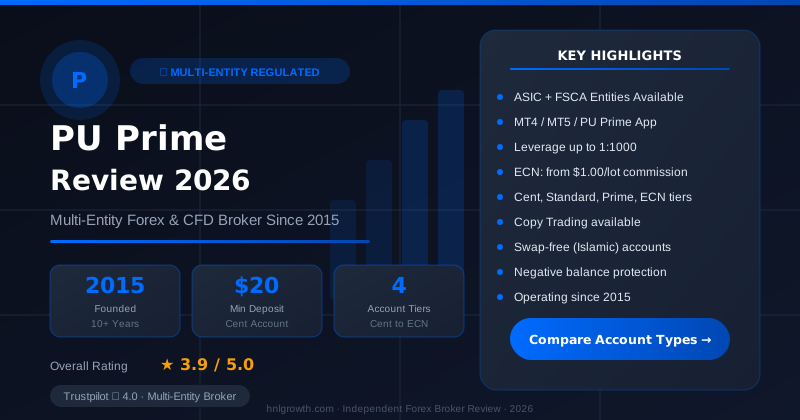
PU Prime — Multi-Entity Forex & CFD Broker
ASIC (AU) + FSCA (ZA) entities available · $20 min deposit (Cent) · MT4, MT5, PU Prime App · 4 account tiers
Forex trading means buying one currency while simultaneously selling another — the price you see is the exchange rate between the two. A demo account gives you access to those prices in real time, but replaces your real money with a virtual balance. Every calculation — profit, loss, margin used, leverage applied — runs exactly as it would on a live account. The only difference is that no real funds are at stake.
That makes a demo genuinely useful for three distinct purposes, not just one:
- Platform orientation. Learning where to find charts, how to place a stop-loss (an automatic instruction to close a trade if it moves too far against you), and how to read your account balance — all without the pressure of real consequences.
- Strategy testing. Running a specific trading idea — for example, "I will buy EUR/USD when the price crosses above its 20-period moving average" — across enough trades to see whether it has an edge, before risking real capital.
- Workflow rehearsal. Experienced traders use demo accounts to practise on unfamiliar platforms, test automated trading scripts, or prepare for new instruments. Demo is not exclusively for beginners.
A quality demo account is not a sales gimmick. It is a practice environment that mirrors real market conditions closely enough to build genuine skill — provided you use it with discipline.
How PU Prime's Demo Account Works
PU Prime's demo account is free to open and does not require a deposit at any stage of the demo sign-up process. You access it through the same platforms used for live trading: MetaTrader 4 (MT4) and MetaTrader 5 (MT5), both available as desktop downloads and as mobile apps on iOS and Android, as well as the PU Prime mobile app.
What the official account-opening page confirms:
- No deposit is required to access the demo; a deposit is only needed when and if you choose to upgrade to a live account.
- The demo runs on MT4 or MT5, and you select your preferred platform during registration.
- While your live account is being verified, you can open a demo and begin practising with virtual funds against real market prices immediately.
What to verify yourself before relying on specific demo conditions:
- The exact virtual balance allocated to your demo account — confirm the current default on PU Prime's account-opening or demo-specific page, as this figure is not confirmed in the sources available for this article.
- Whether the demo account has an expiry period, whether it can be reset, and what happens to your trade history if it does expire — these details are not confirmed in available official sources and should be checked directly with PU Prime support or the relevant FAQ page.
- Which specific account types (Standard, Prime, ECN, Cent) are available in demo format, and whether the demo spreads match the live account conditions listed on the spread and costs page.
- Whether the demo price feed is real-time or carries a brief delay — this directly affects how realistic your practice experience is.
The spread-and-costs page notes that all values shown are for reference only and that MT4/MT5 or the PU Prime mobile app should be checked for the most accurate current figures. The same principle applies to demo conditions: treat any number you read as a starting point, then confirm it in the platform.
Opening Your Demo in Four Steps
The registration process for a PU Prime demo follows the same initial flow as a live account sign-up, minus the document verification and deposit stages:
- Go to the PU Prime account-opening page. Fill in your name, email address, phone number, and create a password. This takes approximately two minutes.
- Select your account currency and platform. USD is the most common account currency. For your platform, MT5 is the newer option with more features; MT4 has a larger community of third-party tools and tutorials. Either works for a demo.
- Choose demo instead of live. At the account-type selection stage, select the demo option. No document upload or deposit is required at this point.
- Download the app or open the web platform, log in, and start. Your virtual balance is available immediately once registration is complete.
The whole process should take under ten minutes.
Start practising with a PU Prime free demo — no deposit needed
Your First Practice Trade, Step by Step
Most beginners access trading platforms on their phones. Here is a mobile-first walkthrough for placing your first demo trade:
- Open the app and tap the Markets or Instruments section. Find a currency pair — EUR/USD (euro versus US dollar) is the most widely traded pair and a sensible starting point.
- Tap the instrument to open its price screen. You will see a Bid price (the price at which you can sell) and an Ask price (the price at which you can buy). The difference between them is the spread — the broker's built-in cost per trade.
- Tap Buy or Sell. This opens the order entry screen.
- Set your trade size. Trade size is measured in lots on MT4/MT5. For practice, start with a micro-lot (0.01 lots) so that each pip (the smallest standard price movement) represents a very small amount of virtual money. This keeps the numbers manageable while you learn.
- Set a stop-loss. A stop-loss is the price level at which your trade closes automatically to limit your loss. Set one on every single trade, even in demo — this is the habit that matters most.
- Set a take-profit (optional but useful). This is the price level at which the trade closes automatically if it moves in your favour.
- Confirm the order. Your trade is now live on your demo account. Watch how the profit/loss figure changes as the price moves.
- Close the trade manually when ready. Find the open position in your account and tap Close. Review the result — did it do what you expected?
One trade, done correctly with a stop-loss and a reviewed result, teaches more than ten trades opened and forgotten.
Where Demo Trading Mirrors the Live Market — and Where It Doesn't
Understanding this distinction honestly is the most important thing this article can give you. Many beginners are either oversold on demo realism or dismissively told "demo means nothing." Both views are wrong.
What Demo Replicates Well
| Feature | What happens in demo |
|---|---|
| Price feed | Real-time or near-real-time market prices (verify the specific feed with PU Prime) |
| Order types | Full range: market, limit, stop-loss, take-profit — identical to live |
| Margin mechanics | Margin (the deposit required to hold a leveraged position) is calculated using live prices, so the numbers behave realistically |
| Leverage | Applied at the same ratios as live accounts — a useful reality check on position sizing |
| Platform navigation | Identical layout to the live environment — skills transfer directly |
| Chart analysis | Full indicator library, timeframe switching, and drawing tools |
What Demo Cannot Teach You
Emotional discipline. This is the most significant gap, and it is not a defect of the demo — it is a feature of human psychology. When virtual money is on the line, your brain simply does not produce the same fear or greed responses as when real money is moving. A strategy that feels easy to follow on demo can feel unbearable to stick to when real losses appear. Demo can help you build mechanical habits; it cannot fully simulate the psychological pressure of live trading.
Real slippage. Slippage means your order fills at a slightly different price than the one you saw when you clicked. It happens in live markets during fast price moves — for example, immediately after an economic announcement. Demo accounts typically fill orders at the exact quoted price, which is an optimistic assumption that live trading does not always honour.
Spread widening during news events. Spreads (the cost built into the bid/ask difference) can widen significantly during major economic releases. A spread that sits at 1.3 pips on EUR/USD during a quiet session might jump to 5 pips or more at the moment of a US Federal Reserve announcement. Demo environments may not fully replicate this.
Liquidity limits. Very large demo orders may fill completely at the quoted price in a way that a real order of the same size might not, depending on available market liquidity.
Myth vs. Reality Table
| Common Belief | Reality | Why the Gap Exists |
|---|---|---|
| "If I profit on demo, I will profit live" | Demo success does not predict live profitability | Emotional pressure, real slippage, and spread widening during news change the experience fundamentally |
| "Demo is only for beginners" | Experienced traders routinely use demos for strategy validation and platform testing | Reducing risk before deploying a new strategy is rational at any skill level |
| "Demo prices are fake or manipulated" | Demo uses real or near-real-time price feeds (verify your broker's specific feed) | The fills may be more optimistic than live, but the underlying price data reflects actual market movement |
| "You can fully learn discipline on demo alone" | Discipline under pressure requires real consequences to develop fully | Mechanical habits can be rehearsed on demo; psychological resilience is built in live conditions |
A Five-Stage Practice Plan for Beginners
Open-ended demo use tends to drift. You log in, place a few trades, close some in profit, close some at a loss, and learn less than you could because there is no structure. These five stages give you a clear progression from your first login to a genuine readiness assessment.
Stage 1 — Platform Orientation Completion criteria: you can navigate to charts, instrument lists, your account overview, and deposit/withdrawal sections without searching. Spend one session doing nothing but exploring. Find the EUR/USD chart. Switch timeframes (5-minute, 1-hour, daily). Add one moving average indicator. Find where your open positions and trade history appear. Do not place a trade yet.
Stage 2 — First Trade Completion criteria: you place one trade, manage it with a stop-loss, and close it deliberately — then write down what happened and why. Follow the mobile walkthrough above. Use a micro-lot. Review the result in writing. This single written entry is the start of your trading journal.
Stage 3 — Strategy Test Completion criteria: you execute one clearly defined strategy across 20 trades and record each one. A strategy needs written rules: what condition triggers entry, where the stop-loss goes, and where you exit. Something simple — for example, "I buy EUR/USD only when the price is above the 50-period moving average and set a stop-loss 20 pips below entry" — is far more instructive than 20 random trades. Log every trade: entry price, exit price, stop-loss level, reason for entry, result.
Stage 4 — Risk Stress Test Completion criteria: you experience a simulated losing streak of three or more trades and do not change your strategy impulsively. Apply three daily discipline habits:
- Daily maximum loss rule: decide in advance how much virtual money you are willing to lose in one session. When you hit that number, log out. Practise this ritual — it is one of the most important live-trading habits you can build.
- Mandatory journal entry: write a brief note after every closed position. Two or three sentences: what you expected, what happened, and what you would do differently.
- 24-hour pause rule: after three consecutive losing trades, stop for that day. Do not open a fourth trade as revenge. Review your journal the next morning before trading again.
Stage 5 — Readiness Review Completion criteria: you score the transition checklist below honestly and reach a score that supports moving forward.
Practising on Your Phone: Mobile Demo Workflow
The majority of new traders access their accounts on a phone rather than a desktop. Mobile demo trading is fully functional but has some practical differences worth knowing.
Charting on a small screen: Use two fingers to zoom in and out on the price chart. Switch to a horizontal (landscape) view for better visibility when analysing price movements. Avoid using more than two or three indicators on a mobile chart — screen space is limited, and clutter obscures the price action you are actually trying to read.
Order entry on mobile: The tap-to-trade flow described in the First Trade section above is designed for mobile. The most common mistake is skipping the stop-loss because it requires an extra step. Never skip it — not even in demo. The habit of always setting a stop-loss before confirming an order must be automatic before you trade live.
Price alerts: Most mobile trading apps let you set price alerts — a notification when a currency pair reaches a specified level. Use this in demo to practise your entry discipline: set an alert at your intended entry level, then decide whether you still want to enter when the alert fires. This separates reactive trading (entering because the price is moving) from planned trading (entering because your pre-set condition was met).
Demo vs. live mode in the app: Confirm in the PU Prime app settings which mode you are in — demo or live — before placing any order. Most apps display this clearly, but checking takes two seconds and prevents costly errors.
How to Know When You Are Ready for a Live Account
The transition from demo to live should be a decision you reach through your own assessment, not a pressure you feel from a countdown timer or an email campaign. The checklist below is a tool for that assessment.
The Transition Readiness Checklist
Score one point for each honest "yes":
| # | Criterion | Yes / No |
|---|---|---|
| 1 | I have a written trading plan that specifies my entry rules, exit rules, and how I calculate position size | |
| 2 | I have defined my maximum loss per trade as a percentage of my intended capital | |
| 3 | I have maintained a trade journal for at least 50 closed demo trades | |
| 4 | I have experienced three or more consecutive losing trades and continued following my plan without changing strategy impulsively | |
| 5 | I set a stop-loss on every single order type I use, without exception | |
| 6 | I understand how leverage and margin work on the specific instruments I intend to trade | |
| 7 | I have reviewed my demo performance over at least four weeks — not based on one good or bad session | |
| 8 | I am financially prepared to lose the amount I plan to deposit without material hardship to my daily life |
Score 7–8: You have built a solid foundation. Proceeding to a live account with a small, affordable amount is a reasonable next step.
Score 4–6: Identify which criteria you are missing and return to the relevant demo stage. Four weeks of structured demo practice is a minimum, not a target ceiling.
Score 0–3: Stay on demo. This is not discouraging — it is honest. Every criterion above represents a skill that will protect your capital once you go live.
Scored 7 or 8? Open a PU Prime live account — start with an amount you can afford to lose
What Happens When You Fund Your First Live Account
Knowing the logistics in advance reduces anxiety at the point of decision. Based on PU Prime's official account-opening page:
- Identity verification: you will need a government-issued ID and a proof of address document dated within the last three months. This step is required by regulators under anti-money-laundering rules — it is standard at every regulated broker.
- Minimum deposit: the Standard account starts at $50; the Cent account (which shows balances in cents, making position sizes and losses proportionally smaller) starts at $20. The Prime account requires $1,000.
- Deposit methods: credit/debit card, bank transfer, and e-wallets including Skrill and Neteller. Card and e-wallet deposits typically arrive quickly; bank transfers may take one to three business days.
- First position sizing: use the same position size on your first live trade that you used consistently in late-stage demo practice. Resist the temptation to start with larger sizes because "it is only $50."
Demo Account Questions Answered
Is the demo genuinely free, or will I be asked for a deposit at some point? The demo account is free to open and no deposit is required to access it. A deposit is only involved when you choose to open and fund a live account — that is a separate decision, made by you, at a time of your choosing.
How long does the demo account stay active? The specific expiry policy for PU Prime's demo account is not confirmed in the official sources available for this article. Before relying on long-term access, check PU Prime's FAQ page or contact support directly to confirm whether the demo expires, whether it can be reset, and what happens to your trade history.
Are the prices on the demo account real? The official account-opening page states that the demo uses real market prices. Whether this is a fully live feed or carries a brief delay is worth confirming with PU Prime directly, as the specific feed specification is not confirmed in the sources reviewed here.
Is PU Prime regulated, and is my data safe when I register? PU Prime operates under the oversight of several financial authorities, including the Financial Services Authority of Seychelles (FSA), the Financial Services Commission of Mauritius (FSC), the Financial Sector Conduct Authority of South Africa (FSCA), and the Capital Market Authority of the UAE (CMA). Each entity applies to specific jurisdictions — the protections available to you depend on which entity covers your country of residence. To verify independently, look up the relevant licence number on the regulator's own public register (not only on the broker's website). Data protection obligations are part of regulatory compliance in each of these jurisdictions.
Can I use demos at more than one broker at the same time? Yes, and for beginners there can be a practical reason to do so: MT4 and MT5 have large communities of tutorials and third-party tools, while a broker's proprietary mobile app may offer a simpler interface for on-the-go practice. Using two demos simultaneously — one for technical depth, one for mobile workflow — is not disloyal or confusing; it is sensible diversification of your learning environment. Once you choose a broker for a live account, focus there.
What makes a demo account worth using — what should I look for? The criteria that matter: the demo should mirror the same price feed and execution model as the live account; the platforms should be identical (not a stripped-down version); mobile access should be available; spreads in demo should reflect at least one live account type so you understand the real cost of trading. Virtual balance size is less important than the quality of the conditions — a large virtual balance does not make a demo more realistic.
What are the red flags that suggest a demo is not trustworthy? Avoid any platform that requires a deposit before activating demo access — no legitimate regulated broker does this. Other red flags: demo fills that are suspiciously perfect (every order at the exact price, no spread widening, no partial fills during news), a demo that cannot be accessed without providing payment details, or a broker whose licence cannot be verified on the regulator's own website.
Still exploring? The best way to understand the platform is to try it — open a free PU Prime demo
Who a Demo Account Is — and Is Not — For
A demo account is the right starting point if you:
- Have no prior experience with trading platforms and want to learn the basics without financial risk
- Have trading experience but want to test a new strategy or learn a new instrument before deploying capital
- Are waiting for a live account to complete identity verification and want to use the time productively
- Have been away from trading for a period and want to refresh your platform familiarity
A demo account alone is not sufficient if you:
- Believe that consistent demo profit directly translates to live profit — it does not
- Are treating demo as a permanent substitute for live trading while avoiding the psychological work of managing real risk
- Are using demo without structure, a journal, or any defined strategy — aimless demo trading builds limited transferable skill
Risk Warning
Risk warning: CFDs and leveraged forex products are complex instruments and carry a high risk of losing money rapidly due to leverage. Consider whether you understand how these products work and whether you can afford to take the high risk of losing your capital. Check the entity, terms, and protections that apply in your jurisdiction before trading. PU Prime operates through multiple regulated entities; the specific entity, protections, and terms that apply to you depend on your country of residence. Review the regulation page to identify the entity relevant to your jurisdiction. Past performance in a demo environment is not indicative of future results in live trading.
Ready to Compare PU Prime Account Types?
PU Prime is a multi-entity broker — ASIC (Australia) and FSCA (South Africa) regulated entities offer stronger oversight, while most international clients are onboarded to the FSA Seychelles or FSC Mauritius entities. Four account tiers (Cent, Standard, Prime, ECN) range from a $20 minimum deposit to full ECN pricing.
Risk disclaimer: PU Prime is a live, regulated multi-entity broker — trading forex and CFDs is done with real capital under normal market risk (this is not a simulated prop-firm evaluation). PU Prime operates under multiple separate licenses (ASIC, FSCA, FSA Seychelles, FSC Mauritius); which entity holds your account depends on your country of residence and determines your leverage cap and protections — confirm this before funding. CFDs and leveraged forex products are complex instruments and carry a high risk of losing money rapidly due to leverage; 62.2% of retail investor accounts lose money when trading CFDs with this provider. Consider whether you understand how CFDs/forex work and whether you can afford the high risk of losing your money. Affiliate disclosure: HNL Growth earns a commission when you open a PU Prime account through links on this page.