Cent Account vs Standard Account in Forex: Lot Size & Margin Guide
A Cent account denominates your balance in US Cents (1,000 USC = $10) with $0.001/pip micro-lots, while a Standard account starts at $0.10/pip.
Reviewed by Hà Ngọc Lộc· Senior SEO Editor

A Cent account denominates your trading balance in US Cents (USC)—meaning a $10 deposit displays as 1,000 USC—and shrinks 1 full lot to 1,000 currency units so a 0.01 Cent lot costs $0.001 per pip on EUR/USD. A Standard account denominates your balance in US Dollars (USD) and defines 1 full lot as 100,000 currency units, making its minimum 0.01 micro-lot worth $0.10 per pip (100 times larger). For traders starting with $10 to $100, Cent accounts at HFM, Exness, JustMarkets, and Valetax allow institutional 1% risk management before graduating to Standard or Raw ECN accounts at Vantage or PU Prime.
1. Core Structural Differences: Cent Account vs Standard Account
When comparing a cent account vs standard account in forex, the trading platform interface inside MetaTrader 4 (MT4) or MetaTrader 5 (MT5) looks identical, yet the underlying contract multiplier is divided by 100. Understanding forex account types explained prevents the most common beginner error: opening a Standard account with $20 and accidentally risking 15% of the account on a single micro-lot trade.
Here is how the contract math compares side by side on EUR/USD (at an exchange rate of 1.1000):
| Specification | Forex Cent Account | Forex Standard Account | Mathematical Ratio |
|---|---|---|---|
| Account Balance Currency | USC (US Cents), EUC, or GBP Cents | USD, EUR, GBP, AUD | $10 USD = 1,000 USC |
| 1.00 Full Lot Contract Size | 1,000 units of base currency (1 Micro Lot) | 100,000 units of base currency (1 Standard Lot) | Standard is 100× larger |
| 0.01 Minimum Trade Size | 10 units of base currency (Nano/Cent fraction) | 1,000 units of base currency (1 Micro Lot) | Standard is 100× larger |
| Pip Value for 1.00 Lot (EUR/USD) | $0.10 USD (10 USC) per pip | $10.00 USD per pip | 1:100 pip value ratio |
| Pip Value for 0.01 Lot (EUR/USD) | $0.001 USD (0.1 USC) per pip | $0.10 USD per pip | 1:100 pip value ratio |
| Margin Required (0.01 Lot @ 1:100) | $0.11 USD (11 USC) | $11.00 USD | 100× lower margin lockup on Cent |
| Typical EUR/USD Spread | 1.0 to 1.6 pips (zero commission) | 0.8 to 1.3 pips (or 0.0 pips + $6/lot on Raw ECN) | Standard/ECN is 15%–40% cheaper per pip |
| Ideal Starting Capital | $10 to $100 | $200 to $2,000+ | Cent bridges the $10–$150 gap |
2. How Balance Display, Lot Size, and Pip Value Work in Practice
To see why a Cent account is so effective for small capital, walk through the exact numbers of a $20 deposit using the rules from our what is lot size in forex and what is a pip in forex guides:
Scenario A: $20 Deposit on a Cent Account (2,000 USC)
- Balance Display: Your MT5 terminal shows
2,000.00 USC. Psychologically, it looks and behaves like a $2,000 account. - 1% Risk Calculation: 1% of 2,000 USC is 20 USC ($0.20 USD).
- Stop-Loss Distance: Suppose your EUR/USD setup requires a 25-pip stop-loss.
- Position Sizing: Since
0.01 Cent lot = 0.1 USC ($0.001) per pip, a 25-pip stop on 0.01 Cent lot costs 2.5 USC ($0.025). To risk exactly 20 USC ($0.20), you divide20 USC ÷ 2.5 USC = 8, giving you an ideal trade size of 0.08 Cent lots (80 units of EUR). - Result: You can adjust your position size in fine increments (0.05, 0.07, 0.08 Cent lots) to match any stop-loss width between 10 pips and 60 pips while keeping risk locked at 1.0% ($0.20) per trade.
Scenario B: $20 Deposit on a Standard Account ($20.00 USD)
- Balance Display: Your MT5 terminal shows
$20.00 USD. - Minimum Trade Floor: You cannot trade less than 0.01 Standard lots (1,000 units), which carries a fixed pip value of $0.10 USD per pip on EUR/USD.
- Stop-Loss Distance: That same 25-pip stop-loss on a 0.01 lot automatically risks $2.50 USD (
25 pips × $0.10). - Result: Even at the absolute minimum lot size allowed by the platform, you are forced to risk 12.5% of your $20 account on a single trade! Nor can you scale out 50% of your position at your first target, because 0.01 lot cannot be split in half.
3. Why Not Use a Cent Account Forever? Spreads, Caps, and Execution
If Cent accounts offer such granular position sizing, why do experienced traders switch to Standard or Raw ECN accounts once their balance passes $250 to $500? There are three structural trade-offs:
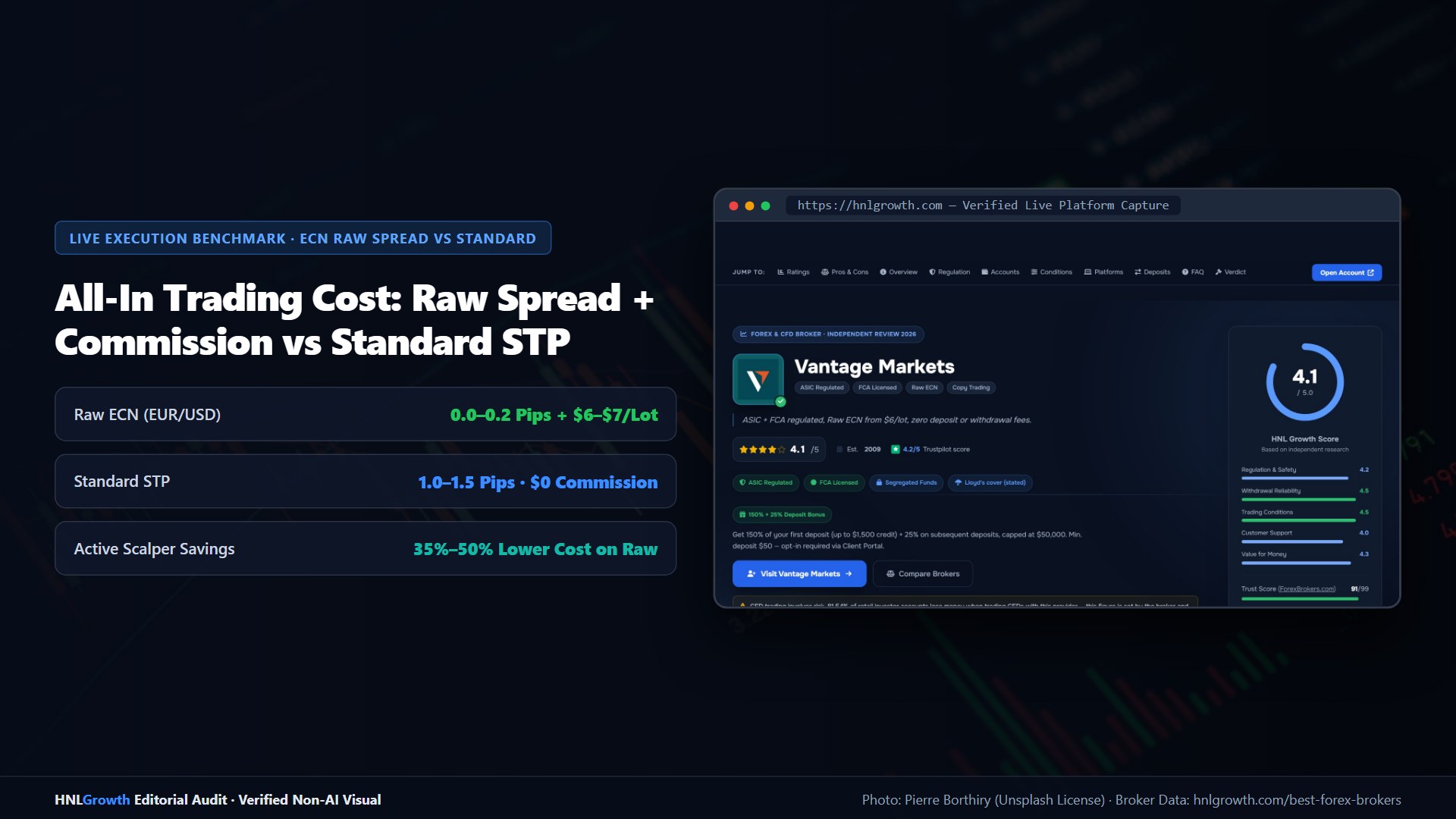
- Wider Bid-Ask Spreads: Because the broker must aggregate tiny 10-unit to 1,000-unit orders internally before hedging net exposure in the interbank market, Cent accounts usually carry a 1.0 to 1.6 pip spread on EUR/USD. By comparison, a raw spread vs standard account setup at Vantage or VT Markets offers 0.0 to 0.1 pip spreads plus a $6/lot commission (~0.6 pips all-in cost)—cutting your execution friction in half.
- Maximum Position Size & Open Order Caps: Most brokers cap Cent accounts at 100 to 200 Cent lots per ticket (equivalent to 1 to 2 Standard lots) and limit total simultaneous open positions to prevent server micro-order flooding.
- Regulatory Jurisdiction: Tier-1 regulators such as the Australian Securities and Investments Commission (ASIC) and the UK FCA typically oversee Standard and Raw ECN accounts at 1:30 retail leverage, while Cent accounts are almost always offered through a broker's international (FSC Mauritius, FSA Seychelles, or FSCA) operating entities.
4. Comparing Top Brokers for Cent vs Standard Accounts (2026)
When evaluating where to open your account (see our full guide on how much money to start forex trading), compare both the Cent entry terms and the Standard/Raw upgrade path within the same broker ecosystem:
| Broker / Provider | Cent Account Min Deposit | Standard / Raw Min Deposit | Cent EUR/USD Spread | Standard / Raw ECN Pricing | Key Advantage for Beginners |
|---|---|---|---|---|---|
| HFM | $0 | $0 (Premium) / $0 (Zero) | From 1.2 pips ($0 comm.) | Zero from 0.0 pips + $6/lot RT | Seamless internal wallet transfer from HFM Cent to HFM Zero |
| Exness | $10 | $10 (Standard) / $200 (Raw) | From 0.3–1.0 pips ($0 comm.) | Raw Spread from 0.0 pips + $7/lot | Unlimited leverage on tiny Cent balances; 0% stop-out level |
| JustMarkets | $10 | $10 (Standard) / $100 (Pro/Raw) | From 0.3–1.2 pips ($0 comm.) | Raw Spread from 0.0 pips + $6/lot | Supports MT4 Standard Cent with swap-free Islamic option |
| Valetax | $8 | $10 (Standard) | From 1.2 pips ($0 comm.) | Standard from 1.0 pips ($0 comm.) | Ultra-low $8 entry threshold with localized Asian/LATAM banking |
| PU Prime | $20 | $20–$50 (Standard / Prime) | From 1.3 pips ($0 comm.) | Prime Raw from 0.0 pips + $7/lot | Strong mobile app & copy-trading bridge to Standard accounts |
| Vantage | N/A (Standard/Raw focus) | $50 (Standard / Raw ECN) | N/A | Raw ECN 0.0 pips + $6/lot RT | Institutional ECN fills + TradingView integration once at $100+ |
5. The 3-Stage Graduation Roadmap: From Cent to Standard or Prop
Instead of jumping straight from a forex demo account to a $500 Standard account, follow this three-stage capital progression:
- Stage 1: Live Execution Conditioning ($10–$30 on a Cent Account): Deposit $10 to $30 (1,000 to 3,000 USC) at HFM or Exness. Execute 50 to 100 trades following your written how to backtest a forex strategy plan, risking 1% (10 to 30 USC) per trade. This proves you can manage real-money emotions, bid vs ask price spreads, and stop-loss discipline.
- Stage 2: Choose Your Capital Multiplier ($32–$250):
- Path A (Retail Broker Growth): Once you have $200 to $500 saved, open a Standard or Raw ECN account at Vantage or PU Prime and trade 0.01 to 0.02 micro-lots using our forex position sizing formula.
- Path B (Entry Prop Evaluation): If your strategy achieved a 1.5+ profit factor on your Cent account but you only have $35 to spare, put $32 into a FundedNext $5,000 Stellar Lite challenge or $39 into a The5%ers $5,000 High Stakes challenge, which operate on Standard lot contract sizes with $400–$500 of usable drawdown buffer. Use our Drawdown Calculator to map your risk per trade.
Cent Account vs Standard Account in Forex: Your Questions Answered
How much is 0.01 lot on a Cent account in forex?
On a forex Cent account, 1.00 full Cent lot equals 1,000 units of the base currency, so 0.01 Cent lot equals 10 units of the base currency. On EUR/USD, a 0.01 Cent lot movement of 1 pip equals $0.001 USD (0.1 US Cents)—meaning a 10-pip move gains or loses exactly 1 cent ($0.01).
Why does my $10 deposit show as 1,000 on my MT4/MT5 Cent account?
Cent accounts display balances in cents rather than dollars (labeled USC for US Cents or EUC for Euro Cents). Since there are 100 cents in every dollar, a $10.00 USD deposit automatically converts to 1,000.00 USC inside your trading terminal, and converts back to USD when you withdraw.
Is execution slower on a Cent account than on a Standard account?
Market order execution speed on modern MT4/MT5 Cent servers (typically 30ms to 80ms) is virtually identical to Standard accounts for retail trade sizes. However, Cent accounts use internal broker B-book aggregation and carry slightly wider spreads (about 0.2 to 0.4 pips higher) than Raw ECN Standard accounts.
Can I use Expert Advisors (EAs) on a forex Cent account?
Yes. In fact, algorithmic traders routinely use Cent accounts at HFM, Exness, and JustMarkets to forward-test multi-level or grid Expert Advisors with $20 to $50 (2,000 to 5,000 USC) because a demo account does not replicate live swap rates or weekend rollover spread widening.
When should I switch from a Cent account to a Standard account?
You should graduate from a Cent account to a Standard or Raw ECN account once your trading capital reaches $200 to $500 USD and you have completed at least 60 to 100 profitable or breakeven Cent trades. At $250+, switching to a Raw ECN account saves roughly 30% to 50% on spread costs per trade.
Related Guides
Sources & verification
- Last checked
- Written by
- HNL Growth Team
- Reviewed by
- Hà Ngọc Lộc
- Length
- 7 min read · 1,679 words
Rules, prices and payout terms on this page were checked against the official websites, help-centre articles and published terms of the firms mentioned, on the date above. Prop firms and brokers change conditions often — confirm the current version on the official site before you buy or deposit. Read our editorial methodology and affiliate disclosure.
Official sources & documentation verified
- Australian Securities and Investments Commission (ASIC)(asic.gov.au · Official Regulator)
Explore Related Hubs & Free Trading Tools
Ready to Start Your Funded Trading Journey?
HashHedge reports $11M+ paid to traders and lists a 4.7/5 Trustpilot rating (check current figures on Trustpilot). Compare HashHedge challenge plans, drawdown rules, and payout terms — apply code ha25 for the current discount.
Risk disclaimer: Challenge fees are non-refundable if you breach the rules. Prop trading involves significant financial risk. Past performance in a simulated environment does not guarantee results on a funded account. Only purchase if you understand the rules fully and can afford to lose the fee. Affiliate disclosure: HNL Growth earns a commission when you purchase a HashHedge challenge through links on this page.