How Much Money to Start Forex Trading? $10 Cent vs $100 Standard
You can start live forex trading with $0 to $10 on a Cent account, $50 to $200 on a Standard account, or $1 to $39 via a prop firm challenge.
Reviewed by Hà Ngọc Lộc· Senior SEO Editor

You can start live forex trading with $0 to $10 on a broker Cent account (HFM $0 minimum deposit, Valetax $8, Exness $10, JustMarkets $10), $50 to $200 on a beginner Standard or Raw ECN account (PU Prime $20, Vantage $50, VT Markets $100), or $1 to $39 for a $5,000 to $6,000 prop firm evaluation (Atlas Funded $1 Pay Later, Goat Funded Trader $17, FundedNext $32 Stellar Lite, The5%ers $39 High Stakes). While minimum deposit thresholds are low, sustainable position sizing at 1% risk per trade requires matching your account balance to the right contract size.
1. Minimum Deposit vs Safe Trading Capital: Why the Difference Matters
Beginners researching what is forex trading often confuse a broker's minimum deposit with the working capital required to survive normal losing streaks. A broker's minimum deposit is simply the lowest payment gateway transfer allowed to activate a live trading account. Safe trading capital, by contrast, is the balance needed to place a 20-pip to 30-pip stop-loss while risking no more than 1% to 2% of your account equity on a single setup.
On a Standard account where the smallest trade size is a 0.01 micro-lot (1,000 units of base currency, worth roughly $0.10 per pip on EUR/USD), a 25-pip stop-loss equals $2.50 in cash risk. If you fund a Standard account with only $10, that single 25-pip stop-loss represents 25% of your entire account balance. Four consecutive stop-outs will wipe out your margin buffer and trigger an automatic stop-out level liquidation.
To solve that math problem without depositing hundreds of dollars upfront, retail traders use three distinct capital pathways: Cent accounts ($10–$50), Standard/Raw accounts ($100–$500+), and Prop Firm evaluations ($1–$39 entry fees).
| Capital Tier | Recommended Starting Balance | Account Structure | Min Lot Unit & Pip Value (EUR/USD) | Dollar Risk on a 25-Pip Stop | Best For |
|---|---|---|---|---|---|
| Tier 1: Micro-Capital | $10 – $50 (1,000 – 5,000 USC) | Broker Cent Account | 0.01 Cent Lot = $0.001 / pip | $0.025 (at 0.01 cent lot) or $0.25 (at 0.10 cent lot) | Testing live execution and psychology with pocket change |
| Tier 2: Entry Standard | $100 – $250 | Standard or Raw ECN Account | 0.01 Micro Lot = $0.10 / pip | $2.50 (1.0% to 2.5% of account equity) | Learning standard lot mechanics on 1–2 major pairs |
| Tier 3: Comfortable Retail | $500 – $2,000 | Raw ECN / Zero Spread Account | 0.01 to 0.05 Micro Lots ($0.10 – $0.50 / pip) | $2.50 to $12.50 (strict 0.5% to 1.0% risk per trade) | Swing and intraday traders building a verified track record |
| Tier 4: Prop Evaluation | $1 – $39 (one-time fee) | $5,000 – $6,000 Simulated Challenge | 0.01 to 0.20 Standard Lots ($0.10 – $2.00 / pip) | $25.00 to $50.00 (0.5% to 1.0% of $5,000 balance) | Disciplined traders with a backtested edge seeking larger notional size |
2. Tier 1: Starting With $0 to $10 on a Cent Account
If your total risk budget is under $50, you should never open a Standard account. Instead, open a dedicated Cent account (see our full guide on cent account vs standard account in forex). When you deposit $10 USD into a Cent account, your MetaTrader 4 or MetaTrader 5 terminal displays a balance of 1,000 USC (US Cents).
Because 1 Cent lot equals 1,000 units instead of 100,000 units, a 0.01 Cent lot on EUR/USD moves at $0.001 (0.1 cents) per pip. That allows a trader with just $10 (1,000 USC) to risk exactly 1% ($0.10 or 10 USC) on a 20-pip stop-loss by executing a 0.05 Cent lot ($0.005/pip × 20 pips = $0.10). You get the exact same percentage math as a $10,000 institutional account while risking dimes instead of hundreds of dollars.
Leading brokers offering low-barrier Cent accounts in 2026 include:
- HFM ($0 Minimum Deposit): HFM's Cent account requires no minimum deposit, supports micro-lot increments inside MT4/MT5, and operates under multi-jurisdictional group entities including the UK Financial Conduct Authority (FCA) (FRN 801701) and FSCA.
- Valetax ($8 Minimum Deposit): Offers rapid local payment methods and Cent accounts designed for micro-capital algorithmic and manual testing.
- Exness ($10 Minimum Deposit): Provides Standard Cent accounts with floating spreads from 0.3 cents, zero commission, and fast automated e-wallet funding.
- JustMarkets ($10 Minimum Deposit): Features Standard Cent accounts in USD-cent denomination with flexible leverage and swap-free options.
You can compare spread markups and entity protections across these providers in our roundup of the best cent account forex brokers.
3. Tier 2 & Tier 3: Starting With $50 to $500+ on Standard and Raw ECN Accounts
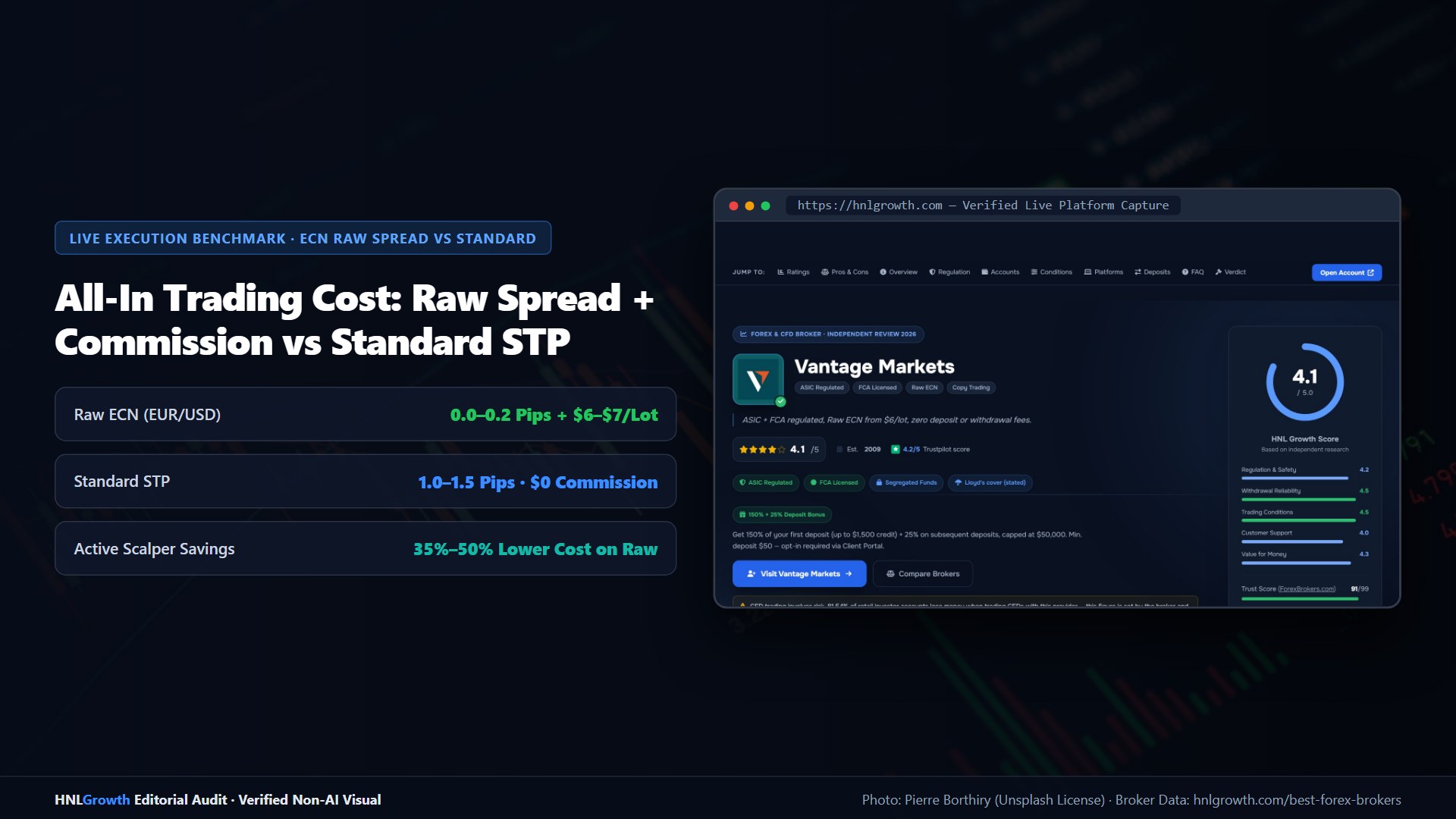
Once you have logged at least 50 to 100 live trades on a Cent account and understand what is lot size in forex, graduating to a Standard or Raw ECN account lowers your transaction costs. Cent accounts typically widen the bid-ask spread to 1.2–1.6 pips to cover micro-order routing. Standard and Raw ECN accounts tighten spreads to 0.0–0.2 pips plus a fixed $6.00 to $7.00 round-turn commission per full lot ($0.06 to $0.07 per 0.01 micro-lot).
To trade a Standard or Raw ECN account safely, let's examine the exact position sizing math at 1% risk per trade:
- 20-Pip Intraday Stop on EUR/USD:
20 pips ×0.10 =2.00 risk. At 1% risk per trade, you need $200 in account equity (or $100 if you accept a 2% risk cap per trade). - 35-Pip Swing Stop on GBP/USD:
35 pips ×0.10 =3.50 risk. At 1% risk per trade, you need $350 in account equity.
If you deposit $20 at PU Prime, $50 at Vantage, or $100 at VT Markets on a Standard account, you must keep your lot size locked at 0.01 micro-lots and restrict yourself to tight 15-pip to 25-pip stops on liquid majors like EUR/USD or USD/JPY. Look at our step-by-step framework on how to grow a small forex account for the exact compounding schedule from $50 to $500.
4. Tier 4: Starting With $1 to $39 via Entry Prop Firm Evaluations
What if you already have a profitable, backtested strategy (verified on a forex demo account and a $10 Cent account) but only have $30 to $40 in disposable capital? Depositing $35 into a retail Standard account forces you to over-leverage just to make $2 per trade.
In that scenario, entry-level prop firm evaluations offer much higher capital efficiency—provided you respect strict daily and maximum drawdown limits:
- Atlas Funded ($1 Pay Later / Access Model): Allows traders to start a simulated evaluation for $1 upfront and pay the remainder of the challenge fee only after passing the profit target.
- Goat Funded Trader ($17 Entry Challenges): Offers $5,000 simulated evaluations during promotional tiers with no calendar time limit and static drawdown options on 2-Step plans.
- FundedNext ($32 Stellar Lite $5,000 Account): Features an 8% Phase 1 target ($400), 4% Phase 2 target ($200), 4% daily loss limit ($200), and 8% maximum drawdown ($400). Your $32 fee buys $400 in usable drawdown room—meaning you can risk $20 per trade (0.4% of $5,000) and have a 20-trade buffer before breaching max loss.
- The5%ers ($39 High Stakes $5,000 Account): A 2-Step evaluation with a $39 one-time fee, 8% Phase 1 and 5% Phase 2 targets, 5% daily drawdown ($250), and 10% max drawdown ($500), scaling up to 100% profit split.
| Provider | Entry Path / Account Type | Upfront Cash Required | Usable Risk Buffer / Equity | Minimum Trade Cost (EUR/USD) | Key Rule or Protection to Check |
|---|---|---|---|---|---|
| HFM | Cent Account (Live Broker) | $0 ($5–$10 practical) | 100% of deposited cash (in USC) | ~1.2 pips spread ($0.0012 at 0.01 cent lot) | Stop-out at 20%; negative balance protection |
| Valetax | Cent Account (Live Broker) | $8 | 100% of deposited cash (in USC) | ~1.2–1.5 pips spread, $0 commission | Fast micro-deposit processing for emerging markets |
| Exness | Standard Cent (Live Broker) | $10 | 100% of deposited cash (in USC) | From 0.3–1.0 pips spread, $0 commission | 0% stop-out on eligible offshore entities |
| JustMarkets | Standard Cent (Live Broker) | $10 | 100% of deposited cash (in USC) | Floating spread from 0.3 pips, $0 commission | CySEC (401/21) and FSA Seychelles group entities |
| PU Prime | Standard Account (Live Broker) | $20 | 100% of deposited cash | Floating spread, 0.01 micro-lot min ($0.10/pip) | ASIC (AFSL 410681) and FSCA regulated entities |
| Vantage | Standard / Raw ECN (Live Broker) | $50 | 100% of deposited cash | 0.0 pips + $6/lot RT on Raw ECN ($0.06/0.01 lot) | Tier-1 ASIC (AFSL 428901) & FCA (FRN 590299) group oversight |
| VT Markets | Standard STP / Raw ECN | $100 | 100% of deposited cash | 0.0 pips + $6/lot RT on Raw ECN | TradingView integration + ASIC/FSCA group entities |
| Atlas Funded | $5,000 Pay Later Evaluation | $1 upfront | $400–$500 simulated max drawdown | Simulated prop feed ($5/lot commission) | Deferred fee due upon passing evaluation |
| Goat Funded Trader | $5,000 2-Step Evaluation | ~$17 – $30 | $500 simulated static drawdown (10%) | Simulated prop feed ($5/lot FX commission) | Custom EAs only; 3 minimum trading days per phase |
| FundedNext | $5,000 Stellar Lite (2-Step) | $32 | $400 simulated max drawdown (8%) | $3/lot commission on Stellar challenges | No time limit; 5 minimum trading days |
| The5%ers | $5,000 High Stakes (2-Step) | $39 | $500 simulated max drawdown (10%) | $4/lot commission on MT5 / cTrader | 3 profitable days required (0.5%+ gain per day) |
5. Hidden Costs Beginners Must Budget For
Before transferring your starting capital, account for three operational expenses that affect small balances:
- Margin Lockup vs Free Margin: As explained in our forex margin explained guide, opening a 0.01 micro-lot on EUR/USD ($1,000 notional) at 1:100 leverage locks up $10.00 in Used Margin, whereas 1:500 leverage locks up $2.00 in Used Margin. Always leave at least 85% to 90% of your account as Free Margin so floating drawdowns never trigger a margin call.
- Payment Gateway & Blockchain Fees: Depositing $15 via an ERC-20 crypto network that charges a $4 gas fee immediately costs you 26.6% of your account before you place a single trade. Use zero-fee local bank transfers, TRC-20/BEP-20 stablecoin rails, or e-wallets (Skrill/Neteller) that charge 0% deposit fees.
- Spread & Swap Drag: Check your exact per-trade cost using our Profit Calculator and compare evaluation breakeven thresholds with the Challenge Calculator.
How Much Money to Start Forex: Your Questions Answered
Can I start forex trading with $10?
Yes, you can start live forex trading with $10 by opening a Cent account at brokers like Exness, JustMarkets, HFM ($0 minimum), or Valetax ($8 minimum). Your $10 deposit converts into 1,000 USC (US Cents), allowing you to trade 0.01 cent lots ($0.001 per pip) and risk just $0.10 (1%) per trade.
Why is $100 the minimum recommended balance for a Standard forex account?
On a Standard forex account, the smallest position size is 0.01 micro-lot, which equals $0.10 per pip on EUR/USD. A normal 20-pip stop-loss risks $2.00. With a $100 account balance, a $2.00 loss equals a manageable 2% risk per trade, whereas on a $20 Standard account that same trade risks 10% of your capital.
Is it better to put $50 into a forex broker or buy a $32–$39 prop firm challenge?
If you are still learning platform execution, order types, and emotional control, deposit $10 to $50 into a broker Cent account where there are no daily drawdown breach rules. Once you have a proven strategy with a positive expectancy over 100+ backtested and live Cent trades, a $32 FundedNext Stellar Lite or $39 The5%ers High Stakes $5,000 challenge gives you $400 to $500 in usable drawdown room—10 times more risk capacity than a $40 cash deposit.
Does higher leverage mean I need less money to start forex trading?
Higher leverage (such as 1:500 vs 1:30) reduces the margin deposit locked up to open a trade, but it does not change the dollar value of a pip or your stop-loss risk. Whether you use 1:30 or 1:500 leverage, a 0.01 micro-lot on EUR/USD still loses $0.10 per pip.
How long should I trade a demo or Cent account before depositing $500+?
You should trade a free demo account for 2 to 4 weeks solely to master MT4/MT5 or TradingView order mechanics, then trade a $10 to $20 Cent account for at least 60 to 90 days (or 100 completed trades). Only deposit $500+ into a regulated forex broker or scale into best prop firms after demonstrating three consecutive profitable or breakeven months.
Related Guides
Sources & verification
- Last checked
- Written by
- HNL Growth Team
- Reviewed by
- Hà Ngọc Lộc
- Length
- 9 min read · 2,106 words
Rules, prices and payout terms on this page were checked against the official websites, help-centre articles and published terms of the firms mentioned, on the date above. Prop firms and brokers change conditions often — confirm the current version on the official site before you buy or deposit. Read our editorial methodology and affiliate disclosure.
Official sources & documentation verified
- Financial Conduct Authority (FCA)(fca.org.uk · Official Regulator)
Explore Related Hubs & Free Trading Tools
Ready to Start Your Funded Trading Journey?
HashHedge reports $11M+ paid to traders and lists a 4.7/5 Trustpilot rating (check current figures on Trustpilot). Compare HashHedge challenge plans, drawdown rules, and payout terms — apply code ha25 for the current discount.
Risk disclaimer: Challenge fees are non-refundable if you breach the rules. Prop trading involves significant financial risk. Past performance in a simulated environment does not guarantee results on a funded account. Only purchase if you understand the rules fully and can afford to lose the fee. Affiliate disclosure: HNL Growth earns a commission when you purchase a HashHedge challenge through links on this page.